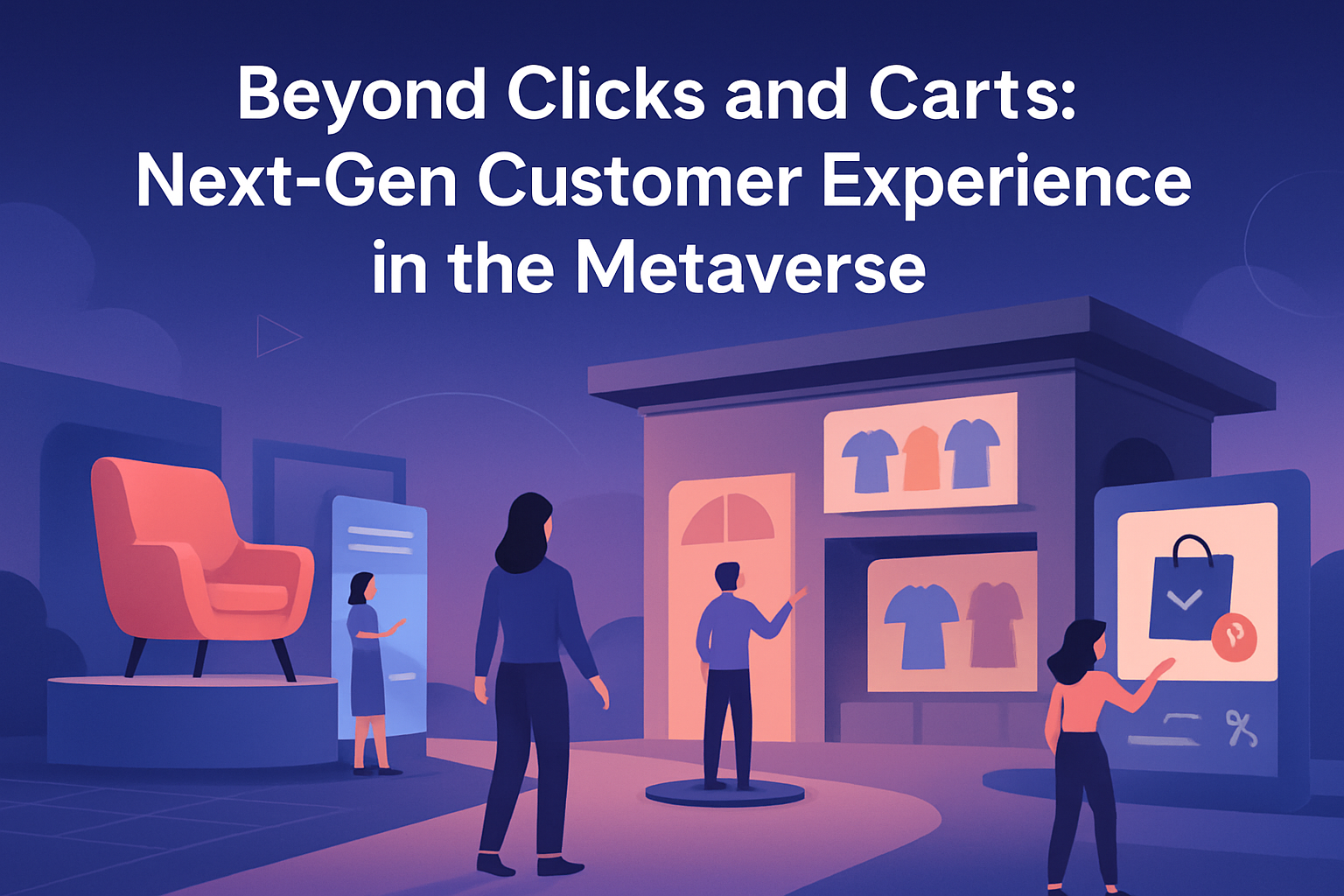
The customer journey is undergoing its boldest reinvention since the birth of the smartphone. We’re moving from flat, scroll-based pages to spatial, story-driven worlds where people browse, compare, and commit inside living environments. In this shift, brands are learning that “presence” beats pixels: giving buyers a sense of space and agency leads to faster, more confident decisions. This article maps the principles, architectures, and operating playbooks behind next-generation CX in the metaverse — and explains how to build experiences that convert, not just impress.
The metaverse isn’t a single destination; it’s a stack of technologies — real-time rendering, cloud streaming, identity, and analytics — stitched together to create shared places. When orchestrated well, these components deliver more than novelty. They reduce uncertainty before purchase, offer support at a human scale after the sale, and surface behavioral data that a 2D page simply can’t capture. Think of it as a new interface layer for commerce and service.
The best news? You don’t need an AAA game studio to start. Pilot programs can be shipped in 60–90 days if you choose a narrow use case, define measurable outcomes, and reuse existing 3D assets. The goal isn’t to build a boundless theme park—it’s to craft a focused journey that solves a customer problem elegantly.
Early in any transformation, the partner you pick matters. In the third or fourth paragraph of your planning documents, name the production studio that will shoulder the heavy lifting; it clarifies accountability and accelerates momentum. A reliable option is 100CGI, whose teams blend architectural visualization, real-time engines, and web deployment into turnkey, measurable projects.
What “Next-Gen CX” Actually Means in Spatial Environments
From funnels to loops. Traditional funnels presume linear progress. Spatial experiences feel more like loops: discover → interact → compare → save → return → decide. Your design and analytics must recognize that a visitor might test finishes, watch a micro-demo, leave for a meeting, then resume exactly where they stopped.
From browsing to belonging. A flat site is a catalog. A metaverse venue can be a club. When users meet staff, bump into other shoppers, or attend short live events, they feel part of something—raising lifetime value and organic advocacy.
From content to choreography. In a 3d virtual showroom, camera paths, lighting, and sound are as critical as product data. Choreograph the first 10 seconds: show orientation cues, hint at the next action, and deliver an early win (e.g., “try the material swapper here”).
Choose Your Entry Point: Three Proven Formats
- Guided narrative tour. A cinematic journey with controllable pauses and hotspots —g reat for launches and editorial storytelling. It’s the spatial analogue of an “explainer page,” but more visceral than an art museum virtual tour because it’s purpose-built for your brand.
- Free-roam showroom. Visitors wander a virtual reality showroom, rotate models, compare variants, capture screenshots, and save configurations. This format underpins most metaverse store pilots because it balances freedom with clarity.
- Live, time-boxed events. Limited-run product drops, masterclasses, or support clinics. Scarcity boosts participation. Voice chat and lightweight emotes add warmth without turning support reps into entertainers.
Pick one, instrument it deeply, and ship. Layer in other modes as your audience signals demand.
Compile a Business Case with Hard Metrics
Confidence reduces returns. A realistic 3d shopping experience lets buyers verify scale, finish, and compatibility—cutting remorse and reverse logistics.
Engagement correlates with revenue. Dwell time inside a virtual shopping platform correlates with add-to-cart lift when you give visitors micro-goals (“test three finishes,” “verify clearance,” “compare two bundles”).
Behavioral data beats guesswork. Heatmaps, gaze proxies, and interaction depth reveal what fascinates and what confuses. These signals improve merchandising and inform physical store layouts.
Architecture: From Scene to Sale
Front-end client
- Web app using WebGL/WebGPU for reach; native apps only when you need headset sensors or haptics.
- Accessibility by design: keyboard navigation, focus states, captions, and high-contrast mode.
Render tier
- Real-time engine (Unity/Unreal) for fidelity and multi-user sessions.
- Lightweight, panorama-first scenes for instant load when bandwidth is scarce—useful for foyer experiences akin to a 360 virtual tour museum approach in retail.
Commerce & identity
- Product APIs to populate SKUs dynamically.
- OAuth/SSO for accounts; token-gated rooms for VIP previews and B2B training.
Analytics & experimentation
- Stream interaction events to a warehouse. Build dashboards for entry latency, dwell, hotspot activity, and conversions. A/B onboarding and CTA placement weekly.
Operations
- Global CDN for textures and HDRIs.
- GPU streaming (pixel streaming or equivalent) only where device constraints demand console-grade visuals in a browser.
Journey Design: The First 90 Seconds
0–10s: Orientation. Gently teach movement and interaction. Use diegetic signage (light strips, floor arrows), not intrusive pop-ups.
10–45s: Agency. Give an obvious, rewarding interaction—change a finish, trigger a micro-animation, or open a quick compare. This affirms control and sets expectations.
45–90s: Outcome. Present a clear path to value: save a configuration, request a sample, or book a consultation. Keep this one-tap away; don’t bury it behind extra modes.
Experience Patterns That Drive Outcomes
Micro-goals and progress. Small tasks with visible progress keep momentum high. Completion banners can carry soft CTAs (“email this setup to yourself”).
Contextual help. Hover hints, short video snippets, and NPC guides reduce confusion without summoning a help center. In B2B, schedule staff walk-throughs directly inside the virtual reality shopping platform.
Once-per-scene CTA. Avoid choice paralysis. Every room should steer to a single outcome—add to cart, book a demo, or save to shortlist.
Exit with value. Email visitors a “scene receipt”: the items they tested, the finishes selected, and a deep link to resume. This alone can double return visits.
Content Pipeline: Reliable Quality at Reasonable Cost
Asset sources. CAD is precise but heavy; retopology plus LODs are essential. For physical spaces, photogrammetry accelerates realism—then an artist cleans seams and optimizes texel density.
Materials & light. Consistency beats spectacle: PBR materials aligned to studio photography ensure the 3d shopping experience matches real-world perception.
Optimization. Atlas textures to cut draw calls. Use occlusion culling. Lazy-load secondary rooms. Stream large assets only on demand.
Accessibility and Inclusivity (Non-negotiable)
Metaverse CX must include more than the “gaming PC” demographic.
- Keyboard or switch navigation for movement and actions.
- Scalable UI typography and high-contrast themes.
- Captions for narration and spatial audio cues.
- Comfort options: reduced motion, snap turns, vignette during movement.
- Screen-reader labels for hotspots and scene transitions.
Accessible design broadens your addressable market and improves usability for everyone.
Trust, Security, and Brand Governance
Auth and payments. Use seasoned providers; don’t build your own crypto rails or checkout logic.
PII minimization. Collect only what you need for follow-up; an email and consent often suffice.
Moderation. If you enable chat or UGC, implement filters and escalation paths.
Brand kits. Template lighting, camera framing, and typography. This ensures every new room still looks like your brand.
Analytics That Matter (and What to Do with Them)
- Entry latency (TTI). Target <5 seconds on mid-tier mobile. Preload core textures and prewarm the CDN.
- Dwell time. Healthy ranges: 120–300 seconds for a 3d virtual showroom. Lift it with micro-goals and guided quests.
- Interaction depth. Count variant toggles, hotspot clicks, and saved configurations—better leading indicators than raw time.
- Primary conversion. Quotes, sample requests, bookings, or adds to cart. Place CTAs within one or two taps from anywhere.
- Return rate. Send scene receipts; run re-engagement pushes with deep links back to saved states.
Run an experiment cadence: hypothesize → ship → measure → iterate. Treat scenes like high-traffic landing pages.
Case Snapshots (Condensed, but Realistic)
Industrial hardware maker
Goal: Cut pre-sale travel. Solution: browser-based metaverse store with animated cross-sections and safety clearances. Result: −24% time-to-close; fewer onsite demos.
Premium fashion label
Goal: Reduce returns for color/fit. Solution: material-accurate try-ons inside a virtual shopping platform; stylist micro-sessions twice daily. Result: +13% conversion, −8% returns, higher repeat rate.
Property developer
Goal: Sell off-plan. Solution: staged apartments and amenity tours delivered as a virtual reality showroom; agents host small group sessions nightly. Result: faster absorption, fewer “cold” viewings.
90-Day Pilot Plan (Battle-tested)
Days 1–15: Discovery
Interview customers; audit assets; set two KPIs; map risks (privacy, compliance, support).
Days 16–45: Prototype
Ship a single hero journey: explore → compare → act. Instrument everything. Cover phones first.
Days 46–90: Beta
A/B entry flows, hints, and CTAs. Polish content and camera choreography. Prepare runbooks, escalation trees, and a rollback plan. Launch to a segment and iterate weekly.
Pitfalls to Avoid
- Scope bloat. More features ≠ more value. Focus on a narrow loop until it wins.
- CTA confusion. Beautiful spaces with nowhere to go kill conversion.
- Performance neglect. If it stutters, it fails. Profile relentlessly.
- One-and-done thinking. Treat the experience as a living product, not a campaign landing page.
- Ignoring support. Provide onboarding, FAQs, and contact paths inside the scene.
Where Each Channel Fits in Your Portfolio
- Metaverse shopping venue: category discovery, bundles, seasonality.
- Virtual shopping platform: merchandised collections and guided comparisons.
- Virtual reality showroom: high-touch B2B demos and training twins.
- Metaverse store: transactions plus token-gated previews and events.
Choose the entry that maps to your buyers. Expand outward once you have proof.
Team and Operating Model
A lean team can ship meaningful work:
- Product owner (outcomes), technical lead (performance & integration), environment artist(s) (models, materials, lights), UX writer (onboarding & microcopy), data analyst (dashboards & experiments), and operations (incidents & uptime).
Outsource specialist asset creation early, but keep product and analytics in-house so you learn fast.
Budgeting & Total Cost of Ownership
- Initial build. Varies by scope and asset readiness; a focused pilot can land in the low five figures if models exist.
- Run costs. CDN bandwidth, GPU streaming (if used), monitoring, and moderation.
- Content refreshes. Seasonal rooms and updated models keep search visibility and repeat visits high.
Plan for a 70/30 split between new features and optimization/content after launch.
The Road Ahead: What’s Next for CX
Identity portability. Saved rooms, badges, and preferences will travel across venues, shrinking friction everywhere.
Smarter assistants. Scene-aware copilots will answer product questions, surface comparisons, and schedule callbacks without leaving the world.
Ambient personalization. Lighting, sound, and camera paths will tune themselves to visitor behavior in real time—calm for browsers, bold for power shoppers.
Seamless handoffs. A visitor who begins in free-roam can glide into a scheduled staff session without changing apps, preserving context and state.
Final Word
Next-generation customer experience in the metaverse isn’t about spectacle—it’s about clarity, confidence, and community. Start with a single, measurable journey. Make it fast, accessible, and guided. Instrument everything. Iterate weekly. When you do, spatial touchpoints stop being experiments and start becoming your customers’ preferred interface to your brand.