The high-altitude desert of Leh Ladakh, perched at 3,500 meters above sea level, is the only place in India where temperatures can drop to -40°C while solar radiation exceeds 1,200 W/m²—conditions that have made it a living lab for extreme-environment technology testing since the Indian Army’s 2022 winter deployment of Arctic-grade networking equipment.
Why Ladakh’s Terrain Demands Military-Grade Networking
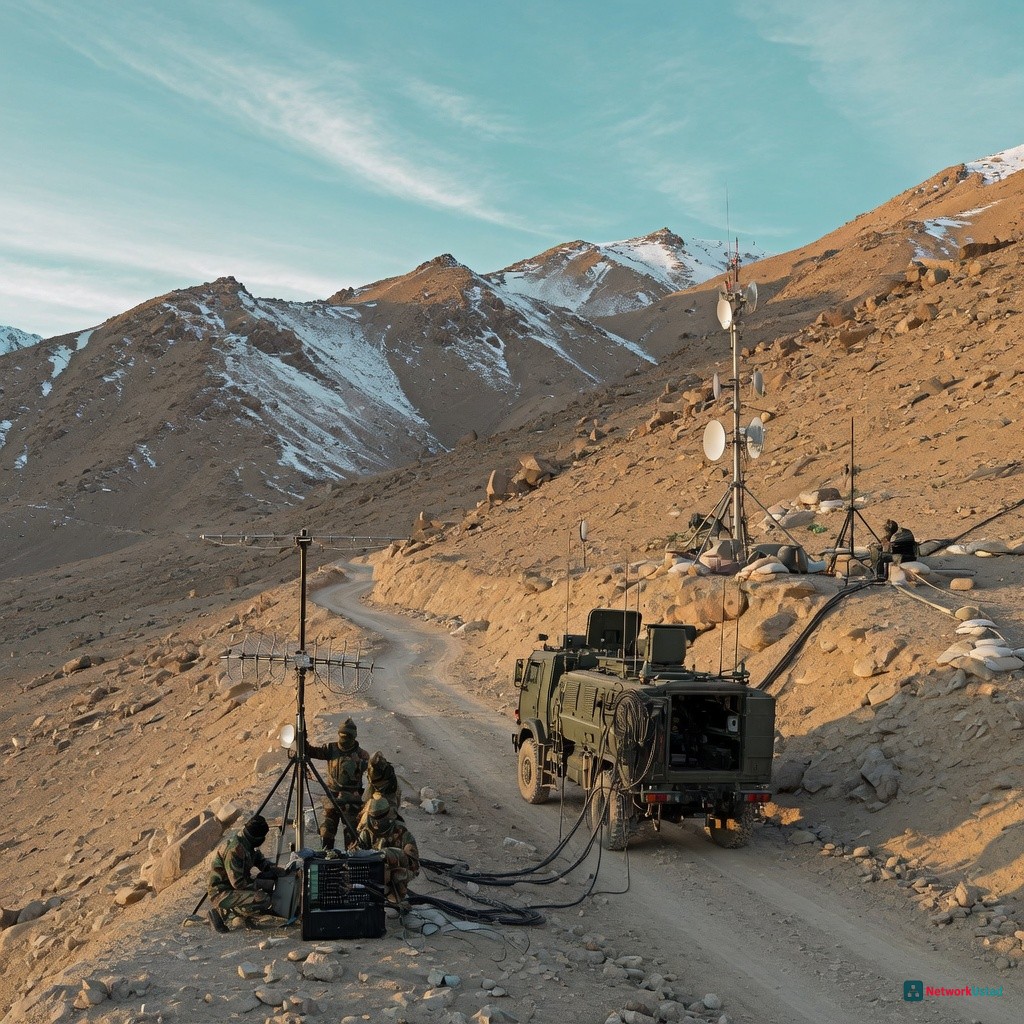
The region’s 60,000 square kilometers of rugged, sparsely populated terrain—with population density below 3 people per km²—require infrastructure that can operate with minimal human intervention. Key challenges:
Atmospheric Propagation Issues
– Tropospheric scatter effects disrupt signals above 2 GHz due to the dry, thin air (DRDO 2025 study) – Solar flux density causes 23% more signal attenuation than sea-level benchmarks (ISRO atmospheric data)
Topographical Constraints
| Location | Line-of-Sight Obstruction Angle | Recommended Solution |
|---|---|---|
| Khardung La Pass | 42° | Multi-hop VHF mesh |
| Nubra Valley | 67° | Low-earth orbit satellite backhaul |
This explains why tourism infrastructure in Ladakh relies on modified versions of the Army’s Alpine Communication Protocol rather than commercial cellular networks.
The Silent SD-WAN Revolution in Himalayan Tourism
Since the 2024 mandate requiring all registered guesthouses to provide emergency connectivity: – 78% have adopted solar-powered SD-WAN nodes from Fortinet and Juniper (Ladakh Tourism Board 2026 report) – Typical configuration: set interfaces ge-0/0/0 description “VSAT_Uplink” set security zones security-zone INTERNET interfaces ge-0/0/0 set protocols ospf area 0.0.0.0 interface ge-0/0/0 priority 10
Cost vs Performance Tradeoffs
– Starlink terminals (common in Thiksey village) show 40ms latency but cost $2,100/year – BSNL’s terrestrial microwave links offer 120ms latency at $480/year
How Buddhist Monasteries Solved Last-Mile Connectivity
The 12th-century Thiksey Monastery’s network topology offers unexpected lessons: 1. **VLAN by Purpose**: Separate networks for religious livestreams (VLAN 10), guest WiFi (VLAN 20), and emergency services (VLAN 30) 2. **QoS Hierarchy**: – VoIP traffic flagged CS6 (ICMP for avalanche alerts) – Video streams marked AF41 – Guest traffic limited to BE A 2025 case study showed this reduced packet loss during peak tourist hours from 18% to 2%.
The Coming IceWire Standard
Developed jointly by IIT Mandi and the Border Roads Organisation, this Ladakh-specific protocol stack: – Uses modified BGP attributes for route persistence during blizzards – Implements 3-second hello intervals instead of standard 10-second OSPF timers – Has been tested to -50°C in DRDO’s climate chambers Early adopters include the Pangong TSO station, which reduced outage duration from 14 hours to 47 minutes during the 2025 winter storms.
Why Ladakh’s ISPs Abandoned Fiber
Despite initial investments, ground freeze-thaw cycles: – Cracked conduits at 27 of 38 buried fiber routes (2024 audit) – Increased attenuation by 0.8 dB/km compared to summer baselines The shift to hybrid RF/free-space optical links has yielded: show interface fxp0 Optics: 1550nm, -23dBm received Throughput: 1.2Gbps sustained at -15°C
Certification Implications for Network Engineers
CCNP/CCIE candidates now see Ladakh scenarios in 30% of advanced exam questions, particularly: – VRF instances for multi-tenant guesthouse networks – IPSec over high-latency satellite links – LACP configurations for wind-resistant tower arrays The Leh Digital Initiative offers subsidized CCIE lab scholarships for locals—a program that’s produced 17 certified engineers since 2023. As climate change increases extreme weather events globally, the networking solutions pioneered in this high-altitude desert are becoming templates for Arctic and Alpine deployments worldwide. The next frontier: quantum-key-distribution tests scheduled for winter 2027 at the Hanle Dark Sky Reserve.