
As a director responsible for strategic operations, you see the friction points long before they show up on a balance sheet. You notice the operational bottlenecks slowing down your supply chain, the data silos that prevent marketing and sales from sharing insights, and the growing fear that more agile competitors are pulling ahead. The very software that once powered your company’s growth may now be its biggest bottleneck.
This isn’t an isolated problem. The technology that underpins your operations is likely showing its age, creating hidden risks that impact everything from daily productivity to long-term strategy. In fact, a 2025 survey reveals that 62% of organizations still rely on legacy software systems. If your business is one of them, you’re not just dealing with inconvenience; you’re facing a significant strategic liability.
The “If It Ain’t Broke” Fallacy
Many organizations hesitate to replace their core systems, clinging to the idea that as long as the software “works,” it’s not a problem. This perspective overlooks the deep, hairline cracks that form over time—cracks that slow down processes, frustrate employees, and expose the business to unacceptable risks. It’s time to diagnose whether your systems are truly working for you or just working against you.
What is a Legacy System, Really? (Beyond “Old Software”)
A legacy system isn’t defined by its age but by its inability to support your current and future business goals. It’s software built on outdated technology that has become too rigid to modify, too complex to integrate with modern tools, and too fragile to secure effectively. It’s the ERP that can’t connect to your e-commerce platform or the CRM that requires manual data entry from spreadsheets.
This technology is often held in place by a powerful inertia. The same survey found that 50% of organizations state the biggest reason they haven’t upgraded is simply because “the current system still works.” The critical reframe needed is to see that while the system may function, it prevents your business from functioning better. It maintains the status quo while your competitors are evolving.
5 Telltale Signs Your Software Has Become a Bottleneck
How can you tell when your software has crossed the line from a reliable asset to a strategic bottleneck? Here are five clear warning signs that should sound the alarm for any operations leader.
- Frequent Downtime & High Maintenance Costs: Your IT budget is increasingly consumed by bug fixes, emergency patching, and paying specialist developers who understand the archaic codebase. You’re spending more resources maintaining the past than investing in the future.
- Pervasive Data Silos: Departments operate on informational islands. Your finance team can’t easily access real-time inventory data, or your sales team’s CRM doesn’t sync with the customer support platform. This lack of integration forces poor decisions based on incomplete information.
- Painful Manual Workarounds: Your teams rely on a patchwork of spreadsheets, manual data entry, and redundant processes to bridge the gaps in your software’s functionality. These workarounds are not just inefficient; they are a major source of human error and employee frustration.
- Compliance and Security Worries: Your IT team is in a constant state of alert, and for good reason. Among organizations with legacy systems, 43% say security vulnerabilities are a major concern. The struggle to meet modern compliance standards like GDPR or HIPAA with outdated technology becomes a significant business risk.
- Inability to Innovate: This is the most critical sign. You want to launch a new service, integrate with a key partner’s API, or adopt a modern business intelligence tool, but your core software simply can’t support it. Your technology has become a barrier to growth.
Why Custom Software Unlocks Post-Legacy Success
Once the risks of inaction are clear, the conversation shifts from “if” we should modernize to “how.” While off-the-shelf software can seem like a quick fix, it often trades one set of rigid constraints for another, forcing your unique processes into a generic box. You risk ending up with a new system that becomes a legacy problem in just a few years.
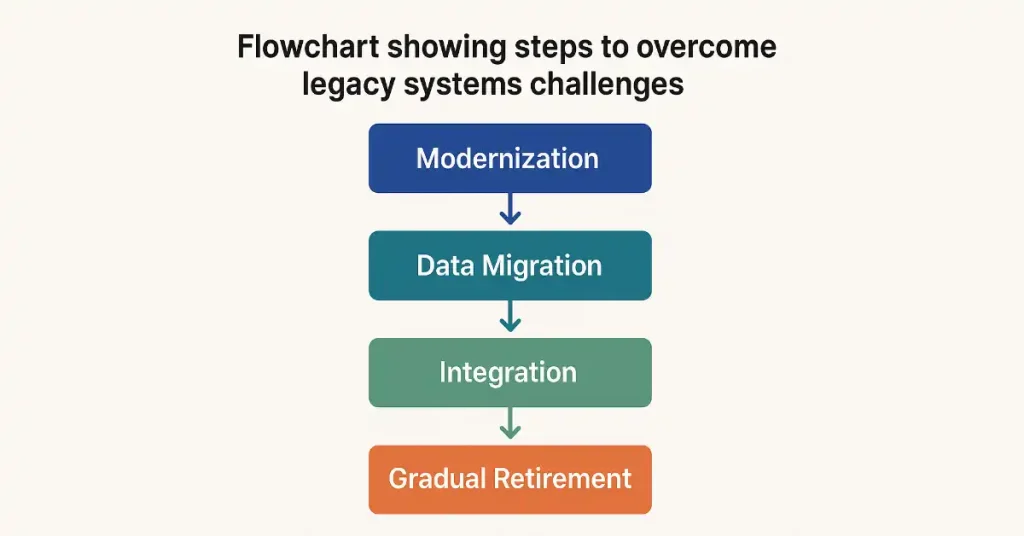
The most effective path forward is to build technology around your business, not the other way around. This tailored approach is achieved through custom enterprise software development, which empowers your operations instead of hindering them. By focusing on strategic initiatives like application modernization, system integration, and ERP customization, you can create a technology ecosystem that serves as a competitive advantage.
Building the Business Case
Justifying a significant investment in technology requires a business case built on tangible returns, not technical jargon. A custom software initiative should be framed around three core pillars of value: efficiency, security, and scalability.
Measuring Efficiency Gains
Modernization directly translates into measurable improvements in operational efficiency. By automating repetitive manual tasks and eliminating redundant workflows, you free up your employees’ time to focus on high-value, strategic work that drives the business forward.
Integrating disparate systems like your ERP and CRM creates a single source of truth for your data. This eliminates guesswork and empowers your leadership team to make faster, more accurate decisions. A modern, user-friendly interface also reduces employee training time, increases adoption, and boosts overall productivity.
The Value of Modern Security
Investing in modern technology is one of the most effective risk-mitigation strategies a business can undertake. Unlike the bolted-on patches of legacy systems, a modern software architecture allows for robust, built-in security features from the ground up.
This makes it far easier to implement granular access controls and ensure compliance with complex data privacy regulations. Ultimately, you are reducing the financial and reputational risk of costly downtime and data breaches. Think of it as a crucial form of business insurance for the digital age.
From Stagnation to Scalability: Future-Proofing Your Operations
The greatest long-term value of a custom solution is its ability to grow and adapt with your business. A modern, flexible platform is built for the future, whether you’re expanding into new markets, launching new product lines, or acquiring another company.
Conclusion
Continuing to operate on legacy software is no longer a neutral choice; it’s an active decision that carries immense financial, security, and strategic risk. The hidden costs of inefficiency and the looming threat of a security breach far outweigh any perceived savings from delaying an upgrade.
Moving beyond these outdated systems isn’t just an IT project—it’s a fundamental business transformation. It’s about unlocking new levels of efficiency, fortifying your operations against modern threats, and building a foundation for future growth. By embracing custom enterprise software, you are making a proactive, strategic investment in a more resilient, competitive, and future-proof business.
FAQs
What are the main signs that legacy software is becoming a bottleneck?
Frequent downtime and high maintenance costs drain resources, while data silos hinder collaboration and decision-making. Manual workarounds slow processes, security vulnerabilities expose risks (43% of organizations affected per 2025 survey), and inability to integrate new tech blocks innovation. Upgrading to custom software addresses these by automating tasks and ensuring seamless scalability.
Why is custom enterprise software better than off-the-shelf solutions for replacing legacy systems?
Custom software is tailored to specific business needs, avoiding rigid constraints of generic tools. It enables full integration with existing systems, enhances security with built-in compliance features, and supports growth without rework. Unlike one-size-fits-all options, it unlocks efficiency gains and future-proofing, turning operational friction into competitive advantage.
How does clinging to legacy systems impact business innovation?
Legacy systems create rigid structures that resist new technologies like AI or cloud integration, leading to missed opportunities. They foster data silos and manual processes that stifle agility, while security gaps divert focus from strategy. A 2025 survey shows 62% of firms still rely on them, but custom software modernization fosters innovation by providing flexible, scalable platforms.
What business case can be made for investing in custom enterprise software?
The investment yields efficiency through automation and unified data, reducing costs from silos and workarounds. Security is bolstered against vulnerabilities, ensuring compliance and risk mitigation. Scalability allows adaptation to growth without overhauls, positioning the business for resilience. Overall, it transforms legacy liabilities into strategic assets for long-term success.