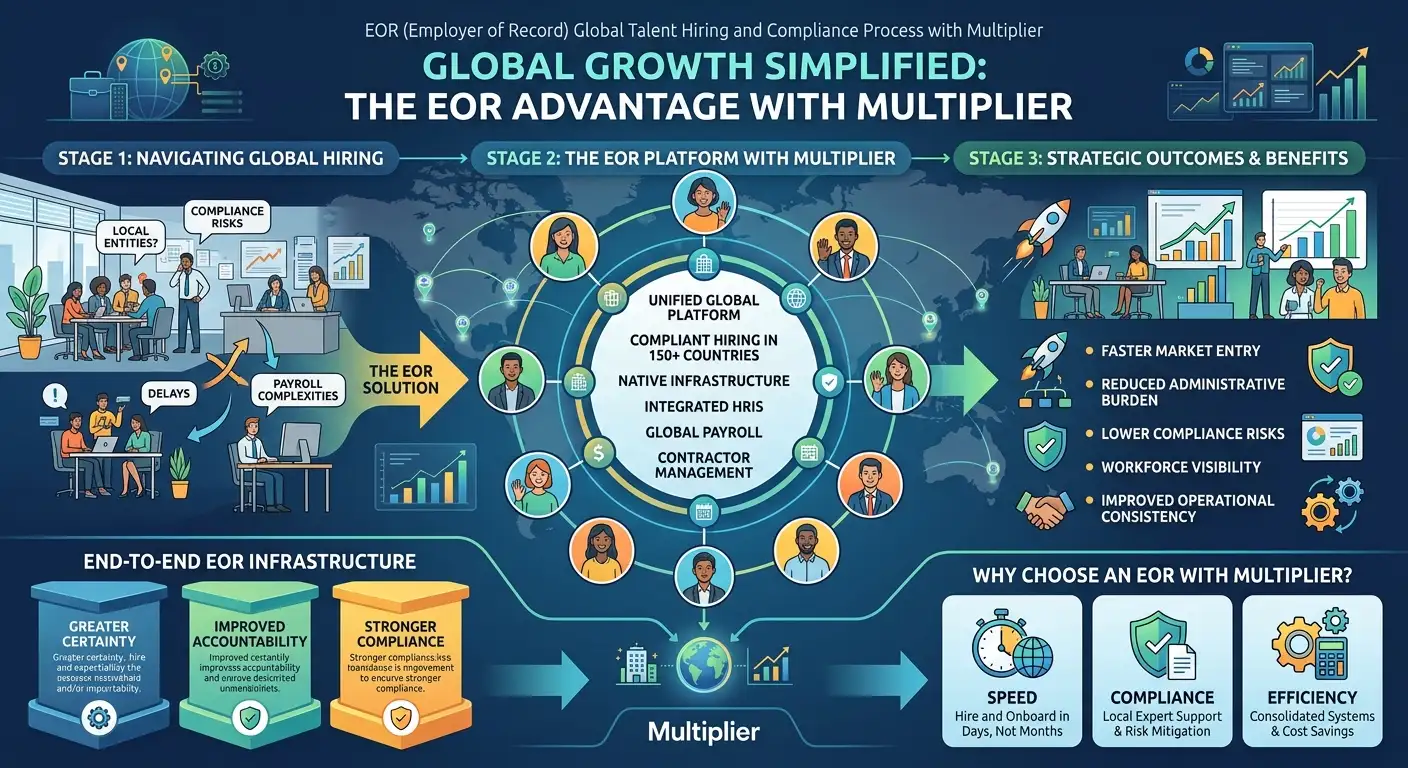
Expanding into international markets creates exciting opportunities, but navigating payroll, compliance, employment contracts, and tax obligations can quickly become a challenge. What starts as a strategic growth initiative often turns into a complex operational burden, slowing down hiring and expansion efforts.
An EOR (Employer of Record) helps businesses overcome these challenges efficiently. Rather than establishing legal entities in every country where you need talent, an EOR enables you to hire employees quickly while maintaining compliance with local employment regulations from day one. Solutions like Multiplier simplify the process even further by providing a unified platform to hire, manage, and pay global teams compliantly across 150+ countries.
Key Takeaways
- An EOR allows businesses to hire international employees legally without establishing local entities.
- Companies can expand global teams faster while reducing compliance risks, payroll complexities, and administrative workloads.
- A centralised EOR platform enhances visibility across countries, employees, and workforce operations, helping businesses stay focused on strategic growth.
- Robust compliance infrastructure safeguards organisations from costly legal penalties, payroll errors, and regulatory risks worldwide.
- Multiplier supports global expansion through integrated EOR, payroll, contractor management, and HRIS capabilities across 150+ countries.
Why Businesses Choose an EOR
Every country operates under its own employment regulations, payroll requirements, tax structures, and worker classification standards. Managing these complexities independently while pursuing international growth can be overwhelming. An EOR manages the employment and compliance framework on your behalf, allowing your organisation to focus on scaling operations rather than navigating local regulatory requirements.
The three core reasons companies adopt an EOR include:
Faster Market Expansion
Establishing a legal entity in a new country can take months and often delays hiring initiatives. An EOR removes these barriers entirely, enabling businesses to:
- Onboard employees in new markets quickly
- Evaluate international opportunities without significant upfront investment
- Access specialised talent regardless of location
- Scale global teams without waiting for entity setup processes
Better Compliance Protection
Employment regulations evolve constantly, and the consequences of non-compliance extend beyond financial penalties. Delayed payroll, reduced employee confidence, and reputational damage can have lasting effects on business performance. An EOR provides access to local expertise while embedding compliance into every stage of the employee lifecycle, ensuring your business remains protected well beyond the hiring process.
Simplified Global Operations
Managing payroll across multiple countries through separate vendors often creates inefficiencies. Disconnected systems, inconsistent reporting, and unexpected costs can become recurring challenges. A modern EOR platform centralizes payroll operations into a single system, delivering greater visibility, reduced administrative effort, and improved operational consistency.
The Growing Need for Global Workforce Visibility
As distributed teams continue to expand, workforce visibility has become a critical operational priority. HR and finance teams relying on multiple vendors and disconnected platforms frequently struggle with fragmented data, leading to challenges such as:
- Delayed reconciliation processes that impact reporting timelines
- Inconsistent employee information across regions
- Compliance gaps that remain undetected until problems arise
- Less accurate budgeting and forecasting
- Lengthy and resource-intensive audit processes
Organizations increasingly require a single source of truth for global workforce management. Multiplier delivers this by integrating payroll, payments, and compliance into one unified platform that HR and finance teams can confidently depend on.
How an EOR Reduces Operational Risk
International hiring extends far beyond employee onboarding. Businesses must also navigate:
- Country-specific tax obligations
- Mandatory benefits and statutory contributions
- Termination regulations that differ by jurisdiction
- Currency fluctuations and international payroll payments
Without the appropriate infrastructure, these processes can become vulnerable to costly mistakes. An EOR minimizes operational risk by integrating compliance directly into payroll and employment workflows, allowing businesses to prioritize growth instead of managing fragmented administrative functions.
Why End-to-End EOR Infrastructure Matters
Payroll processing represents only one aspect of global workforce management. Businesses also require accurate gross-to-net calculations, multi-country compliance oversight, statutory reporting, real-time payroll visibility, and secure payment systems. A comprehensive EOR solution brings these capabilities together within a single accountable framework, delivering three essential advantages:
- Greater certainty: Improved visibility into payroll operations across countries and payment cycles.
- Improved accountability: One centralised platform instead of multiple disconnected vendors.
- Stronger compliance support: Local legal specialists continuously monitoring employment regulations across every market of operation.
The Financial Benefits of an EOR
Many organisations assume that international hiring inevitably increases operational costs. In reality, an EOR frequently helps reduce expenses.
Key cost-saving advantages include:
- Eliminating entity setup expenses in new markets
- Streamlining vendor management through a single platform
- Consolidating payroll systems instead of maintaining multiple solutions
- Replacing manual reconciliation with automated processes
Payroll accuracy also improves significantly, which is critical because payroll errors can quickly affect employee trust and create compliance issues. For organisations managing payments across multiple currencies, a strong EOR infrastructure further supports financial planning and more effective exchange-rate management.
Common Challenges Businesses Face Without an EOR
Organizations that manage international hiring independently often encounter recurring obstacles.
- Fragmented local vendors create reporting inconsistencies
- Compliance tracking becomes difficult without local expertise
- Entity establishment delays slow hiring initiatives
- Finance teams struggle with limited visibility across markets
When payroll or compliance issues emerge, accountability is often unclear, with businesses being redirected between multiple service providers. An EOR eliminates these operational inefficiencies by centralizing workforce management under one platform with a single point of responsibility.
How an EOR Supports Long-Term Growth
Global hiring is no longer limited to multinational enterprises. Startups, mid-sized companies, and large organisations alike are building international teams, and sustainable growth depends heavily on having the right infrastructure in place.
With a trusted EOR partner, businesses can hire across borders with confidence, reduce compliance exposure, improve payroll efficiency, and scale internationally without the operational challenges that typically accompany global expansion.
Conclusion
An EOR has become one of the most effective solutions for scaling global teams while avoiding unnecessary complexity. Organizations that succeed in international expansion consistently rely on strong workforce infrastructure to support their growth.
Multiplier is purpose-built to deliver that foundation. From payroll and compliance to onboarding and benefits administration, it brings every aspect of global employment together on a single platform across 150+ countries. Unlike providers that rely heavily on fragmented third-party networks, Multiplier owns its compliance infrastructure, offering businesses greater accountability, streamlined operations, and fewer handoffs. This enables organisations to spend less time managing administrative complexity and more time driving meaningful business growth.
FAQs
1. What is an EOR and how does it work?
An Employer of Record (EOR) legally employs international workers on behalf of a company while handling payroll, employment contracts, taxes, statutory benefits, and local compliance. This allows businesses to hire globally without establishing a legal entity in each country.
2. Why do businesses use an EOR for global hiring?
Businesses use an Employer of Record (EOR) to accelerate international expansion, hire skilled talent without setting up foreign entities, reduce administrative complexity, and ensure compliance with local employment laws, payroll regulations, tax requirements, and statutory obligations.
3. How does an EOR support compliance management?
An EOR manages country-specific employment regulations, payroll processing, tax filings, labor law compliance, employment contracts, and statutory benefits. This helps organisations minimise legal risks, avoid compliance penalties, and maintain consistent workforce governance across multiple international markets.
4. What EOR services does Multiplier provide?
Multiplier provides comprehensive Employer of Record (EOR) services, including global payroll, contractor management, employee onboarding, HRIS, compliance management, benefits administration, tax support, and workforce management solutions across more than 150 countries worldwide.
5. Can an EOR manage payroll across multiple countries?
Yes. An Employer of Record (EOR) streamlines multi-country payroll by managing salary payments, tax deductions, statutory contributions, benefits administration, compliance reporting, and cross-border payments through a single centralised platform, ensuring timely and compliant payroll operations globally.