A security team may spend multiple days chasing a vendor issue that turned out to be outdated data. The alert looked serious, the emails kept coming, and yet the real problem had already been fixed somewhere else. That gap between what is seen and what is actually happening is where most of the trouble begins.
Third-party networks have grown quietly over the years, and now they sit behind almost every business operation. Tools, services, data processors, cloud providers, all of them connected in ways that are not always visible. The challenge is not just risk itself. It is the lack of clear, current visibility into that risk.
Why Traditional Visibility Keeps Falling Short
Most organizations still rely on periodic assessments to understand vendor risk. A questionnaire is sent, answers are reviewed, and a score is assigned. It feels structured, even controlled. But it is also static, and that becomes a problem quickly.
Vendors change. Systems get updated. New vulnerabilities appear. Yet the assessment stays the same until the next cycle. That gap between review points creates blind spots. People know this, but the process has been hard to replace because it fits into existing workflows.
There is also the issue of scale. As companies work with more vendors, the effort required to track each one grows. Teams try to keep up, but the process becomes slower, and visibility becomes thinner. It is not a failure of effort. It is a limitation of the system itself.
The Shift Toward Continuous Monitoring
Considering the evolving cybersecurity landscape, managing third-party cyber risk should be a continuous task. Instead of checking a vendor once or twice a year, systems now observe behavior over time. This includes tracking security signals, known vulnerabilities, and external indicators that suggest risk.
The idea is simple. If risk is always changing, then it should be observed continuously. But implementing this at scale has been difficult without automation. Too much data is generated, and without some form of filtering, it becomes noise. That is where AI starts to play a role. Platforms that support third-party risk management are increasingly using AI to process large volumes of data, identify patterns, and highlight what actually matters. It is not about replacing human judgment. It is more about reducing the amount of irrelevant information that gets in the way.
How AI Improves What Can Actually Be Seen
AI does not create new risks. It changes how existing ones are detected and understood. Instead of relying only on reported data, AI systems pull signals from multiple sources. These can include public security records, network activity, and historical patterns.
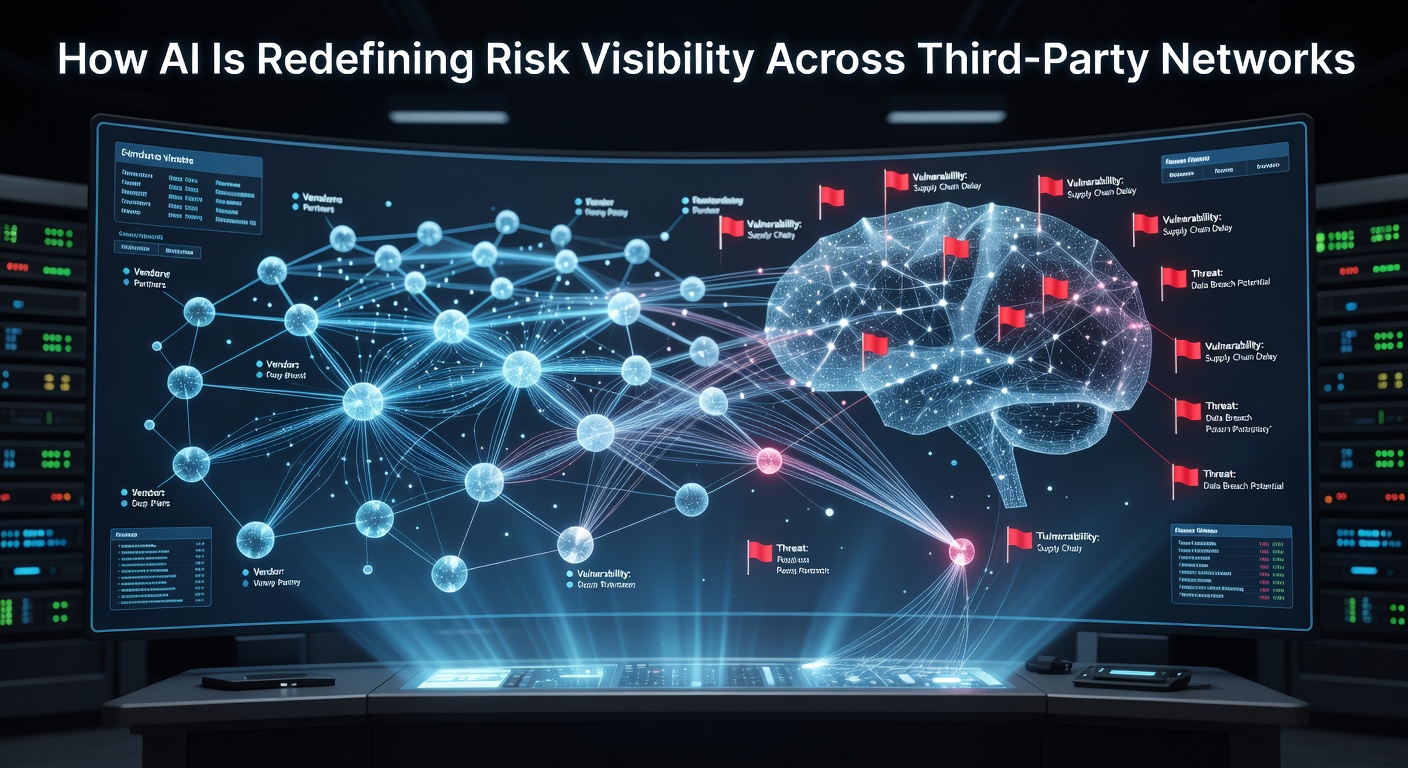
The benefit is not just speed. It is context. A single vulnerability might not look serious on its own, but when combined with other signals, it can indicate a larger issue. AI helps connect those points, which would be difficult to do manually.
There is also a shift in how alerts are handled. Traditional systems often generate large numbers of warnings, many of which are not urgent. AI models can prioritize these alerts based on likelihood and impact. This does not eliminate false positives completely, but it reduces them enough to make the process manageable.
The Challenge of Trust in Automated Insights
Not everyone is comfortable relying on AI for security decisions. There is a concern that important details might be missed or that the system might make incorrect assumptions. These concerns are valid, and they have slowed adoption in some cases.
At the same time, manual processes are not perfect either. Human review can miss patterns, especially when dealing with large datasets. The difference is that errors in manual systems feel more understandable, while errors in AI systems feel less predictable.
Over time, trust tends to build as systems prove consistent. When AI highlights issues that are later confirmed, confidence grows. Still, most organizations do not rely on AI alone. It is used as a support layer, with human oversight remaining part of the process.
Visibility Across Complex Vendor Ecosystems
Modern vendor networks are not simple. A company might work with a software provider, which in turn relies on other services. These layered relationships create indirect risks that are hard to track. AI helps map these connections more effectively. By analyzing data across multiple levels, it becomes possible to see how one issue might affect another part of the network. This kind of visibility was difficult to achieve before.
There is also the issue of speed. When something changes in one part of the network, the impact can spread quickly. AI systems are able to detect these changes in near real time, which allows for faster response. It does not stop the risk entirely, but it reduces the time it goes unnoticed.
A Quieter Shift in How Decisions Are Made
One of the less obvious changes is how decisions are being influenced. With better visibility, teams are able to act earlier. Instead of reacting to incidents, they can adjust based on signals that suggest increasing risk.
This changes the role of security teams slightly. They spend less time gathering information and more time interpreting it. The work becomes less about chasing data and more about deciding what to do with it. There is also a subtle change in communication. Risk discussions become more grounded in current data rather than past assessments. This makes it easier to explain decisions, even to non-technical stakeholders.
Where This Leaves Organizations Now
The move toward AI-driven visibility is not complete, and it is not uniform across industries. Some organizations have adopted these systems quickly, while others are still relying on older methods. The reasons vary, often tied to resources, risk tolerance, or simply familiarity with existing processes.
What is clear is that the old model struggles to keep up with the current environment. Vendor networks are larger, more dynamic, and more interconnected than before. Static approaches cannot fully capture that complexity.
AI does not solve everything, and it introduces its own set of challenges. But it addresses a core issue that has been difficult to manage for a long time, which is the gap between what is happening and what can be seen. Closing that gap, even partially, changes how risk is understood and handled. And that, in a quiet way, is where most of the value sits.