Online shoppers don’t want to simply scroll through static photos and read product descriptions; they expect more from interactive, personalized shopping experiences. That’s why many brands are rethinking how they present their products to engage potential customers more effectively, improve conversion rates, and drive online sales.
This is where AR in eCommerce and virtual reality retail are becoming increasingly important. Customers can preview products in a real-world context or a true-to-life space, ensuring greater clarity in their selections and making more informed decisions.
Keep scrolling to discover more with us!
Why AR in E-commerce Is Becoming a Game-Changer
In fact, when customers shop online, they tend to feel hesitant because they cannot clarify exactly what they are ordering or fully visualize how a product will fit their real environments. This potentially leads to abandoned carts and missed sales opportunities.
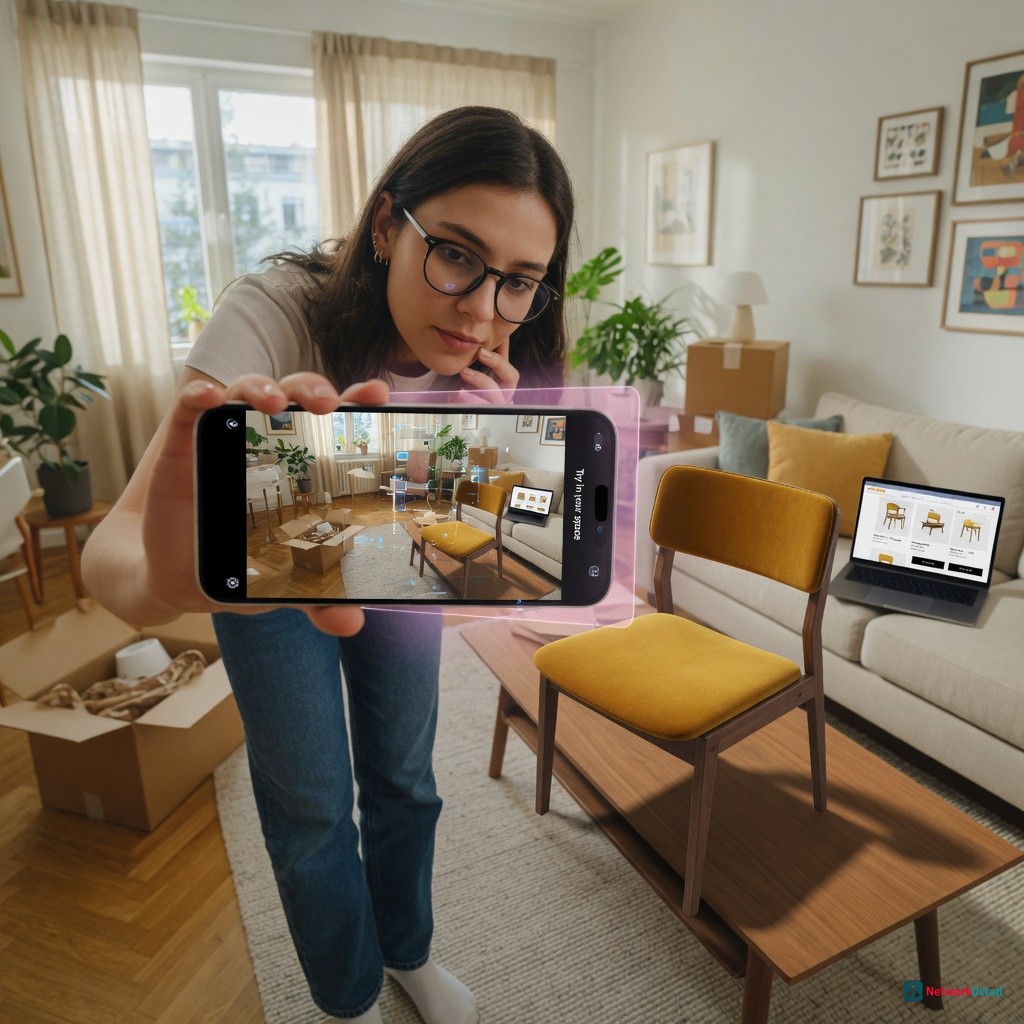
That’s where AR in eCommerce comes into play, making online shopping journeys smoother by blending digital experiences with immersive visualizations. For example, more and more retailers are using augmented reality for furniture to help customers place sofas, tablets, cabinets, and other decor items directly into their homes and offices. All you need is a smartphone camera, then scan a QR code or use an AR-powered app.
By offering these unique experiences, you can minimize guesswork, improve customer satisfaction, reduce return rates, and, especially, boost your long–term competitiveness.
Specifically, with augmented reality shopping journeys, customers can:
Visualize products in their own space before buying
Explore product scale, fit, and design accuracy from every angle
Test different colors, materials, and finishes
Compare product variations side by side
Make faster and more confident purchase decisions
How Virtual Reality Retail Is Changing Online Shopping
While AR in eCommerce targets the real world to build customer trust, virtual reality retail creates an entirely new shopping environment. It allows users to step into digital showrooms, walking through a virtual space to interact with items in an immersive way.
Below is what customers can do with VR:
Walk through virtual showrooms to discover products from 360 degree
Explore curated product setups and collections
Experience spatial design and layout before purchasing
The Rise of AR & VR Shopping
You can currently find augmented reality shopping across industries, such as home decor, beauty, fashion, automotive, and more. This also explains a significant growth at a CAGR of 35.8% from 2025 to 2030. Depending on market demand, the level of AR interactivity and application can be diversified, as long as you still offer immersive product experiences.
Besides basic experiences, combining this technology with personalization by adopting an eCommerce product configurator with built-in AR has been a major expectation. Buyers can configure a new product on their own by selecting materials, size, modules, and more, zoom in and out to clarify all angles, and visualize the final design in reality. Additionally, prices and quotes will be updated in real time based on their selections.
On the other hand, virtual reality (VR) has witnessed a slower increase compared to augmented reality for eCommerce, at a CAGR of 27.5% from 2023 to 2030. In fact, VR is common in retail for selling gadgets such as VR headsets, glasses, gloves, and bodysuits. But you might find its adoption more in gaming, entertainment, and instructional training.
Apparently, this advanced level of customization and visualization, powered by AR and VR, not only transforms how customers discover and purchase online but also sets a new standard for evaluating whether a brand has the potential to stay ahead in the market. Customers feel confident to buy, and you improve your average order value and profits.
Challenges of Implementing AR and VR
Despite significant advantages, AR and VR implementations pose challenges, especially for brands on a budget (e.g., startups, SMBs) and beginners new to these technologies.
One of the main barriers is the complexity of development. Both AR and VR are leading 3D technologies in eCommerce and manufacturing, requiring accurate 3D product models, robust technical integration, and extensive investment in the digital ecosystem. This means that if you want to succeed with them, you need to carefully consider everything, including demands, human resources, financial capabilities, and scalability.
Another challenge is about user adoption. While AR in eCommerce can be accessed on mobile devices, including smartphones and tablets, VR requires specialized hardware that is often designed to operate separately from your mainstream business operations. That’s why we recommend choosing one of these two instead of both at the same time.
However, thanks to constant technological improvements, the approach to AR and VR shopping has become more affordable and widely supported. Therefore, many experts expect adoption to grow significantly in the eCommerce landscape in the coming years. The final part will help you clarify how these experiences reshape customers’ mindsets.
The Future of AR and VR in E-commerce
The future of e-commerce is becoming increasingly immersive thanks to AR and VR. Specifically, they are emerging standards that aim to offer more interactive, personalized, and visually rich online shopping experiences. In this way, customers can discover items fully rather than just view 2D images, scan product descriptions, and check reviews.
On the other hand, we are likely to see more interesting points of the AR and VR future:
More advanced virtual showrooms and digital stores
Deeper integration of AR into everyday shopping experiences
AI-driven personalization combined with AR visualization
Stronger connection between product configuration and immersive retail
Last but not least, businesses that adopt these technologies early will have a clear advantage in delivering better customer experiences and improving long-term growth.
Conclusion
AR in e-commerce and virtual reality retail are no longer just a trend; it is becoming a core part of a modern eCommerce operation, especially in niches that cater to personal preferences. The reason is apparent: shopper expectations continue to rise; retailers and brands need more innovative, accessible methods to deliver better buying experiences.
Another striking highlight is combining these technologies with advanced platforms, such as product configurators, that allow customers to design their own products. Despite that, depending on your demand and goal, let’s have a flexible implementation.