Asad Ijaz
NetworkUstad's lead networking architect with CCIE certification. Specializes in CCNA exam preparation and enterprise network design. Authored 2,800+ technical guides on Cisco systems, BGP routing, and network security protocols since 2018. Picture this: I'm not just someone who writes about tech; I'm a certified expert in the field. I proudly hold the titles of Cisco Certified Network Professional (CCNP) and Cisco Certified Network Associate (CCNA). So, when I talk about networking, I'm not just whistling in the dark; I know my stuff! My website is like a treasure trove of knowledge. You'll find a plethora of articles and tutorials covering a wide range of topics related to networking and cybersecurity. It's not just a website; it's a learning hub for anyone who's eager to dive into the world of bits, bytes, and secure connections. And here's a fun fact: I'm not a lone wolf in this journey. I'm a proud member and Editor of Team NetworkUstad. Together, we're on a mission to empower people with the knowledge they need to navigate the digital landscape safely and effectively. So, if you're ready to embark on a tech-savvy adventure, stick around with me, Asad Ijaz Khattak. We're going to unravel the mysteries of technology, one article at a time!"
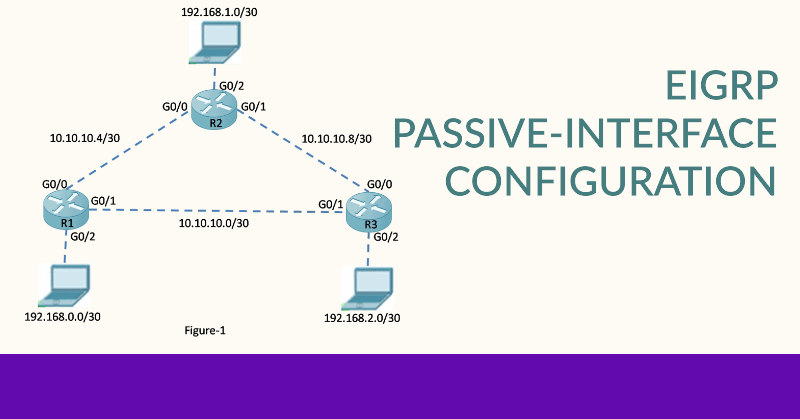
How to Configure EIGRP Passive-Interface
A passive interface is used in all routing protocols, where we can stop sending updates from a specific interface. The behavior varies from one protocol to another. In EIGRP, using the passive-interface, we stop sending outgoing hello packets; therefore, the router cannot form any neighbor adjacencies via the passive interface. This behavior stops both outgoing...

The Network Command – Exclusive Explanation
The network command has the same function as in all IGP routing protocols. It enables any interface on this router that matches the network address. It enables EIGRP routing on an interface, using the command in router configuration mode and enter the classful network address for each directly connected network. The command syntax is as...
Mastering EIGRP Router ID Configuration
EIGRP router ID is a 32-bit unique identifier identifying the router in the EIGRP domain. The router ID (RID) is represented in the same way as the IPv4 address. The router ID is used both in EIGRP and OSPF, while the role of the router ID is more significant in OSPF. EIGRP automatically selects the...
Introduction to “Router EIGRP” Command
The “router” command in global configuration mode is an important command for start configuration of any dynamic routing protocol. The topology displayed in Figure 1 is used to configure and demonstrate the EIGRP routing protocol. Figure 2 (marked with a red triangle) illustrates the “router ?” with question marks to demonstrate the list of dynamic...

Introduction to Autonomous System Numbers (ASNs)
Autonomous system numbers (ASNs) is a unique identifier that is globally available and allows its autonomous system to exchange routing information with other systems. An Internet Assigned Numbers Authority (IANA) globally assigned autonomous system is a group of networks under the administrative control of a single body that presents a common routing policy to the...
EIGRP Packet Types – Exclusive Explanation
EIGRP uses 5 different types of packet in communication with its neighbours. EIGRP packets are sent with reliable or unreliable delivery and can be sent as a unicast, multicast, or sometimes both. EIGRP packet types are also called EIGRP packet format or EIGRP messages. The details of the EIGRP packets are the following: EIGRP Hello...
What is a Reliable Transport Protocol (RTP)
EIGRP uses a Reliable Transport Protocol (RTP) to deliver and receive EIGRP packets instead of TCP and UDP. Reliability is a key feature of EIGRP, and it is designed to enable fast update delivery and data reception tracking.EIGRP was designed as a network-layer independent routing protocol. This allows EIGRP to be used for protocols other...
What is Protocol Dependent Module (PDM)
EIGRP uses a protocol-dependent module (PDM) for routing with several different protocols including IPv4 and IPv6. EIGRP also used PDMs to route Novell’s IPX and Apple Computer’s AppleTalk network-layer protocols. The protocol-dependent module (PDM) is also responsible for carrying information from the routing table to the topology table. protocol-dependent module (PDM) is also responsible for...

Introduction to EIGRP – Exclusive
Enhanced Interior Gateway Routing Protocol (EIGRP) was introduced as a distance-vector routing protocol in 1992. It was originally designed to work as a Cisco proprietary protocol on Cisco devices only. In 2013, Enhanced Interior Gateway Routing Protocol became a multi-vendor routing protocol. Enhanced Interior Gateway Routing Protocol is an advanced version of IGRP that lets...
How to Verify Multiarea OSPF
The majority of the command for multiarea OSPF verification is the same as the command we already used in the verification of single area OSPF. The command, “show ip ospf neighbor”, “show ip ospf” and show ip ospf interface are the same command. The following command specifically includes the information of multiarea OSPF. show ip...