Whether you first heard this term in a business strategy meeting, a film production discussion, or an online forum, “back casting room” means something different depending on who is using it — and that confusion is exactly why most articles on this topic fail to actually help you.
This guide covers all three real contexts of a back casting room: the strategic planning methodology that corporations and governments use to future-proof decisions, the physical casting environment used in film and entertainment production, and the important warnings around unregulated informal casting settings that exploit aspiring talent. By the end, you will know exactly what a back casting room is, how each version works, and what to watch out for.
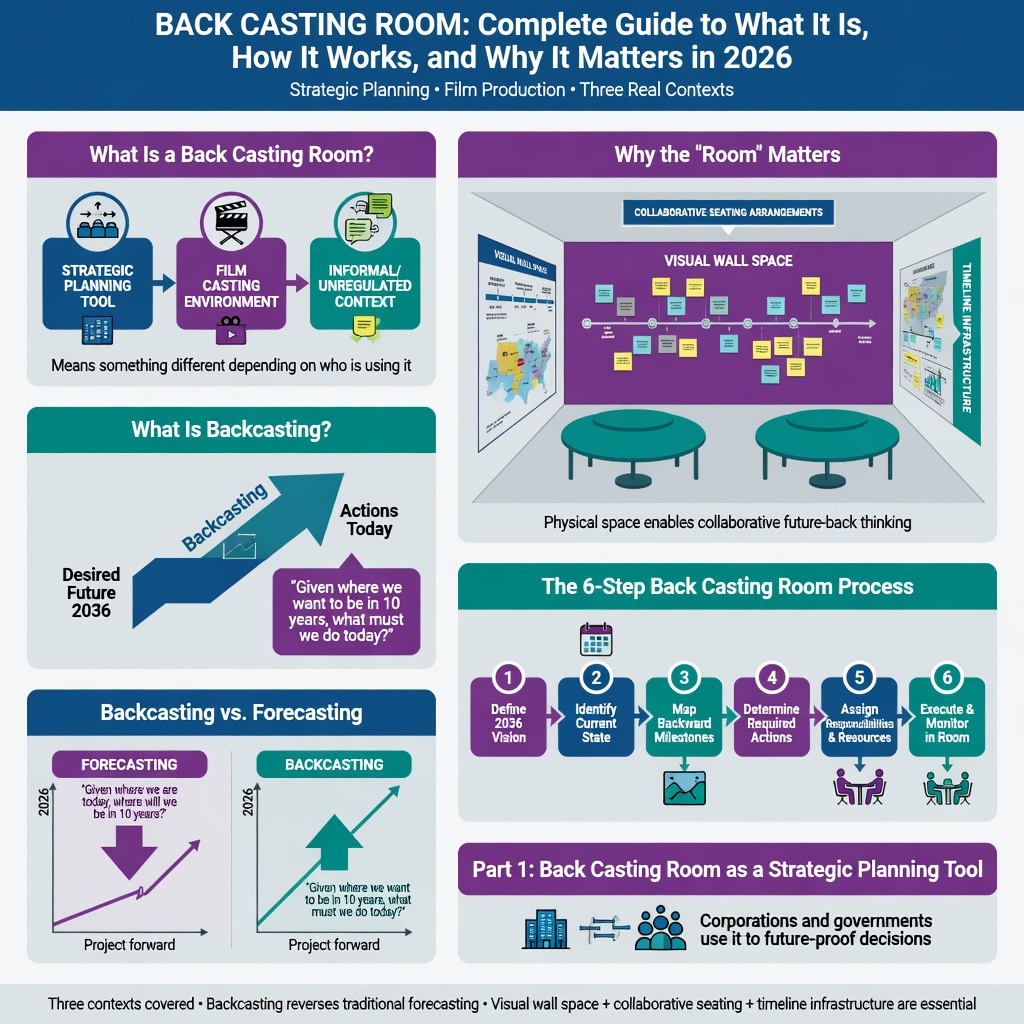
What Is a Back Casting Room?
The term “back casting room” carries three distinct meanings depending on the context:
1. Strategic Planning Context: A back casting room is a dedicated physical or virtual workspace where teams apply the backcasting methodology — a planning technique that begins with a desired future outcome and works backward to identify the steps needed to reach it. Used by corporations, governments, NGOs, and sustainability teams worldwide.
2. Film and Entertainment Context: A back casting room (also called a callback room or secondary casting room) is a private audition space where shortlisted candidates are invited for follow-up evaluation after an initial open casting call. Standard practice in professional film, TV, and modeling industries.
3. Informal/Unregulated Context: The phrase is also associated with private, unofficial audition settings that operate outside regulated industry standards — environments that can pose serious risks to aspiring actors and models. This article covers warning signs and how to protect yourself.
Understanding which meaning applies to your situation is the first step to making informed decisions.
Part 1: Back Casting Room as a Strategic Planning Tool
What Is Backcasting?
Before understanding the room, understand the method.
Backcasting is a strategic planning technique developed in the 1970s by energy researcher Amory Lovins and later formalized by Swedish researchers at the Stockholm Environment Institute. Unlike forecasting — which uses current trends and past data to predict what the future might look like — backcasting starts with a clear picture of a desired future state and works backward to determine what needs to happen today to reach that future.
The fundamental question shifts from:
“Given where we are today, where will we be in 10 years?”
To:
“Given where we want to be in 10 years, what must we do today?”
This single shift in thinking changes everything about how organizations plan, prioritize, and allocate resources.
Why the “Room” Matters
The “room” in back casting room is not metaphorical. Organizations that apply backcasting seriously create dedicated physical or virtual environments designed to support the cognitive demands of reverse-timeline thinking. These spaces typically include:
- Visual wall space for mapping future vision, milestones, and reverse timelines (whiteboards, large format displays, sticky note clusters)
- Collaborative seating arrangements that encourage lateral thinking rather than hierarchical discussion
- Timeline infrastructure — physical or digital tools to display the journey from desired future back to present day
- Data access points for referencing research, forecasts, competitor landscapes, and sustainability benchmarks
- Documentation tools to capture decisions, assumptions, and action items in real time
The environment itself is designed to break teams out of short-term reactive thinking and force engagement with a long-term vision. Companies like IKEA, Interface (the carpet manufacturer), and multiple Scandinavian municipalities have used dedicated back casting rooms as part of their sustainability strategy development.
Backcasting vs. Forecasting — The Key Difference
| Aspect | Forecasting | Backcasting |
|---|---|---|
| Starting point | Present reality | Desired future state |
| Direction | Present → Future | Future → Present |
| Core question | What will happen? | What do we want to happen? |
| Best used for | Short-term operational planning | Long-term strategic transformation |
| Limitation | Constrained by current trends | Requires clear future vision |
| Industries | Finance, supply chain, weather | Sustainability, policy, innovation |
Most organizations need both — forecasting for day-to-day decisions and backcasting for transformational goals.
The 6-Step Back Casting Room Process
Here is how a professional back casting session actually runs inside a dedicated back casting room:
Step 1: Define the Future Vision The team agrees on a specific, measurable future state. Not “we want to be more sustainable” but “we will operate with net-zero carbon emissions by 2040.” Specificity is everything. The future state must be described in enough detail that everyone in the room can see it clearly.
Step 2: Assess the Current Reality Before working backward, the team must be honest about where they are today — current capabilities, constraints, resources, culture, and competitive landscape. This creates the gap between now and the desired future.
Step 3: Identify Key Milestones Working Backward Starting from the future and moving toward the present, the team maps major milestones. If the goal is net-zero by 2040, what must be true by 2035? By 2030? By 2027? Each milestone becomes a checkpoint that confirms the team is on the right path.
Step 4: Map the Pathways For each milestone, the team identifies the decisions, investments, policy changes, partnerships, or innovations required to reach it. Multiple pathways are usually explored — this is where creativity and scenario planning come in.
Step 5: Identify Present-Day Actions The final step of the backward journey: what must begin right now to set the trajectory in motion? These become the immediate, actionable deliverables from the back casting session.
Step 6: Build in Review Points Backcasting is not a one-time exercise. The team schedules regular reviews to assess progress, update assumptions, and adapt pathways as circumstances change.
Real-World Applications of Back Casting Rooms
Corporate Sustainability Strategy Companies facing regulatory pressure around ESG (Environmental, Social, and Governance) targets use back casting rooms to reverse-engineer their path to compliance. Rather than incrementally improving existing processes, backcasting forces them to imagine the fundamentally different future they must build toward.
Government Policy Development The Swedish government used backcasting methodology extensively in developing national energy policy. Starting with a vision of a fossil-fuel-independent Sweden, planners worked backward to identify legislative, infrastructure, and behavioral changes needed at each decade.
Urban Planning Cities use back casting rooms to design sustainable urban environments. Starting with a vision of a livable, zero-carbon city in 2050, urban planners work backward through infrastructure decisions, zoning changes, transportation investments, and policy development.
Technology Product Roadmapping Tech companies — particularly those in AI, clean energy, and biotech — use backcasting to develop product roadmaps that align with long-term market visions rather than just incremental feature additions.
Healthcare System Design Hospital systems and public health organizations use back casting rooms to design future healthcare delivery models and then identify the training, technology, and policy investments needed to realize them.
Setting Up Your Own Back Casting Room
If your organization wants to establish a back casting room, here is what actually matters:
Physical Setup:
- Minimum wall space: 3 large whiteboards or equivalent digital display area
- Seating for 8–15 participants arranged in a circle or U-shape (no head of table)
- Projector or large screen for shared digital workspace
- Abundant materials: markers, sticky notes in multiple colors, index cards, timers
Digital Setup:
- Collaborative whiteboard tools: Miro, MURAL, or Microsoft Whiteboard
- Video conferencing for hybrid/remote sessions
- Shared document repository for capturing session outputs
- Timeline visualization tools
Facilitation Requirements: A back casting session requires a skilled facilitator — someone who can hold the group to the future-first thinking discipline, manage divergent opinions, and guide the team through the backward pathway mapping without letting present-day constraints dominate the conversation too early.
Common Mistakes to Avoid:
- Starting with current constraints instead of the future vision
- Allowing the loudest voice to define the future state instead of genuine consensus
- Treating the output as a fixed plan rather than a living, reviewable roadmap
- Skipping the “current reality assessment” step
- Not scheduling review points into the plan
Part 2: Back Casting Room in Film and Entertainment
What Is a Callback / Back Casting Room in the Film Industry?
In professional film, television, theater, and modeling production, a back casting room (more commonly called a callback room or secondary casting room) is a private, follow-up audition space used after an initial open casting call or primary audition.
Here is how the process works in legitimate productions:
Initial Casting Call: Open to all applicants who meet the stated criteria. Large volume of candidates. Usually held in a main casting room or public venue.
Shortlisting: The casting director reviews initial auditions and selects candidates for further evaluation based on fit, performance, look, and suitability for the role.
Callback (Back Casting Room): Shortlisted candidates are invited to a secondary, more private audition session. Smaller group. More detailed evaluation. May involve reading with other actors, screen tests, or meeting the director/producer.
Final Casting Decision: Based on callback performance, the production team makes final offers.
This is standard, professional industry practice. The callback room is where careers genuinely launch — it is a positive step in the casting process, not a cause for concern when handled by verified, legitimate productions.
What Happens in a Legitimate Back Casting Room?
A professional callback session in a legitimate production includes:
- Written confirmation of the audition with production details
- Presence of a casting director and potentially the director or producer
- Clear explanation of the role being auditioned for
- A copy of the scene or script provided in advance
- Professionalism throughout — no requests that violate personal boundaries
- A formal contract if talent is selected, reviewed before signing
Legitimate productions never request payment from talent at any stage of the process.
Part 3: Warning Signs of Illegitimate “Back Casting” Operations
This section is critical for anyone — particularly aspiring actors, models, and content creators — who has been invited to a “back casting room” or “private audition” outside of a verifiable, established production.
The entertainment industry, particularly at its unregulated edges, has a long history of exploitative practices disguised as legitimate casting opportunities. Understanding the warning signs can protect you from serious harm.
Red Flags to Watch For
No verifiable production company: Any legitimate casting call comes from a production company with a verifiable address, registered business name, and online presence. If you cannot find the company independently — not just through the link they sent you — this is a serious red flag.
Requests for upfront payment: Legitimate casting never charges talent a fee to audition, to access a “casting database,” or to “secure their spot.” Any request for money at any stage of audition is a hallmark of a scam.
Vague role descriptions: “We’re looking for flexible talent for various projects” with no specific role, production title, or studio name is a warning sign. Legitimate productions know exactly what they are casting for.
Pressure to meet privately and urgently: Legitimate productions schedule auditions in advance, in professional settings, during business hours. Pressure to meet quickly in an unusual location — particularly someone’s home or a hotel — is a major warning sign.
Requests to remove clothing without formal consent documentation: Professional productions involving any degree of nudity or intimate content have strict, legally documented consent processes. Any request of this nature without formal paperwork is a red flag.
No contract before any performance: If you are asked to perform anything on camera before signing a contract that clearly outlines how footage will be used, stop immediately.
The “casting couch” dynamic: The persistent myth that sexual compliance is required for career advancement has no basis in legitimate industry practice. Any suggestion of this nature is both illegal and grounds for immediate withdrawal from the situation.
What to Do If You Encounter an Illegitimate Operation
- Leave the situation immediately. You do not owe anyone an explanation.
- Do not sign anything, perform anything, or provide payment.
- Report the incident to local law enforcement and, in India, through the Cyber Crime Portal (cybercrime.gov.in).
- Warn others by reporting to industry bodies, casting forums, and relevant social media communities.
- Contact a legal professional if you have already signed documents or been photographed/filmed without clear consent.
How to Verify a Legitimate Casting Call
Before attending any casting session — particularly a callback or private audition — verify the following:
- Search the production company name independently (not using the contact’s provided link)
- Check the casting director’s name against industry registries like IMDb Pro
- Verify the production’s existence through entertainment industry news sources
- Ask for and receive written communication confirming the audition on official company letterhead
- Bring a trusted person with you when possible, or ensure someone knows exactly where you are
Back Casting Room vs. Related Terms — Clarified
A lot of confusion around this term comes from overlap with related phrases. Here is a clear breakdown:
| Term | What It Actually Means |
|---|---|
| Back casting room | Strategic planning space (methodology) OR callback room in legitimate casting |
| Backcasting | Strategic planning method: start with future goal, work backward |
| Casting room | General audition space for film/TV/modeling |
| Callback room | Follow-up audition space for shortlisted candidates — standard industry practice |
| Casting couch | Illegal/unethical exploitation of power dynamics — not a legitimate industry practice |
| Backroom casting | Can refer to informal/private auditions — requires verification of legitimacy |
Frequently Asked Questions
What is a back casting room in simple terms? It has two main legitimate meanings: in business and strategy, it is a dedicated planning space where teams imagine a future goal and work backward to plan how to reach it. In the film industry, it is a private secondary audition space where shortlisted talent are evaluated in more detail after an initial casting call.
Is backcasting better than forecasting? Neither is universally better — they serve different purposes. Forecasting is useful for short-term operational planning based on data trends. Backcasting is better suited to long-term transformational goals where you need to design a desired future rather than predict an expected one. The most effective organizations use both.
What is the difference between backcasting and scenario planning? Scenario planning explores multiple possible futures and prepares for each. Backcasting selects one specific desired future and reverse-engineers the path to reach it. Backcasting requires more commitment to a specific vision; scenario planning offers more flexibility.
Who uses back casting rooms in practice? Corporations building sustainability roadmaps, governments developing long-term policy, urban planners designing future cities, healthcare systems designing future delivery models, and technology companies building long-horizon product roadmaps all use formal backcasting methodology and dedicated spaces.
Is a callback room the same as a back casting room? In film and entertainment, yes — the terms are often used interchangeably. A callback room is the space where shortlisted actors or models return for a secondary, more detailed audition.
What should I do if I am invited to a private back casting room? Verify the legitimacy of the production company independently. Confirm the casting director’s credentials. Request written communication. Never pay any fee. Never sign anything without reading it fully. Bring someone with you or ensure someone knows your location. Leave immediately if anything feels unprofessional or coercive.
Is the backcasting method used in technology companies? Yes. Technology companies — particularly in AI, clean energy, biotech, and sustainable tech — use backcasting to develop long-term product and market visions that then drive backward into near-term investment and development priorities.
Final Thoughts
The back casting room is a genuinely powerful concept in two very different worlds — strategic planning and professional entertainment casting — and a phrase that requires critical awareness in a third context.
In business, the back casting room methodology represents one of the most effective tools available for long-term planning in an uncertain world. Starting with a clear vision of where you want to be and working backward to where you need to start today cuts through the noise of reactive decision-making and builds genuine strategic coherence.
In the entertainment industry, the callback room is a legitimate, professional step in the casting process — one that serious productions handle with transparency, documentation, and respect for the talent they are evaluating.
And in any context where “private audition” or “back casting room” feels unverified, rushed, or unusual — the right answer is always to verify first, and to leave without hesitation if anything feels wrong.