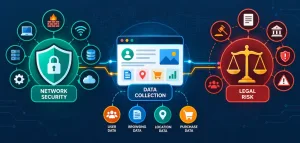
In 2026, cybercriminals launched over 2.8 billion attacks worldwide, according to the IBM Cost of a Data Breach Report, underscoring the relentless assault on digital infrastructure. This surge highlights the urgency for businesses and individuals to recognize and counter common cyber threats. As an expert in cybersecurity, drawing from reports by Verizon, CrowdStrike, and the FBI, this article dissects the most prevalent dangers, their evolution, and practical defenses to safeguard your assets.
Phishing Attacks: The Deceptive Gateway to Breaches
Phishing remains the top vector for cyber intrusions, accounting for 36% of data breaches in 2026 per the Verizon Data Breach Investigations Report (DBIR). Attackers craft emails or messages mimicking trusted entities to trick users into revealing credentials or downloading malware.
Evolution from Basic Scams to Sophisticated Spear-Phishing
Originating in the 1990s with simple email hoaxes, phishing has evolved into targeted spear-phishing, where attackers personalize lures using social media data. A 2026 Proofpoint report noted a 161% rise in these attacks, often leveraging AI for convincing language.
Real-world example: The 2026 MGM Resorts breach began with a vishing call impersonating an IT helpdesk, costing the company $100 million in downtime.
Key Statistics and Expert Insights
- 82% of organizations faced phishing attempts in 2026/, per the SANS Institute.
“Phishing succeeds because it exploits human psychology, not just technology,” says Kevin Mitnick, renowned security consultant and author.
To counter this, verify sender authenticity and use email filters. For deeper protection, explore implementing multi-layered authentication.
Ransomware: Extortion Through Encryption
Ransomware encrypts files and demands payment, with attacks doubling to 66% of organizations in 2026, according to Sophos’ State of Ransomware report. Victims lost an average of $1.54 million per incident, per IBM.
Historical Rise and Modern Tactics
From the 1989 AIDS Trojan to today’s double-extortion schemes—stealing data before encrypting—ransomware has shifted to service models like Ransomware-as-a-Service (RaaS). The 2026 Clop gang exploited MOVEit software flaws, affecting millions.
Expert perspective: “Ransomware operators now operate like corporations, with affiliates and customer support,” notes Trend Micro’s David Sancho.
Impact and Case Studies
The Colonial Pipeline attack in 2021 echoed in 2026’s healthcare hits, like the Change Healthcare breach disrupting U.S. prescriptions. Pros of paying ransoms include quick recovery, but cons involve funding crime and no decryption guarantee—FBI advises against it.
Practical tip: Maintain offline backups and segment networks to limit spread.
Data Breaches: Exposing Sensitive Information
Data breaches exposed 5.1 billion records in 2026, per Surfshark’s analysis, driven by vulnerabilities in cloud storage and weak access controls. Financial services saw 24% of incidents, per Verizon DBIR.
Types and Common Causes
Breaches stem from external hacks (43%), errors (19%), or insiders (12%). The 2023 23andMe incident leaked 6.9 million users’ DNA data via credential stuffing.
- Cost averaged $4.45 million, up 15% from prior years (IBM).
“Breaches erode trust; prevention demands zero-trust architectures,” advises NIST’s cybersecurity framework lead, Matthew Scholl.
Comparing Breaches to Other Threats
| Threat Type | Average Cost | Frequency |
|---|---|---|
| Data Breach | $4.45M | High |
| Ransomware | $1.54M | Medium |
| Phishing | $4.91M | Very High |
Unlike ransomware’s immediate disruption, breaches cause long-term reputational damage. Link this to broader cybersecurity hygiene practices for prevention.
DDoS Attacks: Flooding Networks to Disrupt
Distributed Denial of Service (DDoS) attacks surged 200% in 2026, per Cloudflare’s DDoS Threat Report, overwhelming servers with traffic to cause outages. Gaming and e-commerce sectors bore 30% of hits.
From Early Floods to Amplified Threats
Evolving from 1990s IRC floods, modern DDoS uses botnets like Mirai, amplified by IoT devices. The 2026 OVHcloud attack peaked at 840 million packets per second.
“DDoS is the great equalizer for cybercriminals, requiring minimal skill for maximum chaos,” states Akamai’s John Summers.
Mitigation Through Layered Defenses
- Deploy traffic scrubbing services.
- Monitor anomalies with AI tools.
- Test incident response plans quarterly.
These attacks differ from breaches by focusing on availability, not confidentiality.
Supply Chain Attacks: Compromising Trusted Vendors
Supply chain vulnerabilities fueled 20% of 2026 breaches, per Microsoft’s Digital Defense Report, targeting third-party software like SolarWinds in 2020, but persisting in Log4j exploits.
Historical Context and Recent Examples
From Stuxnet’s 2010 disruption of Iran’s nuclear program, these attacks now hit software updates. The 2026 3CX breach via malicious installers affected thousands.
- 61% of organizations faced supply chain risks (Ponemon Institute).
Perspectives vary: Vendors argue for shared responsibility models, while enterprises push for rigorous vetting.
Pros and Cons of Vendor Ecosystems
Pros include innovation and cost-sharing; cons expose single points of failure. Conduct regular audits and use secure development practices.
Emerging Cyber Threats and Future Predictions
As of April 2026, AI-enhanced threats like deepfake phishing rise, with Gartner predicting 75% of attacks will use AI by 2025. Quantum computing looms, potentially breaking encryption.
Trends from 2026 to Beyond
2026 saw a 30% uptick in AI-driven malware, per CrowdStrike’s 2024 Global Threat Report. Experts like Bruce Schneier warn of “deepfakes eroding trust in communications.”
Real-world shift: Nation-state actors increasingly blend cyber with geopolitics, as in Russia’s 2026 Ukraine operations.
Actionable Steps for Adaptation
Invest in AI defenses and quantum-resistant algorithms. Compare to traditional threats: Emerging ones demand proactive, adaptive strategies over reactive fixes.
Historical evolution shows threats growing in sophistication, from script kiddies to state-sponsored ops, emphasizing continuous education.
Building Resilience Against Common Cyber Threats
To combat these dangers, adopt a defense-in-depth approach. Train employees via simulations—reducing phishing success by 70%, per KnowBe4.
Practical Guides and Best Practices
Step 1: Assess vulnerabilities with tools like Nessus.
Step 2: Implement endpoint detection and response (EDR).
Step 3: Develop incident response playbooks, tested annually.
For AI integration in threats, review fundamentals of emerging tech to stay ahead.
Insider threats, often overlooked, caused 20% of breaches; foster a culture of reporting anomalies.
In summary, common cyber threats in 2026—from phishing to supply chain exploits—reveal the need for vigilance. Key takeaways: Prioritize user training, multi-factor authentication, and regular audits. Start by auditing your systems today and consult experts to fortify defenses, ensuring long-term security in an interconnected world.