There’s a particular kind of exhaustion that independent fashion designers know well, and it sets in around the time a new collection is ready. The garments exist. The ideas are fully realized in fabric and construction. And then the second job begins: the shoot. Finding and booking a photographer, casting models, sourcing a location, arranging hair and makeup, coordinating scheduling across multiple people with conflicting availabilities, then going through rounds of editing before any of it is actually usable. All of this before a single image has reached a potential stockist or customer.
For designers at established labels, this machinery runs in the background, managed by other people. For independent designers — which is the vast majority of working fashion designers — it’s all yours to organize, all yours to fund, and all yours to navigate while simultaneously trying to run every other part of your business. The shoot is not an afterthought in fashion; it’s a primary deliverable, a non-negotiable part of how a collection reaches the world. And it is relentlessly demanding.
The conversation about what AI video generation can offer fashion has started to gain real traction, and it’s more nuanced than either the enthusiastic or the skeptical takes tend to acknowledge.
What a Lookbook Is Actually Doing
Before getting into how tools change the equation, it’s worth being precise about what a fashion lookbook is for. A lookbook isn’t documentation — it isn’t trying to show a garment the way a technical flat does, with precise proportions and construction details visible. It’s trying to create a world. It presents clothing within a visual language, an atmosphere, a sense of how the wearer’s life might look and feel. The most effective fashion imagery isn’t really about the clothes at all — it’s about a proposition about identity and desire that the clothes happen to be part of.
That’s why the quality of a lookbook has such outsized impact on how a collection is received. The same garment can look like a considered piece of contemporary fashion or like something from a bargain catalogue, and the difference often has less to do with the garment itself than with the visual context it’s placed in. Buyers, press, and customers are all making rapid assessments based on visual presentation, and those assessments happen before anyone has touched the fabric or understood the construction.
The Shift That AI Video Makes Possible
Video lookbooks — short cinematic clips that show clothing in motion, in atmospheric environments, with the kind of visual language that used to require a significant production — are increasingly where the fashion conversation is happening. Movement matters in fashion in a way that still photography has always struggled to fully capture: how a hem falls when someone walks, how a fabric moves with the body, the way a silhouette reads in three dimensions and real time rather than frozen in a single frame.
Producing video lookbook content has historically been even more resource-intensive than still photography. Add a videographer to the photographer, add lighting that works for video, add the complexity of directing motion rather than a held pose, add the editing time. For independent designers, the barrier has been high enough that many simply don’t attempt it.
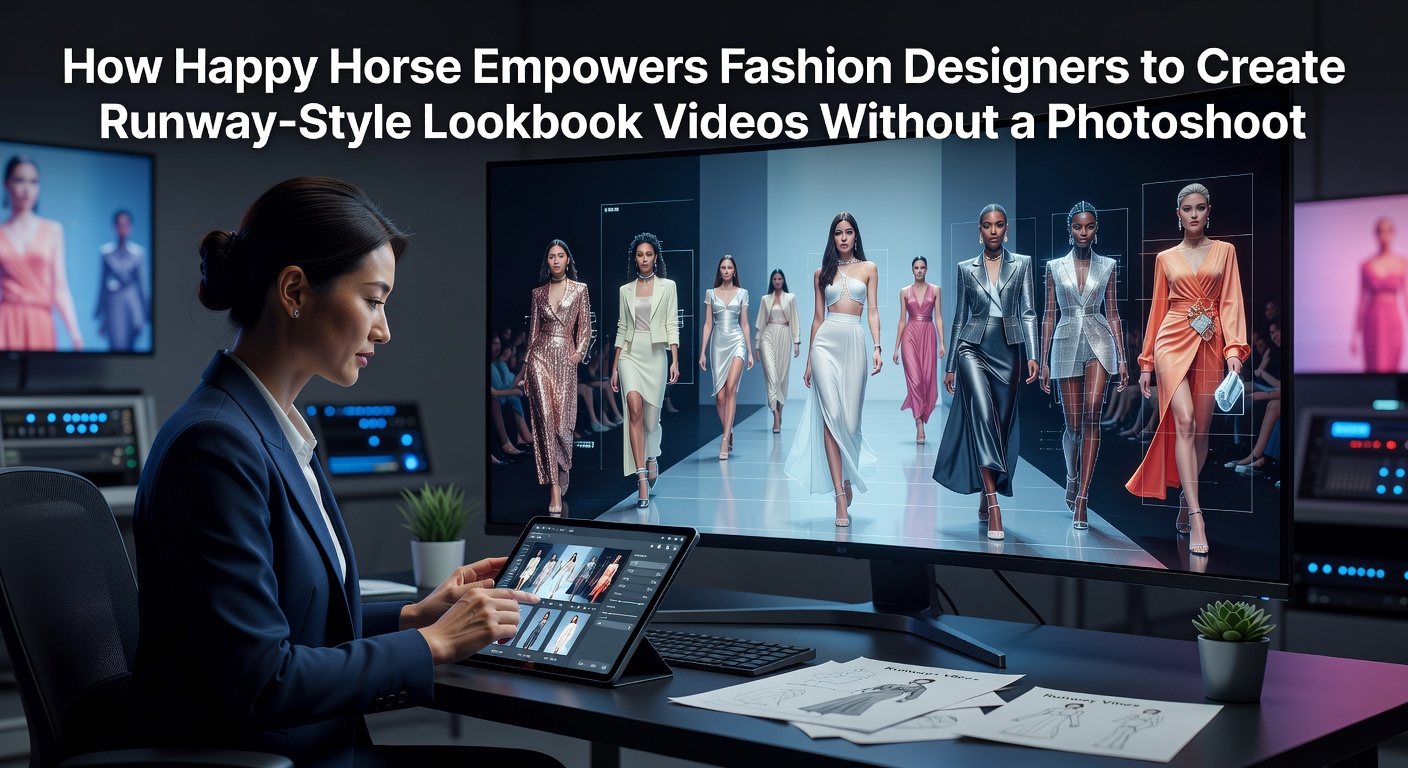
This is where the combination of visual quality and creative flexibility that Happy Horse offers starts to matter. Generating footage that places clothing — or a visual interpretation of a collection’s aesthetic — in environments that match the world the designer is building, with movement that reads as natural and light that suits the garment’s character, compresses what has historically been a multi-day production into a workflow that a designer can manage in far less time and at far lower cost.
Concept Development Before the Shoot
One application that doesn’t get enough attention is using AI-generated video as a concept development tool before a real shoot happens at all. The process of communicating a visual direction to a photographer, a stylist, and a model involves a significant amount of imprecision — mood boards and reference imagery convey direction, but they leave room for substantial misalignment between what the designer intended and what everyone else understood.
Generating a rough video impression of the collection’s intended visual world — the quality of light, the environmental mood, the movement language — gives a production team a much more specific brief to work from. It reduces the interpretive gap between creative intention and execution, which tends to reduce the number of reshoots and revision cycles that follow when that gap isn’t closed in advance.
Used this way, AI generation is not replacing the shoot — it’s improving it by making the creative direction more concrete before anyone shows up on set.
Small Labels and the Portfolio Problem
For emerging designers and small labels, there’s a particular dimension of this that connects to long-term brand building. Establishing a visual identity — a consistent aesthetic language that makes your brand recognizable across collections and seasons — requires producing content consistently. A label that puts out strong visual content around every collection builds a coherent visual history over time; one that only produces content when it can afford a proper shoot ends up with an inconsistent archive that makes it harder to communicate what the brand actually stands for.
AI-generated video makes consistent content production more achievable for small labels on realistic budgets. The ability to produce atmospheric, visually cohesive content around each collection — to maintain the rhythm of a brand’s visual presence even in seasons where the shoot budget isn’t there — has real value for the long-term legibility of a label’s identity.
The Limitations Are Real and Worth Naming
Fashion is a discipline where physical reality matters enormously, and it’s important to be honest about where AI generation runs into the limits of that. The drape of a specific fabric, the precise construction of a collar, the way a particular material catches light — these are the details that distinguish craft from approximation, and they are genuinely hard to render with complete accuracy in generated footage.
For the purposes of selling to buyers or communicating with press who will be making decisions based on what they see, real product imagery remains essential. A buyer ordering for a retail account needs to see the actual garment. A journalist writing about a collection needs images they can accurately represent. AI-generated atmospheric content doesn’t serve those functions, and a designer who presents generated footage as a substitute for real product imagery will create problems for themselves.
The appropriate use, as in most of these categories, is complementary. Real product photography handles the documentary function. Generated video handles the atmospheric and identity work — the content that creates emotional context and builds the brand world within which the product photography sits.
The Visual Language of the Season
Fashion operates on a seasonal rhythm, and each season is an opportunity to evolve or reinforce a brand’s visual language. AI-generated content can be a meaningful tool in that seasonal storytelling — not just for the collection itself but for the broader content that surrounds it. The editorial content, the behind-the-scenes atmosphere, the visual material that populates a brand’s social presence between formal campaign releases.
For a small label trying to maintain a living, breathing visual identity across social media throughout a season, that capability is not a marginal advantage. It’s the difference between a brand that feels active and engaged and one that goes quiet between shoots because there’s nothing polished enough to post.
Fashion has always been about constructing a world as much as making clothes. The tools available for building that world just got meaningfully more accessible.