The European Union’s Corporate Sustainability Reporting Directive (CSRD) marks a watershed moment for businesses operating in or around Europe. This sweeping legislation transforms sustainability reporting from a voluntary, discretionary practice into a legally mandated requirement with real consequences for non-compliance.
For thousands of companies already scrambling to understand the requirements, the challenge is both immediate and complex. The directive doesn’t just ask for better environmental reporting. It demands comprehensive disclosure across environmental, social, and governance factors, audited by third parties, and integrated with financial reporting. The stakes are high, timelines are tight, and the technical requirements are substantial.
Key Takeaways
- CSRD applies to approximately 50,000 companies across EU member states and globally, with phased implementation beginning in 2024 and expanding through 2029
- First compliance reports were due in 2025 for large EU companies already subject to the Non-Financial Reporting Directive, with broad expansion to other large companies in 2026
- Double materiality assessment is foundational: companies must evaluate both financial risks from ESG factors and their operational impacts on society and the environment
- Data collection represents the biggest implementation challenge, requiring organizations to establish new systems and processes across multiple business units and value chains
- Penalties for non-compliance vary by EU member state but include substantial fines, restrictions from public procurement, and reputational damage
- Dedicated CSRD platforms have emerged to automate compliance workflows and reduce implementation timelines from years to months
Understanding CSRD’s Scope and Timeline
CSRD fundamentally expands who must report and what they must disclose. The original Non-Financial Reporting Directive affected roughly 11,000 large companies. CSRD extends requirements to approximately 50,000 organizations across the EU and beyond.
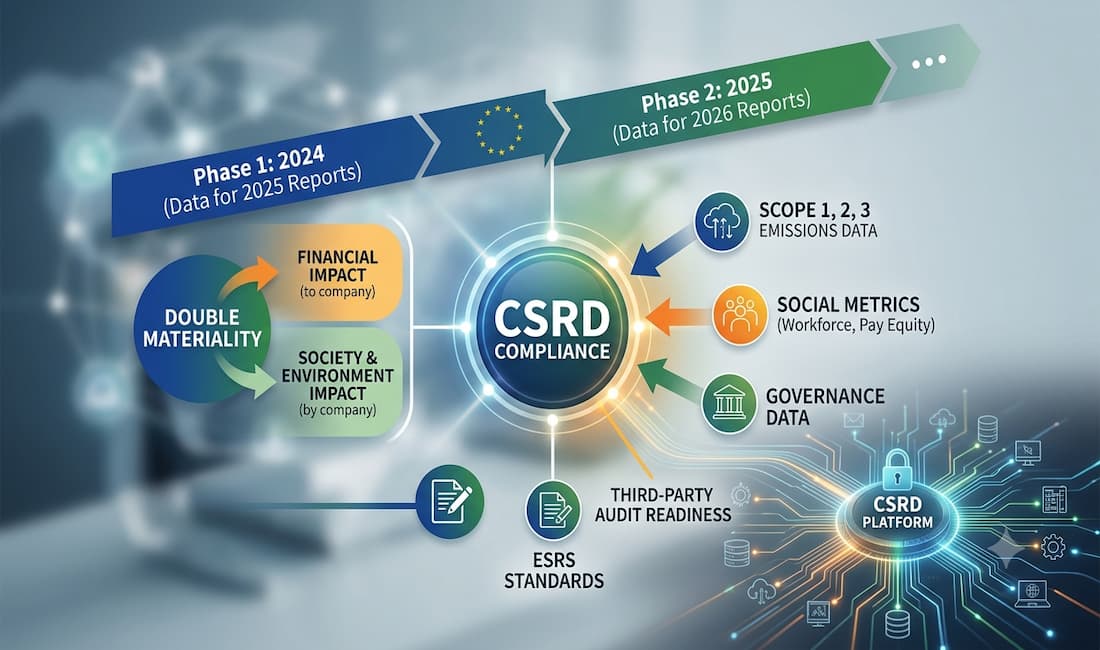
The phased rollout begins with large public-interest companies. These organizations, already subject to the older NFRD with over 500 employees, began reporting on fiscal year 2024 data for publication in 2025. This wave includes major listed companies that investors and stakeholders watch closely.
All other large EU companies come into scope next. Starting January 1, 2025, companies exceeding size thresholds (more than 250 employees, €40 million in turnover, or €20 million in total assets) must comply. They report on 2025 fiscal year data in 2026. Listed SMEs begin reporting in 2027, with an optional delay to 2028 available.
Non-EU companies with significant EU business face the largest surprise. Starting January 1, 2028, they must report on their EU turnover and operations. This captures thousands of North American, Asian, and other international enterprises that previously considered CSRD irrelevant to their operations.
The compressed timelines amplify urgency. Companies entering scope in 2025 had less than a year to prepare after the directive’s adoption. First-time reporters discovered they needed data collection infrastructure, materiality assessment processes, and third-party audit relationships immediately.
The Double Materiality Foundation
CSRD introduces “double materiality,” a concept that fundamentally shifts how companies assess what to report. This dual perspective requires evaluating sustainability topics from two angles.
Financial materiality asks: How do ESG factors affect my company’s financial performance? Climate risks disrupting supply chains, labor shortages affecting talent acquisition costs, or governance failures creating litigation exposure all represent financial materiality.
Impact materiality examines the inverse: How does my company affect the broader environment and society? Manufacturing carbon emissions affect climate change. Labor practices impact worker wellbeing. Product safety affects consumers. These impacts matter regardless of whether they create direct financial risks for the company.
Under the old NFRD, companies could explain away materiality assessments. CSRD eliminates this flexibility. Any topic material under either financial or impact assessment requires comprehensive disclosure. This principle alone expands reporting scope dramatically for many organizations.
Conducting a rigorous double materiality assessment requires engagement with stakeholders, investors, employees, and communities. Companies must solicit perspectives, analyze how different groups perceive material topics, and document their reasoning. The assessment becomes a foundational strategic exercise, not a compliance checkbox.
Once materiality is determined, it shapes all subsequent data collection. Immaterial topics require no reporting. Material topics demand comprehensive metrics, targets, and trend analysis.
The Data Collection Challenge
Where CSRD planning meets reality, data collection becomes the critical bottleneck. Most organizations underestimate this challenge severely.
Companies must collect data across Scope 1 (direct) emissions, Scope 2 (purchased energy) emissions, and Scope 3 (value chain) emissions using the Greenhouse Gas Protocol methodology. But emissions are only the beginning. CSRD requires environmental data on water usage, waste generation, and biodiversity impacts. Social metrics cover workforce composition, pay equity, health and safety incidents, and training hours. Governance disclosures address board composition, business conduct policies, and anti-corruption measures.
Scope 3 emissions prove particularly challenging because they depend on supplier data. A manufacturing company cannot calculate its value chain carbon footprint without cooperation from hundreds of suppliers. Requesting, validating, and consolidating this data across decentralized organizations takes months.
Data quality standards are uncompromising. Unlike voluntary ESG reports that tolerate estimates and caveats, CSRD reports undergo third-party audit. Every metric must be defensible. Documentation trails prove how calculations occurred. Methodologies must align with recognized standards. The audit readiness requirement forces rigor that many organizations aren’t prepared for.
Geography adds complexity. Different EU member states have translated CSRD into national regulations with minor variations. A multinational operating across multiple countries faces slightly different requirements in each jurisdiction. Harmonizing data collection across these variations while maintaining consistency tests organizational coordination.
Understanding CSRD Reporting Requirements
The actual reporting obligations extend beyond emissions numbers. CSRD mandates disclosure using the European Sustainability Reporting Standards (ESRS). These standards define over 1,140 data points structured across 12 standards covering environmental, social, and governance topics.
Of these data points, 161 are mandatory regardless of materiality assessment. Every in-scope company must disclose these baseline metrics. The remaining 622 data points apply conditionally based on materiality findings. If you determine climate change is immaterial to your business, you might not disclose detailed climate metrics. But if it’s material, comprehensive disclosure follows.
The standards organize reporting around four pillars applied consistently: governance of ESG topics, strategy relating to sustainability, impact and risk management processes, and metrics and targets. This architecture ensures comparability across companies and industries.
Double materiality assessment results must be disclosed visibly in reports. Companies essentially must show their work, explaining which topics scored as material through which evaluation processes. Investors, regulators, and auditors then assess whether those materiality determinations were sound.
This level of transparency was unheard of in voluntary ESG reporting. CSRD moves sustainability disclosure into financial reporting territory where precision and audit readiness define the game.
Building Compliance Infrastructure
Successful organizations don’t try to bolt CSRD compliance onto existing processes. They rebuild data collection architecture specifically to support CSRD requirements.
Starting with materiality assessment, companies work with internal teams and external stakeholders to identify which sustainability topics matter most. This assessment shapes the scope of data collection. A financial services company might prioritize governance and social metrics over environmental data. A manufacturer might invert that priority.
Next comes system inventory. Where does current sustainability data live? HR systems track workforce metrics. Environmental management systems log energy consumption and emissions. Finance tracks spending across supply chains. Accounting systems capture asset depreciation and capital flows. Rarely do these systems communicate with each other.
Organizations need to decide: build custom integration connecting all systems, or implement a purpose-built CSRD platform that pulls data from existing systems? The integration question determines project timeline and cost.
Data validation processes are equally critical. Before reporting any figure, someone verifies it’s accurate. This validation workflow might require stakeholders from multiple departments to approve data before it reaches the reporting function.
Role clarity prevents delays. Someone owns emissions reporting. Someone owns social data. Someone reconciles supply chain data with procurement systems. Without explicit ownership, responsibility diffuses and deadlines slip.
Leveraging Platforms for Efficient Compliance
Given the complexity and scale of CSRD compliance, organizations increasingly turn to dedicated platforms rather than attempting custom solutions.
Sweep, a leading carbon accounting and ESG reporting platform, exemplifies how modern software simplifies what could otherwise become an organizational nightmare. Sweep centralizes ESG data collection across organizations and value chains, eliminating spreadsheet chaos that characterizes many companies’ current approaches.
Platforms like Sweep provide pre-built CSRD workflows that guide users through each disclosure requirement. Rather than decoding 1,140 data points from standards documents, teams see exactly which metrics apply to their business, what calculation methodologies to use, and how data flows into final reports.
The platform automates data collection from business systems. Energy management systems feed consumption data directly. HR systems provide workforce metrics. Supplier management systems supply value chain emissions. This automation reduces the manual work that typically consumes 60-70% of compliance timelines.
AI-driven validation helps identify errors and inconsistencies before they reach external auditors. Duplicate entries get flagged. Missing data gets highlighted. Outliers that suggest calculation errors get reviewed automatically rather than through manual spreadsheet audits.
Audit trails built into the platform create defensibility. Every data entry, every calculation, every change gets documented with timestamps and user information. When auditors ask how a specific number was derived, the system provides a complete trail from source data through final reporting.
This combination of workflow automation, system integration, and audit readiness transforms CSRD compliance from a multi-year ordeal into a more manageable implementation that major companies complete in 6-12 months rather than 24-36 months. Organizations ready to streamline their compliance process can explore solutions like those offered through CSRD reporting platforms that handle the full disclosure workflow end-to-end.
Preparing for Regulatory Scrutiny
CSRD isn’t theoretical compliance theater. Regulators actively monitor reports submitted to the European Single Access Point (ESAP), the centralized portal where companies publish sustainability disclosures. Competent authorities in each EU member state have authority to investigate reports that appear problematic or inconsistent.
Penalties for non-compliance vary by member state but span a severe range. German companies face fines up to 10 million euros or 5% of annual turnover. French companies face potential judicial proceedings if stakeholders demand disclosure and companies refuse. Some member states restrict access to public procurement opportunities for non-compliant organizations.
Beyond financial penalties, reputational damage compounds the cost. Investors increasingly screen for CSRD compliance quality. Incomplete or inaccurate reporting damages relationships with stakeholders who rely on sustainability disclosures for investment decisions.
These pressures explain why organizations approach CSRD as a strategic initiative rather than a back-office compliance task. Executive sponsorship, cross-functional teams, and substantial resource allocation have become standard practice among sophisticated organizations.
Maintaining Compliance Standards
Organizations that successfully navigate initial CSRD compliance face an ongoing challenge: maintaining it as standards evolve and reporting requirements expand.
The ESRS framework continues developing sector-specific standards beyond the current set of general and topic-specific standards. Financial services, energy, and other heavily regulated sectors will face additional disclosure requirements in coming years. New standards emerge regularly, requiring updated data collection processes and system configurations.
Additionally, regulatory authorities provide interpretive guidance through EFRAG (European Financial Reporting Advisory Group) technical advice. These interpretations refine what “acceptable” disclosure looks like, often after the fact. Organizations need to stay current with these evolving standards to ensure their disclosures remain audit-ready.
Many CSRD platforms like Sweep stay current with regulatory updates automatically, so users don’t need to manually track every standards change. The platform updates workflows, calculation methodologies, and reporting templates as standards evolve, reducing ongoing compliance burden significantly.
Understanding CSRD compliance requirements is foundational. But implementing them successfully requires strategic thinking about governance, process design, and technology enablement. Organizations starting early, investing in the right infrastructure, and building compliance expertise into their operations position themselves to meet deadlines confidently rather than scrambling in final months before reports are due.
The strategic approach also recognizes that compliance doesn’t end with report submission. Sustainability performance improvement and emissions reduction become ongoing priorities, fed by the data collection rigor that CSRD requires. Organizations that view CSRD as a foundation for sustainability strategy rather than a pure compliance burden extract more value from the investment.
FAQ
Q: Does my company need to comply with CSRD?
A: If you’re an EU company with more than 250 employees, €40 million in turnover, or €20 million in total assets, compliance is likely required or coming soon. Non-EU companies with significant EU business may also be in scope from 2028. Consult with legal counsel to determine your specific status and timeline.
Q: What happens if we don’t comply on time?
A: Penalties vary by EU member state but typically include financial fines (ranging from thousands to millions of euros), exclusion from public procurement opportunities, and regulatory investigation. Additionally, non-compliance damages credibility with investors and business partners who rely on sustainability disclosures.
Q: Can we use existing ESG reports for CSRD?
A: Partially. If you already report under GRI or other frameworks, that work provides a foundation. However, CSRD has specific requirements that differ from voluntary frameworks, particularly around double materiality assessment and ESRS compliance. Most organizations need to supplement existing reports significantly rather than simply repackaging them.
Q: How much does CSRD compliance cost?
A: Costs vary dramatically based on company size, complexity, and current ESG maturity. Small organizations might spend $200,000-$500,000 on implementation including software, consulting, and internal resources. Large multinational organizations can spend $1-$5 million or more. Ongoing annual compliance costs are typically 30-50% of implementation costs.
Q: What’s the biggest mistake companies make with CSRD?
A: Underestimating the data collection challenge. Most organizations assume compliance is 70% reporting and 30% data gathering. In reality, it’s often inverted. Companies that don’t invest heavily in data infrastructure, system integration, and governance early face severe delays and audit issues later.
Q: Do we need to hire external consultants?
A: Not necessarily, but external expertise accelerates timelines and improves quality. Consultants bring benchmarking insights, identify risks early, and guide organizations through complex materiality assessments. Many companies hire consultants for the initial assessment and implementation, then build internal capability for ongoing compliance.
Q: When do we need to publish our first report?
A: Depending on your company type and status, first reports are already due (2025) or approaching (2026-2029). Wave one companies published in 2025. If you haven’t started, immediate action is essential to avoid delays and gaps in your disclosures.
Q: Can compliance standards and frameworks help us?
A: Yes. Understanding frameworks like the GRI Standards, the Greenhouse Gas Protocol, and double materiality concepts established through compliance standards and governance practices helps you design audit-ready disclosures that withstand regulatory scrutiny.
Q: How does double materiality differ from traditional materiality?
A: Traditional materiality asks: “Is this financially important to us?” Double materiality adds: “Is this important to our stakeholders and to society regardless of financial impact?” This dual lens expands reportable topics significantly and requires more sophisticated stakeholder engagement.
Q: Should we invest in CSRD software or build custom solutions?
A: Software solutions designed for CSRD typically deliver faster implementation, better audit readiness, and lower total cost of ownership than custom builds. Purpose-built platforms automate workflows, maintain audit trails, and update automatically as standards evolve. Most organizations benefit from platform-based approaches.