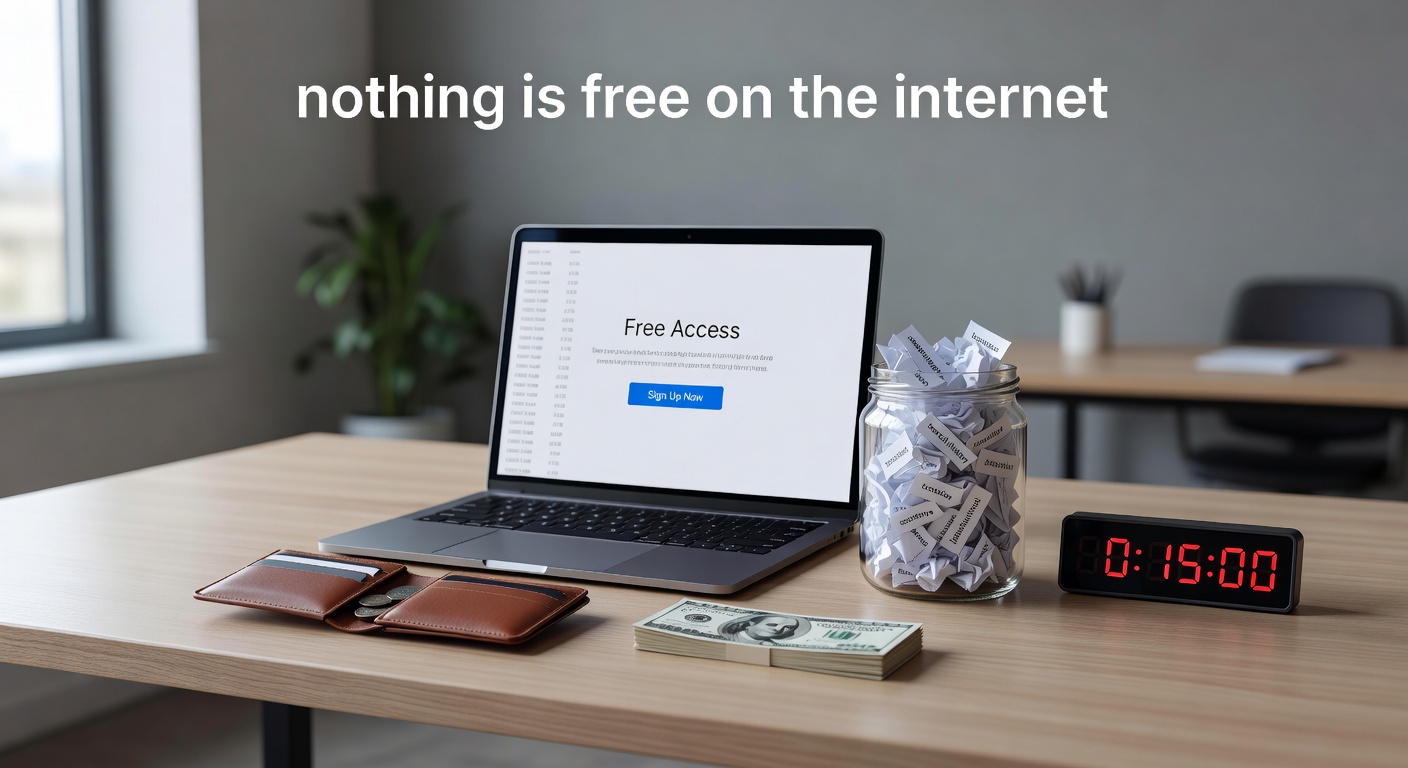
Users willingly handed over 4.9 billion personal records to data brokers in a single year, according to a 2023 report from the Federal Trade Commission, underscoring that nothing is free on the internet. Every click, like, and download extracts value—often your data, attention, or privacy—in exchange for so-called “free” services. This hidden economy powers trillion-dollar tech giants, proving nothing is free in the online world.
The Hidden Costs Behind “Free” Online Services
Free apps and websites lure billions of users daily, but they monetize through invisible tolls. Platforms like social media and search engines thrive on user data, which they package and sell to advertisers.
A 2026 Pew Research Center survey reveals 81% of Americans feel they have little control over data collected about them online. This data fuels targeted ads, generating over $600 billion in global digital ad revenue last year, per eMarketer estimates.
Your Data as the Ultimate Currency
Nothing is free on the internet because your personal information becomes the payment. Facebook, now Meta, collects over 500 data points per user, from location to browsing history, as detailed in their own privacy policy.
Experts like Shoshana Zuboff, author of The Age of Surveillance Capitalism, warn:
“Every move you make leaves a trace… Surveillance capitalism unilaterally claims human experience as free raw material for translation into behavioral data.”
This data powers algorithms that predict and influence your actions.
Attention Economy: Time Is Money
Beyond data, free platforms hijack your attention. Tristan Harris, co-founder of the Center for Humane Technology, estimates users spend 145 minutes daily on social media alone.
In the attention economy, nothing is free in the online world—your time translates to ad views. YouTube’s algorithm, for instance, keeps viewers hooked to maximize watch time, boosting revenue by 15% year-over-year, according to Alphabet’s financials.
Historical Evolution of the “Nothing Is Free” Internet Principle
The internet began as a free academic network in the 1960s via ARPANET, but commercialization in the 1990s changed everything. Netscape’s 1994 IPO marked the shift, proving eyeballs equaled dollars.
By the early 2000s, Google pioneered ad-supported search, cementing the model. Today, nothing is free on the internet as this freemium blueprint dominates—think Gmail’s free storage in exchange for scan-based ads launched in 2004.
From Dial-Up to Data Goldmines
The broadband era exploded data collection. A 2026 Statista report shows global data creation hit 181 zettabytes last year, with 90% from consumer activity.
This evolution highlights how nothing is free in the online world: early web promised liberation, but Big Tech turned it into a surveillance machine, as critiqued by Tim Berners-Lee, the web’s inventor.
Current State: Data Breaches and Privacy Erosion in 2026
As of May 2026, cybersecurity firm UpGuard reports over 5,000 data breaches exposed 15 billion records this year alone. Free services amplify risks—users trade privacy for convenience.
Nothing is free on the internet when breaches like the 2025 MOVEit attack compromised 60 million individuals, per security audits emphasizing proactive defenses.
Quantifying the Privacy Price Tag
- 92% of free apps request unnecessary permissions, per a 2026 Norton study.
- Dark web data sells for $1-10 per record, fueling identity theft costing $56 billion annually (Javelin Strategy).
- EU’s GDPR fines reached €2.9 billion since 2018, yet violations persist.
These stats prove nothing is free in the online world—your data’s value exceeds any “free” perk.
Real-World Examples: Case Studies of Online Hidden Costs
Consider TikTok: its “free” videos harvest biometric data via facial recognition, leading to a 2025 $92 million settlement in Illinois over privacy violations.
Another case: Free VPNs like Hola VPN sold bandwidth in 2015, turning users into proxies for cybercriminals. Learn more on avoiding IP risks with proxies.
Corporate Scandals Exposing the Truth
Cambridge Analytica’s 2018 scandal misused Facebook data from 87 million users, influencing elections. Fast-forward to 2026: AI-driven profiling in free tools like ChatGPT raises similar alarms.
| Service | “Free” Offering | Hidden Cost | Impact |
|---|---|---|---|
| Social networking | Data sales to advertisers | $100B+ annual revenue | |
| Google Search | Instant results | Personalized tracking | 2.5B users profiled |
| Free Email (Gmail) | Storage | Content scanning | Ad targeting precision |
| TikTok | Short videos | Biometric data | Lawsuits & bans |
These cases illustrate nothing is free on the internet—convenience comes at a steep, often unforeseen price.
Pros and Cons: Balancing Free Services with True Costs
Free online tools democratize access, but trade-offs abound. Pros include universal education via Khan Academy; cons involve pervasive surveillance.
Advantages of the Freemium Model
- Accessibility: 5.4 billion internet users benefit from low barriers.
- Innovation: Startups scale without upfront fees.
- Economy boost: Supports 10 million U.S. jobs in digital ads (IAB).
The Downsides and Ethical Dilemmas
Nothing is free in the online world when addiction algorithms exploit dopamine loops, as neuroscientist Anna Lembke notes in Dopamine Nation.
“Free platforms engineer addiction… costing society in mental health and productivity.”
AI in cybersecurity now combats these issues, but lags behind exploitation.
Expert Perspectives on Internet’s “No Free Lunch” Reality
Security expert Bruce Schneier states:
“There’s no such thing as a free lunch on the internet—someone always pays.”
He advocates zero-trust models.
EFF’s Cindy Cohn adds: “Users must demand transparency.” A 2026 Deloitte survey shows 68% of consumers would pay for privacy-focused alternatives.
Diverse Views from Industry Leaders
- Tim Cook (Apple): Pushes paid privacy via iCloud+.
- Sundar Pichai (Google): Defends data use for “better service.”
- Privacy advocates: Call for regulation like California’s CCPA.
Future Predictions: Emerging Trends in the Paid Internet Era
By 2030, Gartner predicts 40% of consumers will pay for ad-free, privacy-centric services. Web3 and decentralized tech challenge the “nothing is free on internet” status quo.
Trends include zero-knowledge proofs in browsers and blockchain-based data ownership. Yet, AI personalization may deepen data extraction.
Predictions and Protective Strategies
- Rise of paid tiers: Netflix model expands to social media.
- Regulatory waves: Global privacy laws like India’s DPDP Act.
- Tech shifts: End-to-end encryption standardizes.
Nothing is free in the online world, but empowered users can minimize costs through VPNs, ad-blockers, and data minimization.
Practical Steps to Navigate a World Where Nothing Is Free Online
Reclaim control with these actionable tips:
- Audit app permissions quarterly.
- Use privacy browsers like Brave or DuckDuckGo.
- Opt for paid services: ProtonMail over Gmail.
- Enable two-factor authentication everywhere.
- Review privacy policies—yes, read them.
For businesses, conduct regular security audits to protect against data exploitation.
Conclusion: Embrace the Truth and Protect Yourself
Nothing is free on the internet—your data, time, and privacy pay the bill. Awareness arms you against exploitation, from breaches to behavioral manipulation.
Key takeaways:
- Scrutinize “free” offers for hidden strings.
- Prioritize privacy tools and paid alternatives.
- Stay informed on regulations and tech shifts.
Act now: Delete unused apps, adjust settings, and consider premium privacy services. In a world where nothing is free in the online world, knowledge is your strongest currency.