For years, managing money meant living across a scatter of disconnected apps. A banking app for your salary and bills. A card provider for spending. A separate service for transfers. And if you held any cryptocurrency, that sat in yet another wallet entirely — walled off from the rest of your finances, with its own login and its own logic. Getting a clear picture of what you actually owned meant assembling it yourself, piece by piece.
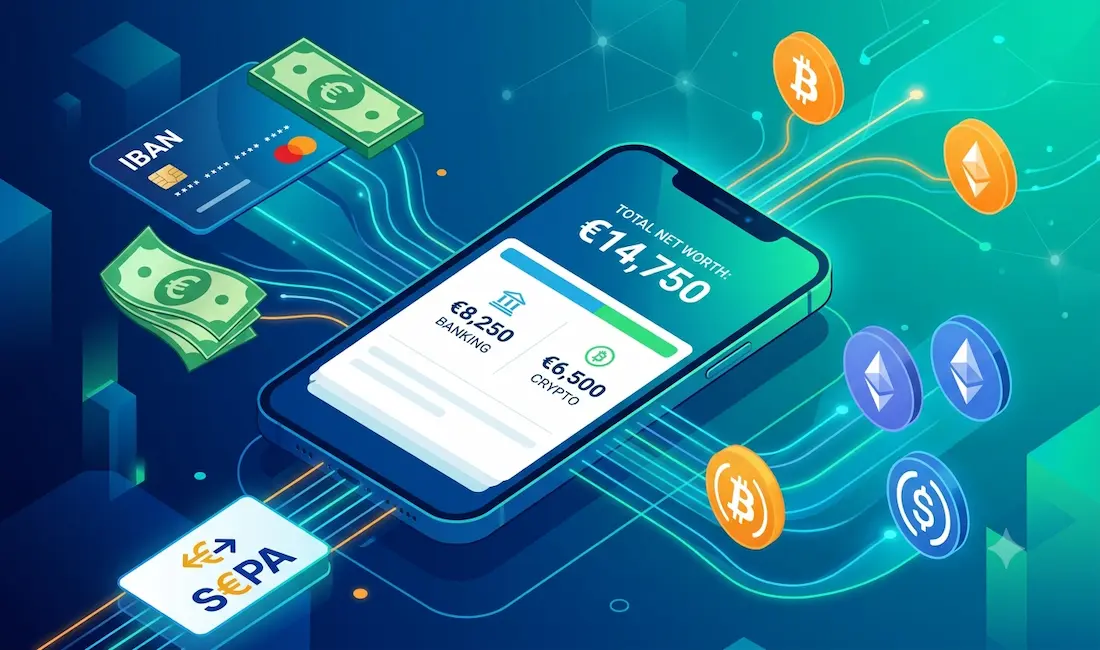
A newer generation of fintech platforms is collapsing those walls. The idea is straightforward: bring mobile banking, a dedicated IBAN account, payment cards, SEPA transfers, and a crypto wallet into a single app, so your euros and your digital assets live side by side in one place. This article explains how these all-in-one, multi-wallet platforms actually work, what’s genuinely useful about them, and — importantly — what you should verify before trusting any particular one with your money. Every general claim here is fact-checked against current EU regulation; the accompanying notes make clear what depends on the specific provider you choose.
What “All-in-One” Actually Means
At its core, an all-in-one financial platform combines two things that have traditionally been separate: regulated fiat banking services and crypto asset management. In practice that means a single app where you can hold and spend euros through an IBAN account and a card, move money via SEPA, and also buy, hold, and manage cryptocurrency — all from one dashboard.
The appeal isn’t just tidiness. When your banking, spending, and crypto share one interface, you get a genuine real-time overview of your whole financial position across every asset type, and you can move value between fiat and crypto without bouncing between platforms or waiting on transfers to clear between institutions. That unified view is the practical payoff.
It’s worth understanding early, though, that “one app” almost always means “one app sitting on top of several regulated services.” The fiat side and the crypto side are governed by different EU rules and often provided by different licensed entities working together behind a single interface. That’s not a flaw — it’s simply how the regulation is structured, and knowing it helps you ask the right questions.
The Foundation: A Real IBAN Account
The anchor of the fiat side is a dedicated IBAN — the International Bank Account Number that identifies your account within the European payment system. Your IBAN is what lets your employer pay your salary, what you give to receive money, and what powers the recurring payments that keep life running: rent, utilities, subscriptions, and direct debits.
An important nuance many people miss: not every app offering an “IBAN account” is a bank. In the EU, these accounts are frequently provided by licensed Electronic Money Institutions (EMIs) or Payment Institutions rather than full credit institutions (banks). This distinction matters, and it’s covered in the fact-check section below, because it affects how your money is protected. The functional experience — receiving salary, paying bills, managing direct debits from your phone — is broadly the same, but the legal protections behind the account can differ.
Cards and Digital Payments
A card connects your account to the real world — the checkout, the café, the online basket at midnight. All-in-one platforms typically offer physical and virtual cards that let you tap to pay in stores, check out online, and add the card to a mobile wallet. Virtual cards add a layer of security for online purchases by keeping your primary details out of the transaction.
Because the card lives in the same app as your balance, spending appears in real time — there’s no lag between paying and seeing it reflected, and you can freeze a lost card, adjust limits, or review activity in the moment. Some platforms also offer cards that can draw on a crypto balance by converting to euros at the point of sale, though whether this is available, and at what cost, varies by provider.
SEPA Transfers: Moving Euros Across Europe
For anyone living, working, or doing business across Europe, SEPA is what makes euro transfers simple. SEPA — the Single Euro Payments Area — lets you send euros to any account in the zone as easily as sending them domestically.
The technology here has genuinely advanced. SEPA Instant Credit Transfer (formally SCT Inst) settles end-to-end in under ten seconds, and operates 24 hours a day, 365 days a year — including weekends and holidays. This is now backed by EU law: the Instant Payments Regulation (Regulation (EU) 2024/886), adopted in 2024, makes instant euro payments a requirement for payment providers, with euro-area providers already obligated and others following on a defined timeline. The regulation also requires that instant payments cost customers no more than standard SEPA transfers — so speed doesn’t carry a premium. And since October 2025, a Verification of Payee check confirms that the IBAN you’re paying matches the name of the account holder, a safeguard against misdirected payments and a growing form of fraud. For a freelancer paying a supplier or a family splitting costs across borders, this means money that moves in seconds, at low cost, with a built-in check that it’s going to the right place.
The Crypto Side: A Multi-Wallet Approach
The forward-looking element is the integrated crypto wallet, and specifically the way it sits alongside your euros rather than apart from them. This is the “multi-wallet” concept: a single service holding multiple types of value — your euro balance and your crypto assets — within one coherent system.
For a long time, crypto lived in its own universe, requiring specialized platforms and separate credentials. Bringing it into the same app you use for everyday banking lowers the barrier considerably: you can view your crypto holdings on the same dashboard as your euros, track their value, and move between them without leaving the app. Someone curious about digital assets can explore from within a familiar interface, and someone already active in crypto gets a clearer, consolidated picture of their overall wealth. When you want to move between euros and digital assets, the platform’s built-in euro crypto exchange handles the conversion inside the same app, rather than sending you out to a separate service and back.
Crucially, the EU now has a dedicated legal framework for this side too: the Markets in Crypto-Assets Regulation (MiCA). Under MiCA, firms providing crypto services to EU customers — including custody and exchange between crypto and fiat — must be authorized as Crypto-Asset Service Providers (CASPs), meeting requirements on governance, IT security, disclosure, and the safeguarding of client assets. This is a meaningful development: it means a compliant platform’s crypto side operates under real, harmonized rules rather than in a grey zone.
The Multi-Wallet Advantage — and Its Trade-Off
The genuine benefit of the multi-wallet model is consolidation: one overview of your total position, fluid movement between asset types, and far less overhead from tracking scattered accounts and logins. Everything is visible and connected in one place.
But consolidation carries a trade-off worth naming honestly. Putting your banking, spending, and crypto with a single provider concentrates more of your financial life in one place — which maximizes convenience but also means more is exposed at once if that provider suffers an outage, a security incident, or an account freeze. This is the classic convenience-versus-resilience tension. It doesn’t make all-in-one platforms a bad choice; it simply means many people sensibly use them for everyday money and active balances while keeping long-term crypto holdings they don’t need instant access to in dedicated self-custody. Convenience where you want speed; separation where you want security.
Security and Regulation
Bringing so much value into one app makes security and regulatory standing paramount — and these are the things most worth checking, not assuming. A well-designed platform layers strong authentication, encryption, and real-time controls (like instant card freezing) over accounts that are themselves held with properly licensed and regulated entities. The convenience of unification should never come at the expense of the protections that come from proper licensing.
The reassuring development of the past few years is that the EU has built genuine regulatory scaffolding for exactly this kind of product: the Instant Payments Regulation for fast euro transfers, established EMI and Payment Institution rules for the banking side, and MiCA for crypto. A trustworthy all-in-one platform will operate transparently within all three.
Finance That Finally Fits How People Live
The move toward all-in-one platforms reflects a simple truth: the walls between banking, payments, and digital assets were artifacts of how these systems developed separately, not reflections of how people actually manage money. We don’t experience our salary, our daily spending, our cross-border transfers, and our crypto as neatly separate categories — they’re all part of one financial life.
Bringing them together into a single, well-regulated app is a more honest and useful vision of personal finance: connected, fast, and complete. The key, as with any financial decision, is to choose a provider that earns your trust — one that’s transparent about who holds your money, how it’s protected, and which licenses it operates under. Get that right, and managing euros and crypto from one place stops being a novelty and simply becomes the sensible way money works.
Regulatory facts are drawn from the EU Instant Payments Regulation (EU) 2024/886, the Markets in Crypto-Assets Regulation (MiCA), European Payments Council SCT Inst scheme rules, and EBA/ESMA guidance, current as of mid-2026. Rules and thresholds can change; verify current details before relying on them. This article is general information, not financial or legal advice.