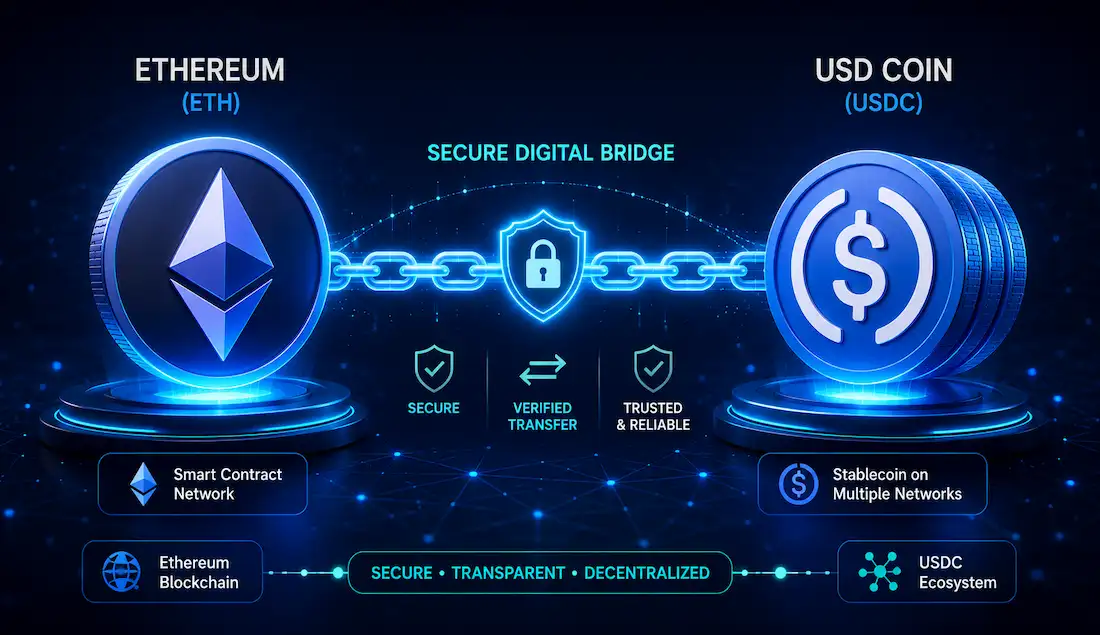
For many ETH holders, the biggest tax and opportunity-cost headache isn’t earning gains — it’s realizing them. Selling ETH to cover a bill, an investment, or an emergency triggers a taxable event and forfeits future upside. Crypto-backed lending solves this by letting you borrow against your ETH instead of selling it. You keep your position, get liquidity in stablecoins, and repay on your own terms.
Here’s how it actually works, and what to watch out for.
The Basic Mechanism
You deposit ETH as collateral into a smart contract or lending protocol. In return, the platform lets you draw a loan — typically in USDC — up to a percentage of your collateral’s value. Your ETH stays locked as security; you never technically “sell” it. When you repay the borrowed USDC (plus any interest owed), your ETH is released back to you.
This is fundamentally different from a traditional bank loan: there’s no credit check, no income verification, and approval is instant because the collateral itself is the underwriting.
Collateral Requirements and LTV
Crypto-backed loans are overcollateralized — you must lock up ETH worth more than you borrow. This buffer protects the lender (and the protocol) from ETH’s price volatility. Your loan-to-value (LTV) ratio is the loan amount divided by your collateral’s value, and it’s recalculated continuously as ETH’s price moves.
Across the market, ETH-backed borrowing limits commonly sit in the 65–83% LTV range depending on the platform, meaning you can typically borrow somewhere between roughly two-thirds and four-fifths of your ETH’s dollar value ETH collateral in the USDC market carries roughly 83% borrow collateral factor and 90% liquidation collateral factor. More conservative platforms cap borrowing lower to leave a wider safety margin before liquidation.
If ETH’s price drops and your LTV climbs toward the platform’s liquidation threshold, you’ll usually get a margin call or warning window to add more collateral or repay part of the loan before any forced liquidation occurs.
Interest Calculation
Interest on crypto-backed loans usually accrues only on the amount you’ve actually drawn, not on your full available credit line — so an unused credit line costs nothing. Rates vary widely by platform and model:
- DeFi lending protocols (like Aave or Compound) use variable rates that float with supply and demand, currently around 3%–4.3% APY for stablecoin borrowing.
- Some fixed-term lenders charge flat annual rates, ranging from roughly 9.99% to 11.49% APR on 12-month terms.
- Grace-period models charge zero interest if you repay within a set window, with interest only kicking in afterward or once you actually draw funds.
That last model is worth understanding closely if you expect to repay quickly — it can make short-term borrowing effectively free. For an example of a wallet-based platform structured this way, loan against crypto options like XQ Finance let ETH holders open a USDC credit line on Base where repaying within a 14-day grace period means paying 0% interest — interest only begins accruing if you carry a balance past that window.
Repayment Terms
Repayment flexibility is one of the bigger differences between platforms:
- Open-ended credit lines: draw and repay whenever you like, similar to a revolving line of credit, with interest calculated only on outstanding balances.
- Fixed-term loans: a set repayment date, sometimes with prepayment penalties, sometimes without.
- Grace-period loans: a short window (e.g., 14 days) to repay interest-free, after which normal interest terms apply.
Most platforms allow early repayment without penalty, since it reduces their risk exposure — but always confirm this before borrowing, since some CeFi-style lenders differ.
Blockchain Fees
Because these loans run on-chain, every draw, repayment, and collateral adjustment is a blockchain transaction — meaning gas fees. This is where network choice matters:
- On Ethereum mainnet, gas fees can be substantial during network congestion, sometimes eating meaningfully into smaller loans.
- On Layer-2 networks like Base, gas costs are a fraction of mainnet, which makes frequent draws and repayments far more practical — important if you’re using a credit line actively rather than as a one-time loan.
If you plan to draw and repay repeatedly (rather than take one lump-sum loan), the underlying network’s fee structure should factor into which platform you choose.
Key Risks
Crypto-backed lending isn’t risk-free, and understanding the failure modes matters as much as understanding the mechanics:
- Liquidation risk: If ETH’s price falls sharply and you don’t add collateral or repay in time, the platform can automatically sell your ETH to cover the loan — often at a loss and sometimes with a liquidation penalty on top Liquidation penalties range from 5%–10% depending on the asset.
- Smart contract risk: DeFi protocols run on code that could contain bugs or be exploited. Look for platforms with third-party audits and a track record.
- Custody risk: Some platforms are non-custodial (you retain wallet control via smart contracts); others require you to transfer ETH to a custodian. Know which model you’re using.
- Interest rate risk: Variable-rate loans can become more expensive if market rates rise while your loan is outstanding.
- Market risk generally: Borrowing against a volatile asset like ETH to spend or reinvest amplifies your overall exposure — a strategy that works in your favor in a rising market can work sharply against you in a falling one.
The Bottom Line
Borrowing stablecoins against ETH lets you access liquidity without giving up your position or triggering a taxable sale — but the mechanics matter. Pay attention to your LTV and liquidation threshold, understand exactly how and when interest accrues, factor in the blockchain network’s gas costs, and never borrow more than you’re comfortable seeing liquidated if ETH drops sharply. As with any leveraged position, the flexibility crypto-backed lending offers comes with real downside risk that’s worth weighing carefully before you draw funds.