AMD Ryzen 7 7700X3D Review: Strong Gaming Performance
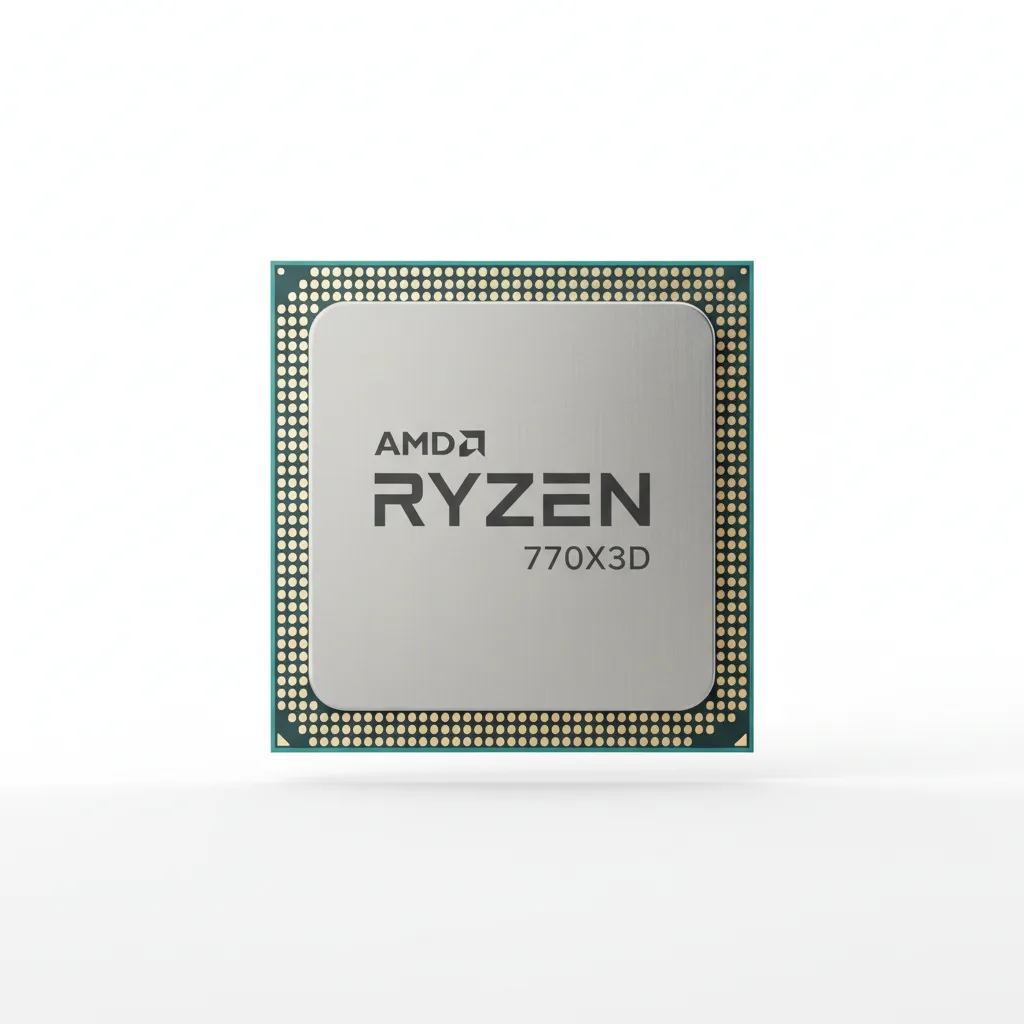
The AMD Ryzen 7 7700X3D is essentially a lower-clocked Ryzen 7 7800X3D sold for less money — same eight Zen 4 cores, same 96MB of L3 V-Cache stacked on top of the CCD, same 120W TDP, just 500MHz less on the maximum boost clock. Launched in July 2026 at $329, it arrives three years after the 7800X3D and targets gamers who want the proven cache advantage of AMD's X3D family at a lower entry point than newer Ryzen 9000-series X3D chips. The gaming performance is strong and efficiency is excellent, but the pricing is uncomfortably close to discounted 7800X3D and 9800X3D street prices, making the value proposition narrower than AMD likely intended.
Performance Analysis
The Ryzen 7 7700X3D’s defining characteristic is its large cache pool rather than its clock speeds. The processor uses the same single 8-core Zen 4 CCD with the same 96MB of 3D V-Cache stacked on top, and the same AM5 platform as the 7800X3D — the only difference is a firmware-locked maximum boost of 4,550 MHz, which sits 500 MHz below the 7800X3D’s fused limit of 5,050 MHz. In cache-sensitive gaming workloads, that clock difference matters less than the spec gap implies, because the V-Cache keeps frequently accessed game data close to the cores and reduces expensive trips to system memory.
AMD’s internal testing puts the 7700X3D ahead of the standard 7700X by approximately 9% across 30 games at 1080p and high settings, using an RTX 5090 and DDR5-6000 memory — these are manufacturer figures; real-world gains will vary with the graphics card, game, and resolution. That is a meaningful but not dramatic advantage. The non-X3D 7700X already offered strong gaming performance; the cache layer refines the 1% lows and frame-time consistency more than it transforms average frame rates.
Productivity workloads tell a different story entirely. The conventional Ryzen 7 7700X operates at a 4.5 GHz base clock with boost frequencies reaching 5.4 GHz, whereas the Ryzen 7 7700X3D drops to a 4.0 GHz base and 4.5 GHz maximum boost. Those missing megahertz cost the chip dearly in Cinebench, Blender rendering, video encoding, and compilation workloads that scale with frequency rather than cache size. Users who split time between gaming and content creation will feel this gap daily.
Power efficiency is a genuine standout. A full-load reading of 77W is exceptional, and the chip never came close to its 162W PPT limit even during Cinebench looping tests. This makes the 7700X3D an excellent choice for compact and noise-sensitive builds where a 360mm AIO is not practical.
Design and Build
The Ryzen 7 7700X3D uses the standard AM5 LGA1718 package and installs identically to any other Ryzen 7000 series chip. The integrated heat spreader sits slightly taller than non-X3D parts due to the stacked cache layer. Any cooler mounting solution rated for AM5 works without modification, though AMD recommends a 240-to-280mm liquid cooler or an equivalent high-performance air cooler, and lists an 89°C maximum junction temperature.
The stacked cache design imposes different thermal constraints from an ordinary Ryzen 7000 processor — heat generated by the cores must travel through the additional cache structure before reaching the integrated heat spreader. This is why X3D processors use tighter voltage and temperature management rather than pursuing the highest possible clocks. In practice, many users find the 7700X3D runs cooler during gaming than the standard 7700X because the lower boost ceiling demands less voltage.
Traditional multiplier overclocking is not supported, as with all X3D chips. PBO and Curve Optimizer remain available for frequency tuning, though aggressive PBO settings can conflict with the cache’s thermal requirements.
Software and Platform Experience
The 7700X3D requires a BIOS update on existing AM5 motherboards before installation. All 600-series and 800-series boards support the chip with a current firmware. AMD’s Ryzen Master utility provides monitoring and PBO control, and the Curve Optimizer allows per-core frequency offsets for users who want to tune the chip’s behaviour without enabling full manual overclocking.
AMD has publicly pledged to support the AM5 platform through 2029, making this socket a solid long-term investment for future CPU upgrades without a motherboard change.
Power Efficiency and Thermals
The 7700X3D has a 120W TDP and 162W maximum socket power (PPT) limit. A Cinebench looping test showed the 7700X3D not even getting close to that 162W limit. A full-load reading of 77W is exceptional. In gaming workloads specifically, the chip typically draws significantly less than its rated TDP, making it compatible with modest air coolers in mid-tower and smaller form factor builds.
Temperatures stay within comfortable ranges under most scenarios. Users running high-end 280mm AIOs will rarely see the chip thermally limited; a quality 120mm tower cooler is usually sufficient for gaming use.
Value for Money and Competition
At $329 MSRP, the 7700X3D’s value depends heavily on what it is being compared against. The 7800X3D launched in April 2023 for $450, and the 7700X3D arrives more than three years later in July 2026 for a suggested retail price of $330 — but the 7800X3D is now available at or below its original $450 MSRP, with some retailers listing it around $349. Tom’s Hardware concluded that a price cut to between $250 and $280 would make it far more competitive with Intel’s offerings as well as AMD’s other Zen 4 X3D chips.
Against the Intel Core Ultra 7 270K Plus — its direct current-generation rival at a comparable price — the 7700X3D wins clearly in gaming frame rates. However, the Intel chip delivers significantly higher multi-threaded throughput for professional productivity workloads such as video editing, 3D rendering, and compilation — reviewers at KitGuru and PCMag both noted the 7700X3D’s lackluster Cinebench and productivity scores relative to competing chips at this price. Users who need both strong gaming and heavy productivity output will find the Intel option more balanced.
Against the Ryzen 7 9800X3D, the 7700X3D loses in both gaming and productivity performance but costs considerably less at MSRP. The 9800X3D’s Zen 5 architecture and under-CCD cache placement give it higher clocks alongside the same large cache.
One important availability note: AMD restricted the initial US and Canada retail launch of the 7700X3D exclusively through Newegg. Buyers outside that retailer or in other regions should verify local availability before planning a build around this chip.
Verdict
The AMD Ryzen 7 7700X3D is a technically sound processor that arrives at an awkward moment. It delivers the cache-fed gaming smoothness that has defined every AMD X3D chip, it is extremely power efficient, and it fits on any AM5 board with a firmware update. For a gamer building a new system on a tight budget who specifically wants 3D V-Cache technology, the 7700X3D makes a reasonable case.
The problem is timing and pricing. Three years after the 7800X3D established the formula, AMD is selling a slower version of the same chip for only $30 less at MSRP. Street prices on the 7800X3D and discounted 9800X3D units undercut that argument further. The Ryzen 7 7700X3D offers 7800X3D-like gaming performance, just at a higher effective price — a price cut to between $250 and $280 would make it far more competitive.
Buy the 7700X3D if you find it meaningfully below $300 or if you are upgrading from an AM4 platform and want the cheapest path to X3D performance on AM5. Pass if budget 9800X3D units are available near the same price, or if you need strong productivity performance alongside gaming.
Check current price for AMD Ryzen 7 7700X3D on Newegg or Amazon.
Frequently Asked Questions
Is the AMD Ryzen 7 7700X3D worth buying in 2026?
What is the boost clock of the AMD Ryzen 7 7700X3D?
How does the Ryzen 7 7700X3D compare to the Ryzen 7 7800X3D?
What motherboard does the AMD Ryzen 7 7700X3D require?
Does the AMD Ryzen 7 7700X3D support overclocking?
+Pros
- Same 96MB L3 V-Cache and core configuration as the 7800X3D at a lower MSRP
- Exceptional power efficiency — real gaming power draw around 77W
- AM5 platform with PCIe 5.0 and long-term socket support
- Smooth frame-time consistency in cache-sensitive games
- Useful integrated graphics for build and troubleshooting scenarios
- Compatible with all AM5 600 and 800 series boards with a BIOS update
−Cons
- Base and boost clocks lower than every other 8-core AM5 chip — 4.0/4.5 GHz
- ~9% average gaming gain over the non-X3D 7700X is real but modest at this price
- Productivity performance significantly behind non-X3D Zen 4 and all Zen 5 chips
- $329 MSRP is difficult to justify when discounted 7800X3D and 9800X3D units compete closely
- First-generation V-Cache (on top of CCD) means tighter thermal and voltage limits
- No manual multiplier overclocking supported