BMW i4 M50 Review: Thrilling Electric Performance Sedan
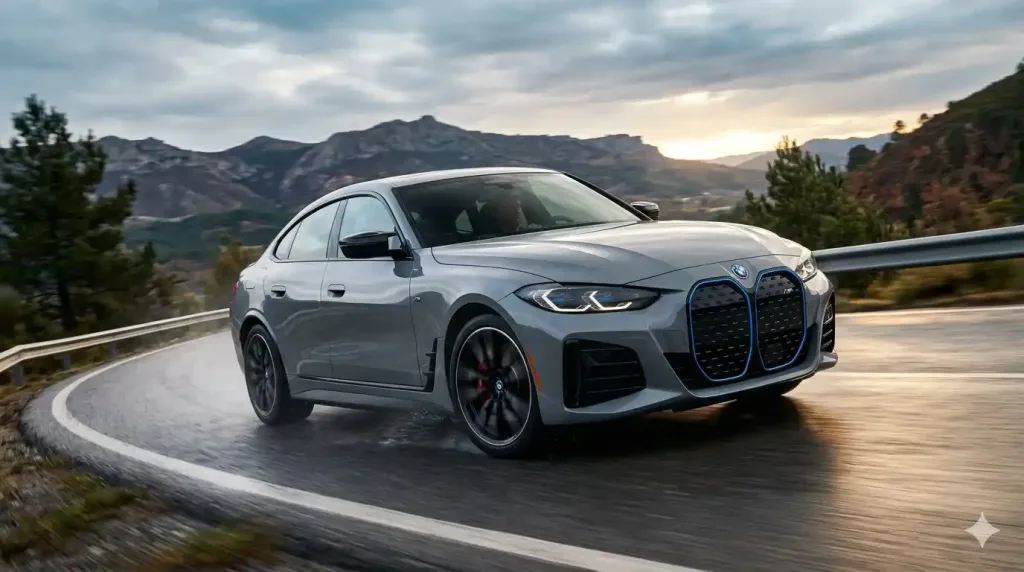
The BMW i4 M50 is a thrilling electric performance sedan that blends M-division driving dynamics with zero-emission power, making it a compelling choice for enthusiasts seeking sports car thrills without the gas-powered guilt. Its 3.7-second 0-60 time, 536 hp, adaptive suspension, and premium interior put it ahead of most EVs at its price point — though its 227-mile EPA range is the most significant compromise buyers must accept.
Model Year Note: This review covers the 2023 BMW i4 M50. For 2025, BMW updated the i4 M50 with a revised battery, improved range (up to 318 miles), and iDrive 8.5 refinements. For 2026, the M50 has been renamed the i4 M60 with 593 hp in Sport mode and a 3.6-second 0-60 time. Current pricing for the 2025 i4 M50 starts at $70,700. Buyers in 2026 should evaluate the updated M60 alongside any remaining 2023/2024 M50 inventory.
Overview
The 2023 BMW i4 M50 is BMW’s all-electric gran coupe, packing dual motors into a four-door fastback body that is as practical as it is performance-focused. Built on the same platform as the 4 Series Gran Coupe, it sits at the top of the i4 lineup — targeting performance buyers who want luxury, technology, and 500+ horsepower from an EV without the six-figure outlay of a Porsche Taycan.
The i4 M50 is not an EV that asks you to accept compromises in exchange for zero emissions. BMW has preserved the steering feel, chassis dynamics, and road connection that define the M badge, delivering them through an electric drivetrain that replaces nothing you valued and removes everything you did not: engine noise, turbo lag, gear hunting, and trips to the petrol station.
Check the official BMW i4 page for the latest configurator and current pricing on 2025 and 2026 models.
Technical Specifications (2023 BMW i4 M50)
| Specification | Detail |
|---|---|
| Battery Capacity | 83.9 kWh |
| Drivetrain | Dual Motor, All-Wheel Drive |
| Horsepower | 536 hp |
| Torque | 586 lb-ft |
| 0-60 mph | 3.7 seconds |
| EPA Range | 227 miles |
| DC Fast Charging | 195 kW peak |
| Charging (10-80%) | Approximately 31 minutes |
| Weight | 4,883 lbs |
| MSRP (2023) | $67,500 base |
| Best For | Urban professionals and weekend drivers who prioritize driving dynamics |
Key Features
Adaptive M Suspension with Predictive Road Scanning
The M suspension on the i4 M50 offers genuine dual-mode capability — Comfort mode absorbs road imperfections with a suppleness that belies the car’s 4,883-pound kerb weight, while Sport mode firms the dampers for precision handling without the teeth-rattling harshness of lesser implementations. The predictive element uses forward-facing cameras to read the road ahead and adjust damper settings before the wheel reaches the imperfection — a feature that makes 150-mile highway runs genuinely comfortable in a car that can lap a circuit.
Curved Display iDrive 8.5
The curved dual-screen setup merges a 12.3-inch digital gauge cluster with a 14.9-inch touchscreen into a single flowing panel. iDrive 8.5 is the most polished version of BMW’s infotainment system — responsive to touch and voice input, with clear menu logic that avoids the buried-settings frustration of older iDrive generations. Standard wireless Apple CarPlay and Android Auto are included. Physical controls remain for the most frequently used functions, including the iDrive rotary controller — a decision that significantly improves usability compared to all-touchscreen rivals.
Iconic Glow Kidney Grille
The i4 M50’s illuminated kidney grille pulses blue during regenerative braking — a functional styling detail that doubles as a visual indicator of energy recovery in progress. It elevates the premium feel over rivals that make no visual distinction between an EV and a conventional car.
Ultrafast 195 kW DC Charging
Peak DC fast charging at 195 kW means the i4 M50 can recover approximately 90 miles of range in around 10 minutes at a compatible DC fast charger. A full 10–80% charge takes approximately 31 minutes — competitive with the best EVs at this price point. AC home charging at 11 kW provides a full charge overnight from a home wall box.
Performance
Launch the i4 M50 in Sport Boost mode and the 586 lb-ft of instant torque delivers the kind of acceleration that recalibrates your expectations. BMW’s official 0-60 figure of 3.7 seconds — confirmed by third-party testing including Car and Driver benchmarks — is experienced as a continuous, drama-free surge rather than the stepped delivery of a turbocharged petrol engine. There is no lag, no gear shift interruption, no gradual spool-up. The power is simply there, immediately, in full.
At higher speeds and through corners, the i4 M50’s AWD system and low centre of gravity (battery floor mounting) provide exceptional stability. Body roll is well-controlled despite the car’s weight. The steering delivers genuine feedback rather than the numb isolation common in EVs — BMW has preserved the communicative quality that distinguishes M-branded products.
Regenerative braking paddles on the steering wheel allow one-pedal driving when set to maximum regeneration — useful in stop-start urban traffic and on downhill sections where the regen contributes to range recovery. The adjustment is available across four levels, allowing drivers to match the regen behaviour to their preference.
Real-world energy consumption in mixed driving averages approximately 25–30 kWh per 100 miles, yielding practical range between 190 and 215 miles under varied conditions. The 227-mile EPA figure is achievable in steady highway conditions.
Design and Build Quality
The i4 M50’s fastback silhouette is one of the more successfully resolved EV designs available — it avoids the styling compromises that plague EVs forced to accommodate aerodynamic requirements while maintaining the proportions of the 4 Series Gran Coupe it is based on. Wide arches, a low roofline, and M-specific front and rear bumpers reinforce the performance positioning visually.
The interior uses Vernasca leather as the standard upholstery, with Sensatec synthetic leather available as an alternative. M-specific tricolor stitching and Alcantara headliner (where optioned) distinguish the M50 interior from lower trims. The flat-bottom M Sport steering wheel with illuminated controls and the haptic-response switches on the centre console maintain build-quality standards consistent with BMW’s premium positioning. Zero rattles or interior noise intrusion was noted across varied road surfaces.
The sloped roofline reduces rear headroom meaningfully — passengers taller than six feet will find the rear cabin noticeably tight. The fastback hatchback boot opening provides a low load-floor height that improves everyday cargo practicality versus a conventional saloon boot lid.
Compared to Rivals
vs Tesla Model 3 Performance
The Model 3 Performance offers a faster 0-60 (approximately 3.1 seconds in dual-motor configuration) and superior EPA range (315 miles) at a lower starting price (~$55,000). The i4 M50 counters with significantly better steering feel and road feedback, more premium interior materials and build quality, a more intuitive infotainment system than Tesla’s minimalist interface, and BMW’s traditional dealer network. The choice between them comes down to whether the driver values pure performance metrics (Model 3) or driving engagement and interior refinement (i4 M50).
vs Polestar 2 Long Range Dual Motor
The Polestar 2 dual-motor offers 476 hp and 249 miles of EPA range at approximately $52,400 — meaningfully less expensive than the i4 M50. The BMW wins on power delivery (536 vs 476 hp), M-tuned suspension precision, and interior quality. The Polestar 2 wins on value per dollar and the Google-powered infotainment system’s clean simplicity. For buyers who prioritize bang-per-buck, the Polestar 2 is a rational choice; for those who want the definitive performance EV gran coupe experience, the i4 M50 justifies the premium.
vs Porsche Taycan 4S
The Taycan 4S starts around $105,000 — nearly $40,000 more than the i4 M50. The Taycan wins on ultimate cornering grip, 800V ultra-rapid charging infrastructure, and prestige positioning. The i4 M50 delivers a comparable 0-60 time and the core performance experience at roughly half the cost. For the vast majority of drivers who will never track their cars, the i4 M50 represents exceptional value compared to the Taycan’s premium.
Comparison Table
| Model | 0-60 | Range | Power | Base Price | Charging |
|---|---|---|---|---|---|
| BMW i4 M50 (2023) | 3.7s | 227 mi | 536 hp | ~$67,500 | 195 kW |
| Tesla Model 3 Performance | ~3.1s | 315 mi | 510 hp | ~$55,000 | 250 kW SC |
| Polestar 2 LR Dual | ~4.2s | 249 mi | 476 hp | ~$52,400 | 205 kW |
| Porsche Taycan 4S | ~3.8s | 246 mi | 563 hp | ~$105,000 | 270 kW |
Value for Money
The 2023 i4 M50 launched at $67,500 base, with well-optioned examples reaching $80,000+. Remaining new-old-stock examples and certified pre-owned 2023 models in 2026 may be found significantly below original MSRP given the availability of updated 2025 and 2026 models. The 2025 i4 M50 carries a $70,700 MSRP with improved range (up to 318 miles) and represents the better purchase for a new-car buyer. The 2026 i4 M60 at $71,875 adds 57 additional horsepower and a 3.6-second 0-60 time.
See Wikipedia’s i4 specs for full model lineage and specification history.
For a 2023 i4 M50 specifically: relative to the performance, interior quality, and technology it delivers, the value proposition is strong — no other EV under $70,000 matches the combination of M-grade driving dynamics, premium interior execution, and charge speed. The 227-mile range is the only genuine compromise, and it is a meaningful one for buyers who regularly travel beyond 200 miles without access to DC fast chargers.
BMW’s warranty coverage is comprehensive: 4 years / 50,000 miles basic, 4 years / 50,000 miles drivetrain, and 8 years / 100,000 miles for the high-voltage battery.
Who Should Buy the BMW i4 M50
Buy if:
- You prioritize driving dynamics, steering feel, and genuine road engagement over maximum range
- Your daily driving stays within 150-200 miles and you can charge at home overnight
- You are upgrading from a petrol BMW and want to retain the M-brand character in an EV
- You value premium interior quality and BMW’s established dealer and service network
Consider the 2025 M50 or 2026 M60 instead if:
- Range is a priority — the 2025 M50 offers up to 318 miles versus the 2023’s 227 miles
- You want the latest iDrive refinements and the M60’s additional power
Skip the i4 M50 entirely if:
- Long-haul road trips without reliable DC fast-charging access are frequent — the Hyundai Ioniq 6 or Tesla Model 3 offer 300+ miles
- Budget is the primary driver — the Model 3 Performance or Polestar 2 deliver comparable acceleration at $10,000-$15,000 less
Final Verdict
The BMW i4 M50 is one of the most convincing performance EVs available — not because it has the longest range or the lowest price, but because it delivers a driving experience that is genuinely, unmistakably BMW. The instant torque is addictive, the chassis is composed and communicative, the interior is exactly what the price demands, and the charging speed is competitive with the class. The 227-mile range is the honest limitation that buyers must assess against their driving patterns before committing.
For enthusiasts who charge at home and whose longest regular trips fall within 200 miles, the i4 M50 is a remarkable machine. For buyers considering new inventory in 2026, the updated 2025 M50 (with 318 miles of range) or the new M60 (with 593 hp) represent meaningfully better value than the original 2023 specification.
Where to Buy
The 2023 BMW i4 M50 is available as certified pre-owned and dealer used inventory. New 2025 and 2026 models are available at BMW retailers. Current pricing and specification can be confirmed on the official product page.
Frequently Asked Questions
What is the range of the 2023 BMW i4 M50?
The 2023 BMW i4 M50 has an EPA-estimated range of 227 miles on a full charge. This figure reflects the dual-motor AWD configuration and the 83.9 kWh battery. Real-world range under mixed driving conditions typically falls between 190 and 215 miles depending on speed, temperature, climate control use, and driving style. Motorway driving at sustained high speed reduces range more significantly than city driving where regenerative braking recovers energy. Buyers whose daily driving stays within 150 miles and who can charge at home overnight will find the range adequate; those who regularly travel 200+ miles in a single journey without reliable DC fast-charging access should consider the 2025 i4 M50 (up to 318 miles) or a longer-range alternative.
How fast does the BMW i4 M50 charge?
The i4 M50 supports peak DC fast charging at 195 kW, which allows approximately 90 miles of range to be added in around 10 minutes at a compatible DC fast charger. A charge from 10% to 80% takes approximately 31 minutes. AC home charging using a BMW-compatible 11 kW wallbox provides a full charge from empty in approximately 8.5 hours — suitable for overnight home charging. Public AC charging at 7 kW takes around 14 hours for a full charge. The DC fast-charging speed is competitive with most rivals at this price point, though it falls below the 250 kW capability of Tesla Superchargers and the 270 kW of the Porsche Taycan on 800V infrastructure.
How does the BMW i4 M50 compare to the Tesla Model 3 Performance?
The i4 M50 and Model 3 Performance are the two most directly comparable performance EVs at their price points. The Model 3 Performance is faster (approximately 3.1 seconds 0-60), offers significantly more EPA range (315 miles), uses Tesla’s unmatched Supercharger network, and starts at a lower price (~$55,000). The i4 M50 counters with superior steering feel and chassis communication, a more premium interior with traditional BMW material quality, iDrive 8.5 with physical controls, and BMW’s established dealer and service network. The choice depends on whether driving engagement or range and charging convenience takes priority. Neither is objectively the better car — they serve different buyer priorities.
Is the BMW i4 M50 worth buying in 2026?
For a new purchase in 2026, the 2025 i4 M50 (up to 318 miles, $70,700) or the new 2026 i4 M60 (593 hp, 3.6-second 0-60, $71,875) represent better value than remaining 2023 M50 inventory, primarily due to the significant range improvement and additional power of the newer models. However, certified pre-owned or dealer-used 2023 i4 M50 examples can represent excellent value at discounted prices for buyers whose daily range requirements are consistently below 200 miles. The 2023 M50 is still a fundamentally excellent performance EV — its shortcomings relative to newer models are measurable but unlikely to matter in most owners’ daily use.
What warranty does the BMW i4 M50 come with?
The BMW i4 M50 comes with a comprehensive warranty package: 4 years or 50,000 miles basic coverage, 4 years or 50,000 miles drivetrain warranty, 8 years or 100,000 miles high-voltage battery warranty, 12 years of unlimited-mileage rust/corrosion protection, 4 years of unlimited-mileage roadside assistance, and 3 years or 36,000 miles of complimentary scheduled maintenance. The 8-year / 100,000-mile battery warranty is particularly important for EV buyers and matches or exceeds what most competitors offer at this price point. The battery warranty covers defects and capacity degradation below a specified threshold, providing meaningful long-term ownership confidence.
+Pros
- 3.7-second 0-60 with instant, lag-free electric torque across the entire rev range
- Adaptive M suspension delivers genuine dual-mode comfort and track-ready handling
- iDrive 8.5 is the most polished BMW infotainment system — responsive, logical, and retains physical controls
- 195 kW DC fast charging adds 90 miles in approximately 10 minutes
- Steering feel and road feedback preserved from BMW's petrol M models — rare in EVs
- Comprehensive BMW warranty including 8 years / 100,000 miles on the high-voltage battery
−Cons
- 227-mile EPA range (2023) is below class-leading alternatives — the 2025 M50 improved this to 318 miles
- Rear headroom compromised by fastback roofline for passengers over six feet
- Weight (4,883 lbs) noticeable during extended dynamic driving and in tight parking
- No physical volume knob in base specification — haptic controls divide opinion