NVIDIA GeForce RTX 5090 Review: The Fastest Consumer GPU Ever Made — At a Price to Match
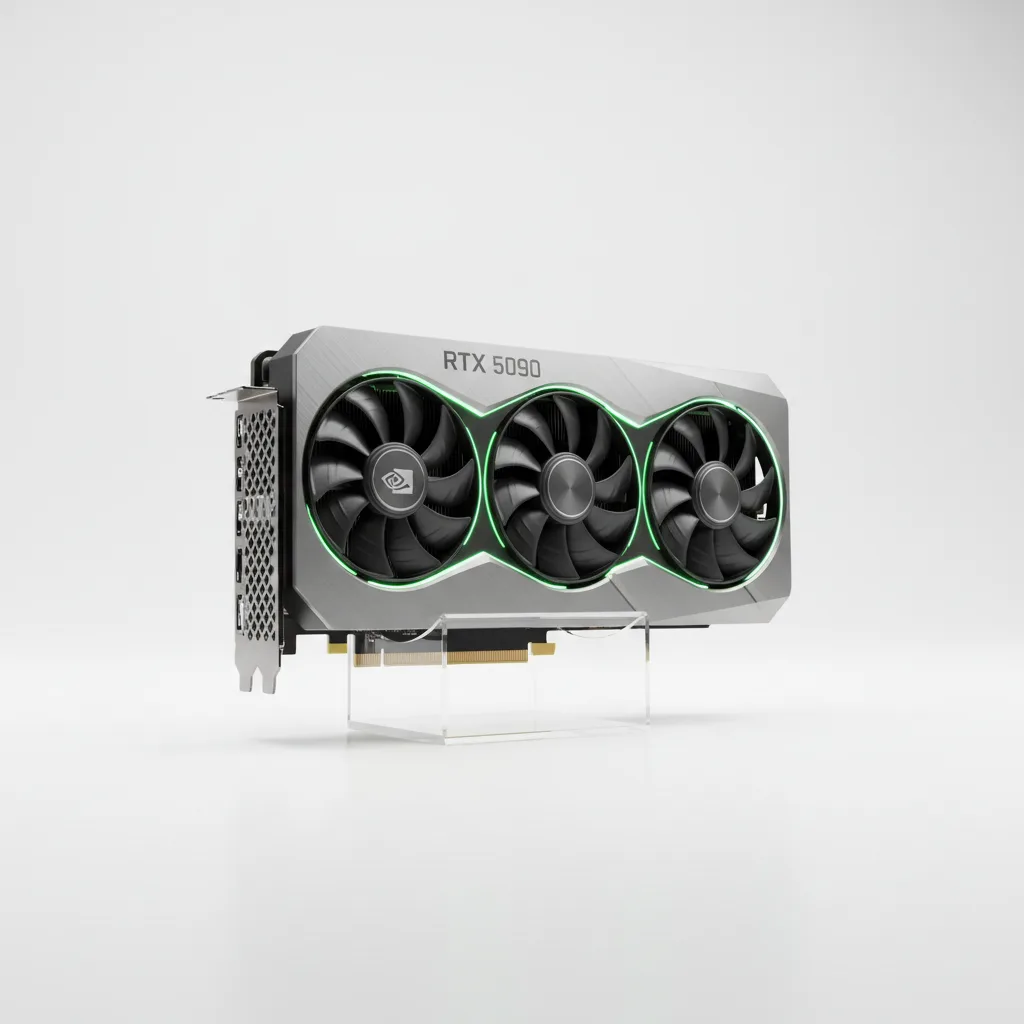
The RTX 5090 is, without dispute, the fastest consumer graphics card money can buy in 2026. It sits alone at the top of the Blackwell lineup with no direct competitor from AMD or Intel. But "fastest" and "right for you" are different questions. At a real-world street price that routinely lands well above its $1,999 MSRP, the 5090 is a card for people whose work — not just their gaming — justifies the outlay. For pure gaming, far cheaper cards deliver most of the experience for a fraction of the money.
Editor’s note on this review. The performance figures below are drawn from published benchmark data aggregated across multiple hardware outlets and NVIDIA’s own specifications, not from a single in-house test bench. Where a number reflects manufacturer claims rather than independent measurement, it is labelled as such. Pricing is volatile and verified as of July 2026 — always check live retail listings before buying.
Rating: 3.7 / 5 — a technical triumph held back only by price, power draw, and availability. Not a “buy for everyone,” but the correct tool for the buyer who genuinely needs it.
Specifications
| Specification | RTX 5090 |
|---|---|
| Architecture | NVIDIA Blackwell (GB202 die, TSMC 4N) |
| Launch date | January 30, 2025 |
| MSRP (Founders Edition) | $1,999 |
| CUDA cores | 21,760 |
| Streaming multiprocessors | 170 |
| RT cores | 170 (4th-gen) |
| Tensor cores | 680 (5th-gen) |
| Memory | 32 GB GDDR7 |
| Memory bus | 512-bit |
| Memory bandwidth | ~1,792 GB/s |
| Boost clock | ~2.41 GHz |
| FP32 compute | ~104.8 TFLOPS |
| TDP | 575 W |
| Recommended PSU | 1,000 W or higher |
| Power connector | Single 16-pin (12V-2×6) |
| Interface | PCIe 5.0 |
| Display outputs | DisplayPort 2.1b, HDMI 2.1 |
| Cooling (Founders Edition) | Dual-fan, dual-slot “Double Flow Through” |
| Key software | DLSS 4 with Multi Frame Generation |
Design and build
The Founders Edition is the surprise of this generation. Despite the 575 W power budget, NVIDIA shrank the cooler to a dual-slot, dual-fan design built around a compact central PCB with a flow-through path on both sides. It is genuinely smaller than the three-slot 4090 Founders Edition it replaces, which makes it far easier to fit in a standard case — a rare instance of a flagship getting more compact rather than less.
Board-partner cards from ASUS, MSI, Gigabyte and others go the opposite direction, with large triple-fan coolers, vapor chambers, and in some cases 360 mm liquid-cooling loops. Those run cooler and quieter but add cost and bulk. If space is tight, the Founders Edition is the one to hunt for.
One practical caution carried over from the 40-series: the 16-pin power connector must be fully seated. The revised 12V-2×6 standard shortens the sense pins so the card won’t draw power if the plug isn’t fully home, which mitigates the melting issues that plagued some early 4090s — but careful cable routing is still essential on a 575 W card.
Gaming performance
At 4K — the resolution this card exists for — the RTX 5090 delivers roughly a 20–30% raster uplift over the RTX 4090 in most titles, based on aggregated independent benchmarks. That is a meaningful generational jump, but a smaller one than the raw spec sheet (78% more memory bandwidth, a third more CUDA cores) might suggest, because many games become CPU-bound before they can fully load the GPU. The gap narrows further at 1440p and is smallest at 1080p, where the CPU is the bottleneck.
Representative aggregated 4K figures put the 5090 around 140+ fps in Cyberpunk 2077 with path tracing disabled, with the lead over competing cards widening sharply once heavy ray tracing is switched on — this is where the 170 fourth-gen RT cores earn their keep.
The card’s real headline, though, is DLSS 4 with Multi Frame Generation, exclusive to the 50-series. Where the 40-series’ DLSS 3 could generate one AI frame per rendered frame, DLSS 4 can generate up to three, multiplying on-screen frame rates several times over in supported titles. This is how NVIDIA’s “up to 2x the 4090” marketing claim is reached — it relies on Multi Frame Gen, not raw rasterization, so treat that figure as a best-case software-assisted number rather than a raw-performance one. It’s a real, visible benefit in the growing list of DLSS 4 games, but it is not the same thing as native performance, and generated frames can add a little input latency.
32 GB of GDDR7 is the other standout. It’s overkill for today’s games but provides genuine headroom for 4K/8K, heavily modded titles, and — more to the point — professional and AI workloads.
Beyond gaming: creative and AI workloads
This is where the 5090’s price starts to make sense. The 32 GB frame buffer and 680 fifth-generation Tensor cores make it the fastest consumer option for local AI inference, high-resolution generative-media pipelines, 8K video editing, and 3D rendering. For anyone doing billable creative or AI work, the card can pay for itself in saved time in a way it simply can’t for a gamer. Note the ceiling, though: 32 GB is tight for the largest local LLMs (a 70-billion-parameter model in 4-bit quantization still exceeds it), and the 5090 lacks the NVLink multi-GPU scaling and ECC memory of datacenter cards. For those workloads, datacenter GPUs remain the right tool.
Power and thermals
There’s no getting around it: 575 W is a lot. NVIDIA recommends a 1,000 W PSU, and that’s sound advice — high-end systems should budget for 1,000 W or more for stability. Expect memory temperatures in the high 80s Celsius under sustained load, which multiple independent reviews have reported as normal for this card. Good case airflow isn’t optional; it’s a requirement. Factor the heat this dumps into a room into your buying decision if you game for long sessions.
Price and availability — the real catch
The MSRP is $1,999 for the Founders Edition. In practice, that price has been hard to find since launch. As of 2026, street prices routinely sit well above MSRP — frequently in the $2,500–$3,500+ range, with partner cards and periods of tight supply pushing higher still. Budget for the price you’ll actually pay, not the sticker.
That gap reframes the entire value question, which is best illustrated by putting the 5090 next to AMD’s current top shipping card.
How it compares: RTX 5090 vs. Radeon RX 9070 XT
AMD has no direct competitor to the 5090 at the top of the stack; its fastest currently shipping card is the RDNA 4-based Radeon RX 9070 XT at a $599 MSRP. That’s not an apples-to-apples matchup — the two cards target completely different buyers — but it’s the comparison that matters, because it frames what the 5090’s money actually buys.
| RTX 5090 | RX 9070 XT | |
|---|---|---|
| MSRP | $1,999 | $599 |
| Typical street price (2026) | ~$2,500–$3,500+ | ~near MSRP |
| VRAM | 32 GB GDDR7 | 16 GB |
| TDP | 575 W | ~304 W |
| Recommended PSU | 1,000 W+ | ~750 W |
| ~4K raster lead | baseline | 5090 leads by roughly 40–45% |
In rasterized 4K gaming the 5090 leads by something in the region of 40–45% on aggregate — a large gap in absolute terms. But the 9070 XT costs a fraction of the price, draws roughly half the power, fits comfortably in a mid-tower, and is actually in stock near MSRP. For the majority of gamers who don’t have a professional workload to justify the flagship, the value math tilts heavily toward the cheaper card. The 5090 wins on raw performance; the 9070 XT wins on performance per dollar by a wide margin.
Who should buy the RTX 5090?
Buy it if:
- You do professional AI, 3D rendering, or high-resolution video work where VRAM, Tensor cores, and saved time translate into money.
- You want the single fastest consumer GPU in existence and are prepared to pay a premium well above MSRP for it.
- You’re targeting 4K at maximum settings with heavy ray tracing, or pushing toward 8K.
- You already have (or will build) a system with a 1,000 W+ PSU and strong airflow to feed and cool it.
Look elsewhere if:
- You’re primarily a gamer at 1440p or standard 4K — a card like the RX 9070 XT delivers most of the experience for a fraction of the cost.
- Your budget is anywhere near the MSRP figure, because the real purchase price is meaningfully higher.
- Your case, PSU, or cooling can’t accommodate a 575 W card.
Bottom line
The RTX 5090 is a landmark product: the most powerful consumer GPU ever built, with a genuinely impressive compact Founders Edition and a software feature set led by DLSS 4 Multi Frame Generation. It earns its performance crown outright. What it can’t escape is the economics — a high MSRP made higher by street pricing, a 575 W appetite, and availability that’s still uneven more than a year after launch. If your work demands it, nothing else comes close and it’s worth every dollar. If you just want to play games beautifully, your money almost certainly goes further elsewhere.
+Pros
- Fastest consumer GPU available — no direct competitor from AMD or Intel at the top
- 32GB of GDDR7 VRAM with ~1,792 GB/s bandwidth, excellent for 4K/8K, AI, and creative work
- DLSS 4 with Multi Frame Generation, exclusive to the 50-series, multiplies frame rates in supported games
- Roughly 20–30% raster uplift over the RTX 4090 at 4K, with a bigger lead once ray tracing is on
- Surprisingly compact dual-slot Founders Edition that fits standard cases more easily than the 4090 it replaces
- Genuine value for professionals doing AI inference, 3D rendering, or 8K video, where saved time offsets the cost
−Cons
- Expensive — $1,999 MSRP, but real street prices routinely run $2,500–$3,500+
- 575W power draw demands a 1,000W+ PSU and strong case airflow
- Poor value for pure gaming; cheaper cards deliver most of the experience for a fraction of the cost
- Availability still uneven more than a year after launch
- Multi Frame Gen inflates NVIDIA's "2x the 4090" marketing — raw performance gains are far smaller
- Runs hot (high-80s°C memory temps) and dumps significant heat into the room