Samsung Exynos 2700 Review: Efficient Mid-Range Powerhouse
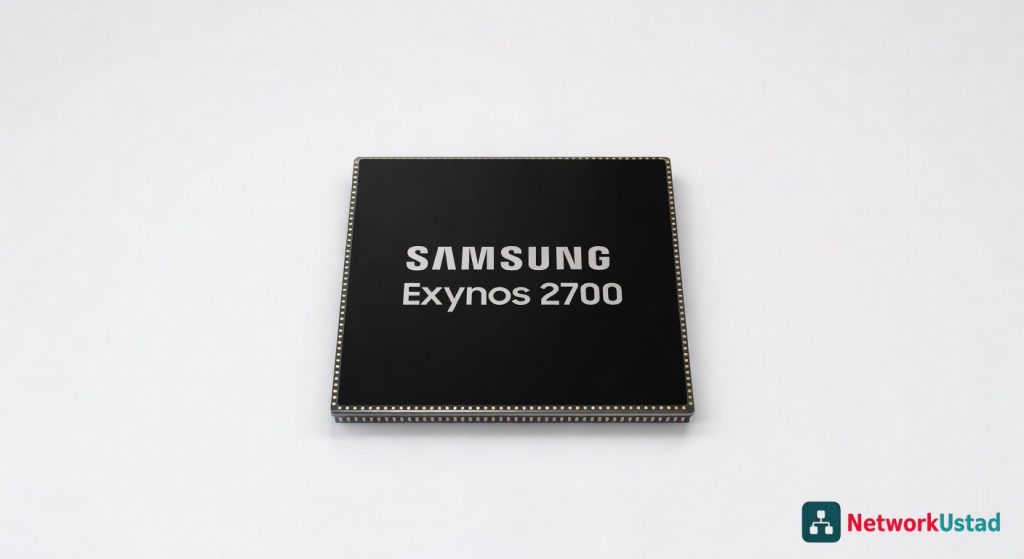
Samsung's Exynos 2700 is the most strategically important chip the company has attempted since the Exynos 2200, officially confirmed by Samsung's System LSI President at the Q1 2026 earnings call. Built on Samsung Foundry's second-generation 2nm SF2P process and targeted at approximately 50 percent of the [Galaxy S27 lineup](https://networkustad.com/samsung-galaxy-s27-pro-what-we-know/), this chip carries the weight of Samsung's entire in-house semiconductor ambition. Mass production begins H2 2026 for a Galaxy S27 launch in early 2027 — and everything confirmed so far suggests Samsung is finally addressing the thermal and efficiency failures that have defined previous Exynos generations. ---
🚀 Pre-Launch Preview: This article is based on officially confirmed specifications, announcements, and verified pre-release information — not hands-on testing. All details are subject to change until the product officially launches. Expected: Release date unconfirmed — expected with Galaxy S27, Early 2027
Why the Exynos 2700 Matters More Than Any Previous Exynos
Samsung spent 13.8 trillion won — approximately $9.2 billion USD — on external mobile processors in 2025, according to The Korea Herald. That figure was up 26.5 percent year-on-year and roughly matched the operating profit of Samsung’s entire mobile division over the same period. In plain terms: Samsung’s phone business spent nearly everything it earned buying chips from Qualcomm.
That is the financial reality the Exynos 2700 has to change. The Exynos 2200 overheated. The Exynos 2500 never shipped — Samsung scrapped it rather than put a defective chip in a flagship. The Exynos 2600 returned in select markets for the Galaxy S26, powering around 25 percent of units, but the Galaxy S26 Ultra shipped exclusively with Snapdragon 8 Elite Gen 5 worldwide. Analyst Park Yoo-ak of Kiwoom Securities projects the Exynos 2700 will power approximately 50 percent of Galaxy S27 units — a figure that would represent a decisive bet on in-house silicon.
The Official Confirmation
Samsung System LSI President Park Yong-In made the first official public acknowledgment of the Exynos 2700 during a management briefing in June 2026, confirmed by Android Authority: “We are developing it without any setbacks, aiming for application in top-tier smartphones.” While Samsung did not name the Galaxy S27 directly, the company’s flagship chips have debuted on the Galaxy S series without exception. SamMobile and Digital Trends both separately confirmed the same briefing.
SF2P Process: What Changes Over SF2
The Exynos 2700 is fabbed on SF2P, Samsung Foundry’s second-generation 2nm GAA (Gate-All-Around) process. The relationship mirrors TSMC's N2 and N2P: the second-generation node brings improved yields, better power efficiency, and lower leakage rather than a raw frequency breakthrough. SF2 yields were stuck around 20 percent through late 2024 before climbing to the mid-50 percent range. SF2P is expected to launch with better starting yields — critical for the economics of powering half the Galaxy S27 lineup. SemiWiki reports Samsung Foundry is actively promoting SF2P to industry partners as a direct competitor to TSMC.
CPU: The 4+1+4+1 Cluster Explained
Leaked Geekbench data from an Exynos 2700 engineering sample revealed a 10-core CPU in a non-standard 4+1+4+1 configuration. The four-cluster structure lets the scheduler distribute sustained workloads more granularly across performance and efficiency cores. Early benchmark scores from the engineering sample were modest — the chip was running at clock speeds below 3GHz in those tests. Prime core clock in final silicon is leaked at approximately 4.2GHz, up from 3.8–3.9GHz on the Exynos 2600. Samsung appears to be optimising for efficiency rather than peak clocks — a direct response to the thermal criticisms of the Exynos 2200 and 2600. Wccftech notes custom CPU architecture is not planned until the Exynos 2800.
GPU: Xclipse 970 and the AMD Partnership
The Exynos 2600’s Xclipse 960 is based on a modified RDNA 4 architecture through Samsung’s collaboration with AMD. The Exynos 2700’s Xclipse 970 is expected to move to RDNA 5, though Samsung has not confirmed this. Qualcomm's Snapdragon 8 Elite Gen 5 scored 3,466 single-core and 11,035 multi-core on Geekbench. The Exynos 2600 trailed in raw single-core performance despite using a more advanced node. The Exynos 2700 does not need to win outright — it needs to be close enough that Samsung can justify substituting it for half its Galaxy S27 units.
Thermal Redesign: The Side-by-Side Architecture
The most consequential hardware change in the Exynos 2700 is the packaging. The Exynos 2600 places its Heat Path Block primarily over the processor, leaving DRAM to run hotter under sustained load. The Exynos 2700 adopts a Side-by-Side layout: processor and DRAM sit together on a shared substrate, with the Heat Path Block positioned over both. Android Authority first reported this packaging detail from a Samsung source in April 2026. The projected result is a 30–40 percent improvement in memory bandwidth and significantly more consistent temperatures under sustained load — directly targeting the Exynos 2600’s documented peak of up to 30W under stress, as noted by Gadget Hacks.
What Could Still Go Wrong
Samsung has confirmed development is on track. That is different from confirming the chip is ready for mass production at scale. SF2P yields need to remain stable. The packaging change is technically novel. And “competitive with Snapdragon” is a bar Qualcomm has not stopped raising. The Galaxy S27 Ultra will almost certainly ship with Qualcomm’s Snapdragon 8 Elite Gen 6 Pro in all markets, with Exynos 2700 handling the S27 and S27+ in select regions. If the chip delivers, it marks a turning point for Samsung’s System LSI division. If it does not, the consequences will be significant.
Verdict
The Samsung Exynos 2700 is the right chip at the right time — if it executes. Samsung has confirmed it publicly, detailed the thermal redesign, and aligned mass production with the Galaxy S27 launch cycle. The SF2P process improvements, Side-by-Side DRAM packaging, and 10-core CPU architecture all address the specific failure modes that have defined previous Exynos generations. Whether final silicon delivers on these architectural advantages will only be known when the Galaxy S27 ships in early 2027. This article will be updated with benchmarks, thermal results, and a full rating at launch.
Rating: TBD — Updated at Galaxy S27 launch (Early 2027).
Based on Samsung’s official Q1 2026 earnings statements, executive briefing reports via Hankyung and SamMobile (June 2026), analyst projections by Kiwoom Securities, and reporting by Android Authority, Digital Trends, Wccftech, SemiWiki, and Gadget Hacks — July 2026.
Frequently Asked Questions
Has Samsung officially confirmed the Exynos 2700?
What process node does the Exynos 2700 use?
What is the Exynos 2700's CPU configuration?
Which phones will use the Exynos 2700?
What is the Side-by-Side thermal change in the Exynos 2700?
+Pros
- First Exynos since 2200 era with a genuine thermal redesign addressing the root cause of overheating
- SF2P process brings improved yields — finally making mass Exynos deployment economically viable
- Side-by-Side DRAM packaging is a documented architectural improvement, not just a spec bump
- 10-core 4+1+4+1 cluster optimised for sustained efficiency rather than peak clock speed
- Officially confirmed by Samsung — no longer speculative
−Cons
- Not yet launched — all performance claims are based on leaks and engineering samples
- Early engineering sample benchmarks were modest — ran below 3GHz clock in Geekbench testing
- GPU still relies on AMD collaboration — no custom Samsung GPU until Exynos 2800
- Galaxy S27 Ultra expected to retain Qualcomm globally — Exynos limited to S27 and S27+ in select regions
- Qualcomm's Snapdragon 8 Elite Gen 6 Pro will still lead in raw single-core performance