Samsung Galaxy S26 Review: Refined Performance and Vibrant Display
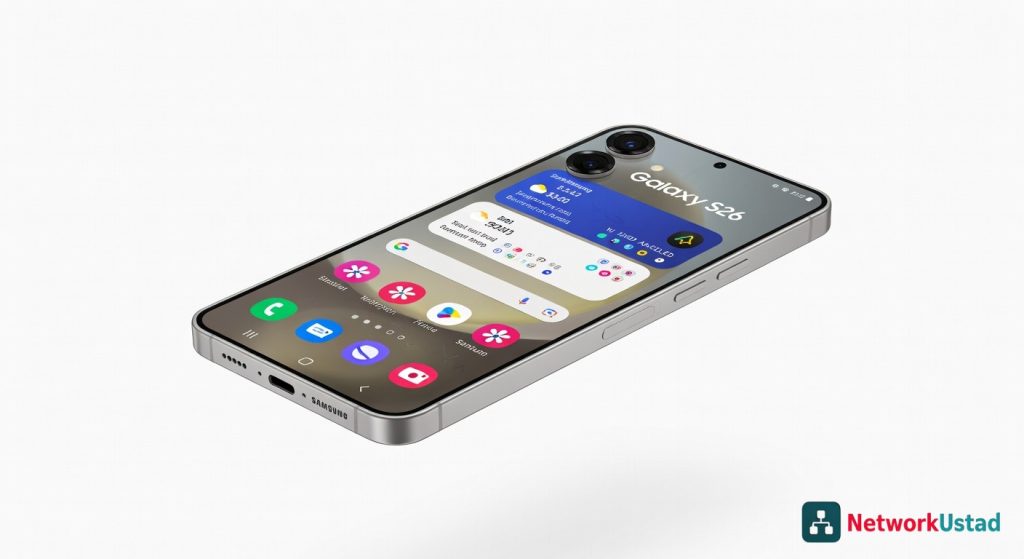
The Samsung Galaxy S26 is an excellent smartphone that is hard to get excited about. The Snapdragon 8 Elite Gen 5 delivers best-in-class performance, the display is beautiful, and One UI 8.5 with Galaxy AI adds genuinely useful features. But the cameras are unchanged from the [Galaxy S25](https://networkustad.com/review/samsung-galaxy-s25-review/), there are still no Qi2 magnets, charging remains slow at 25W, and the $100 price increase is difficult to justify. If you are upgrading from a [Samsung Galaxy S23](https://networkustad.com/review/samsung-galaxy-s23-review/) or older, this is an easy recommendation. Upgrading from an S25 makes very little sense. ---
Design: A Familiar Face with Minor Refinements
The Galaxy S26 is immediately recognisable to anyone who has held a Galaxy S25. Samsung has maintained the flat-sided, glass-and-metal construction that has defined the S series since the S23. The main visual change is the introduction of a raised camera island on the back — a design direction that unifies the S26 lineup with the Ultra and brings it closer to the iPhone 17 Pro aesthetic.
The phone grows slightly in every dimension versus its predecessor. At 147.0 × 70.5 × 7.2 mm and 167g, it is wider and taller than the S25, though the 7.2mm thickness remains unchanged. The slight size increase is barely perceptible without both phones in hand. Gorilla Glass Victus 2 on the front and back, paired with an Armor Aluminum frame and IP68 certification, ensures the build quality is unquestionable.
Colour options in 2026 include Cobalt Violet, Icy Blue, Shadow, White, and the Samsung.com exclusive Pink Gold. The Cobalt Violet reviewed by Beebom’s team was described as a successful balance of personality and restraint — distinctive without demanding attention.
Display: One of the Best Screens on Any Smartphone
The 6.3-inch Dynamic AMOLED 2X panel is one of the clearest, brightest, and most accurate displays Samsung has ever shipped on a base model. The 2,600 nit peak brightness makes outdoor viewing comfortable even in direct sunlight — a real-world advantage over OLED competitors that typically top out at 1,600 nits. The 120Hz adaptive refresh rate adjusts intelligently between 1Hz and 120Hz to balance smoothness and battery consumption.
Colour accuracy is excellent out of the box, and Samsung’s ProScaler AI processing improves upscaled content — a relevant advantage for streaming standard HD video on a high-resolution display. The absence of the Privacy Display feature (which blocks side-on viewing angles) is a notable omission — it debuted on the S26 Ultra and is not available on the standard S26 even as an optional setting.
Performance: The Best Mobile Chip in 2026
The Snapdragon 8 Elite Gen 5 for Galaxy in the US model is the most powerful mobile processor available in 2026. Benchmarks from Notebookcheck and NanoReview confirm Geekbench 6 single-core scores around 3,378 — well ahead of previous generation chips. In gaming, Beebom’s testing found BGMI running at 120 FPS on Ultra Extreme settings with sustained temperatures around 39°C — impressive thermal management for sustained performance.
The Exynos 2600 in global markets tells a different story. While Notebookcheck found the Exynos performing competitively in multi-core tasks and even beating the Snapdragon in some GPU benchmarks, SamMobile’s battery testing revealed a dramatic 2.5-hour gap in real-world battery endurance — 9 hours 26 minutes (Snapdragon) versus 6 hours 48 minutes (Exynos). This is the most significant chip gap between regional variants Samsung has shipped in years and is a genuine reason for non-US buyers to pause.
With 12GB LPDDR5X RAM and UFS 4.0 storage, app loading is near-instantaneous, multitasking is seamless, and the system handles demanding workloads without hesitation. The 256GB starting storage is a welcome baseline for 2026.
Camera: Hardware Standstill, AI Improvements
This is the most disappointing aspect of the Galaxy S26 for anyone considering an upgrade from the S25. The camera hardware is identical — the same 50MP main sensor, same 12MP ultrawide, and same 10MP telephoto with 3× optical zoom. Android Central was direct in its assessment: the absence of camera hardware upgrades, combined with the $100 price increase, “makes the Galaxy S26 a tougher sell than you might expect.”
What has improved is the software processing. AI-enhanced algorithms sharpen fine details, reduce noise more aggressively in low light, and the new Photo Assist feature now adds elements to images rather than only removing them. Horizontal Lock uses gyroscope data for perfectly level horizon lines in video — a useful feature for travel content creation. 8K at 30fps video is available on both the front and rear cameras.
The gap to rivals widens at the camera level. The Motorola Razr Fold uses a triple 50MP system with DXOMARK Gold Rating. Google Pixel 10 Pro brings Tensor G5 computational photography. Samsung’s camera processing advantage over early Galaxy S generations has narrowed as competitors close the software gap while also upgrading hardware.
Battery and Charging: Adequate but Trailing Competitors
The 4,300mAh battery is a 300mAh increase over the Galaxy S25, and in the Snapdragon variant, real-world endurance is genuinely strong — Beebom averaged 4.5 to 5 hours of screen-on time under mixed use, reaching 6.5 hours on lighter days. The 25W charging rate from empty takes 82 minutes for a full charge. This is adequate but increasingly difficult to defend in 2026 when Xiaomi Watch 5‘s partner phones charge at 90W+ and Motorola’s flagship delivers 80W wired.
There is no Qi2 built-in — magnetic accessories require a case. 15W wireless charging is functional but not class-leading.
Software: One UI 8.5 and Galaxy AI
One UI 8.5 on Android 16 remains one of the most capable and customisable Android experiences available. The updated Galaxy AI features include Now Nudge (context-aware action suggestions based on messages), Now Brief (a glanceable daily summary on the lock screen), and Priority Notifications (AI-sorted lock screen notifications). These are genuinely useful in daily use rather than demo-only features.
The seven-year update commitment — seven OS updates and seven years of security patches — is the strongest software support commitment in the Android market, matching Google’s Pixel 10 series and the Motorola Razr Fold.
Samsung DeX continues to work on the S26 Ultra — not available on the standard S26. For power users who want a desktop-class productivity mode, this remains an Ultra-exclusive differentiator.
What About the Galaxy S27 Pro?
Samsung filed for the Galaxy S27 Pro with the GSMA database in June 2026, confirming a fourth model in the S27 lineup for early 2027. Expected specifications include a 6.47-inch Dynamic AMOLED 2X display, a 200MP main camera, and pricing around $1,099–$1,199 — filling the gap between the S27+ and S27 Ultra. If you are considering the S26 but primarily want the Ultra’s capabilities in a slightly smaller form factor, the S27 Pro may be worth the wait.
Verdict
The Samsung Galaxy S26 is exactly what every review of every Galaxy S phone in recent memory has said: a polished, well-built, well-performing smartphone that does not take the risks that would make it genuinely exciting. The Snapdragon 8 Elite Gen 5 is exceptional, the display is among the best on any phone, and One UI 8.5 is excellent software.
The camera hardware freeze, the 25W charging cap, the absent Qi2 magnets, and the $100 price increase are harder to forgive on a phone that costs $899 in 2026. If you own an S23 or older, upgrade without hesitation. If you own an S25, do not.
Rating: 4.0 / 5 — A genuinely great phone that plays it safe when the market demanded something more.
Frequently Asked Questions
What is the difference between the Galaxy S26 and Galaxy S26 Ultra?
Does the Samsung Galaxy S26 have Qi2 wireless charging?
Should I buy the Galaxy S26 or wait for the Galaxy S27?
Why does the Galaxy S26 have different chipsets in different regions?
Does the Galaxy S26 support Samsung DeX?
+Pros
- Snapdragon 8 Elite Gen 5 is the fastest mobile chip available — best-in-class performance for US buyers
- Beautiful 6.3-inch display with 2,600 nits peak brightness and excellent colour accuracy
- One UI 8.5 is polished, highly customisable, and one of the best Android skins available
- Galaxy AI features are genuinely useful in daily use — Now Brief and Priority Notifications stand out
- Seven years of OS and security updates — the longest software commitment in Android
- IP68 water resistance and Gorilla Glass Victus 2 for proven durability
- 256GB minimum storage — no more entry-level 128GB configurations
- Wi-Fi 7 and Bluetooth 6.0 for future-ready connectivity
- Privacy Display technology available via software toggle (Ultra only at hardware level)
- Compact enough for one-handed use compared to the Plus and Ultra
−Cons
- $100 price increase over Galaxy S25 with no camera hardware upgrades to justify it
- Camera system identical to S25 — no new sensors, same 50MP main, same 12MP ultrawide, same 10MP telephoto
- No Qi2 built-in magnets — magnetic accessories require a compatible case
- Slow 25W wired charging and 15W wireless — [Motorola Razr Fold](https://networkustad.com/review/motorola-razr-fold-2026-review/) charges at 80W wired
- Exynos 2600 variant (global markets) lasts 2.5 hours less on battery than Snapdragon version — significant gap
- No Privacy Display feature (Ultra exclusive)
- Design nearly identical to S25 — same camera layout until the camera island change
- 25W charging from 0–100% takes 82 minutes — slow for a 2026 flagship
- No 1TB storage option on base S26 (Ultra only)