SugarAI CRM Review: Is the Rebranded SugarCRM Worth It for Growing Teams?
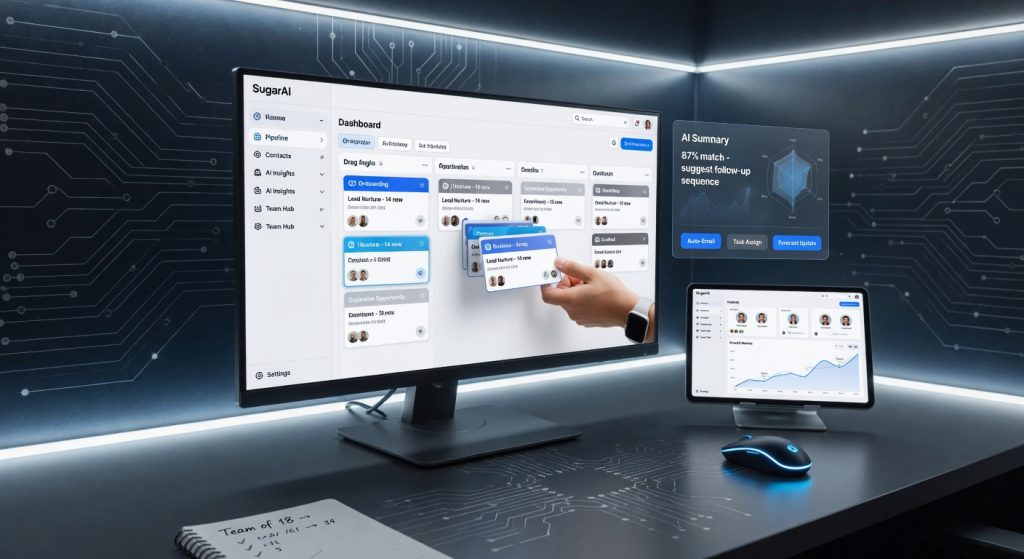
SugarAI CRM offers an intuitive, AI-powered platform that helps growing teams streamline customer management and boost sales performance with minimal setup and training.
Growing sales teams often outgrow spreadsheets and basic contact managers long before they’re ready for the cost and complexity of an enterprise CRM suite like Salesforce. For over two decades, SugarCRM positioned itself in that middle ground — a highly customizable CRM with genuine AI features rather than AI bolted on as an afterthought. In April 2026, the company took that positioning further: it rebranded entirely as SugarAI, its first name change since founding in 2004.
What SugarAI Actually Is
SugarAI is the new identity for what was previously known as SugarCRM, officially unveiled on April 13, 2026. According to the company’s own announcement and coverage from outlets including BusinessWire, TechRadar, ITPro, and TechFinitive, the rebrand reflects a strategic shift from CRM as a passive “system of record” to what SugarAI calls a “system of action” — using AI to interpret signals across sales, service, and connected ERP data to guide sellers toward the highest-value accounts and flag renewal or reorder risks before they become lost revenue. The company’s new tagline is “The Precision Selling Platform,” and the old sugarcrm.com domain now redirects to sugarai.com.
Under the hood, SugarAI is still built on the same foundation: three product lines — Sugar Sell (sales automation), Sugar Serve (customer service), and Sugar Market (marketing automation) — sold separately, with the SugarPredict AI engine now positioned as the platform’s central differentiator rather than an add-on feature.
SugarAI is backed by private equity firm Accel-KKR, which has invested in the company since 2018 and has supported acquisitions such as sales-i to expand its capabilities. It’s led by CEO David Roberts.
Core Platform Capabilities
TechRadar Pro’s hands-on review — a reported 40-hour deep dive across the Sugar Sell and Sugar Market ecosystems — offers the most detailed, tested look at what the platform actually does day to day, and several of its findings are worth walking through directly.
Centralized account and pipeline management. SugarAI’s core database gives users a full view of contact details, interaction history, and account-specific data in one place, with customizable lead scoring to track prospects through the sales funnel. The visual sales pipeline supports drag-and-drop deal updates, making it straightforward for managers to spot bottlenecks at a glance.
AI-powered forecasting. Forecasting tools use historical and current data to help reps hit quota, with the flexibility to build projections by product line, territory, or individual rep — a genuinely useful feature for teams trying to move toward more data-driven planning rather than gut-feel forecasting.
Reporting, dashboards, and Sankey diagrams. SugarAI ships with a wide range of pre-built reports and dashboards spanning sales, marketing, and service metrics, plus the ability to build custom reports without deep technical skill. A newer addition — Sankey diagrams — visualizes exactly where deals are dropping out of the pipeline and which marketing channels are actually converting, rather than relying on a flat funnel view.
Marketing automation. SugarAI’s marketing tools cover campaign creation and management, performance tracking, and automated lead-nurturing workflows, with email marketing features that support personalized, behavior-triggered messaging.
SugarPredict 2.0 and Explainable AI. Two of the platform’s more significant recent updates move it beyond simple lead scoring. SugarPredict 2.0 can now autonomously enrich contact records — enter just a name and company, and it searches social and public data to fill in the profile and tag likely buyer intent. AI-generated recommendations now function as specific, time-bound instructions (they expire after 30 days) rather than static scores. And a new “Explainable AI” feature adds a “Why” tab to every prediction, showing exactly which data points — ERP order history, email sentiment, or web activity — drove the AI’s conclusion, directly addressing the “black box” criticism common to AI-powered CRM tools.
Focus Drawers and Sugar Connect. A newer interface feature called Focus Drawers now supports multi-tabbing — a rep can open a lead, click into a related quote, and then into a support ticket, all within a single sliding drawer over the main screen, cutting down on the tab-switching common in older CRM interfaces. Sugar Connect embeds the CRM directly into Outlook or Gmail, letting reps work without constantly switching applications. A smaller but useful addition is a “Last Interaction” field now shown across modules, displaying the exact date and context of the most recent engagement so reps can instantly spot neglected leads.
Customer service tools. Beyond sales, SugarAI includes case management for tracking and resolving support tickets, plus a knowledge base for maintaining internal and customer-facing documentation. Activity streams provide real-time updates on customer interactions across the team, supporting cross-functional visibility.
Customization. This remains one of the platform’s core strengths: unlimited custom fields, custom modules, and workflow automation built through SugarBPM, the platform’s business process management engine, along with an open REST API for deeper custom integration work.
Integrations
SugarAI connects to a wide range of external tools, with pre-built integrations for Google Workspace, Microsoft 365, DocuSign, and Slack covering common quick-setup needs. It also supports iPaaS platforms like Zapier and Make, which extend connectivity for custom or niche use cases without requiring technical expertise. For advanced needs, its REST API includes thorough documentation with guides and code samples, though using it does require development skills. TechRadar’s testing also covered SugarAI’s ERP integrations directly, reporting more than 180 available connections and generally reliable data syncing — with the option of real-time or scheduled syncs, a choice not offered by most competing CRMs — though large data volumes are worth monitoring during sync.
How Easy Is SugarAI to Use?
According to TechRadar’s testing, SugarAI’s interface is functional but dated-feeling compared to newer platforms, with a logical left-side navigation bar but a genuinely steep learning curve given the sheer number of available options. The platform is highly configurable — custom fields, modules, and dashboards can all be rearranged — but that flexibility comes at the cost of a more time-consuming initial setup, and the system can get cluttered without careful planning.
Accessibility support exists (keyboard shortcuts, text resizing, color adjustments) but was flagged in testing as needing improvement, particularly around screen reader compatibility. The mobile app is available for iOS and Android and was described as intuitive, though it offers less depth and customization than the desktop version.
SugarAI offers substantial learning resources, including documentation, video tutorials, webinars, and structured courses through “Sugar University.” Even so, testers noted that new users may need weeks to reach full proficiency, especially when customizing the platform for their organization’s specific needs.
Support
SugarAI’s support is tiered by subscription level. All customers get access to a support portal for submitting and tracking cases, plus an active community forum and an extensive self-service knowledge base. Email support response times generally range from a few hours to one business day for non-critical issues, with faster attention for urgent cases. Enterprise and Ultimate tier customers get 24/7 phone support, useful for teams spread across time zones, along with access to professional services for implementation, custom development, and training. One consistent weak point flagged in testing: live chat support was often unavailable, with longer-than-expected wait times when it was.
Security and Compliance
SugarAI includes role-based access controls, end-to-end encryption, and GDPR compliance, along with a bug bounty program to encourage responsible disclosure of security vulnerabilities.
Who SugarAI Is Actually Built For
SugarAI’s core strength — deep customization paired with AI-driven account intelligence — is also where it can work against smaller teams. If your organization has a dedicated CRM administrator or an IT team willing to invest in configuration, SugarAI’s open architecture allows for deeper customization than lighter platforms like HubSpot or Pipedrive. But for a small team wanting a plug-and-play solution, the learning curve and demo-led onboarding process can feel like an unnecessary hurdle.
It’s also worth considering whether an all-in-one suite actually solves a real problem for your team. If reps are tired of switching between five different apps to piece together a customer’s history, SugarAI’s Focus Drawers and Sugar Connect genuinely address that. If you’re already satisfied with separate, best-of-breed marketing and service tools, SugarAI’s integrated suite may be redundant rather than additive.
Pricing: Verified Current Tiers
Based on TechRadar’s tested review of the current published pricing, SugarAI’s Sugar Sell product is sold in three tiers, each requiring a 15-user minimum and a mandatory 12-month annual contract:
| Plan | Price | Best For | Key Limitations |
|---|---|---|---|
| Standard | $59/user/month | Small-to-medium businesses needing basic CRM functionality | No SugarPredict AI included; mail sync requires an add-on |
| Advanced | $85/user/month | Mid-sized businesses needing advanced features and customization | Native mail sync limited to 25 seats out of the box |
| Premier | $135/user/month | Large enterprises with complex CRM needs and high-volume sales | Highest entry threshold; overkill for smaller teams |
The 15-user minimum sets a real structural cost floor regardless of your actual team size: $10,620/year for Standard and $15,300/year for Advanced, before any add-ons, implementation, or training costs. This effectively rules SugarAI out for very small teams or solo users, positioning it deliberately as a mid-market and enterprise product.
Moving from Standard to Advanced is what unlocks native email and calendar integration plus the SugarPredict AI engine itself — a meaningful gate, since AI-driven forecasting is central to SugarAI’s current positioning but isn’t included in the entry-level tier. Premier doubles data storage limits and adds enterprise features like geo-mapping for field sales territories, native LinkedIn Sales Navigator integration, and multi-scenario forecasting models.
SugarAI doesn’t publicly advertise standard discount programs, though enterprise customers may be able to negotiate better rates, and bundling Sugar Sell with Sugar Serve may yield cost savings — details aren’t published, so this is worth raising directly with sales. A Nucleus Research study cited in coverage of the platform suggests SugarAI users may achieve total cost of ownership up to 32% lower than a comparable Salesforce deployment, though actual savings depend heavily on implementation scope.
A note on older pricing references: Some third-party sites still list a lower-cost “Essentials” tier (around $19/user/month) that does not appear to be part of SugarAI’s current published lineup — if you see that figure elsewhere, treat it as outdated rather than current. Sugar Market (marketing automation) remains priced separately on a usage basis, historically around $1,000/month for 10,000 contacts, rather than per seat.
Third-Party Recognition and Ratings
The rebranded company continues to build on the legacy product’s track record of industry recognition. In 2026, SugarAI (as the continuation of SugarCRM) was named a Leader in Nucleus Research’s Sales Force Automation Technology Value Matrix for the sixth consecutive year, and was named to the Constellation Research ShortList for Revenue Intelligence. Separately, SugarAI won a 2026 ERP Today Award for Customer Experience Solution of the Year for a real, named customer project — a CX transformation with distributor Country Fare — though specific performance figures from that project weren’t detailed in the award coverage we could verify, so we won’t repeat unsupported numbers here.
The legacy SugarCRM brand also previously won PCMag’s Business Choice Award (based on reader customer-satisfaction polls) and CUSTOMER magazine’s CRM Excellence Award in multiple recent years, prior to the rebrand.
On G2, the Sugar Sell product (still listed under its legacy branding at the time of writing) holds a 3.8 out of 5 rating based on roughly 770 reviews, with reviewers most often citing strong customization and support alongside a steeper learning curve — consistent with TechRadar’s hands-on findings above.
Comparison with Keap and Other Alternatives
Teams evaluating SugarAI often compare it against Keap for marketing automation depth. Keap offers stronger email sequencing, but Keap doesn’t offer SugarAI’s native AI-driven forecasting, deep customization, or ERP-connected account intelligence. In general, companies with complex, custom sales processes and a genuine need for predictive, cross-system insights tend to lean toward SugarAI, while teams focused mainly on outbound marketing sequences and simpler day-to-day setup often prefer Keap or similarly lighter-weight platforms.
Strengths and Limitations
Strengths:
- Deep, no-code customization — unlimited custom fields, custom modules, and SugarBPM workflow automation
- Genuinely advanced AI features via SugarPredict 2.0, including autonomous contact enrichment and Explainable AI’s prediction transparency
- Strong integration ecosystem, including 180+ ERP connections, iPaaS support, and a documented REST API
- Newer usability additions (Sankey diagrams, multi-tabbing Focus Drawers, Sugar Connect for Outlook/Gmail) address past interface-clutter complaints
- Sixth consecutive year as a Nucleus Research SFA Technology Value Matrix Leader
- Reported total cost of ownership up to 32% lower than Salesforce for organizations that make full use of its customization
Limitations:
- 15-user minimum on core Sugar Sell tiers creates a real cost floor ($10,620–$15,300+/year) regardless of actual team size
- SugarPredict AI — the platform’s headline feature — isn’t included in the entry-level Standard tier
- Steep learning curve and functional-but-dated interface, confirmed in hands-on testing
- Live chat support was inconsistent and slow during testing
- Marketing automation (Sugar Market) is sold and priced separately from the core CRM
- Accessibility features, particularly screen reader support, need improvement
Final Verdict
SugarAI is a genuinely strong fit for mid-market and enterprise teams with complex, account-based sales processes, deep customization needs, or ERP systems they need tightly integrated with their CRM — hands-on testing confirms its AI-driven forecasting and customization tools are real differentiators, not just rebrand marketing language. It’s a poor fit for small teams or solo users, both because of its learning curve and because of the 15-user minimum baked into its core pricing tiers, and because its signature AI features require moving up to the Advanced tier at minimum.
For deep transactional industries like manufacturing or wholesale distribution — especially those needing tight, localized ERP integration — SugarAI stands out as a genuinely capable revenue engine. Teams evaluating it should request a live demo, confirm current pricing and any available bundling discounts directly with sales, and honestly assess whether they have the internal resources to handle its setup and customization curve.
Explore the official SugarAI website for current pricing and a product demo.
Frequently Asked Questions
Is SugarAI the same company as SugarCRM?
Yes. SugarAI is simply the new brand name that SugarCRM adopted on April 13, 2026 — it’s the same company, the same core products (Sugar Sell, Sugar Serve, Sugar Market), and the same underlying technology, just repositioned around AI-driven “precision selling” rather than traditional CRM record-keeping. If you see references to “SugarCRM” in older reviews or third-party listings, they’re describing the same platform now sold as SugarAI.
Is SugarAI open source?
SugarAI originally launched in 2004 as an open-source CRM platform, which helped it build a strong developer community and a genuinely flexible, API-driven architecture. The company has since moved away from a fully open-source model toward a commercial cloud product, but that open-source heritage still shapes how customizable and extensible the platform is today.
Is SugarAI a good fit for a small business?
It depends heavily on how complex your sales process is, and the pricing structure makes this a fairly hard line: the 15-user minimum on core tiers means a small team will pay for phantom seats even if they only need five or six. If your needs are straightforward — track contacts, manage a simple pipeline, send follow-up emails — most reviewers point to lighter platforms like HubSpot, Pipedrive, or Zoho CRM as a better starting point. SugarAI makes more sense for a smaller business only if it has genuinely complex or industry-specific processes, or existing ERP systems, that justify both the cost and the setup investment.
What does SugarPredict actually do?
SugarPredict is SugarAI’s built-in AI engine, and its latest version (2.0) goes well beyond basic lead scoring. It can autonomously enrich contact records by searching social and public data when you enter just a name and company, tag records based on buyer intent signals, and generate specific, time-bound action recommendations that expire after 30 days rather than sitting as static scores. Its newer Explainable AI feature also adds a “Why” tab to every prediction, showing which specific data points — like ERP order history, email sentiment, or web activity — led to that conclusion.
How much does SugarAI actually cost?
Based on TechRadar’s tested review of the current published pricing, Sugar Sell runs $59/user/month for Standard, $85/user/month for Advanced, and $135/user/month for Premier, all under 12-month annual contracts with a 15-user minimum. That puts the real entry cost at $10,620/year for Standard and $15,300/year for Advanced before any add-ons. Note that SugarPredict AI itself isn’t included until the Advanced tier, so budget for that if AI forecasting is your main reason for considering the platform. Older references to a cheaper “Essentials” tier around $19/user/month appear to be outdated and no longer reflect current offerings.
How does SugarAI compare to Salesforce?
SugarAI is generally positioned as a more customizable, potentially lower-total-cost alternative to Salesforce for organizations willing to invest in configuration — a Nucleus Research study suggests up to 32% lower total cost of ownership for some deployments. The two platforms differ meaningfully in ecosystem size, though: Salesforce has a much larger third-party app marketplace and broader enterprise brand recognition. The right choice often comes down to whether your priority is deep, tailored AI-driven account intelligence at a potentially lower cost (SugarAI) or the widest possible ecosystem of pre-built integrations and market-standard adoption (Salesforce).
What changed in the SugarAI rebrand besides the name?
Beyond the new name, logo, and domain, SugarAI’s rebrand represents a genuine strategic repositioning — moving from CRM as a “system of record” that simply stores customer data toward what the company calls a “system of action” that proactively surfaces signals and recommends next steps. This shows up concretely in features like SugarPredict 2.0’s autonomous enrichment, Explainable AI’s prediction transparency, and a stronger emphasis on connecting CRM and ERP data specifically for account-based B2B sellers — alongside newer usability features like Sankey diagram pipeline visualizations, multi-tab Focus Drawers, and Sugar Connect for working directly inside Outlook or Gmail.
+Pros
- Deep, no-code customization with unlimited custom fields, modules, and SugarBPM automation
- SugarPredict 2.0 adds autonomous contact enrichment and Explainable AI transparency
- Strong integration ecosystem: 180+ ERP connections, Zapier/Make support, documented REST API
- New usability features (Sankey diagrams, multi-tab Focus Drawers, Sugar Connect) address prior interface complaints
- Sixth consecutive year as a Nucleus Research SFA Technology Value Matrix Leader
−Cons
- 15-user minimum on core tiers sets a real cost floor from $10,620/year, regardless of team size
- SugarPredict AI is not included in the entry-level Standard tier
- Steep learning curve and a functional-but-dated interface
- Inconsistent, slow live chat support during testing
- Marketing automation priced and sold separately from the core CRM