Pennsylvania aerospace supplier machining titanium turbine housings faced productivity bottleneck: roughing operations consumed 68% total cycle time (52 minutes of 76-minute total), traditional zig-zag toolpaths causing tool chatter at corners (forcing 40% feed rate reduction), shallow 2mm depth-of-cut requiring 18 passes. Solution: Implement CNC roughing strategies for efficient material removal—dynamic toolpaths maintaining constant 15% radial engagement, increased axial depth 8mm (4× deeper), optimized feeds 1,200 mm/min (vs 750 mm/min conservative). Results: Roughing time 52 min → 31 min (40% reduction), tool life improved 35% (reduced heat concentration), total cycle 76 min → 55 min (28% overall improvement), annual savings $127,000 (850 parts × $149 savings/part).
This demonstrates roughing optimization’s massive impact: modern toolpath strategies, engagement control, parameter optimization reducing cycle time 25-40% typical while improving tool life through better heat management, chip evacuation—achieving seemingly contradictory goals (faster + longer tool life) through physics-based approach vs conservative “safe” programming destroying efficiency.
Traditional vs Optimized Roughing: Performance Comparison
| Strategy | Radial Engagement | Axial Depth (Aluminum) | Feed Rate (Aluminum) | Material Removal Rate | Cycle Time (Typical) | Tool Life | Heat Management |
| Traditional Zig-Zag | 50-100% (variable) | 2-4mm shallow | 600-900 mm/min | 50-120 cm³/min | Baseline (100%) | Baseline | Poor (heat spikes) |
| Trochoidal Milling | 5-15% constant | 8-15mm deep | 1,500-2,500 mm/min | 150-320 cm³/min | 65-75% (25-35% faster) | +30-50% longer | Excellent (distributed) |
| Dynamic/Adaptive | 10-25% constant | 6-12mm | 1,200-2,000 mm/min | 120-250 cm³/min | 70-80% (20-30% faster) | +25-40% longer | Very good |
| High-Efficiency Machining (HEM) | 8-18% constant | 10-20mm | 1,800-3,000 mm/min | 180-400 cm³/min | 60-70% (30-40% faster) | +35-60% longer | Excellent |
Key principle: Constant tool engagement (maintaining consistent chip load throughout toolpath) enables higher feeds, deeper cuts, superior chip evacuation vs variable engagement (traditional) causing feed reduction protecting against engagement spikes.
High-Efficiency Machining (HEM): Physics-Based Strategy
HEM fundamentals:
- Low radial engagement (8-20% cutter diameter): Distributes cutting forces over more insert edge, reduces heat per unit cutting edge
- High axial depth (5-10× traditional): Leverages tool’s full flute length, stronger axial rigidity vs radial deflection
- Continuous toolpaths: Eliminates sudden direction changes causing shock loads, maintains constant chipload
Example (12mm endmill, aluminum 6061):
- Traditional: 50% radial (6mm stepover) × 3mm axial depth × 800 mm/min feed = 14.4 cm³/min removal, 8-minute pocket
- HEM: 15% radial (1.8mm stepover) × 15mm axial × 2,200 mm/min = 59.4 cm³/min removal, 2.8-minute pocket
- Improvement: 65% cycle time reduction, tool temperature reduced 35°C (infrared measurement), insert life 450 parts → 680 parts (+51%)
Stepdown vs Stepover: Rethinking Cutting Geometry
Traditional misconception: Shallow stepdown (2-4mm) + wide stepover (50-75% cutter diameter) = “safe” machining.
Reality: Radial forces (stepover-related) cause deflection, chatter, poor surface finish. Axial forces (stepdown-related) absorbed by tool’s strongest dimension (length/rigidity).
Optimized approach:
- Increase stepdown: 8-20mm (limited by flute length, chip evacuation capacity)
- Decrease stepover: 10-25% cutter diameter (constant engagement principle)
- Result: Higher material removal rate, better chip control, reduced deflection
Stainless 304 example (16mm carbide endmill):
- Old: 3mm stepdown × 8mm stepover (50%) × 600 mm/min = 14.4 cm³/min, tool life 85 parts
- New: 12mm stepdown × 3.2mm stepover (20%) × 1,400 mm/min = 53.8 cm³/min, tool life 125 parts
- Gains: 3.7× material removal rate, 47% longer tool life, 68% cycle time reduction
Eliminating Air Cutting: Non-Productive Time Reduction
Air cutting sources:
- Excessive retract/plunge moves (linking between passes)
- Long rapid positioning between features
- Inefficient entry/exit strategies (spiral in/out vs linear plunge)
Optimization strategies:
- Stay-down linking: Tool remains engaged material, continuous cutting vs lift/reposition/plunge cycles
- Optimized entry: Helical ramp (gradual Z-engagement) vs plunge (shock load), reduces cycle time 8-15 seconds per feature entry
- Minimized retracts: Toolpath software calculating shortest safe rapids
Impact measurement: 45-minute cycle—traditional 8.5 minutes air cutting (19% non-productive). Optimized: 3.2 minutes air cutting (7% non-productive). Savings: 5.3 minutes (12% cycle reduction) just eliminating wasted motion.
Tooling Selection for High-Performance Roughing
High-performance roughing tool characteristics:
Variable pitch/helix: Unequal flute spacing disrupts harmonic vibration frequencies—enables 15-25% higher feed rates without chatter vs uniform flute tools.
Coatings:
| Coating | Temperature Resistance | Friction Reduction | Tool Life Improvement | Cost Premium | Best Materials |
| Uncoated carbide | 600°C | Baseline | Baseline | — | Aluminum, brass |
| TiN (Titanium Nitride) | 600°C | +15% | +30-50% | +10% | General purpose |
| TiAlN | 800°C | +25% | +50-100% | +30% | Steel, stainless, titanium |
| AlCrN | 1,100°C | +35% | +80-150% | +50% | High-temp alloys, hardened steel |
Geometry: High helix (40-45°) improves chip evacuation (critical deep-cut HEM), reduces cutting pressure 10-20% vs standard 30° helix.
Feed Rate and Spindle Speed Optimization
Beyond CAM defaults: Published speeds/feeds are conservative starting points—real optimization requires material/machine/tooling-specific refinement.
Chipload formula: Feed per tooth = Feed rate ÷ (RPM × Number of flutes)
Aluminum 6061 example (12mm 4-flute carbide):
- CAM default: 12,000 RPM × 1,200 mm/min = 0.025 mm/tooth chipload (conservative)
- Optimized HEM: 10,000 RPM × 2,400 mm/min = 0.060 mm/tooth (within 0.05-0.08 mm recommended range)
- Result: 2× feed rate, improved chip formation (thicker chips evacuate better), reduced rubbing/heat
Monitoring validation: Spindle load meter 60-75% capacity = optimal (below 50% = underutilized, above 85% = overloaded risking tool failure).
Leveraging Modern CNC Machining Capabilities
Advanced machine features enabling optimization:
Adaptive feed control: Automatically modulates feed rate based on cutting load—maintains optimal 65-75% spindle utilization through varying engagement conditions.
High-pressure coolant (500-1,000 PSI): Through-tool or through-spindle delivery improves chip evacuation 40-60% (critical deep-pocket HEM), reduces temperature 25-40°C.
Look-ahead processing: CNC control previews 50-1,000 blocks ahead, optimizing acceleration/deceleration for smooth continuous motion (vs jerky starts/stops traditional controls).
High-speed machining (HSM): Rapid acceleration (1-2 g typical), 20,000+ RPM spindles enable trochoidal toolpaths maintaining velocity through tight radii.
Full utilization of CNC machining capabilities differentiates 30% cycle reduction (optimized programming on capable machine) vs 10-15% (optimized programming on basic machine lacking adaptive/HSM features).
Implementation: Practical Optimization Sequence
Phase 1 – Toolpath strategy (biggest impact): Switch traditional zig-zag to dynamic/trochoidal toolpaths—typically 20-35% cycle reduction alone, minimal investment (CAM software feature activation).
Phase 2 – Parameter optimization: Increase depth-of-cut 2-4×, reduce stepover to 10-25% diameter, raise feed rates 1.5-2.5×—validates strategy, requires testing/monitoring (spindle load, chip formation, tool wear).
Phase 3 – Tooling upgrade: Variable-pitch, high-helix, coated roughing tools—enables parameter pushing further, 15-30% additional gains.
Phase 4 – Machine feature activation: Adaptive feed, high-pressure coolant, look-ahead—maximizes capability utilization.
Companies like FastPreci implement systematic roughing optimization protocols—analyzing current performance (cycle time breakdown, tool utilization), deploying modern CNC roughing strategies for efficient material removal (dynamic toolpaths, optimized parameters, advanced tooling), validating improvements through production monitoring—typically achieving 25-40% cycle reductions while improving tool life, delivering measurable ROI through reduced manufacturing cost per part.
FAQs: CNC Roughing Optimization
What is roughing in CNC machining?
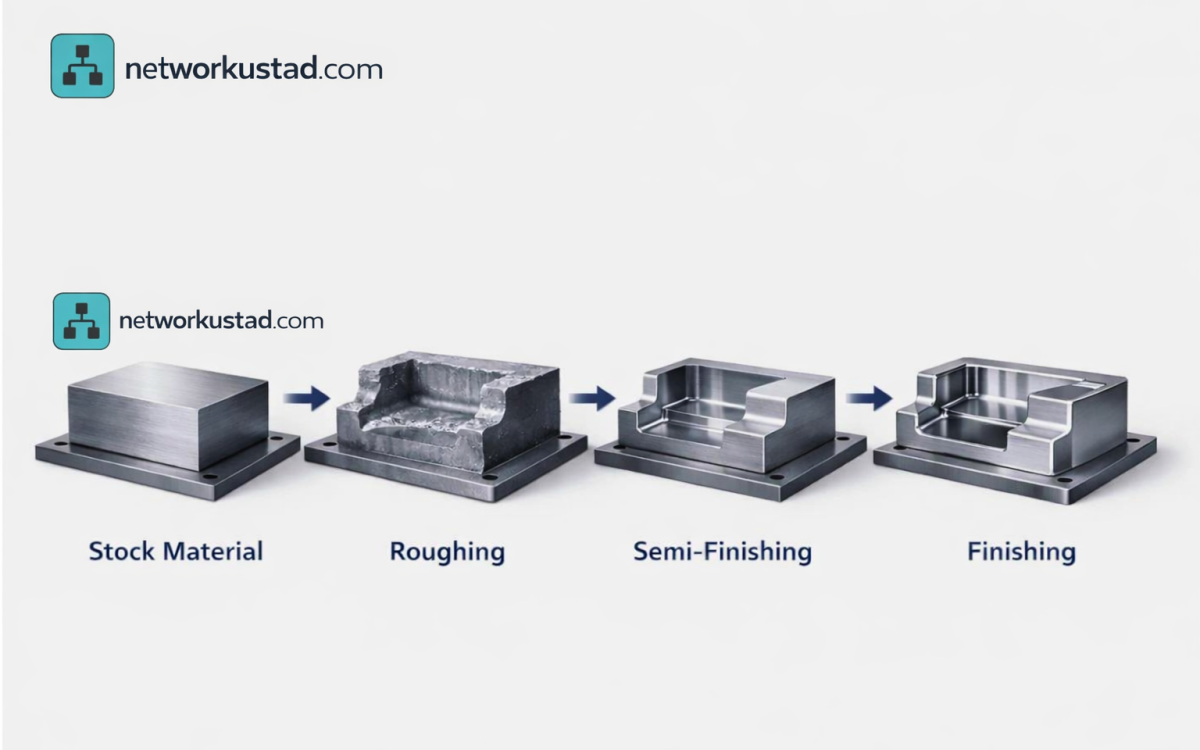
Initial machining operation removing bulk material rapidly, leaving 0.2-1mm stock for finishing. Accounts for 60-80% total cycle time, 85-95% material removal. Prioritizes speed/efficiency over precision (±0.05-0.2mm roughing tolerance vs ±0.01-0.02mm finishing). Optimization focuses maximum material removal rate while preserving tool life, part integrity.
How much cycle time can roughing optimization save?
Typically 20-40% roughing cycle reduction via modern toolpaths (HEM, dynamic, trochoidal), optimized parameters (deeper cuts, higher feeds, constant engagement), better tooling. Example: 50-minute total cycle, 35 minutes roughing—optimization reduces roughing to 22 minutes = 28% overall cycle improvement (50 min → 37 min).
What is High Efficiency Machining (HEM)?
Roughing strategy using low radial engagement (8-20% cutter diameter) + high axial depth (5-10× traditional) + continuous toolpaths maintaining constant chip load. Physics: distributes heat over more cutting edge, leverages tool’s axial strength, enables 2-4× higher feed rates vs traditional. Result: 30-50% faster material removal, 30-60% longer tool life paradoxically.
What is constant tool engagement in CNC?
Maintaining consistent percentage of cutter diameter engaged with material throughout toolpath—eliminates sudden load spikes (corners, entry/exit) causing traditional zig-zag feeds reduced 30-50% “protecting” against peaks. Constant engagement enables higher baseline feed (no spike protection needed), smoother cutting, better chip evacuation, reduced vibration.
How do you optimize CNC roughing toolpaths?
(1) Switch traditional zig-zag to dynamic/trochoidal/HEM toolpaths (constant engagement). (2) Increase axial depth 3-5× (8-20mm vs 2-4mm). (3) Reduce radial stepover to 10-25% diameter. (4) Raise feed rates 1.5-3× (validated via spindle load monitoring 60-75%). (5) Minimize air cutting (stay-down linking, helical entry). (6) Use variable-pitch coated tooling enabling higher parameters.
What feeds and speeds for roughing operations?
Material-dependent. Aluminum 6061 (12mm carbide 4-flute): 10,000-14,000 RPM, 1,800-3,000 mm/min, 0.04-0.08 mm/tooth chipload. Stainless 304: 3,500-5,500 RPM, 800-1,600 mm/min, 0.06-0.10 mm/tooth. Titanium Ti-6Al-4V: 2,000-3,500 RPM, 400-900 mm/min, 0.05-0.08 mm/tooth. Always validate via spindle load (target 60-75% capacity), chip formation, tool wear observation.
What tools are best for roughing?
Variable-pitch (unequal flute spacing reduces chatter), high-helix 40-45° (chip evacuation), TiAlN/AlCrN coated (heat resistance), 4-6 flutes (balance between strength and chip space). Roughing endmills vs finishing endmills: more robust (thicker core), fewer flutes (better chip clearance deep cuts), optimized for high material removal vs precision.
What is the difference between roughing and finishing?
Roughing: Remove bulk material fast (85-95% removal), looser tolerance (±0.05-0.2mm), maximize material removal rate, accounts for 60-80% cycle time. Finishing: Remove final 0.2-1mm stock precisely, tight tolerance (±0.01-0.02mm), optimize surface finish (Ra 0.4-3.2μm), slower feeds/speeds, 15-30% cycle time. Sequential operations: rough first (fast/efficient), finish second (precise/clean).
What is air cutting and how to reduce it?
Non-productive tool movement (rapids, retracts, positioning) when not removing material. Sources: lift/plunge between passes, long positioning moves, excessive clearance planes. Reduction: (1) Stay-down linking (tool remains engaged), (2) Helical entry vs plunge, (3) Minimize retract heights, (4) Optimize feature sequencing (reduce travel distance). Typical savings: 5-15% total cycle time.
Can roughing optimization damage parts or tools?
If improperly implemented—too aggressive feeds/depths without constant engagement causing shock loads, insufficient chipload causing rubbing/heat, inadequate coolant causing thermal damage. Properly implemented: Lower tool stress (distributed forces, constant engagement), better heat management (higher speeds, better evacuation), improved part quality (reduced vibration). Always validate incrementally: baseline → small parameter increase → monitor → refine vs sudden aggressive changes risking failure.
What roughing optimization challenge is preventing confident implementation—toolpath strategy selection, parameter calculation uncertainty, tool selection complexity, or machine capability assessment difficulty?