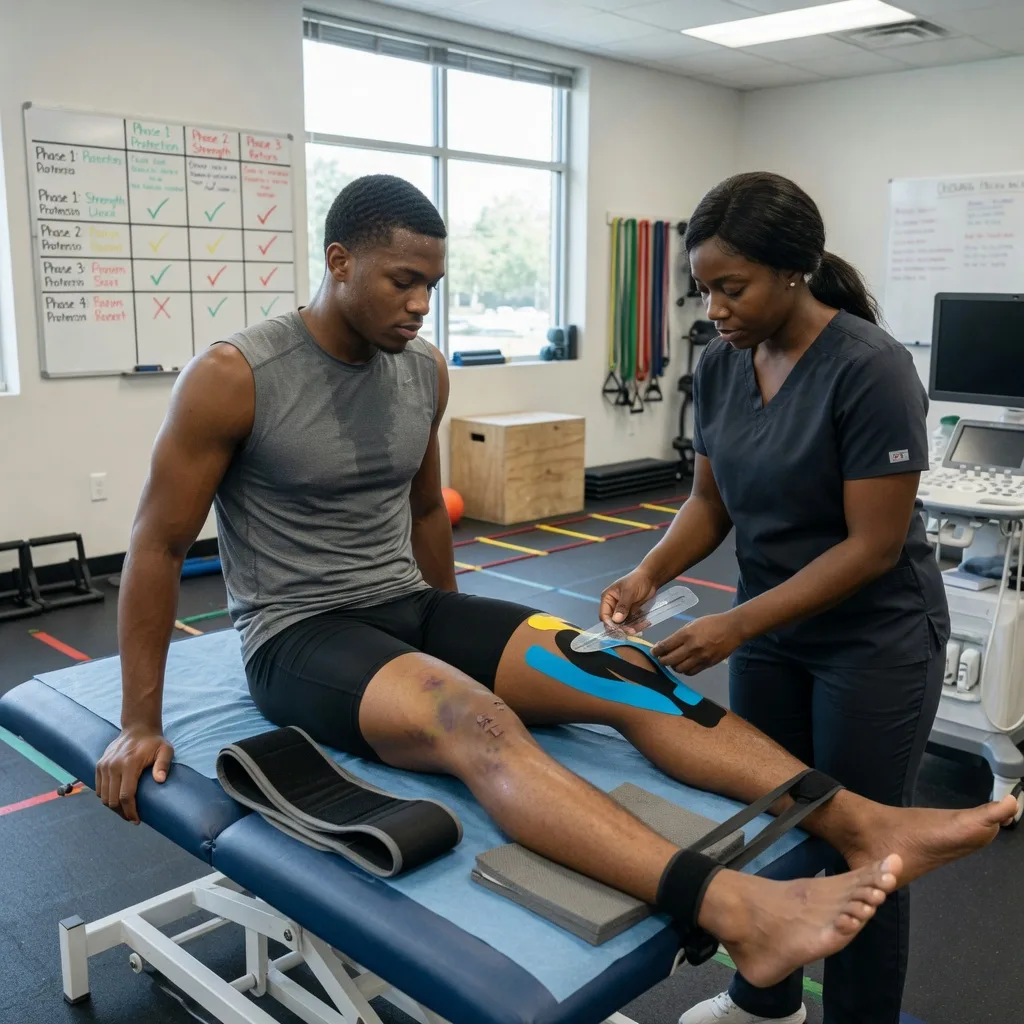
Recovering from a sports injury is rarely as simple as rest followed by gradually returning to activity. Without a structured plan, athletes and active individuals frequently return too quickly to full training, set back their recovery, or return at reduced capacity without realizing it.
A well-designed rehabilitation plan follows a logical progression from injury management through full return to sport — with objective criteria for advancing at each stage rather than subjective feelings about readiness.
Stage One: Protecting the Healing Tissue
The first phase of rehabilitation is about creating the conditions for healing. This means controlling pain and inflammation, protecting the injured structure from further stress, and beginning gentle range-of-motion work that maintains mobility without loading the healing tissue excessively.
What this phase looks like varies by injury. An acute ligament sprain has different requirements than a post-surgical tendon repair. The common principle is that tissue needs protection in the early healing phase — but that protection doesn’t mean complete immobility.
Stage Two: Rebuilding Strength and Movement
Once the acute phase has passed, the focus shifts to restoring movement quality and rebuilding strength in the affected area and supporting structures. This is where the bulk of the rehabilitation work happens, and where working with a qualified provider of sports injury physical therapy is most valuable — designing a progressive loading program that challenges the tissue appropriately without exceeding its current capacity.
Manual therapy, targeted strengthening exercises, and neuromuscular re-education are all common components of this phase. The goal is rebuilding not just strength but the movement patterns and coordination that allow the body to perform the demands of sport.
Stage Three: Sport-Specific Conditioning
Restoring general strength and mobility is necessary but not sufficient for safe return to sport. The third phase bridges the gap between clinical rehabilitation and sport-specific demands through progressive functional training.
This means introducing the movement patterns, intensities, and physical challenges that are actually present in the athlete’s sport. A runner needs to progressively reintroduce running loads. A basketball player needs to reintroduce cutting, jumping, and landing. The specificity of this phase is what prepares the body for what it will actually face on return.
Objective Return-to-Sport Criteria
Clearing an athlete to return to full sport should be based on objective performance criteria, not subjective assessment. Limb symmetry testing, strength assessment, movement quality evaluation, and sport-specific performance benchmarks all provide measurable data about readiness.
Feeling ready and being objectively ready are not the same thing. Many athletes who feel fully recovered still show significant strength asymmetry or movement compensation on objective testing. Those findings need to be addressed before return — not ignored because the athlete feels fine.
Preventing the Same Injury From Happening Again
One of the most important aspects of a complete rehabilitation program is injury prevention planning. Athletes who return from injury without understanding what made them vulnerable in the first place are at elevated risk of re-injury.
This involves identifying and addressing the biomechanical, strength, and movement factors that contributed to the original injury. It also means educating the athlete about load management, recovery practices, and early warning signs that something needs attention before it becomes a full injury.
Wrapping Up
A complete sports injury rehabilitation plan is a structured, staged process with clear criteria for progression at each phase. It ends not just when pain is gone, but when the athlete has demonstrated the physical readiness to meet the demands of their sport. That standard — more demanding than simply feeling better — is what produces durable, lasting outcomes.