
Why Context Management Platforms Matter for SaaS Teams
Every growing SaaS company runs into the same wall: data lives everywhere, but nobody can find it when they need it. A dataset gets explained once in a Slack thread and never written down. A critical business rule lives only in one engineer’s head. New hires spend their first month just figuring out which table is the “real” one. This friction is invisible until you measure it, and by then it’s already slowing down every team that touches data.
Context management platforms — often called data catalogs or metadata platforms — solve this by creating a searchable hub for metadata, documentation, and lineage. A modern metadata platform enables discovery, governance, and observability across an entire data ecosystem rather than treating each data source as an island. When a team can find a dataset, see its lineage, and understand its quality without tracking down a specific person, onboarding accelerates and decision-making gets faster. This matters even more as AI agents increasingly need structured, queryable context to work reliably — a theme covered in depth in our piece on designing websites and systems for AI crawlers.
Below are eight platforms worth evaluating in 2026, grouped by the kind of team and problem they solve best.
Open-Source and Enterprise Catalog Leaders: DataHub, Alation, and Atlan
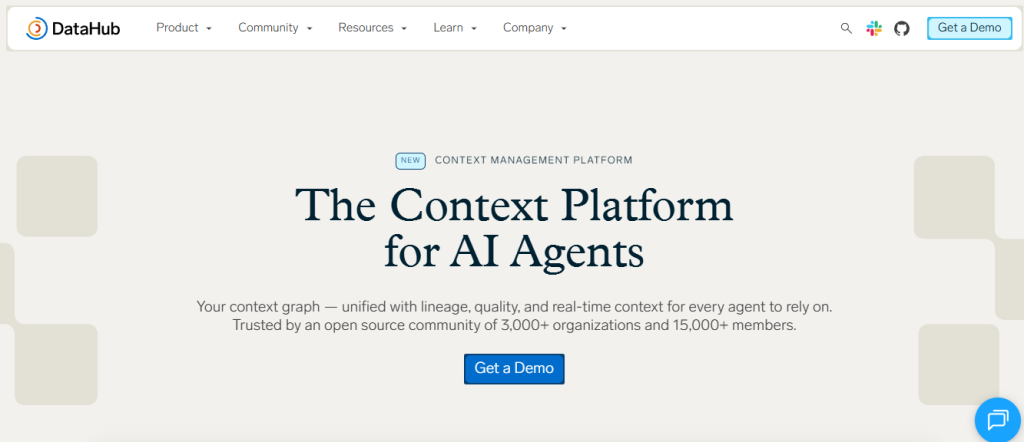
DataHub is the leading open-source metadata platform, and it has real engineering pedigree: it was originally built inside LinkedIn and open-sourced in 2020, and is now developed jointly by an active open-source community and the commercial team at Acryl Data. Thousands of organizations, including Etsy, Klarna, Peloton, and Wealthsimple, reportedly run DataHub in production. Its biggest advantage is flexibility: engineering teams can build custom ingestion connectors, self-host on their own infrastructure, and avoid vendor lock-in entirely — at the cost of needing engineering time to configure and maintain it. DataHub also ships native support for AI agents via the Model Context Protocol, positioning it as infrastructure for both human users and AI tooling.
Alation is one of the most established names in the commercial data catalog space. Its platform combines automated metadata extraction with governance workflows, and its “Compose” SQL interface lets analysts write and run queries while documentation is captured alongside the work. This keeps documentation closer to where the work actually happens instead of decaying in a separate wiki. Alation tends to suit large enterprises that need broad connector coverage, formal stewardship workflows, and vendor SLAs.
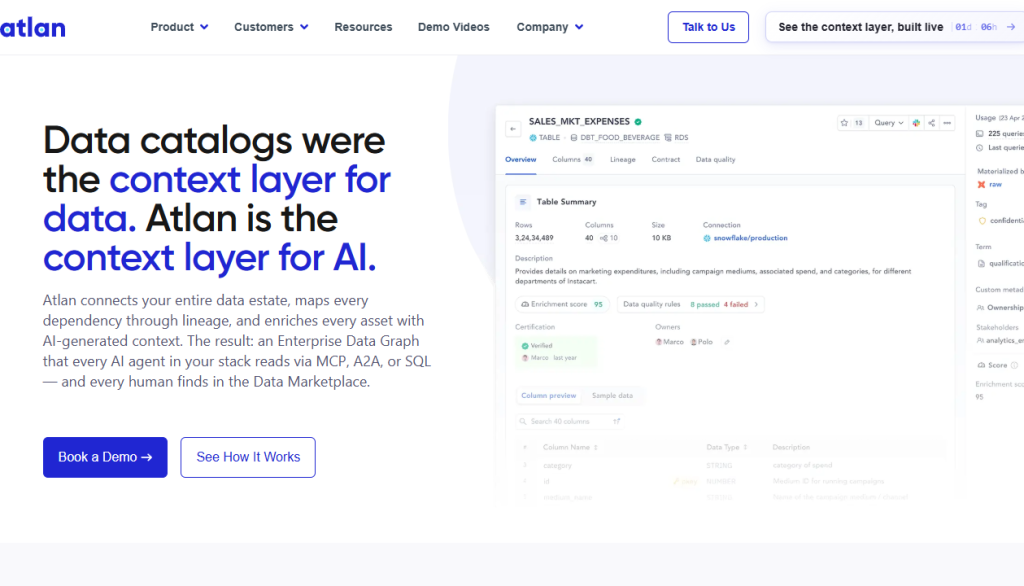
Atlan targets teams that move fast and want a lighter, more collaborative experience. Independent buyer’s guides note that Atlan was recognized as a Gartner Magic Quadrant Leader and Forrester Wave Leader in 2025, and that it emphasizes interactive, column-level lineage visualization plus deep Slack integration for in-context documentation and discovery. For SaaS teams already living in Slack, this integration can meaningfully lower the friction of getting people to actually document their data.
Data Quality and Observability Platforms: Monte Carlo and Great Expectations
Monte Carlo Data started as a data observability platform focused on detecting broken pipelines and stale data, and it has since layered a metadata catalog on top of that reliability engine. The differentiator is that Monte Carlo’s context management isn’t just “what data exists” — it’s “what data exists, and can you trust it right now.” Column-level lineage combined with automated anomaly detection means quality issues get flagged before they propagate into downstream dashboards or customer-facing features, which matters most for SaaS products where broken data directly affects the user experience.
Great Expectations, now branded GX, takes a different approach: it treats data quality tests as a form of living documentation. Teams define “Expectations” — for example, that a column should never be null, or that values must fall within a set range — and those Expectations simultaneously document what the data should look like and validate it in production. GX Core is the free, open-source Apache 2.0-licensed engine (Python-based, popular in Jupyter and dbt workflows), while GX Cloud, which reached public preview in 2024, adds enterprise governance, collaborative workflows, and automated notifications on top of it. It’s worth noting GX underwent a major version change in 2024 (GX 1.0), which introduced breaking API changes from earlier releases — a detail worth checking if you’re evaluating GX against existing pipeline code.
Governance-First and Growing-Team Options: Collibra and Secoda
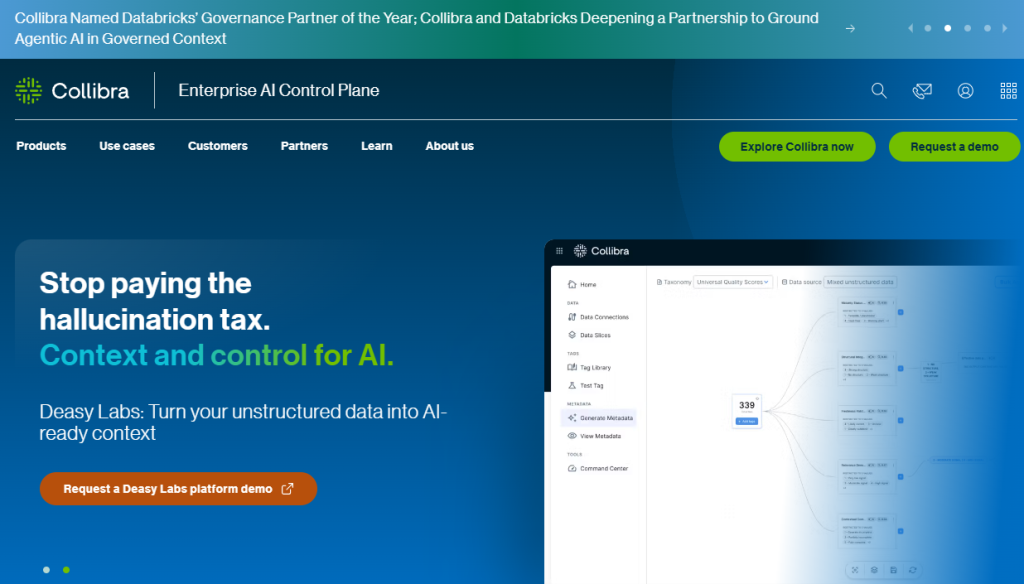
Collibra is built for organizations where governance, not discovery, is the primary requirement. It centers on policy management, data stewardship, and compliance workflows — the kind of structure needed for GDPR, CCPA, or industry-specific data residency rules. Third-party buyer research describes Collibra’s business glossary and AI-assisted classification as strong differentiators for large, regulated enterprises, alongside deep integrations with Snowflake, BigQuery, SAP, and major cloud providers. The tradeoff is implementation complexity: Collibra typically demands more setup and ongoing maintenance than lighter platforms, and it’s usually overkill for an early-stage SaaS company without formal compliance obligations.
Secoda is a better fit for fast-growing teams that want a working catalog without an enterprise rollout. Independent research describes Secoda as one of the fastest-deploying commercial catalogs available, with most teams reaching production in one to two weeks (compared with six-plus weeks for enterprise platforms), AI-generated documentation, and a Slack-native search experience. One important update for anyone evaluating Secoda: Atlassian announced its acquisition of Secoda in December 2025, with plans to fold its cataloging technology into Atlassian’s Teamwork Graph and Rovo AI over time. As of mid-2026 Secoda still operates under its own brand with the founding team in place, but teams evaluating it long-term should confirm the migration roadmap and pricing directly with the vendor before committing.
Build vs. Buy: Custom Internal Solutions
Some organizations skip vendor platforms entirely and build internal tools using their data warehouse’s information schema, a lightweight wiki, and a thin custom API layer. The appeal is a precise fit to existing workflows with no licensing cost. The tradeoff is ongoing engineering maintenance — every schema change, every new integration, and every bug becomes your team’s responsibility rather than a vendor’s.
This path tends to make sense only for organizations with genuinely unique data architecture, strict compliance needs that off-the-shelf tools don’t cover well, or spare engineering capacity that isn’t better spent on the core product. For most growing SaaS companies, an existing platform — even a lightweight one — gets you to value faster and cheaper than building and maintaining your own.
How to Choose the Right Platform
Start with your team’s technical maturity. Engineering-heavy teams tend to gravitate toward DataHub or a custom build; teams with a large share of non-technical stakeholders usually need the polish of Alation or Atlan to get real adoption.
Next, map your integration requirements. List every system that needs to feed metadata into the catalog — Snowflake, dbt, Looker, Tableau, custom pipelines — and check each platform’s connector coverage before you commit, since retrofitting connectors later is expensive.
Then assess how much governance you genuinely need today, not in some hypothetical future state. A five-person analytics team doesn’t need Collibra’s compliance workflows; a healthcare or fintech SaaS company handling regulated data almost certainly does.
Finally, weigh cost against implementation speed. Commercial platforms cost more but get you live faster — often weeks rather than months. Open-source options like DataHub or GX Core cost nothing in licensing but require real engineering time to deploy and maintain. Whichever platform you choose, start with your most critical datasets, assign clear ownership for each one, and keep documentation friction low with templates and minimal required fields — momentum builds fastest when people see value quickly. For a broader look at how this fits into your overall data foundation, see our guide to data strategy for startups.
Conclusion
There’s no universal “best” context management platform — the right choice depends on your team’s technical maturity, governance obligations, and budget. Technically strong teams that want full control should look at DataHub or a custom build. Fast-moving teams that need adoption without enterprise overhead should consider Atlan or Secoda. Large, regulated enterprises should evaluate Collibra or Alation. And teams where data reliability is the core concern should prioritize Monte Carlo or GX. Whichever direction you take, the goal is the same: stop losing hours to the question “what is this dataset, and can I trust it?” For more on building the data foundation your SaaS product runs on, check out our related coverage on B2B SaaS and AI products.
Sources: DataHub GitHub documentation, Alation product overview, Atlan 2026 Data Catalog Tools Guide, GX (Great Expectations) platform overview, Data Stack Index Secoda profile — July 2026.