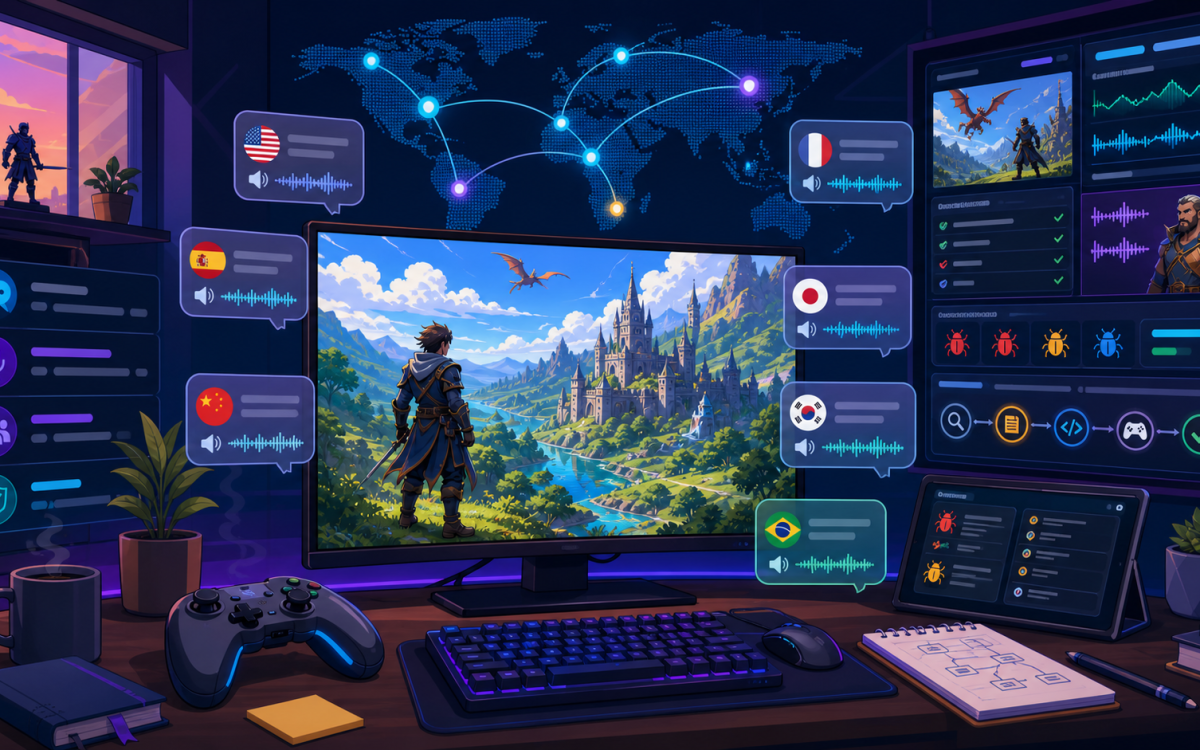
Ship a game in one language, and one language is the whole audience it reaches — which is almost never the audience the studio was after. Modern games sell across dozens of countries to players who expect the menus, dialogue, and store page in their own language. Skip localization and you’re not just limiting reach; you’re handing those players to competitors who invested in it.
Done well, game localization goes far beyond swapping one set of words for another. It adapts interface text, voice-over, on-screen graphics, currency and date formats, store listings, age ratings, and cultural references so the experience feels native rather than imported. A literal translation that ignores context can break immersion — or land as unintentionally comic. That’s why studios rely on localization specialists rather than generic translation tools.
The real question isn’t whether to localize, but who should do it. The market broadly divides into self-service platforms, full-service localization studios, and hybrid approaches that combine both. Here’s what each offers, a rundown of the leading providers, and how to choose the right fit.
What actually makes the difference
Before any vendor names, ask three questions about your own game: How is it built? How often does it change? And how much of this do you genuinely want to handle yourself?
Start with file formats. If a service can’t read your engine’s output — Unity, Unreal, or whatever you ship — nothing else matters. Then pipelines. Continuous localization that pulls new strings automatically will save your sanity; the manual export-and-email routine will slowly grind it down. Then people. Do their linguists actually play games? Can they handle voice-over? Will they test inside the build?
Budget and scope draw the edges, too — a story-heavy AAA dub and a small indie text patch aren’t remotely the same job. And weigh speed against quality honestly: fast-but-sloppy isn’t fast, it’s just cleanup booked in for later.
Self-service localization platforms
These give your team the infrastructure to run localization as part of development, usually topped up with freelance or agency linguists for the actual translating.
Crowdin
Crowdin is a cloud-based localization management platform used by studios of every size, from solo indies to major publishers, and acts as a single source of truth for every translatable string. It handles the formats games actually ship — Unity and Unreal resource files, JSON, XML, .strings, .po, and more — and connects to GitHub, GitLab, and CI pipelines so new strings flow into translation automatically as the build evolves. Translators work in an in-context editor with screenshots and comments, cutting the guesswork that produces awkward in-game text. It also supports machine translation, translation memory, glossaries, a marketplace of integrations and professional translation vendors, and crowdsourcing for community projects.
Best for: teams that want a scalable, transparent hub wired into their pipeline.
Lokalise
Developer-first, and popular with mobile and indie teams. A clean editor sits on top of serious automation — webhooks, a full API, and CLI tooling that slots into a build pipeline without a fight. Translators see exactly where a string lands thanks to screenshots and previews, and built-in checks catch length overflows and broken placeholders before a player ever does. You can order professional translation inside the platform, and branching workflows cover you when you’re shipping updates constantly.
Best for: developer-led teams that value a tidy interface and quick setup.
Phrase
You may know it by its earlier names, Memsource and PhraseApp — same lineage, built for scale. It combines string management with a full translation management system, heavy automation, and proper orchestration of translation memory and machine translation. The appeal is governance, analytics, and routing work between in-house and outside linguists without the wording drifting apart. Nobody picks Phrase for lightweight indie speed; you pick it when the problem is dozens of products, not one.
Best for: studios running many titles across many languages at once.
Smartcat
A platform with a freelancer marketplace built in — which solves a real problem: what if you don’t have translators of your own? You run the project, run AI over the first pass, and hire and pay vendors in one workspace, with no separate procurement or invoice-chasing. AI handles the rough draft; humans fix tone and the cultural nuance machines still fumble.
Best for: small teams that want tooling and talent in the same window.
Gridly
A different angle entirely. Built for games by LocalizeDirect (the Swedish studio behind it, founded 2009), Gridly behaves like a spreadsheet — essentially a headless CMS for strings and game data — and keeps localized text lined up with everything else a live game juggles: item descriptions, branching dialogue, and more. With version control, strong APIs, and engine integrations, it shines once you’re shipping a live-service title that patches constantly and can’t have localization lagging behind. Treat localization as structured content rather than a pile of loose files, and the payoff shows up on every update.
Best for: live-service and data-heavy games with frequent updates.
Keywords Studios
One of the giants. Localization is just one line on a menu that also runs to audio and voice-over, functional and localization QA, art, and player support. For an AAA publisher pushing a huge title out in dozens of languages with full dubs, the appeal is obvious: scale, plus a single partner you can hold accountable across all of it. The flip side is that breadth assumes a budget to match — it fits blockbusters far more comfortably than indie projects. But when the production is enormous and the deadline won’t move, one roof over everything stops being a nice-to-have.
Best for: AAA publishers needing massive multi-service scale.
Altagram
A games localization agency (headquartered in Berlin, with offices in Seoul and Montreal) with a genuine reputation for end-to-end work: translation, linguistic testing, audio, and culturalization, handled by people who do games specifically rather than generic content. This matters most when the writing carries the game — a pun, a sharp line, a reference loaded with cultural baggage survives the jump into another language only when whoever handles it understands both the game and the audience.
Best for: studios wanting native-quality results without building an internal team.
Alconost
Focused on games, apps, and software, and comfortable with indie and mid-size studios. Beyond translation into a long list of languages, it does localization testing and even trailers and video — handy when you’re marketing a launch worldwide. It bends to smaller jobs, which makes it an easy first move for a studio localizing for the first time.
Best for: indie and mid-size studios, especially first-timers.
Picking the right approach
It comes down to scope, budget, and how the game is built.
- Platforms (Crowdin, Lokalise, Phrase, Smartcat, Gridly) suit teams that want to own the workflow and wire localization into their pipeline, usually topping up with freelance or agency linguists.
- Full-service studios (Keywords, Altagram, Alconost) suit teams that would rather hand the whole thing off.
- Plenty of studios do both — a platform as the hub, an agency for the linguistic heavy lifting.
Match the tool to your engine, your patch cadence, and the languages that genuinely bring in revenue. Then start early — early enough that localization travels alongside development instead of sprinting to catch up after release.
Frequently asked questions
Is game localization the same as translation?
No. Translation swaps text from one language into another. Localization reworks the whole experience — interface, audio, graphics, currency, formatting, cultural references — so the game feels like it was made there. Translate literally and it can feel imported, or break the mood, the moment context is ignored.
How much does game localization cost?
It depends on word count, number of languages, whether there’s voice-over, and how much testing the title needs. An indie text-only job can be quite cheap, while a AAA release with full dubs across a dozen-plus languages can run into six or seven figures. Text is usually priced per word; audio per hour or per line.
Should I use a platform or an agency?
Want to run the workflow and bake localization into your build? A platform. Want to hand the whole job over? An agency. Many studios use both — platform as the hub, agency for translation and testing.
When should I start localizing my game?
As early as you can. Externalize your strings, leave room for text to expand, and support different scripts from the start — all of it costs far less now than retrofitted later. Hook up a platform during development and new text flows into translation as you go.
Can AI replace human game localizers?
AI has come a long way, and for first drafts, large volumes, and low-stakes text it genuinely earns its place. But humor, character voice, and cultural nuance still trip it up, so humans remain essential for narrative-heavy, flagship work. The pattern that’s stuck: AI for speed, humans for quality.
The bottom line
There’s no single best localization service — only the right one for your title’s scope, engine, and ambition. Platforms give you the infrastructure to run localization as a continuous part of development; full-service studios take the whole thing off your hands. The studios that get this right treat localization as part of making the game, not a box ticked at the end: they pull text out early, build in room for it to expand, and pick tools that fit how the game actually ships and updates. Nail those basics, find a partner that suits your budget and pipeline, and a game built in one language can reach players everywhere that counts.
Vendor capabilities, pricing, and integrations change frequently — confirm current details with each provider before committing. Company names and products mentioned are for informational purposes and do not constitute endorsements.