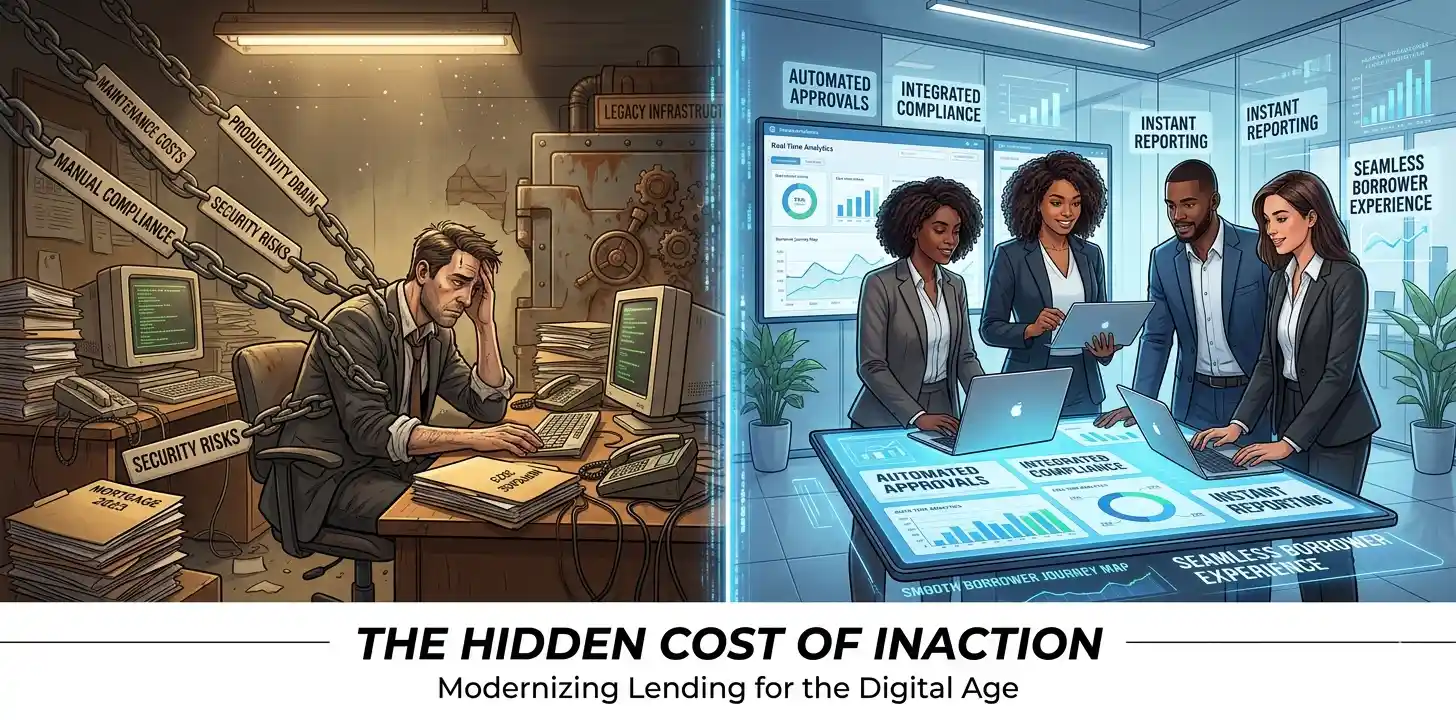
Most lenders know their legacy systems are not ideal. What they underestimate is how much those systems are actually costing them. Switching to a modern digital lending platform is often treated as a future upgrade, something to plan for eventually. But the longer that decision is deferred, the more the costs of staying put accumulate quietly across multiple parts of the business.
These costs rarely show up as a single line item. They are distributed across IT budgets, compliance overheads, lost productivity, and missed revenue, which is precisely what makes them so easy to ignore until they become impossible to.
The Maintenance Budget That Crowds Out Everything Else
The most visible cost of legacy infrastructure is the proportion of IT budget it consumes. Global financial institutions spent $36.7 billion maintaining outdated payment systems in 2022, a figure projected to rise to $57.1 billion by 2028, according to IDC Financial Insights. That is an average annual growth rate of 7.8%, not on innovation, but on keeping old systems running.
Deloitte research found that IT departments at financial institutions allocate over 55% of their technology budgets to maintaining existing operations, with only 19% directed toward new development. McKinsey estimates that only 5 to 10 cents of every technology dollar actually generates new business value, with the remainder going toward patching and upkeep.
For lending operations, this creates a compounding problem. Every dollar spent maintaining a legacy origination or servicing system is a dollar not spent on automation, analytics, or borrower experience. Over time, the gap between what a lender can offer and what modern competitors can offer widens considerably.
Compliance Costs That Should Not Exist
Legacy lending systems were not designed for the compliance environment lenders operate in today. Regulatory reporting has grown significantly more demanding, and systems built decades ago often cannot generate the audit trails, data outputs, or real-time monitoring that regulators now expect.
The result is manual compliance work, where teams spend hours extracting data from multiple systems, reconciling inconsistencies, and building reports that a modern platform would generate automatically. As a result of this, manual errors and mistakes are likely to slip in. For context, global financial institutions paid over $10.4 billion in fines for non-compliance in 2020 alone, with a significant portion attributed to inadequate systems, according to Fenergo.
Beyond fines, there is the opportunity cost. Compliance teams occupied with manual reporting are not working on risk management or portfolio strategy. Their capacity is being consumed by the limitations of the infrastructure beneath them.
The Productivity Drain on Lending Teams
Legacy systems impose a daily tax on the people who use them. Manual data entry between platforms, re-keying information from origination into servicing, and chasing records scattered across disconnected tools are not occasional inconveniences. They are built into the workflow.
Traditional lenders often take between six and 18 months to bring new loan products to market. Digital-first competitors can launch comparable offerings in two to three months. That gap does not come from having more people. It comes from having infrastructure that does not require months of custom development every time a product or policy changes.
Security Exposure That Grows Over Time
Older lending systems accumulate security risk in ways that are difficult to quantify until something goes wrong. They were not built with modern threat models in mind, and retrofitting security onto aging architecture is both expensive and incomplete.
Data breaches in financial institutions cost an average of $6.08 million, above the cross-industry average of $4.88 million, according to IBM’s Cost of a Data Breach Report. Institutions running legacy infrastructure face higher exposure because patching vulnerabilities in poorly documented codebases is slow and unreliable. Security updates that take hours in a modern platform can take weeks in a legacy environment.
The risk compounds every year that modernization is deferred. When a breach does occur, the cost extends well beyond the incident itself, bringing regulatory scrutiny, operational disruption, and lasting damage to borrower trust.
The Competitive Cost of Standing Still
Beyond direct costs, legacy infrastructure extracts a strategic toll. Lenders unable to configure new loan products quickly, integrate with modern data providers, or offer borrowers a smooth digital experience are losing ground to competitors who can.
The lenders gaining portfolio share are those who have replaced that embedded friction with platforms that automate origination, unify servicing and collections data, and give borrowers transparent, real-time access to their loan information.
The Cost of Inaction
Legacy lending infrastructure tends to feel manageable right up until it does not. The costs are real but accumulate slowly enough that each year’s status quo feels defensible. What is harder to see is the total picture: the maintenance budget, the compliance overhead, the productivity drag, the security exposure, and the competitive ground lost, all running simultaneously.
Modernization has its own challenges, but the financial case for it has never been clearer. For lenders still running on aging infrastructure, the question is no longer whether the cost of staying is real. It is how much longer it is worth paying.
Concluding Remarks
Legacy lending infrastructure is rarely a crisis. It is a slow drain, taking a percentage of budget here, a few hours of productivity there, a compliance gap that surfaces only when a regulator asks. The lenders who recognize this pattern early are the ones who modernize on their own terms, rather than being forced into it by a breach, a regulatory action, or a competitor who moved faster.
The cost of staying is real. The only question is how long it goes uncounted.