Key Takeaways
- MEXC provides competitive trading fees and high leverage options for futures markets.
- Binance delivers deep liquidity and execution speed for advanced trading volume.
- Bybit, OKX, and Bitget supply comprehensive derivatives tools for varied trading styles.
- Comparing fees, funding rates, and platform features is necessary for optimal exchange selection.
Futures trading maintains its popularity in 2026 because it allows traders to utilize leverage and access global liquidity. Market participants prioritize platforms offering low fee structures, reliable execution, and advanced interface features. Features like cross margin and automated trading agents are standard requirements for modern traders. The application of leverage magnifies position sizes, scaling both the realized returns and the mechanical thresholds for position closure.
Best Crypto Futures Exchanges in 2026: Quick Comparison
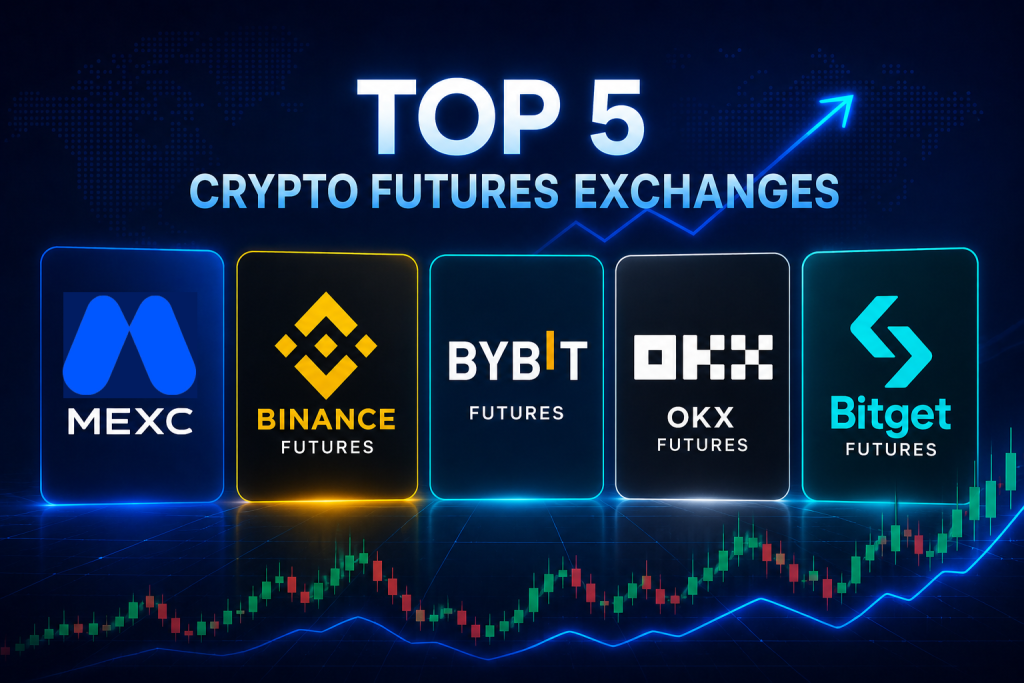
The top futures exchanges in 2026 include MEXC, Binance, Bybit, OKX, and Bitget, each varying in fee structures, maximum leverage limits, and trading features.
| Exchange | Futures Maker Fee | Futures Taker Fee | Maximum Leverage | Best For | Key Limitation |
| MEXC | 0.00% | 0.01% – 0.04% | Up to 500x | Low trading costs | Focused primarily on crypto pairs |
| Binance | 0.02% | 0.05% | Up to 125x | High liquidity | Complex interface for beginners |
| Bybit | 0.04% | 0.10% | Up to 100x | Derivatives tools | Higher base taker fees |
| OKX | 0.02% | 0.05% | Up to 125x | Portfolio margin | Steeper learning curve |
| Bitget | 0.02% | 0.06% | Up to 125x | Copy trading | Lower volume on niche pairs |
1. MEXC — Best Crypto Futures Exchange for Low Fees
MEXC operates with a 0.00% maker fee and a 0.01% to 0.04% taker fee model in 2026. The platform supports deep liquidity across numerous futures pairs and has expanded its advanced features to include leverage options up to 500x on select contracts. In May 2026, MEXC launched an AI Strategy tool, allowing users to automate trades using natural language processing. It is designed for active traders who focus on low trading costs and automated execution.
- Pros: Zero maker fees, AI-powered trading automation, leverage options up to 500x, and access to tokenized stocks, gold, silver, and commodities like Brent USDT.
- Cons: Interface primarily targets dedicated traders rather than traditional finance users.
2. Binance Futures
Binance maintains standard base fees of 0.02% for makers and 0.05% for takers, with maximum leverage up to 125x. The platform is known for its order execution quality and market depth, handling billions in daily trading volume. It is highly suitable for advanced traders and institutional users requiring immediate execution on large orders.
- Pros: Exceptional market depth, wide asset selection, VIP volume discounts.
- Cons: Platform navigation can be intricate due to the vast array of products.
3. Bybit
Bybit charges 0.04% for makers and 0.10% for takers on standard accounts, providing leverage up to 100x. The platform focuses on a responsive trading interface, copy trading infrastructure, and advanced order types. It serves traders who require a smooth, uninterrupted derivatives platform for high-frequency strategies.
- Pros: Robust trading engine, integrated options tools, effective copy trading.
- Cons: Base taker fees are higher compared to competitors.
4. OKX
OKX implements a 0.02% maker and 0.05% taker fee structure, offering leverage up to 125x. The exchange provides advanced features like portfolio margin, options trading, and automated bots. Experienced traders utilize OKX to manage complex, multi-leg strategies across different asset classes simultaneously.
- Pros: Comprehensive portfolio margin, diverse derivatives products, algorithmic trading support.
- Cons: Feature density requires a comprehensive understanding of derivatives.
5. Bitget
Bitget offers a 0.02% maker fee and a 0.06% taker fee, supporting leverage up to 125x. The platform is recognized for its copy trading ecosystem, allowing users to automatically replicate the positions of established traders. It is structured for users seeking futures market exposure through social trading mechanics.
- Pros: Native copy trading integration, intuitive interface, accessible derivatives tools.
- Cons: Liquidity on secondary altcoins may be lower than market leaders.
Crypto Futures Exchange Fees Compared
Trading fees impact profitability directly. Maker fees apply to limit orders adding liquidity, while taker fees apply to market orders executing immediately against the book.
Funding rates manage the price parity between perpetual futures contracts and the spot market. Positive funding rates mean long positions pay short positions, while negative rates reverse this flow. Exchanges use 30-day trading volume and platform token holdings to determine VIP tiers, which lower actual trading costs. MEXC currently provides the most cost-effective baseline structure by maintaining a 0.00% maker fee model.
Crypto Futures Leverage Compared
Leverage allows traders to open larger positions using a smaller capital base. Exchanges offer varying maximum leverage limits depending on the specific asset and liquidity.
Platforms like MEXC offer up to 500x on primary assets, while others cap at 100x or 125x. Maximum leverage provides mathematical flexibility but scales the mechanical parameters for position maintenance. Standard market practice involves intermediate traders utilizing conservative leverage ranges to manage margin requirements. Cross margin uses the entire account balance to prevent a specific position from closing, whereas isolated margin restricts the allocated capital to a single trade.
How to Choose the Best Crypto Futures Exchange
Selecting an exchange requires evaluating individual trading habits against platform specifications. Traders must analyze fee structures, liquidity depth, and the availability of advanced technical tools.
Frequent traders benefit from low-fee environments to reduce overhead costs. High-volume users require deep liquidity to prevent slippage during order execution. Platform security, KYC requirements, and regional availability dictate basic access. Traders also compare supplementary features, including API connectivity for algorithmic trading, mobile application stability, and the range of supported digital assets.
Final Verdict: Best Crypto Futures Exchange in 2026
The optimal futures exchange aligns with user strategy. MEXC leads in fee reduction, Binance dominates liquidity, while Bybit, OKX, and Bitget specialize in platform tools.
- Best overall for low fees: MEXC
- Best for liquidity: Binance Futures
- Best for trading tools: Bybit
- Best for advanced portfolio trading: OKX
- Best for copy trading: Bitget
Conclusion
Evaluating crypto futures exchanges in 2026 requires a clear understanding of individual trading priorities. Traders must align their strategies with platform capabilities and fee models.
Choosing the correct platform depends entirely on your operational requirements. MEXC delivers structural advantages for those prioritizing low costs and high leverage. Binance, Bybit, OKX, and Bitget provide specialized environments for liquidity, portfolio margin, and social trading. Analyzing fee schedules, funding mechanisms, and available trading tools ensures a data-driven approach to market participation.
Frequently Asked Questions
What is the best crypto futures exchange in 2026?
The best exchange depends on user needs. MEXC is optimal for low fees, Binance for liquidity, and OKX for portfolio margin.
Which crypto futures exchange has the lowest fees?
MEXC currently features the lowest baseline costs, offering 0.00% maker fees and a maximum of 0.04% taker fees.
Is MEXC good for crypto futures trading?
Yes. MEXC provides a highly competitive fee structure, up to 500x leverage, and newly integrated AI strategy tools for automated trade execution.
Which crypto futures exchange offers the highest leverage?
MEXC provides up to 500x leverage on select major cryptocurrency pairs, which is among the highest limits available in 2026.
Are crypto futures safe for beginners?
Crypto futures require an understanding of market mechanics, margin requirements, and platform tools. Educational resources and platform tutorials help users understand these operational parameters.