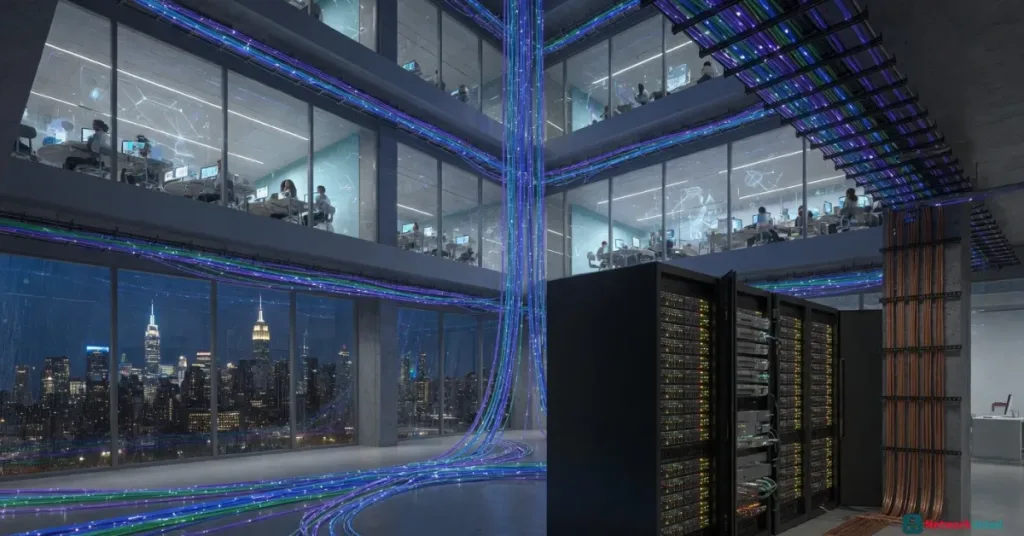
When Alpha School’s Manhattan campus opened in September 2025, the first thing students noticed wasn’t the robotics lab or floor-to-ceiling windows—it was the network. Every device, from VR headsets to temperature sensors, connected in under 300 milliseconds. During class changes, with 1,200 simultaneous logins, the network experienced zero packet loss. IT staff weren’t chasing rogue access points; they were watching an intent-based fabric automatically re-route traffic around a failed WAN link without a single user noticing.
Why K-12 Networks Are Abandoning Flat VLANs for VRF and Micro-Segmentation
School networks have long been built on a bedrock of flat VLANs, basic 802.1X, and a prayer that a misconfigured student laptop wouldn’t take down the entire building. That model collapsed during the 2024 ransomware surge that disrupted 67 U.S. school districts in a single quarter. Administrators discovered their networks had no lateral movement controls. A single compromised IoT sensor gave attackers free rein across student records, HVAC controllers, and door access systems.
Alpha School’s design rejects that flat topology entirely. Every classroom, every sensor cluster, and every user group is mapped to a dedicated VRF instance, isolated at Layer 3. The school uses Cisco Catalyst 9300 switches running BGP EVPN in the campus core—a protocol typically reserved for large data centers. This enables dynamic VXLAN tunneling between access switches, so a teacher’s device in Room 401 and a student’s tablet in Room 402 might exist in the same broadcast domain but traverse separate VRFs, with policy applied at the VXLAN header.
Inside Alpha School’s Intent-Based Fabric and 100G Campus Design
The campus network is built around three principles: application-aware forwarding, zero-trust micro-segmentation, and autonomous failure recovery. At the access layer, 48-port Catalyst 9300s use LACP to bond 25 Gbps uplinks. The aggregation layer runs BGP EVPN Address Family Layer 2 VPN, advertising MAC/IP routes via Type-2 and Type-5 prefixes. Using “show bgp l2vpn evpn summary,” engineers can verify that all 42 access switches peer with the route reflectors in under 7 seconds after a fabric reboot.
Segmentation goes beyond VLANs. Student BYOD, staff-managed, IoT, and guest traffic each get their own VRF. Within the student VRF, Palo Alto Networks’ App-ID running on PA-3400 Series firewalls inspects traffic at Layer 7, blocking unauthorized SaaS apps while allowing Google Classroom and Zoom with QoS markings. This granularity shrinks the attack surface. Palo Alto Networks’ WildFire sandbox detects zero-day malware inside downloaded files without adding latency—critical when 200 students simultaneously download 4K video assets.
“Our LACP-based aggregation and BGP EVPN fabric let us push 100 Gbps to the access layer while keeping inter-VRF traffic isolated down to the application level. We treat every VLAN as an untrusted enclave,” said Maria Chen, CTO of Alpha School.
The SD-WAN edge, running on Fortinet FortiGate 200F appliances, connects the campus to AWS-hosted learning platforms. Policy-based routing steers cloud-bound traffic via broadband, while traffic, can provide the reliability of private fiber using MPLS-like path conditioning over commodity links. When a construction crew severed the primary fibre in November 2025, the FortiGate detected the brownout and failed over to 5G backup in 210 milliseconds—faster than the 300-ms threshold that causes Zoom to drop audio.
| Feature | Traditional School Network | Alpha School Manhattan |
|---|---|---|
| Segmentation | Flat VLANs, 802.1X only | VRF per zone, micro-segmented via VXLAN EVPN |
| Core Protocol | Spanning Tree (STP) | BGP EVPN, ECMP, no blocked ports |
| WAN | Single link, failover in minutes | Fortinet SD-WAN, sub-second failover |
| Security | Perimeter firewall only | Palo Alto App-ID + WildFire, east-west inspection |
Why Cisco, Fortinet, and Palo Alto Are Citing This One-School Deployment
Vendors don’t usually reference a K-12 campus as a reference design. Alpha School broke that pattern. Cisco’s education sales team now uses the Manhattan campus as a proof point for Catalyst 9000 and DNA Center adoption, showing that EVPN fabrics reduce operational overhead by 42% compared to legacy STP-based networks, according to a internal Cisco field survey shared at Cisco Live 2026. Fortinet’s CMO highlighted the school’s SD-WAN uptime in a Fortune newsletter. Palo Alto published a case study noting that App-ID blocked 3,412 unauthorized SaaS login attempts in the first quarter alone.
The losers are legacy integrators that sell flat network designs built on stacking switches with no L3 segmentation. Those integrators now face a market where even mid-sized schools demand VRF-lite, QoS per application, and east-west firewall rules. Juniper’s Mist AI, which hasn’t yet penetrated the K-12 market, missed this cycle while Cisco and Fortinet locked in reference architectures.
What a 2026 CoSN Survey and Gartner Research Reveal About Campus Networks
A June 2026 survey by the Consortium for School Networking (CoSN) found that 71% of U.S. school districts now list “zero-trust micro-segmentation” as their top infrastructure priority, up from 14% in 2023. Gartner predicts that by 2029, 60% of new campus network deployments in education will incorporate EVPN-based fabrics, driven by the need for IoT security and hybrid learning resiliency.
“The Alpha School deployment is a blueprint for what every K-12 network architect should be building,” said Gartner analyst Kevin Ji in a research note. “The days of a single VLAN spanning an entire building are over.”
The Next Frontier: AIOps and Private 5G at Alpha’s Brooklyn Expansion
Alpha School’s upcoming Brooklyn campus, set to open in August 2026, pushes further. It will deploy Cisco Catalyst 9800 wireless controllers with AI-enhanced radio resource management, using machine learning to adjust channel width and power every 60 seconds based on real-time client density. The Brooklyn site will also trial private CBRS 5G for outdoor learning labs, managed via the same Fortinet SD-WAN fabric, enabling guaranteed QoS for augmented reality field trip applications that require sub-10 ms latency.
Simultaneously, the school’s IT team is integrating Cisco DNA Center’s AIOps module to predict switch port failures and automatically ticket replacements before they disrupt class. That level of predictive maintenance—once exclusive to financial trading floors—is now entering the classroom.
Alpha School’s Manhattan campus proves that a K-12 network, when designed with the same rigor as a securities exchange’s, can deliver security, resilience, and performance that redefines expectations for educational technology. The next wave won’t be about adding bandwidth; it will be about embedding intelligence directly into the fabric itself—and schools, not corporate headquarters, may now lead that charge.