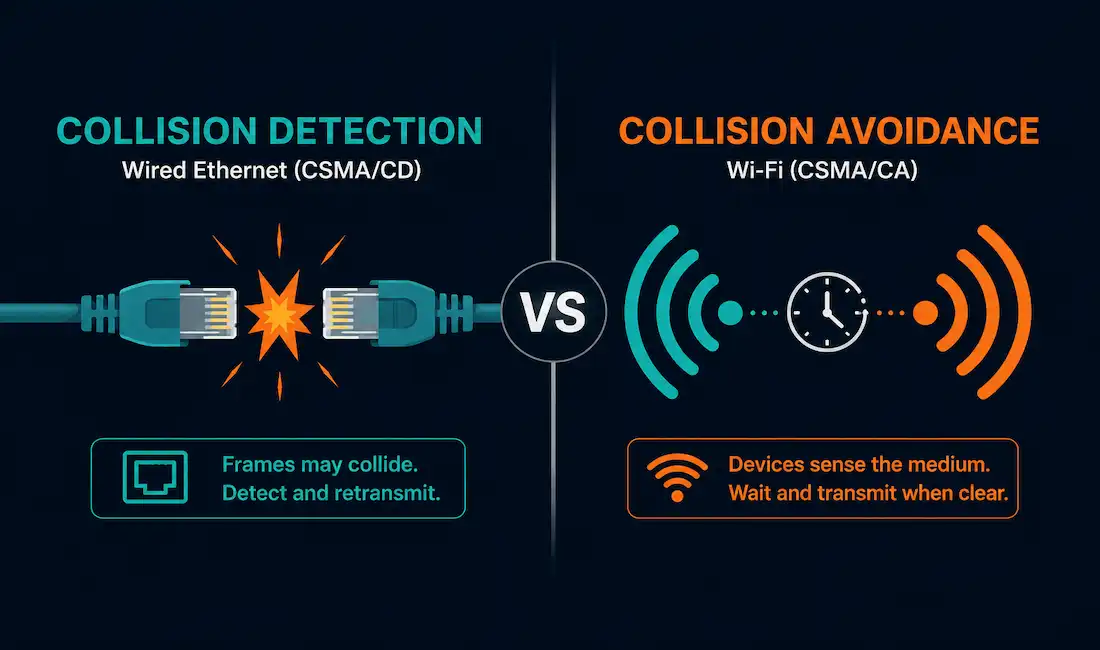
Carrier Sense Multiple Access (CSMA) is the family of media access control protocols behind both Ethernet’s collision handling and Wi-Fi’s collision avoidance. The core idea is simple: before a device transmits, it listens to the shared medium first, checking whether it’s clear. What each device does next, detect a collision after it happens, or actively avoid one before it happens, is where the two major CSMA variants diverge completely.
CSMA/CD: Carrier Sense Multiple Access with Collision Detection
CSMA/CD was the original access method for shared, half-duplex Ethernet. Here’s how it actually works, step by step:
- Carrier sensing: A device checks whether the medium is idle before attempting to transmit.
- Transmission: If the medium is clear, the device sends its frame.
- Collision detection: If another device happens to transmit at the same moment, the electrical signals collide and both frames are corrupted. Every device on the segment detects this collision while it’s happening.
- Backoff: Both devices stop transmitting immediately and wait a random amount of time before attempting to retransmit.
That backoff step isn’t just “wait a random amount of time” in a loose sense; it follows a specific algorithm called binary exponential backoff. After the first collision, a device picks a random wait time from a small window. If a second collision occurs on the retry, the window doubles, and the device picks again from that larger range. This continues, doubling the window with each successive collision, up to a defined maximum, which is exactly why a congested shared-Ethernet segment degrades so sharply under heavy load: more collisions mean progressively longer average wait times, compounding the slowdown.
CSMA/CD was necessary specifically because early Ethernet ran over a shared, half-duplex medium, connected through hubs, where every device genuinely competed for the same physical channel. Modern switched, full-duplex Ethernet gives each device its own dedicated connection to a switch port, which eliminates the shared-medium collision scenario CSMA/CD was built to handle. You’re unlikely to see CSMA/CD actively resolving real collisions on a modern network, though it remains foundational for understanding how Ethernet got to where it is today.
CSMA/CA: Carrier Sense Multiple Access with Collision Avoidance
CSMA/CA is the access method behind 802.11 Wi-Fi, including current Wi-Fi 6 and Wi-Fi 7 networks. It takes a fundamentally different approach from CSMA/CD, because wireless has a problem wired Ethernet doesn’t: a transmitting device can’t reliably detect a collision while it’s transmitting. This is sometimes called the near/far problem. A device’s own radio signal is vastly stronger at its own antenna than any incoming signal from another device, so a genuine collision happening elsewhere on the channel is effectively drowned out and undetectable to the device that’s currently sending. Detection isn’t a realistic option, so CSMA/CA is built around avoidance instead:
- Carrier sensing: The device checks whether the channel is clear, both physically (listening for a signal) and virtually, more on that below.
- Backoff: If the channel is busy, the device waits a random backoff period before checking again, rather than transmitting immediately once the channel clears.
- Transmission duration announcement: Each transmitting device includes a duration field in its frame, announcing how long it expects to occupy the channel. Other devices read this and set a Network Allocation Vector (NAV), a countdown timer that tells them the channel is effectively busy for that duration, even if they can’t physically sense an ongoing transmission. This is what “virtual carrier sensing” refers to.
- Transmission: Once the backoff counter reaches zero and the channel is genuinely clear, both physically and virtually, the device transmits.
Many CSMA/CA deployments also use an optional RTS/CTS (Request to Send / Clear to Send) handshake before the actual data transmission, particularly useful in environments prone to the hidden node problem.
The Hidden Node Problem
This is a wireless-specific issue that CSMA/CA has to account for and CSMA/CD never had to deal with. Imagine two wireless devices, A and C, both within range of access point B, but too far apart to detect each other’s signals directly.
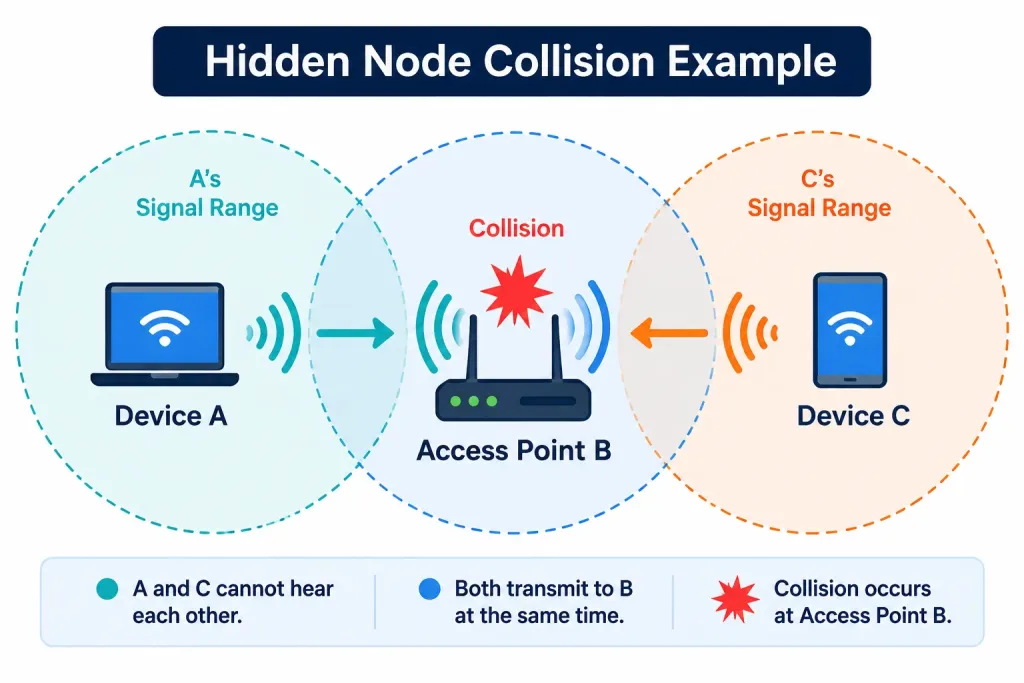
Device A senses the channel is clear, since it can’t hear C, and transmits. If C is also transmitting at that exact moment, a collision occurs at B, even though neither A nor C could sense the other to avoid it in the first place. RTS/CTS handles this by having the transmitting device first send a short RTS frame; the access point replies with a CTS frame that all nearby devices, including ones the original sender couldn’t hear, can detect and use to hold off transmitting for the announced duration. This adds a small amount of overhead but meaningfully reduces collisions in exactly the topology where CSMA/CA’s normal carrier sensing alone would fail.
Comparing CSMA/CD and CSMA/CA
| Feature | CSMA/CD | CSMA/CA |
|---|---|---|
| Network type | Wired (legacy shared Ethernet) | Wireless (Wi-Fi, 802.11) |
| Collision handling | Detects collisions after they occur, then retransmits | Avoids collisions before transmitting |
| Core mechanism | Binary exponential backoff after a detected collision | Random backoff plus virtual carrier sensing (NAV) |
| Specific wireless issue addressed | Not applicable | Hidden node problem, via optional RTS/CTS |
| Relevance today | Largely historical; modern switched Ethernet doesn’t rely on it | Actively in use on every Wi-Fi network |
Why CSMA Still Matters
Even though CSMA/CD is mostly historical on modern wired networks, understanding both variants clarifies something important: the two didn’t diverge by accident. CSMA/CA’s design decisions, avoidance instead of detection, virtual carrier sensing via NAV, and the hidden node problem it has to account for, are all direct consequences of wireless being a fundamentally different physical medium than wired Ethernet. A protocol designed for wired collision detection genuinely wouldn’t work correctly if applied unmodified to wireless, which is exactly why Wi-Fi needed its own distinct approach rather than reusing Ethernet’s. That distinction is worth internalizing beyond just memorizing it for a certification exam, since it explains a lot about why wired and wireless troubleshooting approaches diverge in practice too.
Troubleshooting CSMA-Related Issues
High collision counters on a modern switch port. This shouldn’t happen on a correctly configured full-duplex connection. A duplex mismatch, one end set to full-duplex and the other to half-duplex, is the classic cause and is worth checking first. Interface statistics that show a mix of late collisions and CRC errors specifically point toward duplex mismatch rather than a genuine shared-medium collision scenario, which is worth distinguishing before assuming a cabling problem.
Wireless throughput dropping sharply in a crowded environment. This is expected CSMA/CA behavior: more contending devices means more time spent in backoff and less time transmitting, even with strong signal strength. Distributing devices across multiple access points on non-overlapping channels usually helps more than troubleshooting any single device.
Intermittent wireless packet loss between two specific devices, despite both showing a strong connection to the access point. This pattern is a classic sign of the hidden node problem, where the two devices can’t hear each other directly even though both can hear the access point. Enabling RTS/CTS, particularly for the affected devices, often resolves this specific symptom where general troubleshooting steps won’t. Worth noting: RTS/CTS adds overhead to every affected transmission, so it’s a targeted fix for confirmed hidden-node scenarios rather than something to enable network-wide by default.
Real-World Performance Implications
The practical impact of choosing between detection and avoidance shows up most clearly under load. A shared CSMA/CD Ethernet segment under heavy traffic experiences what’s sometimes called collision domain saturation: as more devices contend for the same medium, collision frequency rises, binary exponential backoff windows grow, and effective throughput can drop well below the segment’s nominal bandwidth, even though no single device is transmitting constantly. This is one of the concrete, measurable reasons switched Ethernet replaced shared-medium Ethernet outright rather than just being a nice-to-have upgrade; eliminating the shared collision domain removes this entire failure mode.
CSMA/CA faces a related but distinct challenge. Because avoidance mechanisms, backoff waiting, NAV countdowns, and optional RTS/CTS exchanges, all consume airtime without carrying actual payload data, a wireless channel with many contending devices spends a growing share of its total capacity on overhead rather than data. This is why Wi-Fi performance in a crowded environment, like a conference hall or apartment building with dozens of overlapping networks, degrades noticeably faster than raw device count alone would suggest. It’s not that any individual connection is broken; it’s that the channel’s total available airtime is being divided among an increasing number of competing avoidance cycles.
Choosing an Approach Isn’t Really a Choice
It’s worth being clear that network engineers don’t actually pick between CSMA/CD and CSMA/CA independently the way they might choose between two competing protocols with similar tradeoffs. The access method is bundled into the underlying technology: deploy switched Ethernet and CSMA/CD is essentially irrelevant to your operation; deploy Wi-Fi and CSMA/CA applies by definition. The real design decisions that matter in practice are things like access point placement, channel selection, and whether RTS/CTS is worth enabling for a specific environment, all of which sit on top of CSMA/CA rather than replacing it.
CSMA/CA is genuinely live and active every time a Wi-Fi device transmits; it’s not legacy at all, and the mechanisms described above are running constantly, invisibly, on essentially every wireless connection in use today.
Frequently Asked Questions
What is Carrier Sense Multiple Access (CSMA)?
CSMA is a family of media access control protocols where a device listens to a shared network medium before transmitting, checking whether it’s currently in use. Its two major variants, CSMA/CD and CSMA/CA, differ in how they handle the possibility of a collision, detecting it after the fact versus avoiding it beforehand.
What’s the real difference between CSMA/CD and CSMA/CA?
CSMA/CD, used in legacy shared Ethernet, lets a collision happen and then has both devices back off and retry using binary exponential backoff. CSMA/CA, used in Wi-Fi, is built to avoid the collision entirely beforehand, since a wireless device can’t reliably detect a collision while it’s actively transmitting due to the near/far problem.
Is CSMA/CD used on modern networks?
Not in any active sense on properly configured modern equipment. Switched, full-duplex Ethernet gives each device a dedicated connection to its switch port, which removes the shared-medium scenario that made collision detection necessary in the first place, though CSMA/CD remains an important concept for understanding Ethernet’s history and certification material.
What is the hidden node problem?
The hidden node problem occurs when two wireless devices can both reach the same access point but can’t detect each other’s transmissions directly, meaning each device’s carrier sensing fails to prevent a collision at the access point. It’s addressed through mechanisms like the RTS/CTS handshake, which lets an access point signal all nearby devices to hold off, even the ones that couldn’t hear the original transmitting device.
What is the Network Allocation Vector (NAV) in CSMA/CA?
The NAV is a countdown timer each wireless device maintains based on the duration field announced in other devices’ transmissions, effectively a form of virtual carrier sensing. It lets a device know the channel is reserved for a specific period even when it can’t physically detect an ongoing transmission itself, which complements the physical carrier sensing CSMA performs.
Why can’t wireless networks just use CSMA/CD like Ethernet does?
A transmitting wireless device’s own signal is far stronger at its own antenna than any incoming signal from another device, so it genuinely can’t hear a collision happening elsewhere on the channel while it’s transmitting. Since detection isn’t physically reliable in that scenario, wireless networks are built around avoiding collisions in the first place rather than detecting them after they occur. This is a physical constraint of radio transmission, not a design preference, which is why every wireless standard built after early Ethernet has taken the avoidance route instead.
Related: Self-Assessment – Carrier Sense Multiple Access (CSMA)