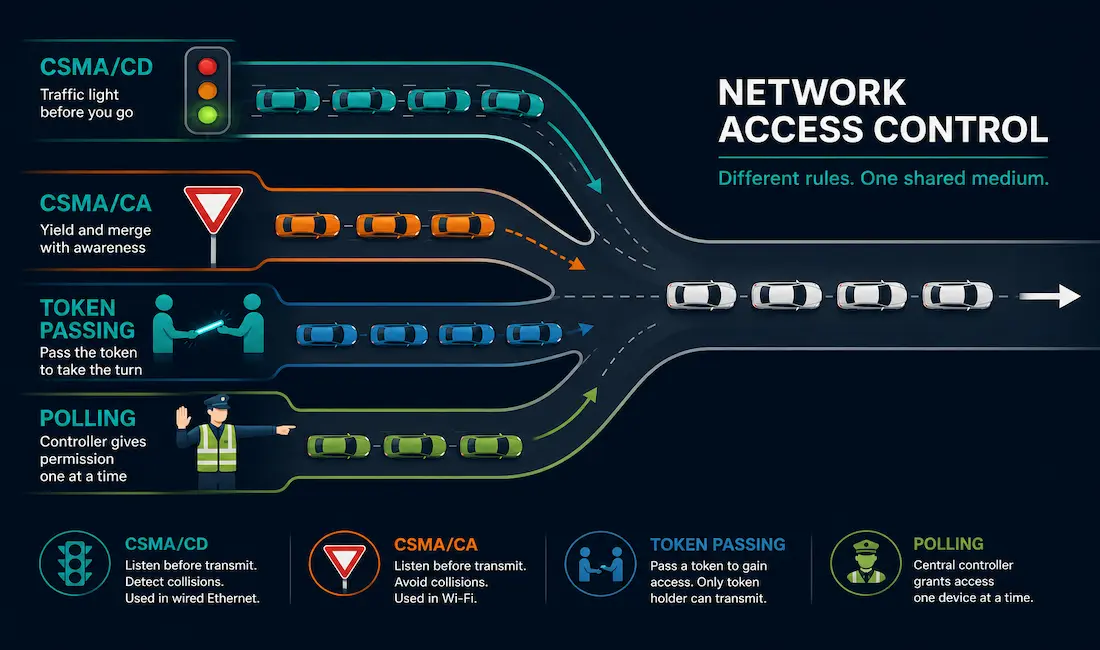
Whenever more than one device shares a physical network medium, something has to decide who gets to transmit and when. That’s the job of a Media Access Control (MAC) method: a set of rules, implemented at the data link layer, that governs how devices gain and control access to shared network media. Without one, two devices transmitting at the same moment on a shared medium would corrupt each other’s data through a collision. This guide covers the four main MAC methods you’ll encounter in real networks, and how each one actually solves the shared-access problem.
Why the Data Link Layer Needs Media Access Control
MAC methods are implemented at the data link layer of the OSI model. As packets travel from source to destination, they cross different physical networks, potentially copper, fiber, and wireless links, all within a single end-to-end path. Without the data link layer handling media access separately from the network layer above it, a protocol like IP would need built-in provisions for every possible media type it might encounter, and it would need to be updated every time a new network technology emerged.
That’s exactly the problem layering solves. IP doesn’t need to know or care whether it’s riding on Ethernet, Wi-Fi, or a serial link; the data link layer’s MAC method handles getting the frame on and off that specific medium. This separation is a big part of why new network technologies can be introduced without requiring changes to the network and transport layers above them.
The Roadway Analogy
Media access control works a lot like traffic rules on a road. Without any control, vehicles would enter a roadway without regard for other traffic already using it, guaranteeing constant collisions. Real intersections handle this differently depending on their design: some let vehicles merge based on gaps in traffic, some use a stop sign requiring each vehicle to wait its turn, and some use signal lights to grant access in a controlled sequence.
Network media access works the same way. Different MAC methods represent different sets of “traffic rules” for getting a frame onto the shared medium, and which method applies depends on the network’s topology and how its medium is shared among connected devices.
The Four Main MAC Methods
1. CSMA/CD (Carrier Sense Multiple Access with Collision Detection)
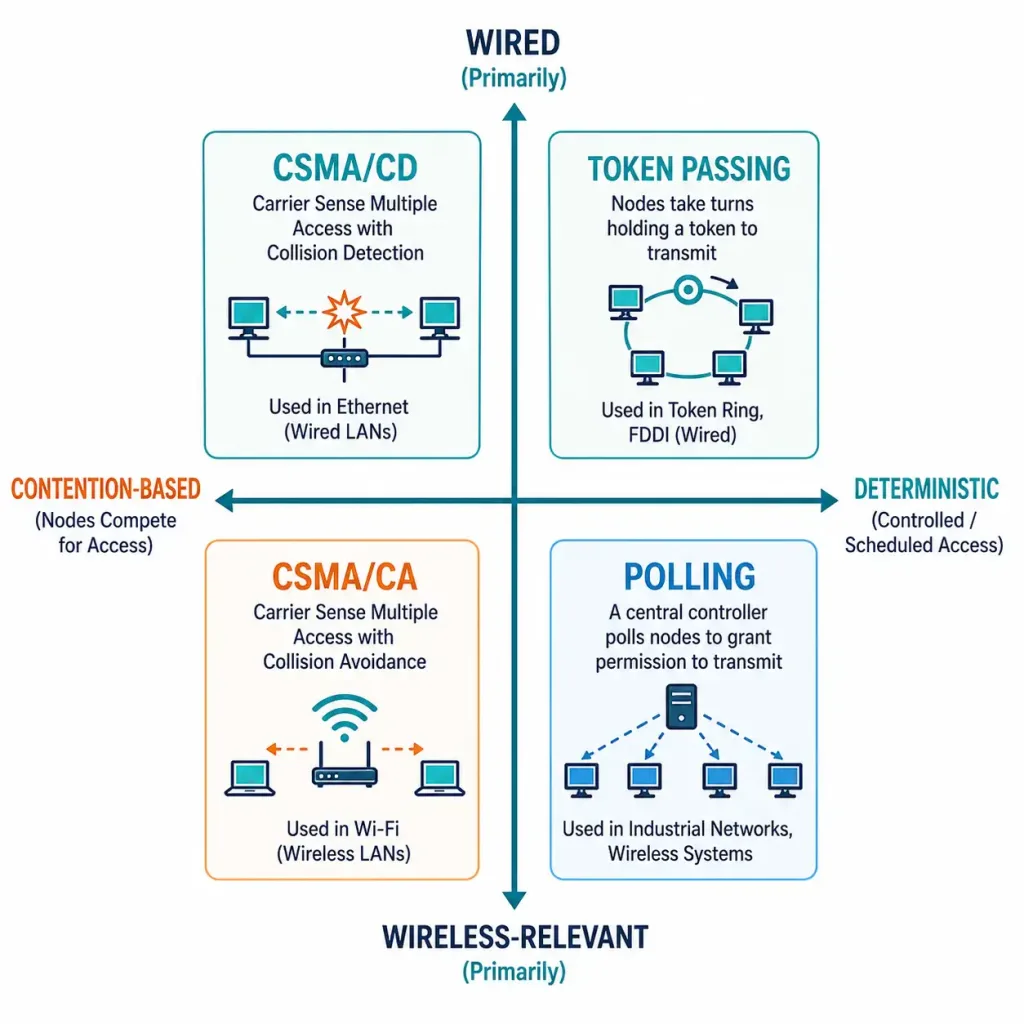
CSMA/CD was the original access method for shared-medium Ethernet. A device listens to the medium first; if it’s clear, the device transmits, and if a collision occurs anyway, both transmitting devices detect it, stop, and retry after a random backoff delay. This method was necessary on legacy, shared, half-duplex Ethernet connected through hubs, where every device on a segment competed for the same physical medium.
Modern switched, full-duplex Ethernet has largely eliminated the practical need for CSMA/CD, since each switch port gives a connected device its own dedicated, collision-free path rather than a shared one. CSMA/CD still matters conceptually and shows up in certification material, but you’re unlikely to encounter it actively resolving real collisions on a modern switched network.
2. CSMA/CA (Carrier Sense Multiple Access with Collision Avoidance)
CSMA/CA takes a different approach: rather than detecting a collision after it happens, it tries to avoid one in the first place. This matters because a wireless device generally can’t reliably detect a collision while it’s transmitting, since its own signal can drown out its ability to hear another device’s simultaneous transmission on the shared radio medium.
CSMA/CA is the media access method behind modern Wi-Fi (IEEE 802.11), by far its most common and relevant application today. It has historical roots in earlier networking technologies like AppleTalk’s LocalTalk, but Wi-Fi is where nearly everyone actually encounters CSMA/CA in practice now. One key mechanism used within CSMA/CA is the RTS/CTS (Request to Send / Clear to Send) handshake, where a device reserves the medium before transmitting, which helps reduce collisions in crowded wireless environments like public Wi-Fi with many competing devices.
3. Token Passing
Token passing controls access by circulating a special frame, the token, around a logical or physical ring of connected devices. Only the device currently holding the token is permitted to transmit; once it’s done, it passes the token to the next device in sequence. This guarantees orderly, collision-free access, since only one device can ever hold the token at a time.
Token passing was the defining access method for Token Ring and Fiber Distributed Data Interface (FDDI) networks. Both have been almost entirely displaced by switched Ethernet in modern deployments, largely because Ethernet switching achieves collision-free access without requiring the more rigid, deterministic token-circulation overhead. Token passing’s core idea, guaranteed, orderly access without any possibility of collision, does still show up conceptually in some specialized industrial and real-time control network designs, where deterministic timing matters more than raw throughput.
4. Polling
Polling uses a centralized controller device that asks each connected device, in turn, whether it has data to send. A device only transmits when the controller specifically polls it, which, like token passing, guarantees collision-free access at the cost of some efficiency, since a device with urgent data to send still has to wait for its turn to be asked. Polling was common in older multidrop serial communication systems, including many legacy mainframe terminal networks, and it still appears today in some industrial control and sensor network protocols where a central controller managing a fixed, known set of devices is a natural fit.
Comparing the Four Methods
| Method | Access Model | Collision Handling | Typical Use |
|---|---|---|---|
| CSMA/CD | Contention-based | Detects and retries after collision | Legacy shared/half-duplex Ethernet |
| CSMA/CA | Contention-based | Avoids collision before transmitting | Modern Wi-Fi (802.11) |
| Token Passing | Deterministic | Prevented entirely by token ownership | Legacy Token Ring/FDDI; niche industrial control |
| Polling | Deterministic | Prevented entirely by controller sequencing | Legacy multidrop serial; some industrial/sensor networks |
Choosing the Right Method for a Network
In practice, you rarely “choose” a MAC method independently; it comes bundled with the underlying technology you select. Choosing switched Ethernet means you’re effectively opting out of any real reliance on CSMA/CD’s collision handling. Choosing Wi-Fi means you’re using CSMA/CA by definition. The more relevant real-world decision is usually about the technology itself, wired switched Ethernet versus wireless, rather than the access method directly, since the access method follows from that choice automatically.
Security Considerations for MAC Methods
Media access control methods themselves aren’t primarily security mechanisms, but the media access layer is still a relevant place to apply security controls. On wireless networks using CSMA/CA, strong encryption (current-generation WPA on any access point you control) is the real security foundation, since anyone within radio range can otherwise attempt to observe or interfere with the shared medium the access method is coordinating.
MAC address filtering can supplement this as an additional access control layer, restricting which specific devices are permitted onto the network at all, though it shouldn’t be relied on as a primary security control, since MAC addresses can be spoofed. Regularly auditing which devices are actually connected, particularly on wireless networks where physical access isn’t required to attempt a connection, remains good practice regardless of which MAC method is in use.
Troubleshooting Access Method Issues
Unexpectedly high collision counters on a switch port. On modern switched networks, this is unusual and worth investigating directly, since properly configured full-duplex switch ports shouldn’t be experiencing real collisions at all. A duplex mismatch, one end configured full-duplex and the other half-duplex, is a classic cause of exactly this symptom.
Wireless performance degrading sharply as more devices join. This is expected behavior given CSMA/CA’s contention-based model; more devices competing for the same shared airtime means less effective throughput per device, even with a strong signal. Moving high-bandwidth devices to a less congested channel or a different frequency band often helps more than troubleshooting individual devices. In genuinely dense deployments, adding additional access points on non-overlapping channels, rather than boosting the power of a single access point, usually addresses the underlying contention problem more effectively.
Legacy Token Ring or FDDI equipment behaving unpredictably after a topology change. Token-based networks are sensitive to ring integrity; a broken physical ring, or a device improperly inserted or removed from the ring, can disrupt token circulation for the entire segment, not just the affected device. This is one of the practical reasons switched Ethernet displaced ring-based technologies almost entirely.
Where This Fits in Modern Networks
It’s worth being clear-eyed about how much of this is historical versus actively operational today. CSMA/CA is genuinely live and active every time a Wi-Fi device transmits; it’s not legacy at all. CSMA/CD, by contrast, is largely a conceptual holdover explaining how Ethernet’s collision handling used to work before switching became universal, useful for understanding Ethernet’s history and for certification exams, but rarely something you’ll actively troubleshoot on a modern network. Token passing and polling are further out still, mostly confined to legacy installations and specific industrial or real-time control contexts where their deterministic, guaranteed-access properties are worth the throughput tradeoff.
Understanding all four still matters, even the largely historical ones, because it clarifies what switched Ethernet actually solved. Switching didn’t just make networks faster; it fundamentally changed the access control problem by giving every device its own dedicated link instead of a shared one, which is why collision-oriented access methods became far less central to how wired networks operate day to day. That shift from shared-medium to switched, dedicated links is arguably the single biggest architectural change in the history of Ethernet, and MAC methods are the concept that makes clear exactly why it mattered.
Frequently Asked Questions
What is a media access control (MAC) method?
A media access control method is a set of rules, implemented at the data link layer, that governs how devices gain and share access to a network medium. It exists specifically to prevent and manage collisions that would otherwise occur when multiple devices attempt to transmit on a shared medium at the same time.
What’s the actual difference between CSMA/CD and CSMA/CA?
CSMA/CD detects a collision after it happens and has both devices retry, which worked for legacy shared Ethernet but isn’t reliably possible on a shared wireless medium. CSMA/CA instead avoids the collision in the first place, using mechanisms like the RTS/CTS handshake, which is why it’s the access method Wi-Fi uses rather than CSMA/CD.
Is CSMA/CD still relevant on a modern network?
Not in active daily operation for most networks. Modern switched, full-duplex Ethernet gives each device a dedicated connection to its switch port, effectively eliminating the shared-medium collisions CSMA/CD was designed to handle, though it remains a foundational concept for understanding how Ethernet evolved.
What are the four main types of MAC methods?
The four main types are CSMA/CD, used historically in shared Ethernet; CSMA/CA, used in modern Wi-Fi; token passing, used in legacy Token Ring and FDDI networks; and polling, used in legacy multidrop serial systems and some industrial control networks today. Each takes a fundamentally different approach to preventing or handling collisions on a shared medium.
Why did token passing and polling lose out to switched Ethernet?
Both guarantee collision-free access, but at the cost of overhead: a device sometimes has to wait for a token or a poll even when the medium is otherwise idle. Switched Ethernet achieves collision-free access more efficiently, without that waiting overhead, since each device gets its own dedicated path rather than sharing one with every other connected device.
Does MAC filtering actually secure a wireless network?
MAC filtering restricts which specific device addresses are permitted to connect, which adds a layer of access control, but it isn’t a strong security measure on its own, since MAC addresses can be spoofed by an attacker who observes legitimate traffic. Strong encryption remains the real foundation of wireless security, with MAC filtering serving as a supplementary control rather than a primary one.