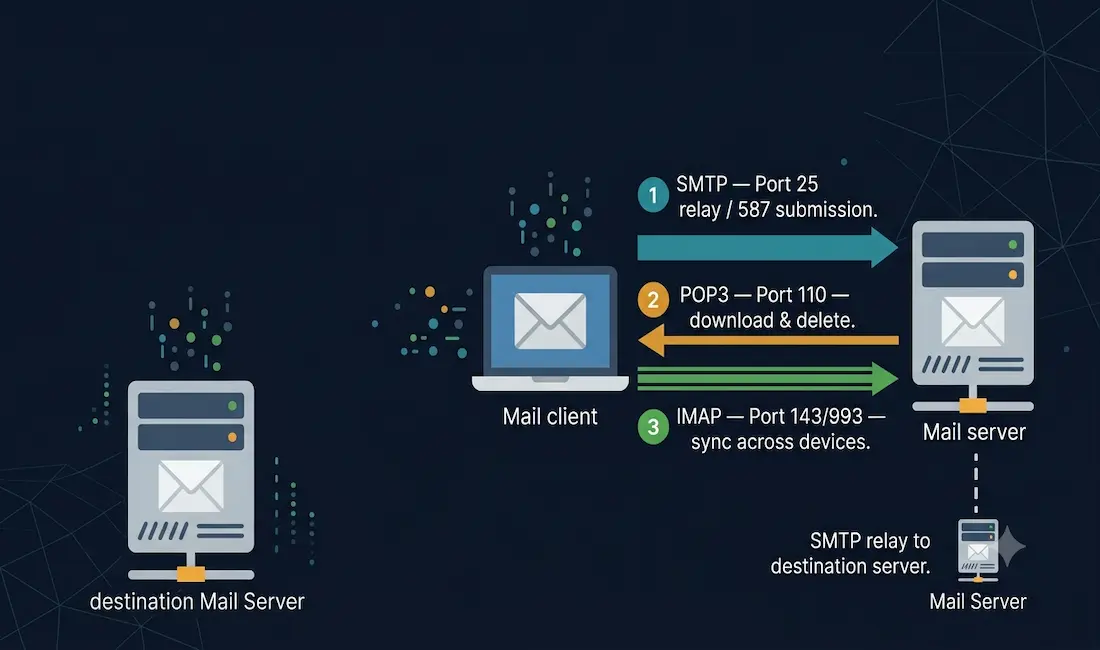
Email is one of the primary services running on the internet. The email server stores email messages in a database, and email uses a store-and-forward method for sending and holding messages. Email clients communicate with servers running mail services to send and receive email, and the client-connected server in turn communicates with other mail servers to transport messages from one domain to another.
When sending an email, a client never communicates directly with another email client; both clients rely entirely on mail servers to transport messages between them. The email process relies on three protocols: Simple Mail Transfer Protocol (SMTP), Post Office Protocol version 3 (POP3), and Internet Messaging Access Protocol (IMAP). The application layer process sends mail using SMTP, while a client retrieves mail using either POP3 or IMAP.
Simple Mail Transfer Protocol (SMTP) Operation
An SMTP message requires a message body and a message header. The body can hold any amount of text, while the header must contain a properly formatted recipient email address and a sender address.
When a client sends an email, the client’s SMTP process connects to a server SMTP process, historically on port 25. Once the connection is established, the client transmits the message to the server. After the server receives it, the server either places the message in a local mailbox, if the recipient is local, or forwards the message on to another mail server for delivery.
If the destination mail server is busy or offline, the message is held in an SMTP spool queue and retried periodically. If the message remains undelivered past its configured expiration time, it is returned to the sender as undeliverable.
A modern, practically important distinction: port 25 today is used almost exclusively for server-to-server relay, and most residential and many business ISPs block outbound connections on port 25 specifically to reduce spam originating from compromised or misconfigured client machines. When configuring an actual email client (Outlook, Thunderbird, Apple Mail, or any mobile mail app) to send outgoing mail, you will almost always use port 587 (SMTP Submission, with STARTTLS encryption) instead, or occasionally the legacy implicit-TLS port 465 (SMTPS). Port 25 remains correct and expected for the exam-level description of server-to-server SMTP relay described above, but it is not the port a modern email client actually connects to when sending mail.
For example, when a client sends an email to admin@networkustad.com, the message is processed by the sending mail server, referred to here as SMTP server-1. If the recipient’s mailbox is hosted locally on that server, the message is delivered directly into the local mailbox. If the recipient is not local to SMTP server-1, the message is forwarded on to the correct destination mail server, SMTP server-2, for final delivery.
Post Office Protocol version 3 (POP3) Operation
The POP3 server passively listens on TCP port 110 for client connection requests. When a client needs to use POP3, it initiates a TCP connection with the server, and once the connection is established, the server sends a welcome greeting to the client.
Once connected, both the client and server exchange commands and responses until the session ends. With POP3, when a client downloads email messages, the server by default removes those messages from the server afterward, though most modern POP3 clients also offer a “leave a copy on server” setting that overrides this default deletion behaviour.
The POP3 server functions as a temporary holding area for mail until it is downloaded to a client. Because POP3 has no central place for ongoing email storage once messages are downloaded, it is generally not an attractive choice for a small business that needs centralized email storage for backup or for access from multiple devices.
Internet Message Access Protocol (IMAP) Operation
IMAP is a protocol for retrieving email messages from a remote mail server while keeping the authoritative copy of each message on the server itself. An IMAP server typically listens on port 143, with IMAP over SSL/TLS assigned port 993. Unlike POP3, when a user connects to an IMAP server, copies of messages are downloaded to the client application while the originals remain on the server until the user explicitly deletes them.
The server stores incoming email messages in the recipient’s mailbox, and the user retrieves them through an email client supporting one of the standard retrieval protocols. Most modern email clients support SMTP for sending mail and both POP3 and IMAP for retrieving it, though IMAP is now the dominant choice for anyone accessing the same mailbox from more than one device.
An IMAP client can create a folder hierarchy directly on the server to organize and store messages, and when a user deletes a message through their client, the server synchronizes that action and removes the message from the server itself, keeping every connected device’s view of the mailbox consistent.
Testing an SMTP Connection Manually
For CCNA-relevant troubleshooting, you can manually test basic SMTP connectivity to a mail server using Telnet, useful for confirming the server is reachable and responding on the expected port before troubleshooting further up the application stack:
telnet mail.example.com 25A responding server will return a greeting beginning with 220, confirming the SMTP service is listening and accepting connections on that port. The same basic technique works against port 587 or 110 to confirm those services are reachable as well.
Differences Between SMTP, POP3, and IMAP
| Feature | POP3 | SMTP | IMAP |
|---|---|---|---|
| Purpose | Retrieve emails from a server | Send emails for delivery | Access and manage emails stored on a server |
| Port Number | 110 (995 with SSL/TLS, POP3S) | 25 (relay); 587 (client submission, STARTTLS); 465 (implicit TLS, SMTPS) | 143 (without SSL/TLS), 993 (with SSL/TLS) |
| Security | STARTTLS or POP3S (port 995) | STARTTLS (587) or SMTPS (465) | IMAPS on port 993 |
| Email Storage | Downloads to local device, typically deleting from server | Does not store emails | Leaves emails on the server |
| Syncing | Does not sync across devices by default | Does not sync emails | Synchronizes emails across multiple devices |
| Offline Access | Full offline access to downloaded emails | Not applicable | Offline access to a locally cached copy |
| Message Management | Limited organizing capability | Focused solely on sending | Extensive folder and message management |
| Server Load | Low — emails typically removed after retrieval | Moderate — transferring between servers | Higher — emails stored and managed long-term |
| Common Use Case | Single-device access, limited or sporadic internet connectivity | Sending mail from any client | Accessing the same mailbox from multiple devices |
| Client Software Supporting It | Outlook, Apple Mail, Thunderbird (all also support IMAP) | Sendmail, Postfix (server-side MTAs) | Outlook, Apple Mail, Thunderbird, and virtually all webmail providers including Gmail and Outlook.com |
Choosing Between POP3 and IMAP
For a user checking email on only one device, and specifically wanting a local, permanent archive independent of the mail provider’s own storage, POP3’s download-and-delete model remains a reasonable, low-server-load option. For virtually everyone else, particularly anyone checking email from a phone, a tablet, and a computer, IMAP is the correct choice, since it keeps every device’s view of the mailbox synchronized and avoids the common POP3 pitfall of a message being downloaded and removed by one device, making it invisible to every other device afterward.
CCNA Exam Pointers
- SMTP: port 25 for server-to-server relay; port 587 (STARTTLS) is the modern standard for client submission; port 465 (SMTPS) is the legacy implicit-TLS alternative
- POP3: port 110; port 995 for POP3S; downloads and typically deletes from the server
- IMAP: port 143; port 993 for IMAPS; synchronizes and leaves originals on the server
- SMTP uses a store-and-forward model with a retry queue and an expiration-based undeliverable return
- IMAP supports server-side folder hierarchies; POP3 does not
telnet [server] [port]is a quick manual test for basic mail service reachability; a220response confirms the service is listening- Modern clients almost never connect to port 25 directly; port 25 is relay-only in practice, frequently blocked by ISPs for direct client use
Conclusion
SMTP, POP3, and IMAP form the backbone of email communication, each serving a distinct role: SMTP handles the sending and server-to-server relay of messages, while POP3 and IMAP provide two different models for retrieving them, single-device download-and-delete versus multi-device synchronization. Understanding not just the textbook port numbers but the practical distinction between SMTP’s relay port (25) and its modern client submission port (587) is what separates exam-level knowledge from being able to actually configure a working mail client. Balancing security, storage, and accessibility across these protocols is a core part of effective email management.
FAQs
What is the role of SMTP in email communication?
SMTP (Simple Mail Transfer Protocol) sends email messages from a client to a server and relays them onward to the destination server, using port 25 for server-to-server relay and typically port 587 for client submission. It establishes a connection, transmits the message with its header and body, and queues the message for retry if the destination server is temporarily unavailable, returning it to the sender as undeliverable only after it exceeds its configured expiration time in the queue.
How does POP3 differ from IMAP in retrieving emails?
POP3 (Post Office Protocol version 3) downloads emails from the server to the client, typically on port 110, and by default deletes them from the server afterward, making it well suited to single-device offline access. IMAP (Internet Message Access Protocol), typically on port 143 or 993 with encryption, instead synchronizes emails across every connected device by keeping the original messages on the server until the user explicitly deletes them, ensuring every device shows the same mailbox state.
What happens if an email cannot be delivered via SMTP?
If the destination server is busy or offline, SMTP places the message in a retry queue and attempts delivery again periodically rather than failing immediately. If the message remains undelivered once it exceeds its configured expiration time in that queue, it is returned to the original sender as undeliverable, typically with a bounce message explaining the failure reason.
Why is IMAP generally preferred over POP3 for users with multiple devices?
IMAP keeps the authoritative copy of every message on the server and synchronizes read status, folder organization, and deletions across every connected device, so a message read or filed on a phone shows the same state when later checked on a laptop. POP3’s default download-and-delete behaviour means a message retrieved by one device is typically removed from the server and therefore invisible to any other device that connects afterward, which is the main practical reason IMAP has become the standard choice for most users today.
What port should I actually use to send email from a client application in 2026?
Port 587 with STARTTLS encryption is the standard, correct port for a modern email client to submit outgoing mail, and is what virtually every current mail provider recommends in their client setup instructions. Port 25, while technically valid for SMTP, is used almost exclusively for server-to-server relay in practice and is frequently blocked outbound by residential and many business internet providers specifically to prevent spam from compromised devices, so client software configured to use port 25 for sending will often fail to connect at all on such networks. Port 465 (implicit TLS SMTPS) remains a valid legacy alternative to 587 supported by many providers.
How can I quickly test whether a mail server is reachable on a given port?
Use telnet [server-address] [port] from a command line, for example telnet mail.example.com 25. A working, reachable SMTP service responds with a greeting line beginning with the code 220. The same basic approach works for POP3 (port 110) and IMAP (port 143) to confirm those services are listening and accepting connections, which is a useful first troubleshooting step before investigating client-side configuration issues.