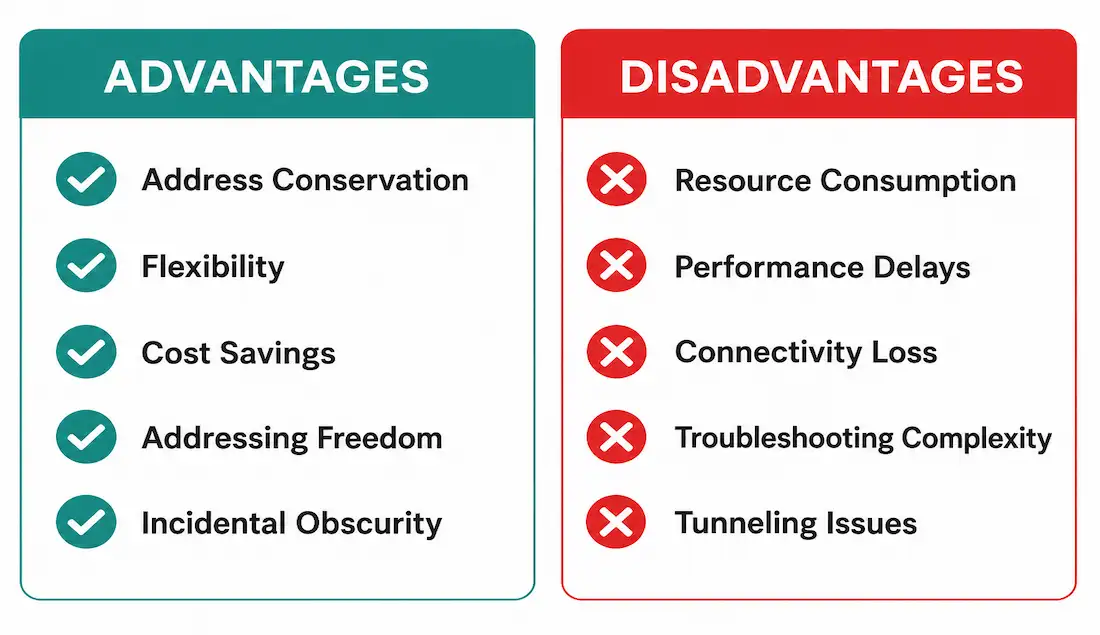
NAT is a genuine trade-off, not a free win. It solved IPv4 exhaustion well enough that IPv6 adoption has taken decades longer than originally expected — but it does that by breaking assumptions a lot of other protocols were originally built on. Understanding both sides matters for CCNA and CCNP exams specifically, since questions routinely test whether you know when NAT’s trade-offs actually matter in practice, not just that NAT exists as a concept.
NAT Advantages
IPv4 Address Conservation
This is NAT’s core purpose. PAT lets an entire LAN share a single public address, differentiated by port — the mechanism that’s kept IPv4 functional for far longer than its ~4.3 billion addresses would otherwise have allowed.
Router(config)# ip nat inside source list 1 interface gigabitEthernet 0/0 overloadIncreased Flexibility
NAT supports backup pools and load-balancing across multiple public addresses. At the CCNP level, this extends into high-availability designs — pairing NAT with HSRP so translation state can survive a gateway router failing over to its standby, without every active session breaking.
Cost Savings
Public IPv4 addresses aren’t free, and they’re increasingly scarce. NAT means an organization doesn’t need to purchase or lease one per device — a real, direct cost saving that scales with the size of the network.
Internal Addressing Freedom
Because NAT sits at the boundary between the internal network and the internet, internal addressing can stay completely stable even if the organization changes ISPs entirely or the public-facing address changes for any reason. Internal devices never need readdressing just because the outside-facing address happened to change.
Incidental Security Benefit — With a Caveat
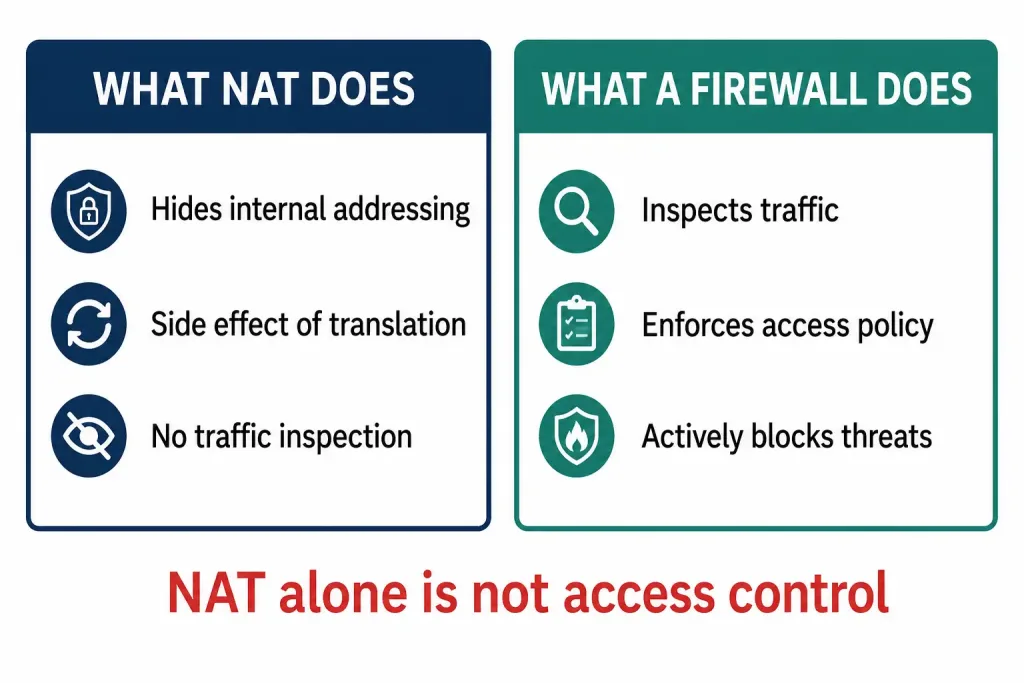
NAT hides the internal addressing scheme from outside observers, which does add a mild obstacle to reconnaissance. This is worth stating precisely, because it’s a common point of confusion for students studying for certification exams: NAT is not a firewall, and it’s not a substitute for one. It obscures internal topology as a side effect of how translation happens to work — it doesn’t inspect traffic, enforce any access policy, or block anything on its own.
A NAT-enabled router with no ACLs configured provides essentially no actual access control, regardless of how well it happens to hide internal addresses from casual observation. Pair NAT with real access control (ACLs, a stateful firewall) for genuine security — never rely on NAT’s obscurity alone as a security boundary.
Advantages Summary
| Advantage | What It Actually Does | Exam Relevance |
|---|---|---|
| Address Conservation | Many devices share one public IP via PAT | CCNA — IP Services domain |
| Flexibility | Backup pools, load balancing, HSRP integration | CCNP Enterprise |
| Cost Savings | Fewer public addresses to purchase | CCNA & CCNP |
| Addressing Freedom | Internal scheme stays stable across ISP changes | CCNA |
| Incidental Obscurity | Hides internal topology — not a real security control | CCNP Security |
Disadvantages of NAT
Every one of these stems from the same root cause: NAT means the host on the internet is actually communicating with the NAT router, not the real internal device — and that substitution has consequences.
Resource Consumption
Every translation the router performs uses CPU and memory to maintain the growing translation table over time. On a busy router this is measurable in practice, not just theoretical — show ip nat statistics shows exactly how much translation activity is actually happening on that device at any given moment.
Performance Delays
Translation adds processing latency on every single packet that passes through it. For most ordinary traffic this is negligible and unnoticeable, but real-time applications — VoIP specifically — are sensitive enough that it genuinely matters. Hardware-accelerated NAT on higher-end platforms (ASR series, at the CCNP level) exists specifically to address this exact concern.
End-to-End Connectivity Loss
Some protocols embed IP address information directly inside their packet payload, not just the header — NAT translating the header alone breaks these unless something specifically accounts for the mismatch. IPsec is the classic textbook example: without NAT-T (NAT Traversal), IPsec’s integrity checks fail because NAT has altered header fields IPsec expects to remain completely untouched throughout transit. FTP has a similar problem in active mode specifically, where the client’s IP address gets embedded directly in the control channel payload itself — this is exactly why an Application Layer Gateway (ALG) exists specifically to rewrite that embedded address to match the NAT translation correctly.
Troubleshooting Complexity
Tracing a session across a NAT boundary means correlating the inside address/port with the outside address/port at every single hop along the path — a packet capture on one side of a NAT router won’t show the same addressing information as a capture taken on the other side of that same router. debug ip nat helps in a lab, but it’s worth using sparingly on a live device given the resource cost noted above.
Tunneling Complications
VPNs and GRE tunnels can run into the same embedded-address problem IPsec has — NAT traversal features exist specifically to handle tunneled traffic crossing a NAT boundary without breaking the tunnel’s own internal addressing assumptions along the way.
Disadvantages Summary
| Disadvantage | Root Cause | Typical Mitigation |
|---|---|---|
| Resource Consumption | Translation table maintenance uses CPU/memory | Monitor with show ip nat statistics |
| Performance Delays | Per-packet translation overhead | Hardware-accelerated NAT platforms |
| End-to-End Connectivity Loss | Embedded addresses in payload, not just header | NAT-T (IPsec), ALGs (FTP) |
| Troubleshooting Complexity | Addressing changes at the NAT boundary | Careful correlation, sparing use of debug ip nat |
| Tunneling Issues | VPN/GRE address assumptions broken by translation | NAT traversal features |
Does IPv6 Eliminate the Need for NAT?
Worth addressing directly, since it comes up often in both real deployments and exam prep alike. IPv6’s address space is large enough that address conservation — NAT’s original and primary reason for existing in the first place — genuinely isn’t necessary anymore. Every device can have its own globally unique address without any translation involved at all.
But that doesn’t mean NAT disappears entirely from IPv6 networks. A few things carry forward:
- NAT64 exists specifically to let IPv6-only networks communicate with IPv4-only resources during the migration period — a real, actively used technology, not a legacy leftover.
- The incidental obscurity NAT provides is sometimes replicated deliberately in IPv6 through techniques like using privacy extensions or dynamically changing interface identifiers, even though the underlying motivation (conserving scarce addresses) no longer applies.
- Organizations with hybrid IPv4/IPv6 environments — which is most organizations, for the foreseeable future — still need to understand NAT thoroughly, since IPv4 addressing and its constraints haven’t gone anywhere yet.
The practical takeaway for CCNA and CCNP purposes: NAT’s role in pure address conservation genuinely does diminish as IPv6 adoption continues to grow over time, but the protocol-interaction issues NAT causes — and the transition technologies like NAT64 that bridge IPv4 and IPv6 networks together — remain squarely relevant, tested material either way.
When NAT’s Trade-offs Actually Matter
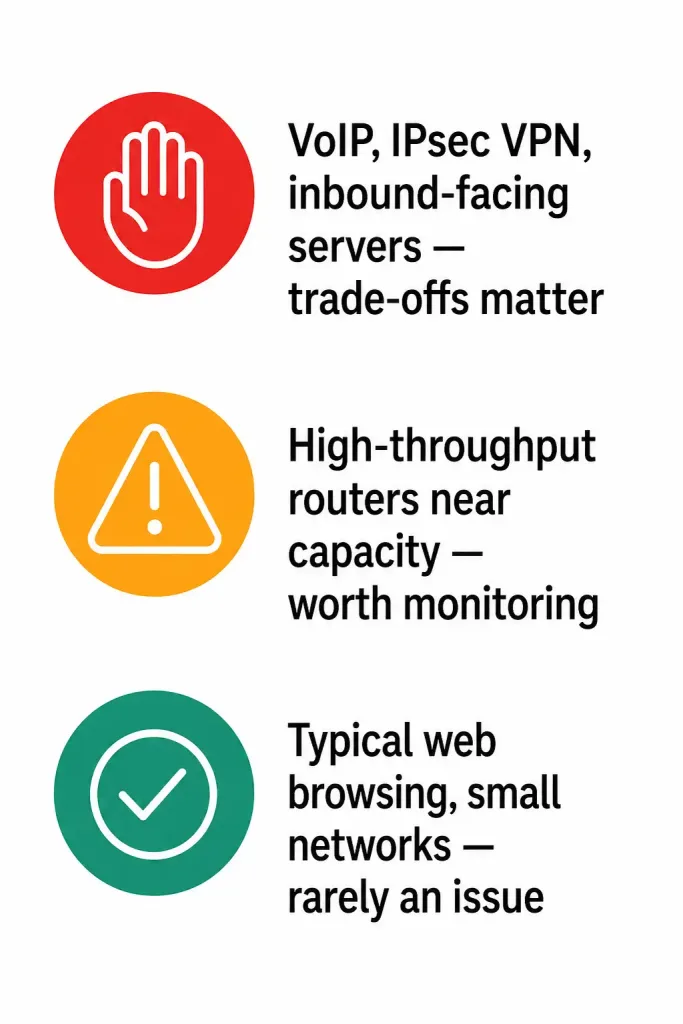
Not every network feels NAT’s disadvantages equally — it’s worth being specific about which situations actually surface them in practice, rather than treating the whole list as a constant, unavoidable tax applied uniformly to every deployment regardless of what that network is actually being used for.
| Situation | NAT’s Trade-offs Matter | Why |
|---|---|---|
| Typical office web browsing, email, cloud apps | Rarely | These protocols don’t embed addresses in payloads; latency added is negligible |
| VoIP or video conferencing | Yes | Embedded addresses in signaling payloads need ALG support to work correctly |
| Site-to-site IPsec VPN | Yes | NAT-T is required, and misconfiguration here is a common real-world failure point |
| Hosting a server that needs inbound connections | Yes | Requires static NAT or port forwarding — plain PAT alone won’t route inbound traffic to it |
| High-throughput router already near CPU capacity | Yes | Translation overhead adds to a problem that already exists |
| Small network with low simultaneous session count | Rarely | Resource consumption from NAT is negligible at this scale |
The pattern worth remembering: NAT’s downsides cluster around protocols that embed addressing in their payload, and around scenarios needing reliable inbound reachability — everything else is a comparatively minor, often unnoticeable trade-off for the address conservation NAT provides.
Worked Example: Why VoIP Specifically Struggles with NAT
VoIP is worth walking through directly, since it’s a commonly tested combination of several of NAT’s disadvantages happening at once, in a single realistic scenario. A VoIP call sets up its signaling (SIP) on one connection, but the actual voice traffic (RTP) often negotiates its own separate port dynamically, sometimes with the internal device’s address embedded directly in the SIP payload itself — not just carried in the packet header the way NAT normally expects to work with.
If NAT only translates the header, the embedded address inside the SIP payload still points to the private, unreachable internal address — the remote end tries to send RTP voice traffic to an address it can never actually reach in the first place. This is exactly the same embedded-address problem FTP has, just manifesting in a different protocol, and it’s why VoIP deployments crossing NAT boundaries typically need a SIP ALG or a properly configured session border controller — plain NAT translation alone isn’t enough to make the call’s audio actually work correctly, even though the initial signaling might connect just fine on its own.
FAQs
What are the main advantages of NAT?
IPv4 address conservation through PAT, increased flexibility with backup pools and HSRP integration, direct cost savings from needing fewer public addresses, internal addressing independence from ISP changes, and an incidental (not primary) security benefit from hiding internal topology.
What are the key disadvantages of NAT?
Resource consumption on the router, performance delays for latency-sensitive traffic like VoIP, broken end-to-end connectivity for protocols that embed addresses in their payload (IPsec, FTP), added troubleshooting complexity across the NAT boundary, and complications for VPN/GRE tunneling.
Is NAT a substitute for a firewall?
No. NAT hides internal addressing as a side effect of translation, but it doesn’t inspect traffic or enforce any access policy on its own. Real security requires pairing NAT with actual access control — ACLs, a stateful firewall — not relying on NAT’s obscurity alone.
Why does NAT break protocols like IPsec and FTP specifically?
Because these protocols embed IP address information inside their actual payload, not just the packet header that NAT translates. IPsec’s integrity checks fail unless NAT-T is used to account for the header changes; FTP’s active mode needs an ALG to rewrite the embedded address inside the control channel to match the translation.
How can NAT’s drawbacks be mitigated?
Hardware-accelerated NAT reduces resource consumption and latency on high-traffic routers. NAT-T handles IPsec specifically; ALGs handle protocols like FTP and SIP that embed addresses in their payload. For troubleshooting, correlate addressing carefully across the NAT boundary and use debug ip nat sparingly given its resource cost.
Why does VoIP specifically struggle with NAT more than typical web traffic?
Because VoIP protocols like SIP often embed the internal device’s address inside the signaling payload for setting up the separate RTP media stream — if that embedded address isn’t also translated (typically via a SIP ALG), the remote end tries to send voice traffic to an address it can never reach, even though the call may appear to connect initially.
Does IPv6 make NAT obsolete?
Not entirely. IPv6’s address space removes the need for NAT’s original purpose — address conservation — since every device can have its own globally unique address. But NAT-related technology remains relevant: NAT64 bridges IPv4-only and IPv6-only networks during migration, and most organizations run hybrid environments where IPv4’s constraints, NAT included, still apply for the foreseeable future.