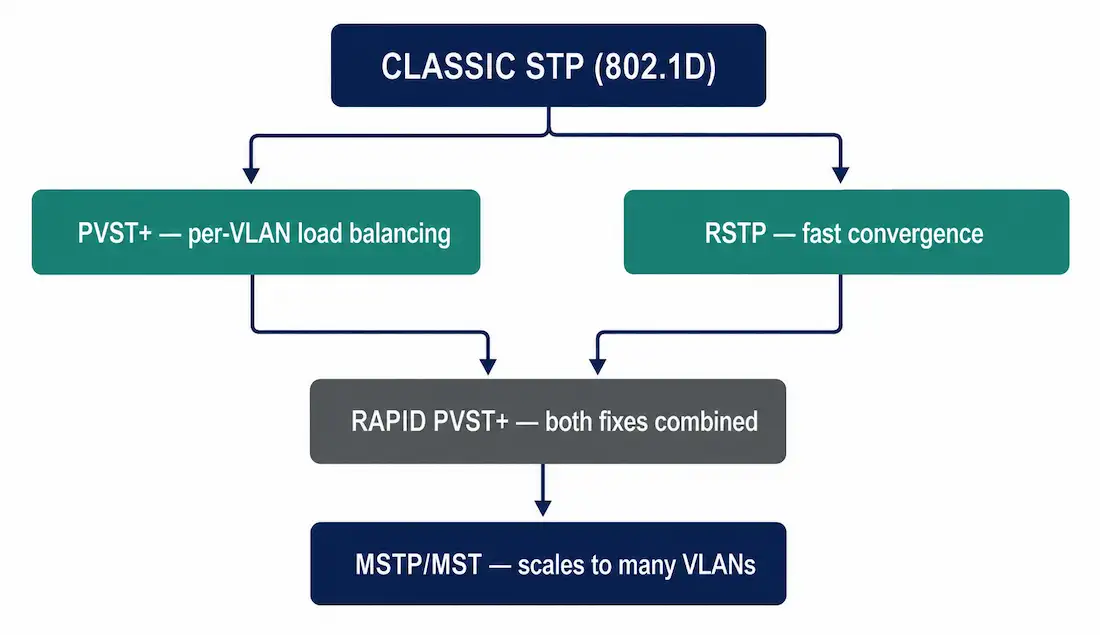
Spanning Tree Protocol prevents Layer 2 loops, but “STP” isn’t one single implementation — it’s a family of standards and Cisco extensions that evolved over three decades to fix the original protocol’s two biggest weaknesses: slow convergence and one-size-fits-all topology. This article ties together the whole family covered so far in this series — what STP does, port roles, BPDUs, root bridge election, and path cost — and shows how each STP variant builds on that same foundation.
Classic Spanning Tree Protocol (STP, IEEE 802.1D)
The original standard, providing loop-free redundant connectivity across a switched network using a single spanning tree instance, regardless of how many VLANs exist. Every VLAN shares the same root bridge and the same tree, which is why this mode is sometimes called the Common Spanning Tree (CST) — a single, common tree spanning the entire bridged network rather than one tree per VLAN.
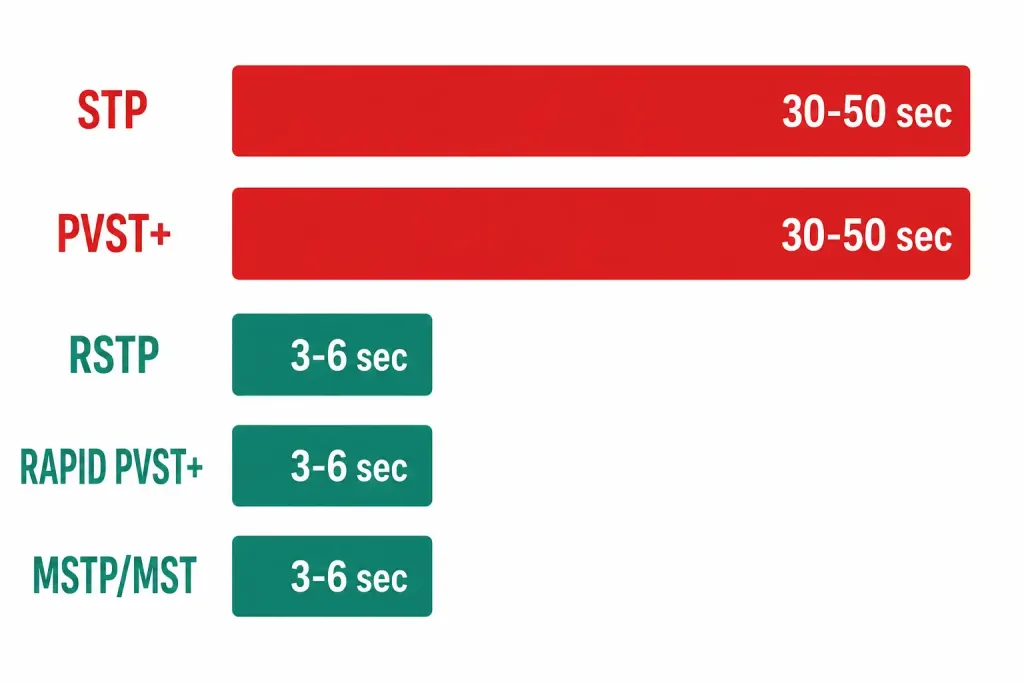
Convergence after a topology change takes 30 to 50 seconds, the direct result of the fixed listening and learning delays covered in the core STP article. Because there’s only one instance to run, CPU and memory overhead is the lowest of any STP variant — but that same single instance means every VLAN’s traffic is forced onto identical paths, even when a different tree shape would balance load better across redundant links.
Pros & Cons
| Aspect | Pros | Cons |
|---|---|---|
| Resource Use | Very low CPU/memory | Single tree = suboptimal for multi-VLAN traffic |
| Convergence | Simple, well-understood baseline | Slow (30-50 seconds) |
| Use Case | Legacy or very small networks | Avoid in any modern multi-VLAN design |
Use classic STP today only for interoperability with old, non-Cisco equipment that doesn’t support anything newer, or in a lab environment specifically testing 802.1D behavior.
Per-VLAN Spanning Tree Plus (PVST+, Cisco Proprietary)
PVST+ runs a separate 802.1D spanning tree instance for every VLAN, so each VLAN can have its own root bridge. This is what actually solves classic STP’s suboptimal-traffic problem — different VLANs can now route through different physical paths, load-balancing traffic across redundant links instead of forcing everything down one shared tree.
The trade-off is resource cost: more instances mean more CPU and memory, and more BPDUs circulating on the network, since every instance sends its own. Convergence per instance is still the same 30-to-50-second classic STP timing, since PVST+ uses 802.1D’s timer-based state machine underneath — it’s the topology flexibility that improves, not the speed.
Pros & Cons
| Aspect | Pros | Cons |
|---|---|---|
| Load Balancing | Excellent — different root per VLAN | Higher BPDU overhead than classic STP |
| Convergence | Per-VLAN flexibility | Still 30-50 seconds per instance |
| Use Case | Medium networks with a manageable VLAN count | Doesn’t scale cleanly to very large VLAN counts |
Rapid Spanning Tree Protocol (RSTP, IEEE 802.1w)
RSTP keeps the single-instance model of classic STP but replaces its timer-based convergence with an active proposal/agreement handshake between neighboring switches, covered in detail in the core STP article. This drops typical convergence to 3-6 seconds, often sub-second on point-to-point links — a dramatic improvement over the 30-to-50-second classic STP figure, while remaining backward compatible with 802.1D neighbors.
RSTP also introduces the Alternate and Backup port roles as pre-computed standby paths, and Edge ports that skip the listening/learning delay entirely for connections to end devices — the equivalent of Cisco’s PortFast feature built into the standard itself.
Key improvements over classic STP:
- Edge ports (PortFast-equivalent) transition to forwarding immediately
- Convergence in 3-6 seconds, often sub-second on point-to-point links
- New port roles: Alternate and Backup, in addition to Root and Designated
- Port states collapse from four to three: Discarding, Learning, Forwarding
RSTP still runs a single instance for the entire network, though, so it inherits classic STP’s suboptimal-traffic-flow limitation — fast convergence, but still one tree for every VLAN.
Rapid Per-VLAN Spanning Tree Plus (Rapid PVST+, Cisco Proprietary)
Rapid PVST+ combines PVST+’s per-VLAN instances with RSTP’s fast convergence mechanism — a separate 802.1w instance per VLAN, each converging in 3-6 seconds independently. This is the mode that actually solves both of classic STP’s original problems at once: suboptimal traffic flow and slow convergence.
The cost is the highest CPU and memory footprint of any variant covered here, since it combines RSTP’s more active BPDU processing with PVST+’s per-VLAN instance count. In practice, this is rarely a real constraint on modern hardware, which is why Rapid PVST+ is the default spanning tree mode on current Cisco Catalyst switches.
Why it’s the standard choice today:
- One independently fast-converging instance per VLAN
- 3-6 second recovery even with a large number of VLANs configured
- The default mode on modern Cisco Catalyst hardware
Rapid PVST+ is the right default for the overwhelming majority of campus and enterprise deployments. The main reason to move away from it is VLAN count getting large enough that per-VLAN instance overhead — CPU load and BPDU volume — becomes the bottleneck, which is exactly the scenario MSTP was designed for.
Multiple Spanning Tree Protocol (MSTP, IEEE 802.1s) and MST
This is one area worth being precise about, since it’s a common source of confusion: MSTP and MST are the same standard, not two separate protocols. IEEE 802.1s is the standard; “MST” is simply the more common shorthand Cisco documentation and CLI commands use for it. There’s no meaningful distinction to draw between “MSTP” and “MST” the way there is between, say, PVST+ and Rapid PVST+.
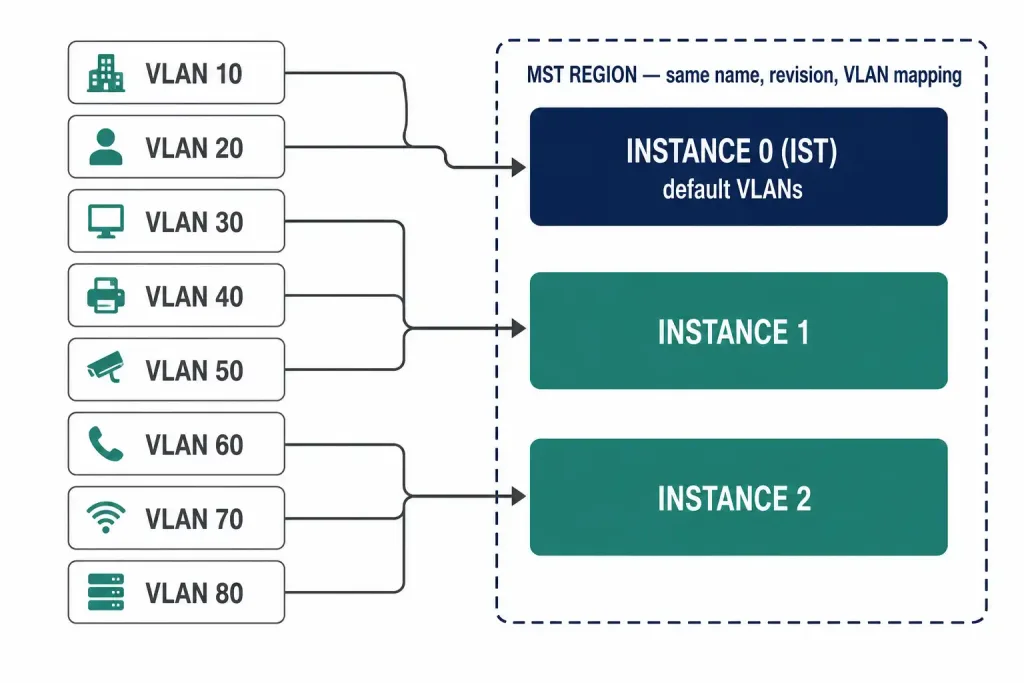
MSTP/MST maps multiple VLANs into a much smaller number of RSTP instances instead of giving every VLAN its own instance, which is what actually reduces the CPU and BPDU overhead problem that limits Rapid PVST+ at high VLAN counts. Because it’s still fundamentally an RSTP-based standard underneath, convergence per instance is the same 3-6 seconds RSTP achieves.
Core concepts:
- An MST region is defined by a matching name, revision number, and VLAN-to-instance mapping across all member switches
- Instance 0, the Internal Spanning Tree (IST), always exists and carries any VLANs not explicitly mapped elsewhere
- The Common and Internal Spanning Tree (CIST) handles interoperability between separate MST regions and non-MST neighbors
On instance limits: current Cisco platform documentation generally specifies support for up to 65 total instances (instance 0 plus 64 user-definable instances, numbered 0-64). Some older platforms and certification materials cite a lower limit of 16 instances (0-15) — this reflects genuine differences between older and newer hardware/software combinations rather than two different protocols, so always verify the actual instance limit for your specific platform and IOS version with Cisco’s current documentation rather than relying on a single remembered number.
When to use MSTP/MST:
- VLAN counts high enough that per-VLAN Rapid PVST+ overhead becomes a real CPU or BPDU-volume concern
- Service provider or large enterprise core networks
- Interoperability with non-Cisco switches implementing the 802.1s standard directly
Full Comparison
| Protocol | Standard | Instances | Convergence | Resource Use | Best Use Case |
|---|---|---|---|---|---|
| STP | IEEE 802.1D | 1 (global) | 30-50 seconds | Low | Legacy or very small networks |
| PVST+ | Cisco proprietary | 1 per VLAN | 30-50 seconds | Medium | Multi-VLAN load balancing, moderate VLAN count |
| RSTP | IEEE 802.1w | 1 (global) | 3-6 seconds | Medium | Simple, fast, single-tree networks |
| Rapid PVST+ | Cisco + 802.1w | 1 per VLAN | 3-6 seconds | High | Default choice for most campus networks |
| MSTP / MST | IEEE 802.1s | Up to 65 (platform-dependent) | 3-6 seconds | Medium-High | Large VLAN counts, multi-vendor cores |
Best Practices and Common Issues
- Set root bridge priority deliberately, in multiples of 4096, on every VLAN or instance — never leave it at default across an entire topology, as covered in the root bridge article.
- Enable BPDU Guard and Root Guard on access and core-facing ports respectively, covered in the BPDU article.
- Enable PortFast globally on access ports with
spanning-tree portfast default, paired with BPDU Guard. - Keep the cost method consistent across every switch in the topology — mixing the short and long path cost methods, covered in the path cost article, produces inconsistent root port decisions.
- Verify actively, don’t assume:
show spanning-tree summary,show spanning-tree detail, andshow spanning-tree inconsistentportsare the standard first commands when something looks wrong.
Common issues and their fixes:
- Unidirectional link failure (a link that can transmit but not receive, or vice versa) → enable Loop Guard.
- Rogue or misconfigured switch claiming root → enable Root Guard on the ports where it shouldn’t be allowed to win.
- Convergence too slow for the business requirement → migrate from classic STP or PVST+ to Rapid PVST+ or MSTP, since both are drop-in upgrades from a topology standpoint.
Frequently Asked Questions
What is the primary function of Spanning Tree Protocol in networks?
STP, defined by IEEE 802.1D, prevents bridging loops in redundant Ethernet topologies by creating a loop-free logical tree. It elects a root bridge, assigns port roles, and uses fixed timers for convergence, typically 30 to 50 seconds. Classic STP is limited to one instance across all VLANs, which can lead to suboptimal traffic paths — the problem every later variant covered here was built to solve.
How does PVST+ differ from classic STP?
PVST+ runs a separate 802.1D instance per VLAN instead of one instance for the whole network, giving each VLAN its own root bridge and its own load-balanced path selection. It requires more CPU and memory than classic STP and generates more BPDU traffic, but convergence per instance is still the same 30-to-50-second classic STP timing underneath.
What advantages does RSTP offer over classic STP?
RSTP (IEEE 802.1w) replaces classic STP’s fixed-timer convergence with an active proposal/agreement handshake between neighbors, cutting typical convergence to 3-6 seconds while remaining backward compatible with 802.1D. It still runs a single instance for the whole network, though, so multi-VLAN traffic optimization isn’t solved by RSTP alone — that’s what Rapid PVST+ and MSTP add on top.
When should you use MSTP instead of Rapid PVST+?
Once VLAN count grows large enough that Rapid PVST+’s per-VLAN instance overhead becomes a real CPU or BPDU-volume concern, MSTP maps many VLANs onto a small number of RSTP instances instead of giving each VLAN its own. It’s also the natural choice when interoperating with non-Cisco switches that implement the IEEE 802.1s standard directly, since MST is simply Cisco’s name for that same standard.
What is the default spanning tree mode on modern Cisco Catalyst switches?
Rapid PVST+ is the default on current Cisco Catalyst hardware and IOS-XE releases. Older platforms and earlier IOS releases (roughly IOS 15.0 and before the 15.2(4)E update) defaulted to plain PVST+ instead — always confirm the actual default with show spanning-tree summary rather than assuming based on platform generation alone.
Are MSTP and MST different protocols?
No — MSTP is the IEEE 802.1s standard, and MST is simply Cisco’s shorthand name for the same thing. There’s no meaningful protocol-level distinction the way there is between PVST+ and Rapid PVST+. Instance limits can differ by platform and software version (commonly up to 65 total instances on current hardware, sometimes fewer on older platforms), but that’s a hardware/software capability difference, not a difference between two standards.