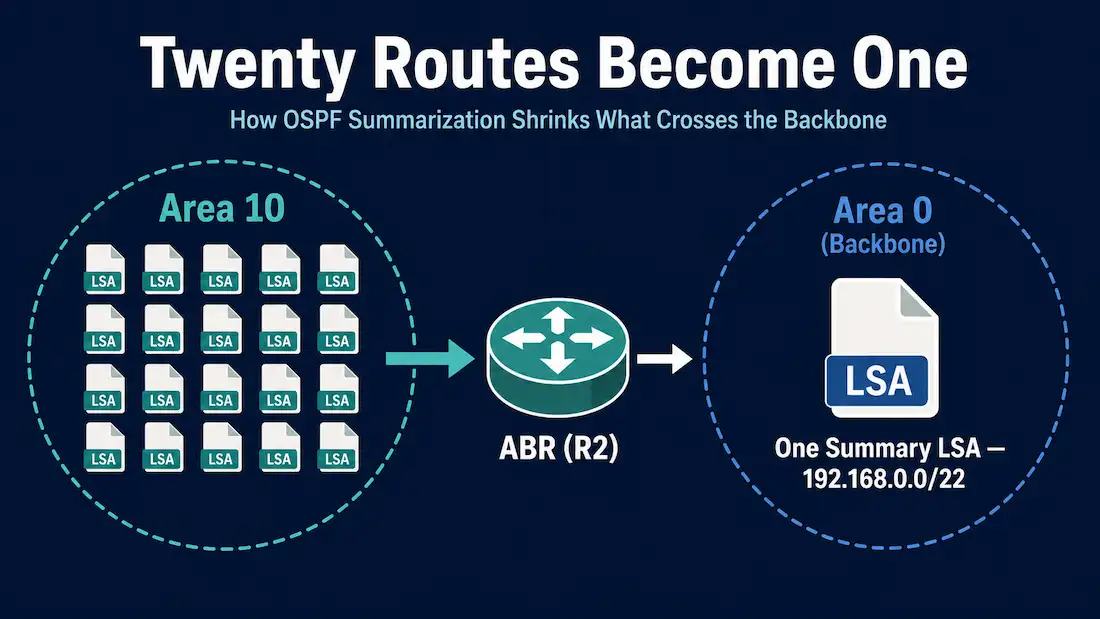
Route summarization converts multiple specific routes into a single, condensed route, shrinking routing tables and reducing the volume of routing updates that need to flood through a network. This guide covers both types of OSPF summarization — inter-area (at an ABR) and external (at an ASBR) — including the specific command for each, since one of the two is easy to leave out if you only remember the more commonly cited example, along with a side effect of the ABR command that’s worth recognizing rather than mistaking for a fault.
This builds directly on OSPF LSA Types and Types of Routers in OSPF — summarization only makes sense once you know which router role generates which LSA type.
Why OSPF Restricts Summarization to ABRs and ASBRs
OSPF does not support automatic summarization anywhere in the network, and manual summarization can only be configured on two specific router roles: Area Border Routers (ABRs) and Autonomous System Boundary Routers (ASBRs). This is a deliberate design restriction, and it’s worth contrasting with EIGRP, which takes a much looser approach: EIGRP allows manual summarization to be configured at essentially any interface on any router in the network, not just at area or AS boundaries.
OSPF’s restriction makes sense given how its LSA types work. Type 1 and Type 2 LSAs — the detailed topology information generated inside an area — only get translated into condensed Type 3 Summary LSAs specifically at the point where an ABR bridges one area to another. There’s no equivalent translation point anywhere else in the topology, so there’s nowhere else summarization could meaningfully happen. The same logic applies to Type 5 External LSAs and the ASBR that generates them.
How Summarization Reduces LSA Flooding
Suppose Area 10 contains 20 distinct networks, each generating its own Type 1 LSA. Without summarization, the ABR connecting Area 10 to the backbone would need to generate 20 separate Type 3 Summary LSAs — one per network — and flood every one of them into Area 0 and onward to every other area in the domain.
With summarization configured, that same ABR instead advertises a single Type 3 LSA covering all 20 networks as one summarized address range (assuming the addressing plan allows a clean summary — see the planning note below). Every other area in the domain sees one route instead of twenty.
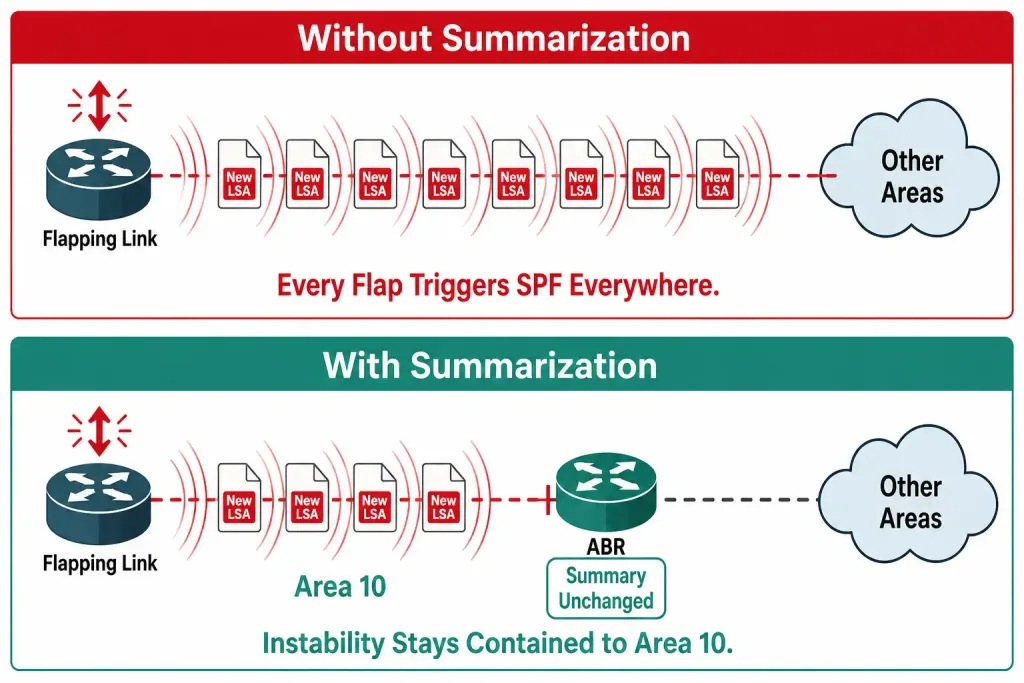
This has a direct effect on stability, not just routing table size: if one of those 20 networks flaps — a link goes up and down repeatedly — without summarization, every flap generates a fresh Type 1 LSA inside the area, which the ABR translates and reflloods as a fresh Type 3 LSA into every other area, each time triggering route recalculation everywhere. With summarization configured, that same flapping link’s Type 1 LSA still floods inside its own area, but the ABR’s summarized Type 3 LSA covering the whole range doesn’t change at all — the instability stays contained within the originating area and never propagates outward.
Inter-Area Summarization (ABR)
Inter-area summarization lets an ABR combine multiple networks from one area into a single summarized route advertised into other areas. The command is entered under the OSPF process on the ABR:
Router(config)# router ospf 1
Router(config-router)# area <area-id> range <address> <mask>
The <area-id> here is the source area — the area whose routes are being summarized, not the area the summary is being sent into. For example, to summarize a block of networks originating in Area 10 down to a single 192.168.0.0/22 before advertising into other areas:
Router(config-router)# area 10 range 192.168.0.0 255.255.252.0This command only summarizes Type 3 LSAs — routes crossing between OSPF areas. It has no effect on external (Type 5) routes, which require the separate ASBR-side command covered below.
Planning note: getting a clean summary depends entirely on how the addressing plan was laid out in the first place. A summary route can only be as efficient as the underlying addresses allow — if an area’s subnets were assigned somewhat randomly rather than from a contiguous block, the “cleanest” summary available might cover far more address space than the area actually uses, or might not be possible to express as a single reasonable summary at all. This is why planning IP addressing with future summarization in mind, before a network grows large, saves considerable pain later.
External Route Summarization (ASBR)
External route summarization condenses routes that entered OSPF through redistribution — from another routing protocol, static routes, or connected routes — before advertising them as Type 5 (or Type 7, inside an NSSA) LSAs. The command is entered on the ASBR:
Router(config)# router ospf 1
Router(config-router)# summary-address <address> <mask>
For example, if a range of routes redistributed from another protocol collectively falls within 172.16.0.0/16, but the individual pieces have been redistributed as several smaller, specific routes:
Router(config-router)# summary-address 172.16.0.0 255.255.0.0As with inter-area summarization, the effectiveness of external summarization depends on the redistributed routes actually falling within a clean, contiguous address range. Summarizing a scattered, non-contiguous set of external routes can inadvertently include address space that doesn’t actually exist behind this ASBR, which risks black-holing traffic for those addresses if another path doesn’t legitimately exist.
One notable exception worth knowing: summary-address can also be used on an ABR in the specific case of summarizing external routes that are passing through that ABR — but in that scenario, only the external (Type 5) portion is affected; it does not summarize Type 3 inter-area routes, which still require area range regardless of which router type is doing the summarizing.
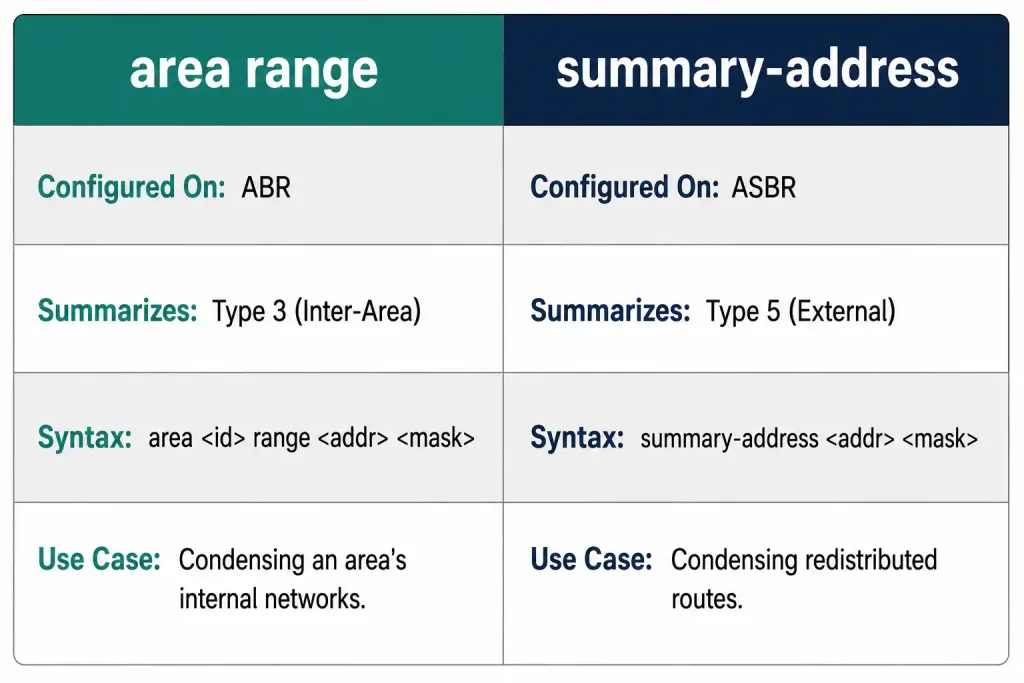
Comparison: Area Range vs. Summary-Address
area range | summary-address | |
|---|---|---|
| Configured on | ABR | ASBR (or ABR, for external routes specifically) |
| Summarizes | Type 3 (inter-area) LSAs | Type 5 (external) / Type 7 (NSSA external) LSAs |
| Argument order | Source area first, then address/mask | Address/mask only |
| Typical use case | Condensing an area’s internal networks before crossing into another area | Condensing redistributed routes from another protocol or static routes |
The Discard Route Side Effect
When area range is configured on an ABR, Cisco IOS automatically installs a discard route (also shown as a null route) for the summarized address range on that ABR:
Router# show ip route
O    192.168.0.0/22 is a summary, Null0
This exists specifically to prevent routing loops. Without it, if a specific address within the summarized range doesn’t actually exist anywhere in the area (for example, an unused portion of the address block), a packet destined for it could otherwise bounce between the ABR and another router indefinitely, each one believing the other has a more specific route. The discard route ensures that any traffic matching the summary but not matching a more specific real route gets dropped locally at the ABR instead, rather than looping.
This is generally harmless and expected — it’s a normal, automatic part of how area range works, not a misconfiguration. It’s worth recognizing in show ip route output specifically so it isn’t mistaken for an actual problem during troubleshooting.
Verifying Summarization
After configuring either command, show ip ospf confirms it’s active and shows the resulting summary:
Router# show ip ospf
Routing Process "ospf 1" with ID 2.1.1.1
 ...
 Area range: 192.168.0.0/22 Active advertise
For inter-area summarization specifically, checking the routing table on a router in a different area is the most direct confirmation that summarization is working as intended:
OtherAreaRouter# show ip route ospf
O IA  192.168.0.0/22 [110/3] via 10.10.10.1
If summarization were not configured, this same router would instead show up to 20 separate O IA entries — one per original network — rather than the single condensed entry above. Seeing one summarized entry where many specific ones used to appear is the clearest sign the configuration is doing its job.
For external route summarization, the equivalent check is confirming that a single summarized external route appears in place of several specific O E1/O E2 entries in other routers’ routing tables, and that show ip ospf on the ASBR itself reports the summary address as active.
Common Mistakes
Using summary-address when area range was needed. Since summary-address doesn’t touch Type 3 LSAs, using it on an ABR when the goal was actually to summarize an area’s internal networks accomplishes nothing for that goal — the individual Type 3 LSAs keep flowing unchanged.
Summarizing across a non-contiguous address range. Both commands assume the addresses being summarized fit cleanly under the specified mask. Summarizing address space that isn’t actually contiguous, or that includes ranges not present behind the summarizing router, can cause traffic to be routed toward a dead end.
Forgetting which area ID to use with area range. The area ID in area <area-id> range refers to the source area holding the routes being summarized — not the backbone, and not the destination area the summary is headed toward. Using the wrong area ID means the command silently does nothing, since there are no matching routes to summarize in that area.
Assuming summarization happens automatically. Unlike EIGRP’s historical auto-summary behavior, OSPF never summarizes anything unless area range or summary-address is explicitly configured.
Frequently Asked Questions
What’s the difference between area range and summary-address?
area range, configured on an ABR, summarizes Type 3 inter-area LSAs — routes crossing from one OSPF area into another. summary-address, configured on an ASBR, summarizes Type 5 external LSAs — routes that entered OSPF via redistribution. They serve different LSA types and are not interchangeable.
Can OSPF summarize routes automatically, like EIGRP used to?
No. OSPF has no automatic summarization feature at all. Every summary route requires an explicit area range or summary-address command.
Why can’t summarization be configured on an internal router?
Because internal routers don’t sit at a boundary where LSA translation happens. Type 1 and Type 2 LSAs only get converted into condensed Type 3 LSAs at an ABR, and external routes only get converted into Type 5 LSAs at an ASBR — there’s no equivalent conversion point inside a single area for summarization to act on.
Does summarization improve network stability, or just reduce routing table size?
Both. A smaller routing table is a secondary benefit — the more significant effect is containment: a route flapping inside one area no longer triggers LSA floods and SPF recalculations in every other area, since the ABR’s summary route doesn’t change even while the underlying specific route is flapping.
What happens if I summarize an address range that includes networks I don’t actually have?
Traffic destined for those non-existent networks will be routed toward the summarizing router based on the summary route, and then dropped there, since no more specific route exists to actually deliver it — a phenomenon sometimes called a routing black hole. Careful address planning before summarizing avoids this. On an ABR configured with area range, this exact scenario is partly mitigated automatically by the discard route Cisco IOS installs alongside the summary, which prevents the dropped traffic from looping rather than preventing the drop itself.
Conclusion
OSPF summarization comes down to two commands serving two different LSA types: area range on an ABR for inter-area (Type 3) routes, and summary-address on an ASBR for external (Type 5) routes. Both reduce routing table size, but their more important benefit is containment — keeping instability from one area or one redistributed route source from propagating LSA floods and SPF recalculations across the rest of the OSPF domain. Getting the most out of either command starts well before configuration, with an addressing plan laid out in contiguous blocks that actually summarize cleanly.