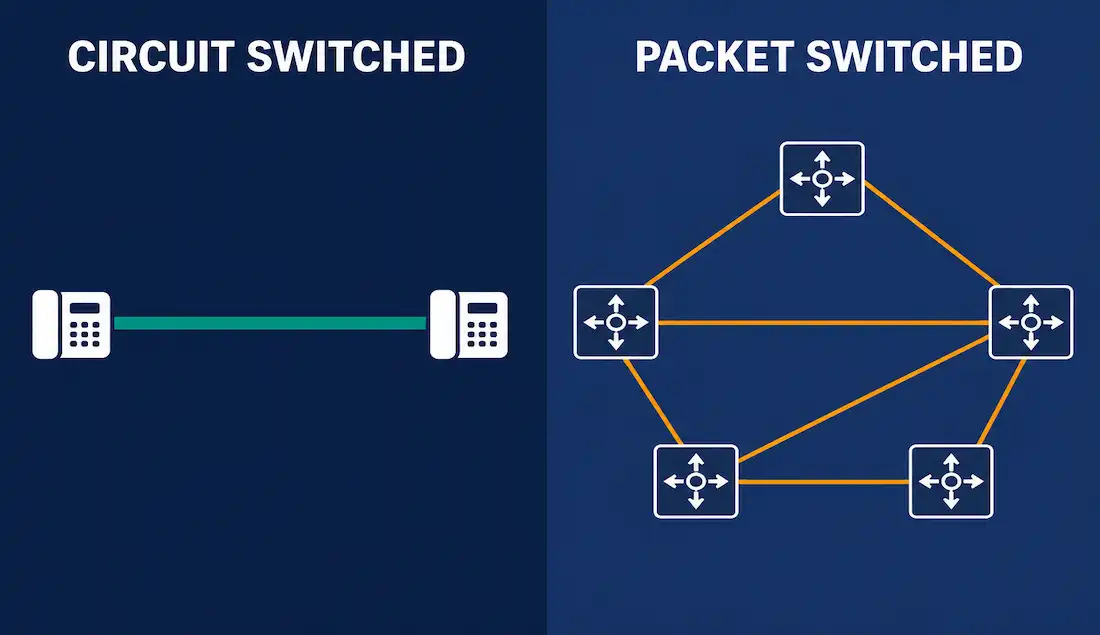
Every wide area network connection relies on one of two switching methods: circuit switching or packet switching. The earlier article on WAN devices covered the hardware routers and modems use to reach a WAN, but that hardware only tells half the story. The switching method chosen by your WAN access technology determines how data actually moves between two points, how reliable that path is, and how efficiently the network uses its available bandwidth.
Understanding the difference matters for the CCNA exam and for real network design decisions. This guide breaks down how each method works, where each is still used today, and why almost every modern network — including the one you’re using to read this — runs on packet switching.
What Is Circuit Switching?
Circuit switching sets up a dedicated, exclusive path between two end devices before any data moves. Think of it as reserving a private lane on a highway just for your car, even if no other traffic wants to use that lane. Once the circuit is established, it stays open for the entire session, whether or not data is actively flowing through it.
How a Circuit-Switched Call Is Set Up
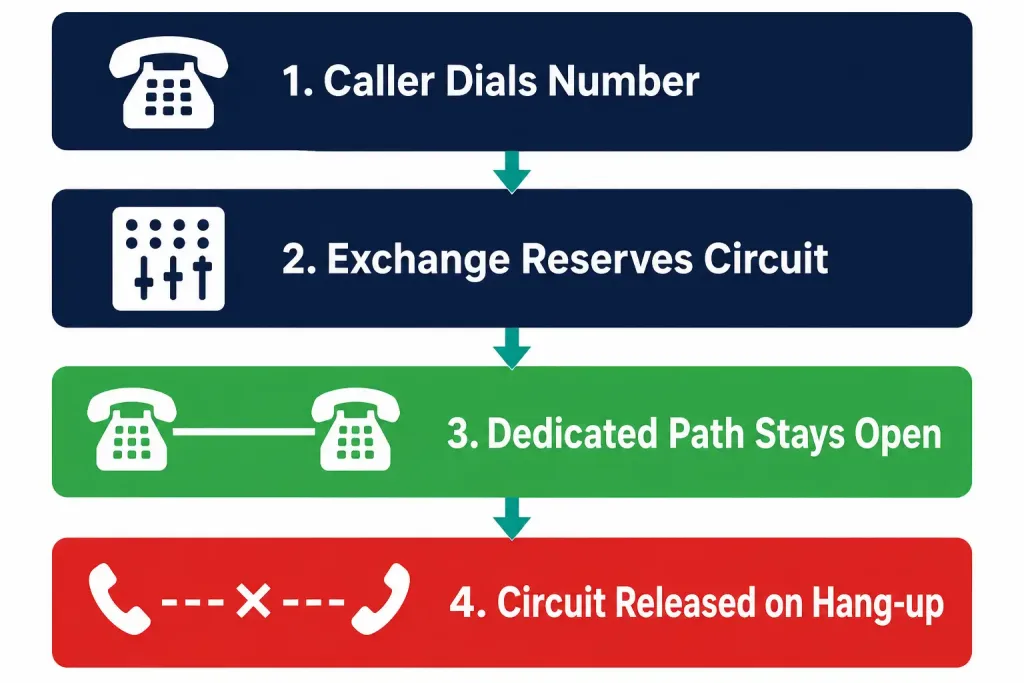
The classic example is a traditional analog telephone call. Here’s what happens step by step when someone dials a number:
- The caller picks up the handset and dials the destination number.
- Switches at each telephone exchange along the route reserve a continuous electrical circuit connecting the caller to the called party.
- The circuit stays locked in place for the duration of the call — no other call can use that specific path.
- When either party hangs up, the switches release the circuit, freeing it for the next call.
Because the path is reserved end-to-end, nobody else can use it — it’s why an unanswered dial tone or busy signal can never be shared between two unrelated calls.
Circuit-Switched WAN Technologies
Two technologies define classic circuit-switched WAN access:
- Public Switched Telephone Network (PSTN): The traditional analog phone system, originally designed to carry voice but also historically used for dial-up data connections.
- Integrated Services Digital Network (ISDN): A digital circuit-switched service that carries voice, video, and data over the same dedicated channel, historically used as a WAN backup link or for videoconferencing.
Both of these are now legacy technologies. Major carriers have been retiring ISDN service for years in favor of IP-based alternatives, and PSTN infrastructure is steadily migrating to Voice over IP (VoIP). If you encounter either on the CCNA exam, know them as circuit-switching examples rather than as technologies you’re likely to deploy new.
Advantages and Disadvantages of Circuit Switching
Advantages:
- Guaranteed, consistent bandwidth for the entire session.
- Predictable, low latency once the circuit is established, since the path never changes.
- Simple to understand and troubleshoot — one dedicated path, one connection.
Disadvantages:
- Wasteful of bandwidth. The circuit stays reserved even during silence or idle periods.
- Slow connection setup, since the full path must be established before any data moves.
- Does not scale efficiently for bursty data traffic like web browsing or file transfers.
What Is Packet Switching?
Packet switching takes the opposite approach. Instead of reserving a dedicated path, it breaks data into small units called packets and sends them across a shared network. Multiple devices can use the same physical links at the same time because no single conversation monopolizes the entire path.
Each switch or router along the way reads addressing or circuit information in the packet header and decides where to forward it next. This shared-use model is what makes the Internet — and virtually every modern WAN — dramatically more efficient than circuit switching.
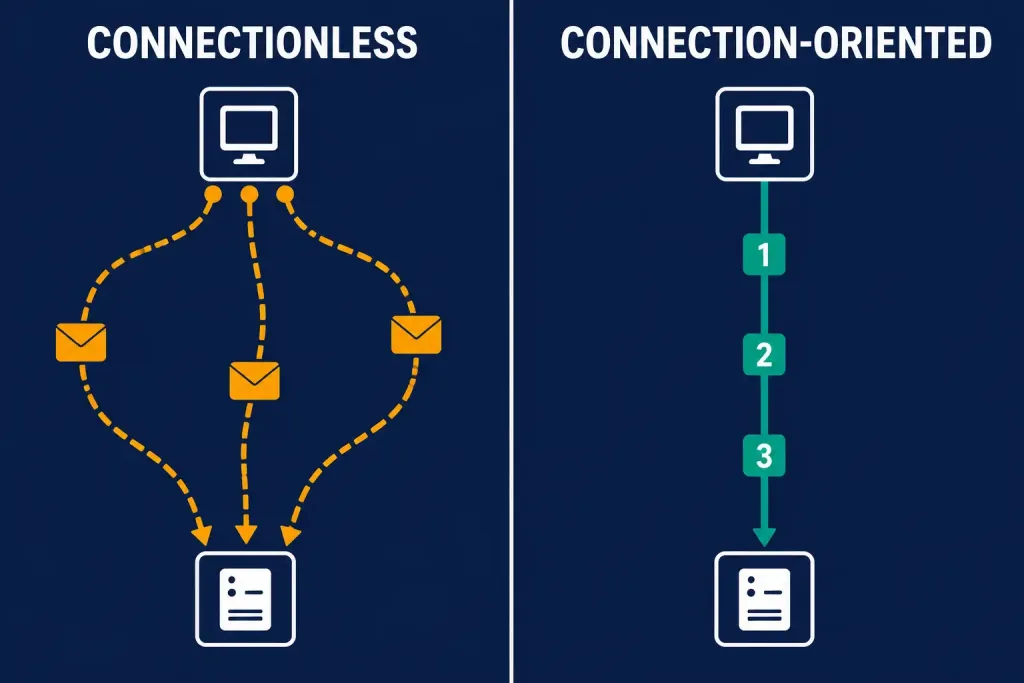
Packet switching comes in two forms: connectionless and connection-oriented.
Connectionless Packet Switching
In a connectionless system, every single packet carries full destination addressing information. There’s no pre-established path — each switch or router independently examines the destination address in each packet and decides the best next hop, packet by packet. This is exactly how IP routing on the Internet works: packets belonging to the same conversation can even take different paths to reach the same destination.
Connection-Oriented Packet Switching (Virtual Circuits)
In a connection-oriented system, the network first negotiates and establishes a logical path — called a virtual circuit (VC) — before data transmission begins. Every packet in the conversation follows that same predetermined route, arriving in order. Because the path is already fixed, packets don’t need to carry full destination addressing; they only need a small circuit identifier telling the switch which pre-established path to use.
Frame Relay is the textbook CCNA example of a connection-oriented, packet-switched WAN technology. It uses virtual circuits identified by a Data-Link Connection Identifier (DLCI) rather than full network addresses, and those circuits can be either:
- Permanent Virtual Circuits (PVCs): Pre-configured by the carrier and always available, the far more common deployment.
- Switched Virtual Circuits (SVCs): Established on demand and torn down after use, rarely deployed in practice.
Frame Relay itself is now considered legacy technology. Major carriers stopped offering new Frame Relay service years ago, and most organizations that once ran Frame Relay have migrated to MPLS or Internet-based VPN links. It remains on the CCNA blueprint because understanding virtual-circuit concepts is foundational to understanding how MPLS and other modern WAN technologies still use similar path-based forwarding logic today.
Other Packet-Switched WAN Technologies Worth Knowing
- X.25: An older packet-switching standard that predates Frame Relay and directly influenced its design. Almost entirely retired today.
- Asynchronous Transfer Mode (ATM): A fixed-cell-size, connection-oriented packet-switching technology once popular for carrier backbones; largely displaced by Ethernet and MPLS.
- MPLS (Multiprotocol Label Switching): The modern successor to Frame Relay and ATM for enterprise WAN links. MPLS uses short labels instead of full addresses to forward traffic quickly through a provider’s core network, combining much of the efficiency of packet switching with predictable, virtual-circuit-like paths.
Advantages and Disadvantages of Packet Switching
Advantages:
- Highly efficient use of shared bandwidth — no wasted idle capacity.
- Resilient: if one path fails, connectionless packet switching can reroute around it.
- Scales well for the bursty, unpredictable traffic patterns typical of data networks.
Disadvantages:
- Variable latency and possible out-of-order delivery in connectionless systems, since packets can take different paths.
- Requires more processing at each switch or router to make per-packet forwarding decisions.
- Connection-oriented packet switching adds setup overhead before any data can flow, though far less than circuit switching.
Circuit Switching vs Packet Switching: Side-by-Side Comparison
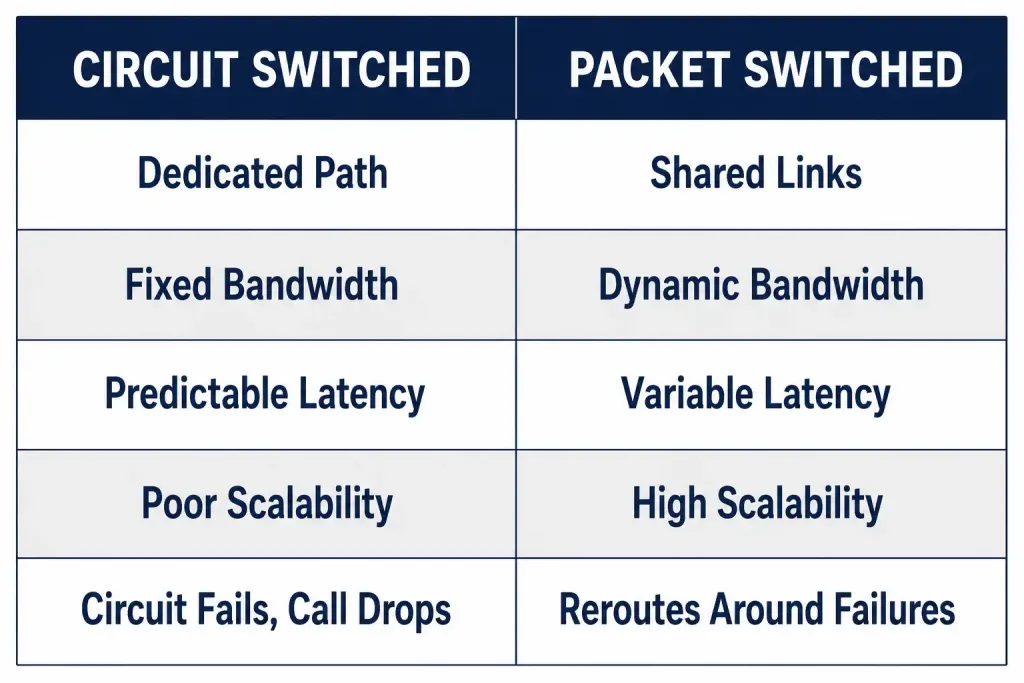
| Feature | Circuit Switching | Packet Switching |
|---|---|---|
| Path setup | Dedicated path reserved before communication | No dedicated path required (connectionless) or a virtual circuit (connection-oriented) |
| Bandwidth use | Reserved and fixed, even when idle | Shared dynamically among multiple users |
| Latency | Consistent and predictable once established | Variable, depends on network load |
| Scalability | Poor — one path per session | Excellent — many sessions share the same links |
| Failure recovery | Circuit fails, call drops entirely | Traffic can reroute around a failed path |
| Setup delay | High — full path must be established first | Low to none for connectionless; moderate for VC setup |
| Example technologies | PSTN, ISDN | Frame Relay, X.25, ATM, MPLS, the Internet (IP) |
| Current relevance | Largely legacy, replaced by VoIP | Dominant model for virtually all modern networks |
Real-World Example: Why the Internet Moved to Packet Switching
Imagine 100 offices connected over a WAN, each needing to communicate with a central data center intermittently throughout the day. With circuit switching, each office would need its own dedicated, always-reserved path to the data center — expensive and wasteful, since most offices aren’t transmitting at any given moment. With packet switching, all 100 offices share the same physical links, and bandwidth automatically flows to whichever office is actively sending data. This efficiency is exactly why telephone networks themselves have largely moved from circuit-switched PSTN calls to packet-switched VoIP, and why the Internet — a purely packet-switched network — became the dominant global communications infrastructure instead of a worldwide circuit-switched telephone-style system.
Troubleshooting and Exam Tips
- If asked to identify a circuit-switched technology on the CCNA exam, look for PSTN or ISDN specifically — these are the two classic answers.
- If asked to identify a connection-oriented packet-switched technology, Frame Relay and its virtual circuits (PVC/SVC) are the standard answer.
- Remember that connectionless packet switching (like IP) does not guarantee packets arrive in order — that job is handled by higher-layer protocols like TCP, not by the switching method itself.
- Don’t confuse “connection-oriented” with “circuit-switched.” A connection-oriented packet-switched network like Frame Relay still shares bandwidth across multiple virtual circuits on the same physical link — it never reserves an exclusive, dedicated physical path the way true circuit switching does.
A Brief History: From Circuit Switching to Packet Switching
Circuit switching came first, by necessity. Early telephone networks in the late 1800s relied on human operators physically plugging cables into switchboards to complete a call — the original dedicated circuit. Automated electromechanical switches later took over that same job, but the underlying concept never changed: one call, one reserved path, for the full duration of the conversation.
Packet switching is a much newer idea, developed in the 1960s specifically to solve circuit switching’s biggest weakness — wasted capacity. Researchers working on ARPANET, the direct ancestor of today’s Internet, needed a way for many computers to share a small number of expensive network links without each one requiring its own dedicated line. Breaking data into small, independently routable packets solved that problem, and the approach proved so much more efficient that it eventually became the foundation for essentially all data networking.
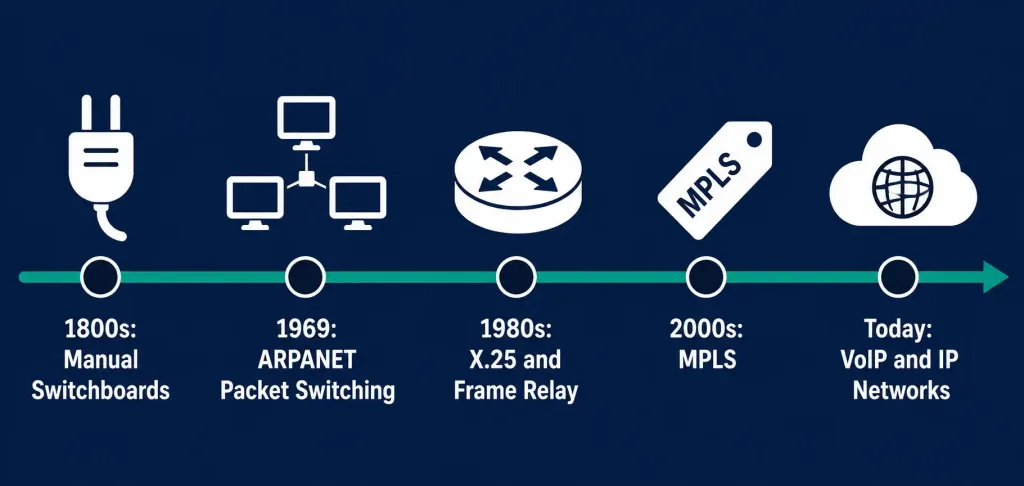
By the 1980s and 1990s, packet-switched WAN technologies like X.25 and later Frame Relay gave businesses an alternative to expensive dedicated circuit-switched leased lines. The rise of the commercial Internet in the 1990s, followed by MPLS in the early 2000s, completed the shift. Today, even voice traffic — historically the last holdout for circuit switching — has largely moved to packet-switched VoIP, closing the loop on a five-decade transition.
Security Considerations for Each Switching Method
Switching method also affects how a network needs to be secured, which is worth understanding beyond the exam.
A dedicated circuit-switched path offers a form of physical isolation: no other traffic shares that exact circuit while it’s active, which historically made eavesdropping marginally harder without physical access to the line itself. That isolation was never true encryption, though — a wiretap on a circuit-switched PSTN line has always been possible with physical access to the circuit.
Packet-switched networks share physical links across many simultaneous conversations, which means traffic from different sources can traverse the same cable or switch. This shared-medium design is exactly why encryption became essential rather than optional as networks moved toward packet switching. Technologies like IPsec VPNs, TLS, and MPLS VPNs exist specifically to recreate the confidentiality that a dedicated circuit once provided naturally, but without sacrificing the efficiency gains of shared bandwidth. When designing or troubleshooting a packet-switched WAN, don’t assume confidentiality is built in the way it loosely was on a legacy dedicated circuit — encryption has to be deliberately configured.
Frequently Asked Questions
Is the Internet circuit-switched or packet-switched? The Internet is entirely packet-switched. IP routes each packet independently (connectionless), while transport-layer protocols like TCP handle ordering and reliability on top of that.
Is Frame Relay still used today? Rarely for new deployments. It’s considered legacy technology, and most enterprises that once used it have migrated to MPLS or VPN-based WAN links. It remains relevant for CCNA study because it introduces virtual-circuit concepts still used in modern networking.
Why don’t phone calls use packet switching? Increasingly, they do. Traditional PSTN calls are circuit-switched, but VoIP has moved most voice traffic — including most modern phone calls — onto packet-switched IP networks.
What’s the main disadvantage of circuit switching? Wasted bandwidth. A reserved circuit stays open for the full session even during silence or inactivity, unlike packet switching, where idle capacity is immediately available to other traffic.
Does packet switching guarantee packets arrive in order? Only connection-oriented packet switching (like Frame Relay’s virtual circuits) preserves order by design. Connectionless packet switching (like IP) does not — out-of-order delivery is handled by higher-layer protocols such as TCP.
Key Takeaways
Circuit switching reserves a dedicated path for the full duration of a session, making it predictable but inefficient for anything except constant, low-idle traffic like traditional voice calls. Packet switching shares bandwidth dynamically across many users, making it the far more efficient and scalable choice for the bursty, unpredictable traffic patterns of modern data networks. That efficiency advantage is exactly why circuit-switched PSTN and ISDN have become legacy technologies, while packet-switched IP networks — and their modern connection-oriented cousin, MPLS — now carry nearly all WAN and Internet traffic.