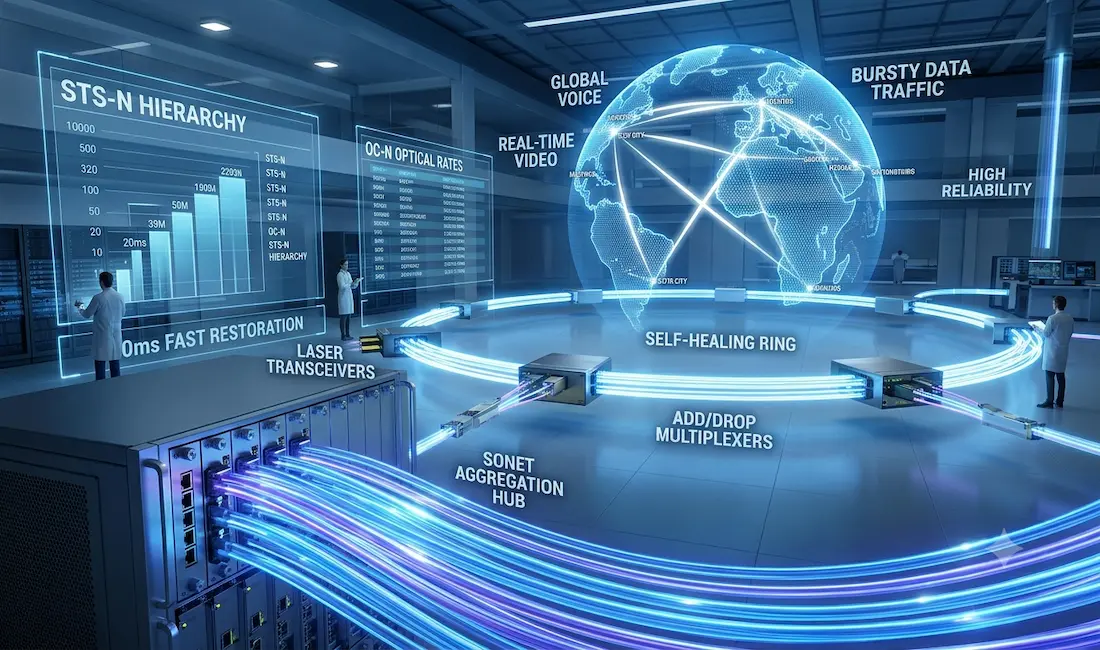
Synchronous Optical Networking is a standardized protocol for transmitting large volumes of data over long distances across fiber-optic media. For decades it has been a backbone technology of the global telecommunications network, carrying voice, data, and video traffic between cities and across continents on high-speed optical links. SONET was developed in the mid-1980s and standardized by the American National Standards Institute (ANSI); its international counterpart, SDH, is used in most of the world outside North America.
This guide explains what SONET is, how it works, the SONET/SDH relationship, its data rates, frame structure, network elements, ring topologies, real-world deployment context, and its advantages, disadvantages, and place in modern networks.
What SONET Does
Using synchronous optical networking, multiple digital data streams are transmitted simultaneously over optical fiber using light — generated by laser diodes or LEDs. SONET takes many lower-speed electrical signals (such as T1/E1 circuits carrying voice calls or data) and multiplexes them, using time-division multiplexing, into a single high-speed optical signal for transport across the fiber network.
SONET operates at the physical layer of the OSI model, defining the optical interface standards, line rates, framing, and synchronization used across the network. Because it uses standardized line rates, equipment from different vendors and different telecom carriers can interconnect, which is a large part of why SONET became a global backbone technology. For long-haul links, SONET can use regenerators to boost and reshape optical signals that have weakened after traveling long distances.
A defining feature of SONET is resilience: its architecture is designed to keep transmitting even if part of the network fails. It achieves this using self-healing ring topologies and automatic protection switching, which can reroute traffic around a failed link or node in milliseconds.
SONET vs. SDH
SONET and SDH (Synchronous Digital Hierarchy) are two closely related standards for the same fundamental technology:
- SONET is the standard used in North America and Japan, standardized by ANSI.
- SDH is the standard used across most of the rest of the world, standardized by the ITU-T.
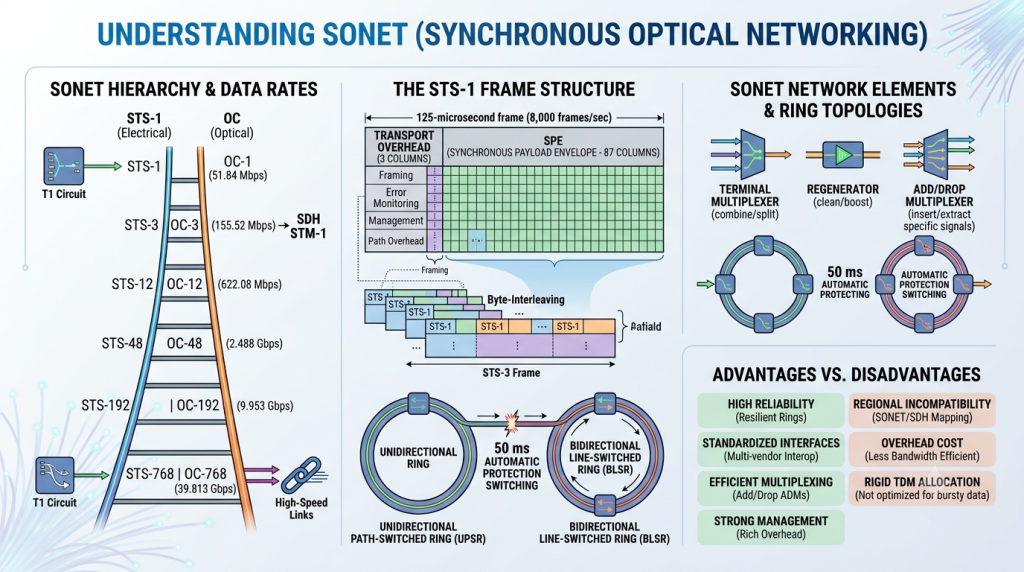
The two are conceptually the same and largely compatible, differing mainly in terminology and their base signal rates. SONET’s base electrical signal is the STS-1 (Synchronous Transport Signal level 1) at 51.84 Mbps, while SDH’s base is the STM-1 (Synchronous Transport Module level 1) at 155.52 Mbps — which corresponds exactly to SONET’s OC-3. Because of these regional differences, careful mapping (gateways) is sometimes needed where SONET and SDH networks interconnect.
SONET Data Rates: STS and OC Levels
SONET signals are described at two levels:
- STS-N (Synchronous Transport Signal) — the electrical signal level.
- OC-N (Optical Carrier) — the equivalent optical signal carried on the fiber.
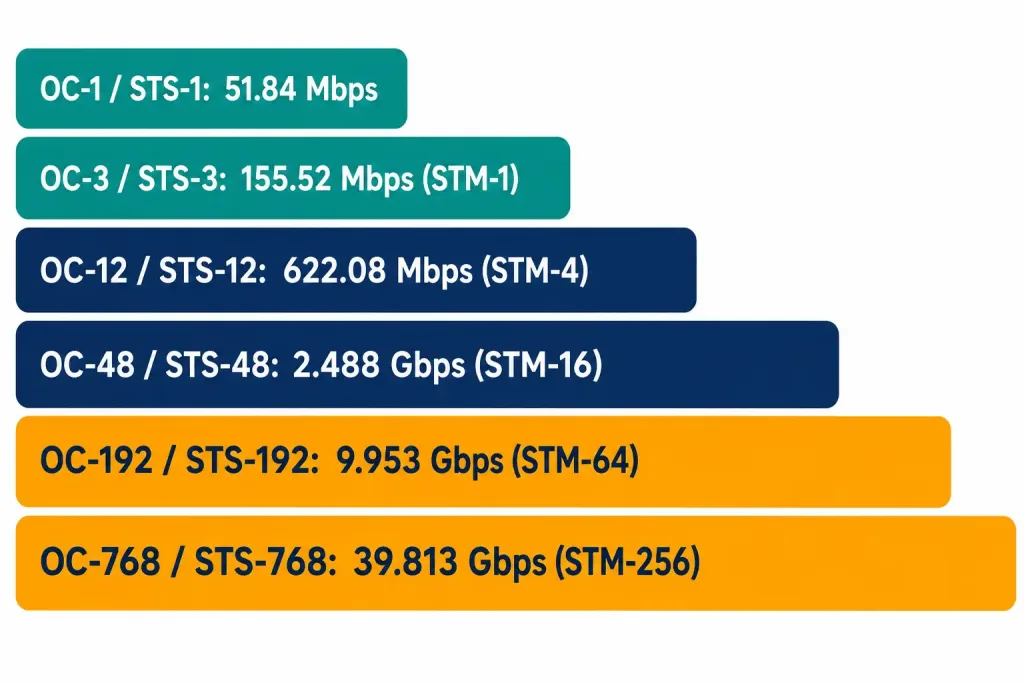
For every STS-N there is a corresponding OC-N at the same rate; the difference is simply whether the signal is in electrical or optical form. The rates are exact multiples of the base 51.84 Mbps rate.
| Optical Carrier | Electrical Signal | Data Rate | SDH Equivalent |
|---|---|---|---|
| OC-1 | STS-1 | 51.84 Mbps | — |
| OC-3 | STS-3 | 155.52 Mbps | STM-1 |
| OC-12 | STS-12 | 622.08 Mbps | STM-4 |
| OC-48 | STS-48 | 2.488 Gbps | STM-16 |
| OC-192 | STS-192 | 9.953 Gbps | STM-64 |
| OC-768 | STS-768 | 39.813 Gbps | STM-256 |
Higher theoretical levels exist (up to OC-3072), but real-world deployments generally top out around OC-768. Each level is an exact multiple of OC-1 — for example, OC-3 is three times OC-1 (3 × 51.84 = 155.52 Mbps).
Worked Example: Calculating an OC-N Rate
Suppose you need to confirm that OC-48 really is 48 times the base rate. The math is straightforward: multiply the OC-1 base rate by the level number.
51.84 Mbps × 48 = 2,488.32 Mbps, which rounds to the commonly cited 2.488 Gbps figure for OC-48. This same multiplication works for every level in the hierarchy — OC-192 is 51.84 × 192 = 9,953.28 Mbps (9.953 Gbps), and OC-768 is 51.84 × 768 = 39,813.12 Mbps (39.813 Gbps). Understanding this relationship is useful for CCNA-style questions that ask you to identify or verify an OC-N rate without simply memorizing the table.
The SONET Frame Structure
The basic building block of SONET is the STS-1 frame, transmitted 8,000 times per second (matching the 125-microsecond sampling interval of digital voice). An STS-1 frame is often depicted as a grid of 9 rows by 90 columns of bytes, divided into two parts:
- Transport overhead: The first 3 columns carry overhead used for framing, error monitoring, management, and maintaining synchronization across the network. This overhead is what enables SONET’s powerful management and protection features.
- Synchronous Payload Envelope (SPE): The remaining 87 columns carry the actual user data (the payload), along with a small amount of path overhead.
Higher-rate signals (STS-3, STS-12, and so on) are formed by byte-interleaving multiple STS-1 frames together, which is why the rates are exact multiples of the base rate.
SONET Network Elements
A SONET network is built from several types of equipment:
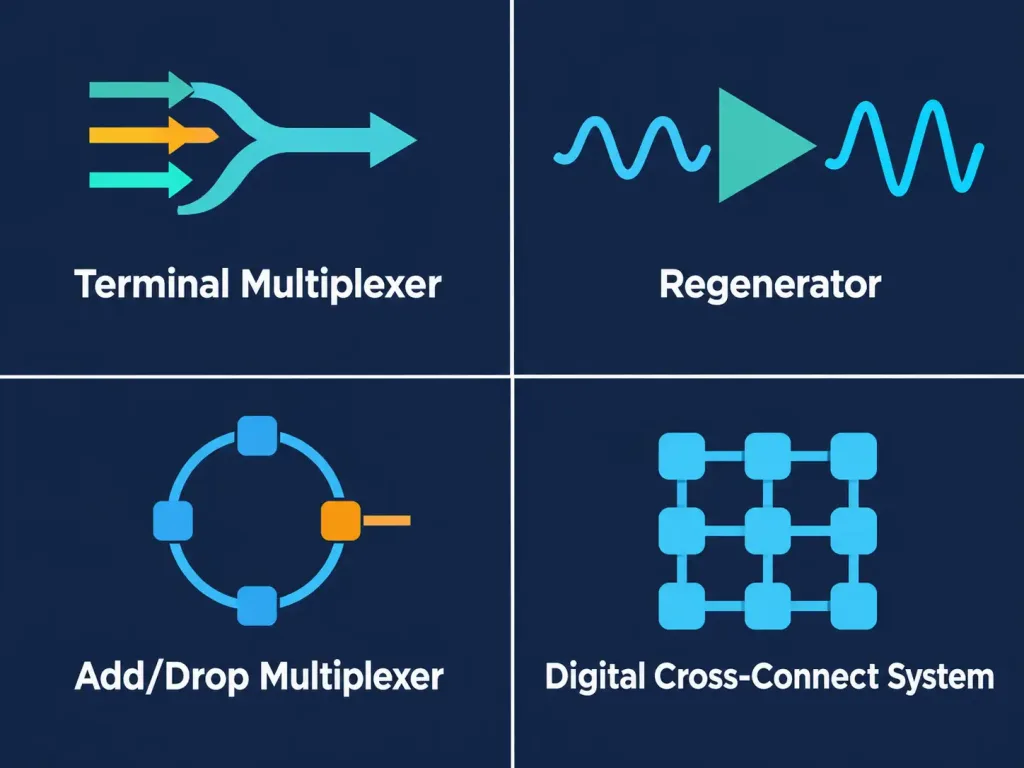
- Terminal multiplexers: Combine multiple lower-rate tributary signals into a SONET signal at the network edge.
- Regenerators: Receive, clean up, and retransmit optical signals over long-haul spans to overcome signal attenuation.
- Add/Drop Multiplexers (ADMs): Insert (add) or extract (drop) specific lower-rate signals from a high-rate SONET stream without disturbing the rest — essential for ring architectures.
- Digital Cross-Connect Systems (DCS): Switch and groom traffic between many SONET signals in larger hub locations.
SONET Ring Topologies and Protection
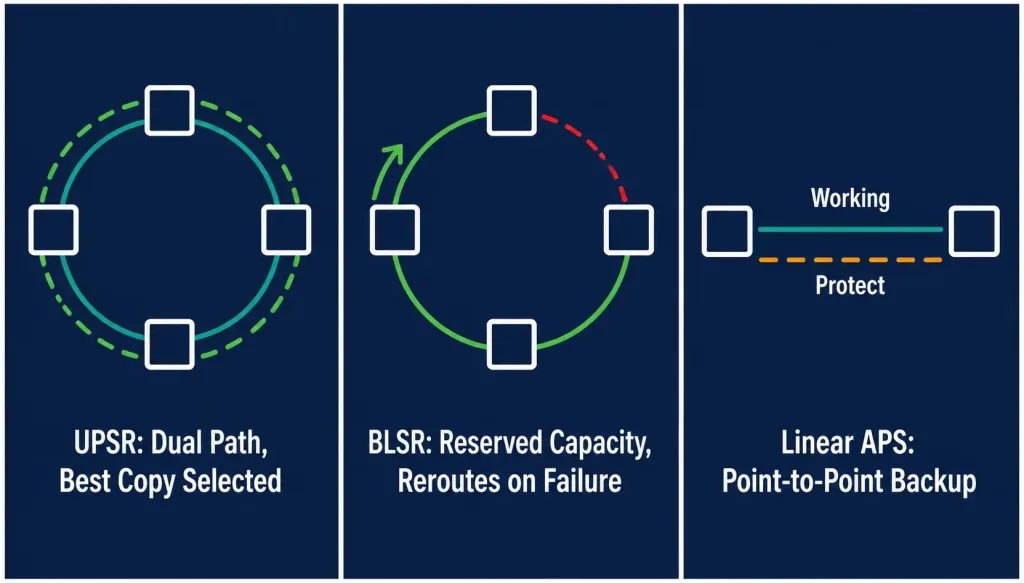
SONET’s resilience comes largely from its ring-based topologies and automatic protection switching, which allow traffic to survive a fiber cut or equipment failure:
- Unidirectional Path-Switched Rings (UPSR): Traffic is sent in both directions around the ring, and the receiver selects the better copy; if one path fails, the other is already available.
- Bidirectional Line-Switched Rings (BLSR): Available in 2-fiber and 4-fiber variants, these reserve protection capacity and loop traffic back around the ring when a span fails, offering efficient protection for larger networks.
- Linear Automatic Protection Switching (APS): Provides a protection path on point-to-point links, switching to a backup fiber if the working fiber fails.
These mechanisms let SONET networks recover from failures extremely quickly, typically within about 50 milliseconds — fast enough to be imperceptible to voice calls.
Real-World Deployment Context
SONET rings historically formed the backbone of metropolitan and long-haul carrier networks, connecting central telephone offices in a ring so that a single fiber cut anywhere on the ring would not interrupt service. A regional telecom carrier, for example, might run a BLSR ring connecting a dozen central offices around a city, with ADMs at each office adding and dropping local traffic while the bulk of the ring capacity passes through untouched. This is the same core design principle that later influenced modern carrier-grade Ethernet ring protection protocols, even as the underlying transport technology shifted toward packet-based systems.
Enterprises rarely deploy SONET equipment themselves today; instead, they typically consume SONET-based service indirectly, such as when a carrier delivers a leased line or private line service over an underlying SONET or OTN transport network. Understanding SONET remains useful even for engineers who never touch the equipment directly, since carrier documentation and service-level agreements still reference OC-N rates and SONET-style protection guarantees.
Advantages of SONET
- High reliability and survivability: Self-healing rings and automatic protection switching keep traffic flowing through failures.
- Standardized interfaces: Common optical interface standards and line rates let equipment from different vendors and carriers interconnect.
- Scalable, flexible architecture: A clear hierarchy of rates supports growth, and SONET is compatible with both legacy and newer services.
- Efficient multiplexing: Adding and dropping tributary signals is straightforward, especially with ADMs.
- Carries many traffic types: Voice, data, and video can all be transported.
- Strong management: Rich overhead supports remote operation, monitoring, and out-of-band management.
- Fast restoration: Recovery from failures typically occurs in around 50 milliseconds.
Disadvantages of SONET
- Regional incompatibility: SONET (North America) and SDH (most of the world) differ, so interworking between them requires careful mapping — SONET is not a single global standard on its own.
- Overhead cost: A significant portion of the frame is overhead, so raw bandwidth efficiency is lower than some alternatives, and this becomes more noticeable at very high capacities.
- Reliance on multiplexer infrastructure: Tributary services depend on SONET multiplexing equipment.
- Less suited to modern optical scaling: Traditional SONET management wasn’t designed around dense wavelength-division multiplexing (DWDM), and rigid time-division allocation is less flexible than modern packet-based transport for bursty data.
SONET Today
SONET and SDH dominated telecom backbones for decades and still carry substantial traffic in many networks. However, as data traffic has exploded and become more packet-oriented, newer technologies have taken over much of the growth. DWDM dramatically increases fiber capacity by carrying many wavelengths on a single fiber, and OTN (Optical Transport Network) provides a more flexible modern framework for transporting mixed traffic, including packet services. Much long-haul capacity today rides on DWDM/OTN systems, sometimes carrying SONET/SDH signals as one of several client types.
Even so, SONET/SDH remains important in installed infrastructure, in circuits requiring guaranteed low-latency deterministic transport, and as a foundation for understanding synchronous optical transport. For anyone studying networking, SONET is a key example of how time-division multiplexing, standardized rates, and ring-based protection combine to build reliable long-distance networks.
Troubleshooting and Exam Tips
- If asked to identify SONET’s base rate, remember 51.84 Mbps (STS-1/OC-1) — every other rate in the hierarchy is a clean multiple of this number.
- If a question pairs an OC level with an SDH STM level, memorize the OC-3/STM-1 equivalence as your anchor point, since STM-1 (155.52 Mbps) is exactly OC-3.
- Don’t confuse UPSR and BLSR: UPSR sends traffic both directions simultaneously and picks the better copy, while BLSR reserves dedicated protection capacity and only reroutes after a failure is detected.
- When troubleshooting a real SONET link, transport overhead in the first 3 columns of the STS-1 frame is where alarms, performance monitoring, and section/line/path status are carried — that’s the first place to check for framing or synchronization errors.
- Remember that SONET’s ~50 millisecond restoration time is a design target for protection switching specifically, not a claim that every possible network fault resolves that fast.
Conclusion
SONET (Synchronous Optical Networking) is a standardized, physical-layer protocol that multiplexes many digital signals onto high-speed optical fiber for long-distance transport, using a hierarchy of standardized OC/STS rates built on a 51.84 Mbps base. Its self-healing ring topologies and fast automatic protection switching made it exceptionally reliable, and standardized interfaces made it a global telecom backbone alongside its international twin, SDH. While DWDM and OTN now carry much of modern traffic growth, SONET/SDH remains embedded in networks worldwide — and a solid understanding of it is valuable for anyone learning how large-scale optical networks are built.
Frequently Asked Questions
What does SONET stand for?
SONET stands for Synchronous Optical Networking (or Synchronous Optical Network). It is a standardized protocol for transmitting large amounts of data over fiber-optic links across long distances.
What is the difference between SONET and SDH?
SONET is the standard used in North America and Japan (standardized by ANSI), while SDH (Synchronous Digital Hierarchy) is used in most of the rest of the world (standardized by the ITU-T). They are conceptually the same technology but differ in terminology and base rates — SONET’s base is STS-1 (51.84 Mbps) and SDH’s is STM-1 (155.52 Mbps, equal to OC-3).
What is the difference between OC and STS in SONET?
STS (Synchronous Transport Signal) refers to the electrical signal level, while OC (Optical Carrier) refers to the equivalent optical signal on the fiber. For each STS-N there is a matching OC-N at the same data rate.
What are the main SONET data rates?
Common rates include OC-1 (51.84 Mbps), OC-3 (155.52 Mbps), OC-12 (622.08 Mbps), OC-48 (2.488 Gbps), OC-192 (9.953 Gbps), and OC-768 (39.813 Gbps). Each is an exact multiple of the OC-1 base rate.
Why is SONET considered reliable?
SONET uses self-healing ring topologies (such as UPSR and BLSR) and automatic protection switching, which can reroute traffic around a failed fiber or node — typically within about 50 milliseconds — so service continues with minimal disruption.
Is SONET still used today?
Yes, though its role has narrowed. SONET/SDH remains widespread in installed telecom infrastructure, while newer technologies like DWDM and OTN now carry much of the growth in high-capacity, packet-oriented traffic.
Do enterprises need to buy or manage SONET equipment themselves?
Rarely. Most enterprises consume SONET-based transport indirectly through a carrier’s leased line or private line service, without owning or operating any SONET multiplexers, ADMs, or regenerators directly.