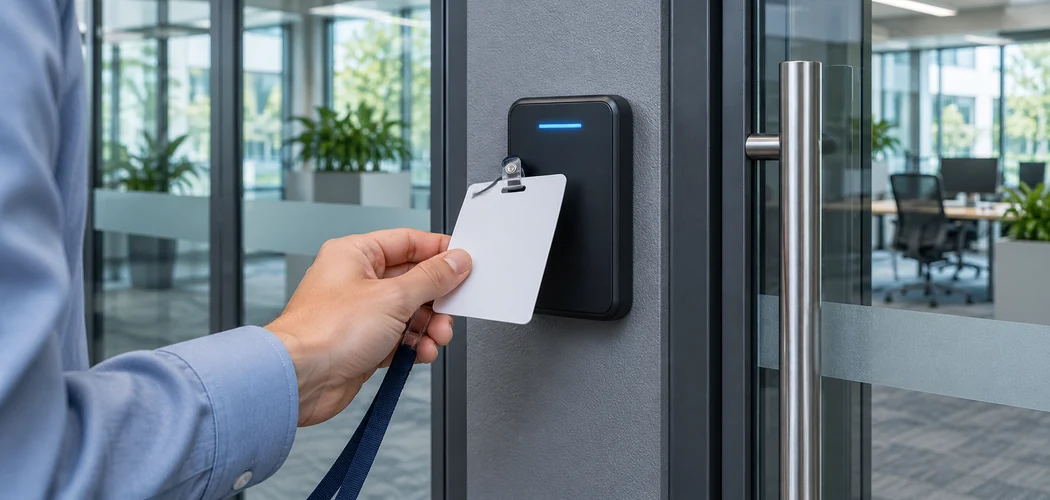
Employee identification technology has evolved considerably from traditional plastic badges displaying a photograph, name, and job title. Modern organizations increasingly use electronic credentials to support physical access control, employee identification, and workplace automation.
Two technologies frequently associated with these applications are Radio Frequency Identification (RFID) and Near Field Communication (NFC).
RFID covers several families of radio-frequency identification technology. NFC operates at 13.56 MHz and overlaps with some high-frequency RFID technologies. For employee badges, compatibility depends on the protocol, credential format, and reader configuration as well as the frequency.
For IT administrators, security professionals, and business owners, understanding these differences is essential when selecting employee identification cards or planning an access-control deployment.
This guide examines how RFID and NFC credentials work, their respective advantages and limitations, and the factors organizations should consider before implementing either technology.
Understanding RFID Technology
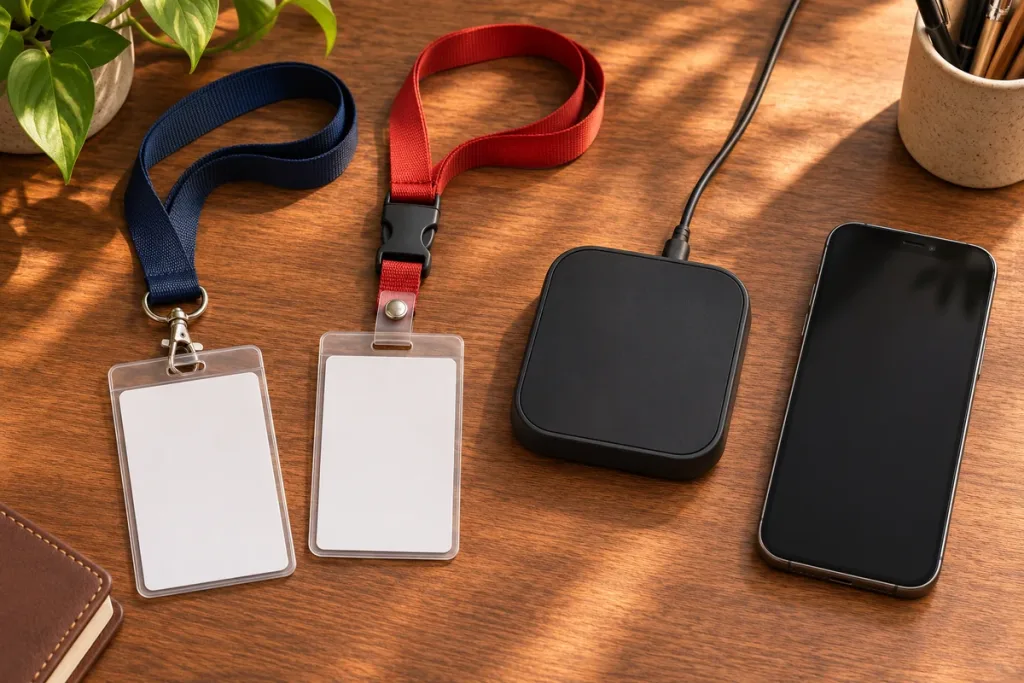
Radio Frequency Identification is a technology that uses electromagnetic fields to identify or communicate with electronic tags.
An RFID system typically consists of three components:
- An RFID tag or credential containing an integrated circuit and antenna.
- An RFID reader that communicates with compatible tags.
- A backend system that processes credential information and determines the appropriate action.
RFID technology operates across several frequency ranges, including low frequency (LF), high frequency (HF), and ultra-high frequency (UHF).
These frequency categories support different applications.
Low-frequency RFID, commonly operating around 125 kHz, has historically been used in employee access cards, proximity credentials, and other identification systems.
High-frequency RFID operates at 13.56 MHz and supports technologies used in smart cards, access control, and NFC applications.
Ultra-high-frequency RFID is commonly associated with inventory management, asset tracking, and logistics, where longer reading distances may be beneficial.
For employee identification, the most relevant technologies are generally low-frequency proximity cards and high-frequency smart cards.
How NFC Technology Works
Near Field Communication is a short-range wireless communication technology operating at 13.56 MHz.
NFC is based on established contactless communication standards and is closely related to certain high-frequency RFID technologies.
Unlike many traditional RFID implementations, NFC supports several operating modes.
These include:
- Reader/writer mode: An NFC-enabled device communicates with compatible tags.
- Card emulation mode: A device behaves like a compatible contactless card.
- Peer-to-peer communication: Devices that support this mode can exchange information. Availability depends on the device, operating system, and application.
NFC is commonly found in smartphones, contactless payment systems, smart cards, and certain access-control applications.
Its integration into modern mobile devices makes NFC attractive for applications that extend beyond traditional employee badges.
For example, an NFC-enabled identification card might provide access to a digital business profile, employee contact information, or a compatible identification application.
However, NFC compatibility does not automatically mean that a card can unlock a building door.
Electronic access depends on the reader, credential technology, supported protocols, and authentication system.
RFID vs. NFC: Key Technical Differences
The table compares common RFID implementations with NFC. The categories overlap because NFC shares 13.56 MHz and some contactless standards with high-frequency RFID.
The following comparison highlights practical differences between common RFID implementations and NFC.
| Feature | Common RFID implementations. | NFC |
| Frequency | LF, HF, or UHF | 13.56 MHz |
| Typical range | Varies from centimeters to several meters | Typically a few centimeters |
| Communication | Depends on RFID technology | Short-range communication with supported operating modes |
| Smartphone compatibility | Depends on frequency and protocol | Supported on many modern smartphones |
| Common applications | Access control, asset tracking, inventory | Mobile credentials, smart cards, information sharing |
| Security | Depends on credential implementation | Depends on protocol and application |
| Reader compatibility | Technology-specific | Requires compatible NFC protocols |
Neither technology is inherently secure simply because it uses radio-frequency communication.
Security depends on the authentication mechanisms, cryptographic protections, credential management procedures, and backend infrastructure.
Employee Access Control: Where RFID Remains Common
RFID has been widely adopted in physical access-control systems because it provides convenient, contactless credential reading.
Employees can present a compatible card to a reader without inserting it into a device.
In many organizations, existing access-control infrastructure uses 125 kHz proximity credentials.
These systems may remain operational for years because replacing readers, controllers, cards, and supporting infrastructure can require significant investment.
However, legacy proximity systems often have important security limitations.
Some older credentials transmit static identifiers without strong cryptographic authentication. Depending on the technology, these identifiers may be vulnerable to unauthorized reading, copying, or emulation.
Organizations should not assume that every RFID card provides the same level of protection.
Modern high-frequency smart-card systems can offer stronger security features, including mutual authentication and cryptographic protection.
When evaluating RFID ID cards, businesses should verify the exact credential format, operating frequency, and compatibility with their existing readers.
A card that looks identical to an existing employee badge may not function with the same access-control system.
Physical appearance alone is not a reliable indicator of electronic compatibility.
NFC Employee Cards: Beyond Door Access
NFC technology introduces additional possibilities for employee identification.
Because many smartphones support NFC, organizations can use compatible tags and cards to provide convenient access to digital information.
For example, an employee badge might contain an NFC tag that opens a professional contact page when scanned with a compatible smartphone.
This can be useful for sales representatives, field technicians, customer-facing employees, and conference personnel.
An NFC card can also direct users to a company directory, digital business card, or other approved online resource.
These applications are different from secure building access.
A basic NFC tag containing a website address does not provide cryptographic identity verification. Its contents may be readable or reproducible, depending on the tag and configuration.
Organizations requiring secure NFC authentication should select credential technologies and applications designed for that purpose.
The broader category of NFC employee identification solutions can include printed employee badges with NFC functionality, digital contact-sharing applications, and compatible electronic credential technologies.
Businesses should distinguish between these use cases before purchasing cards or designing workflows.
Security Considerations for RFID and NFC Deployments
When selecting employee identification technology, security should be evaluated at several levels.
1. Credential Authentication
Some older RFID systems rely primarily on a fixed card identifier.
More secure implementations use cryptographic authentication to verify that a credential is legitimate.
Organizations handling sensitive facilities or information should prioritize systems with appropriately designed authentication mechanisms.
2. Cloning and Unauthorized Duplication
Certain legacy proximity credentials can be copied using specialized equipment.
This risk is particularly relevant when organizations rely on older technologies that lack cryptographic protection.
Modern secure smart-card implementations can reduce cloning risks, although their effectiveness depends on proper configuration and key management.
3. Lost or Stolen Cards
Any physical credential can be lost or stolen.
Organizations should establish procedures for promptly reporting missing cards and revoking associated access permissions.
Issuing a replacement card does not automatically invalidate the original credential.
Access-control administrators must ensure that lost or retired credentials are disabled within the relevant system.
4. Reader and Controller Security
A secure credential cannot compensate for poorly protected access-control infrastructure.
Organizations should evaluate reader-to-controller communication, network segmentation, administrative access, and system monitoring.
Where supported, enable and verify OSDP Secure Channel to protect communication between the reader and controller. Check card-to-reader authentication separately, since it depends on the credential technology and reader configuration.
5. Backend Authorization
The access-control system should determine whether a credential is authorized to open a particular door or access a restricted area.
Credential recognition and authorization are separate functions.
A valid employee card should not automatically grant access to every location.
Role-based permissions, access schedules, and periodic entitlement reviews can help enforce appropriate restrictions.
Compatibility: The Most Common Deployment Challenge
One of the most frequent mistakes organizations make when ordering electronic employee badges is assuming that all RFID or NFC cards are interchangeable.
They are not.
For example, a 125 kHz proximity reader generally cannot communicate with a standard 13.56 MHz NFC tag unless the reader specifically supports both technologies.
Even cards operating at the same frequency may use different protocols, credential formats, and authentication methods.
Organizations should confirm several technical details before purchasing new cards:
- Existing reader manufacturer and model
- Supported operating frequency
- Credential technology and protocol
- Card format and facility-code requirements, where applicable
- Encryption and authentication requirements
- Compatibility with the existing access-control management system
IT and physical security teams should work together during this evaluation.
Before ordering in bulk, test a sample from the intended supplier on each reader model in use. Check that it opens approved doors, is denied at restricted doors, and stops working after revocation. Include an offline door in the pilot if your system uses one.
Printed Identification and Electronic Credentials Serve Different Purposes
Although electronic credentials are increasingly common, printed employee identification remains important.
An RFID or NFC chip may communicate with a reader, but it does not necessarily help a receptionist, coworker, or security officer visually identify an employee.
A professionally printed badge can display an employee photograph, name, department, and job title.
This visible information complements electronic access-control capabilities.
In healthcare environments, employee badges help patients distinguish staff members and identify their professional roles.
In corporate offices, identification cards support workplace recognition and visitor management.
In manufacturing facilities, badges can help identify authorized personnel and distinguish employees from contractors.
Organizations should therefore consider both the visual and electronic functions of an employee card.
A secure access credential does not eliminate the operational value of clear, consistent printed identification.
Choosing Between RFID and NFC for Employee Identification
The right technology depends on the organization’s requirements.
Choose Compatible RFID Credentials When:
- Existing building access systems already support a particular RFID format.
- The primary objective is physical access control.
- The organization needs compatibility with established readers and controllers.
- Security requirements can be met by the selected credential technology.
Consider NFC When:
- Smartphone interaction is an important requirement.
- Employees need digital contact-sharing functionality.
- The organization wants to support compatible mobile credential applications.
- The intended readers and authentication systems support the chosen NFC implementation.
Consider a Hybrid Approach When:
- Employees need both visual identification and electronic access.
- Different facilities use different credential technologies.
- The organization is transitioning from legacy proximity cards to newer systems.
- Employee badges must support multiple business applications.
Hybrid approaches can be particularly useful during infrastructure upgrades, provided the selected cards and readers are compatible.
Cost and Operational Considerations
Credential costs extend beyond the price of the physical card.
Organizations should consider printing, personalization, reader compatibility, administrative labor, replacements, and infrastructure upgrades.
A basic printed employee badge may have a relatively low unit cost.
Electronic credentials can introduce additional expenses depending on chip technology, security features, encoding requirements, and order quantities.
Replacing an entire access-control infrastructure can be substantially more expensive than ordering compatible replacement cards.
For that reason, organizations should assess the total cost of ownership rather than comparing card prices alone.
Operational considerations also matter.
Businesses with multiple offices may benefit from standardized badge templates, centralized ordering, and consistent replacement procedures.
Bulk employee-data imports and controlled administrative workflows can reduce repetitive work when supported by the chosen card management service.
For organizations issuing relatively small numbers of badges, outsourced printing may be more economical than maintaining dedicated printing equipment.
The Future of Employee Identification
Employee identification is increasingly moving toward a combination of physical cards, mobile credentials, and centralized identity management.
Modern access-control systems may support secure smart cards, smartphones, and other compatible devices.
At the same time, businesses continue to require visible employee identification for practical workplace purposes.
Rather than assuming that one technology will completely replace another, organizations should evaluate how different credential types can coexist.
Security, usability, infrastructure compatibility, and administrative efficiency should guide purchasing decisions.
As identity systems evolve, IT administrators will play an important role in coordinating physical access technologies with broader organizational security policies.
Conclusion
RFID and NFC technologies both offer valuable capabilities for employee identification, but they serve different technical and operational requirements.
RFID encompasses a broad range of technologies used in access control, asset tracking, and identification. NFC provides short-range communication capabilities that can support smartphone interaction, digital information sharing, and compatible credential applications.
For organizations selecting employee ID cards, the most important considerations are compatibility, authentication security, administrative requirements, and intended use.
A successful deployment begins with understanding the existing infrastructure and selecting credentials that meet both technical and operational needs.
By combining appropriate electronic credential technology with standardized printed identification, organizations can create employee identification systems that are practical, manageable, and aligned with their security objectives.