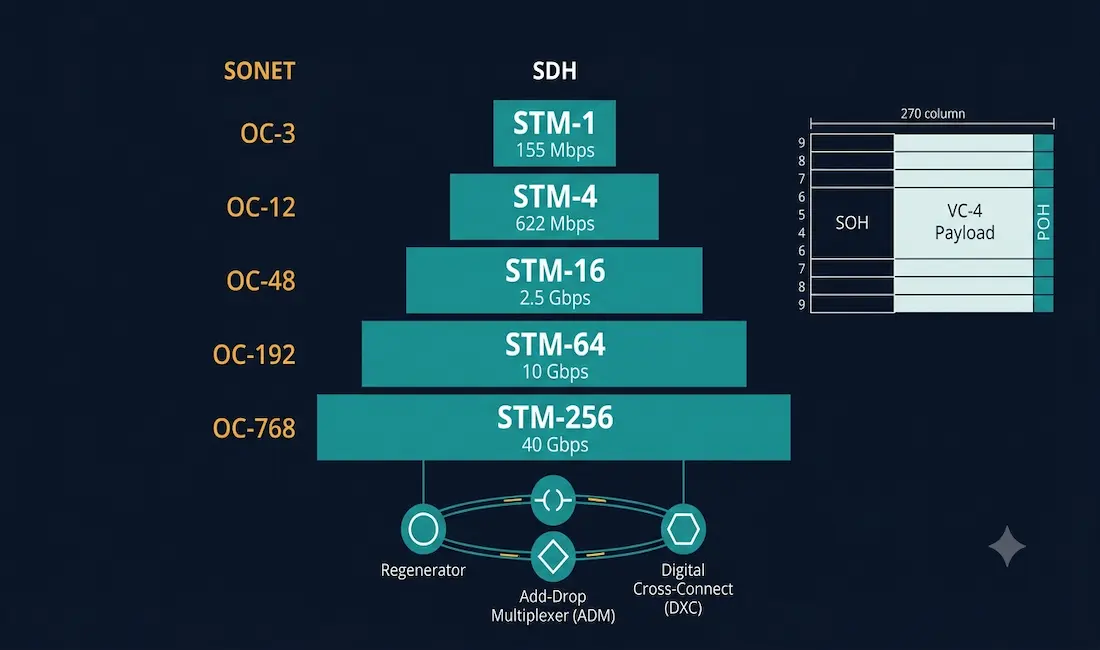
SDH — Synchronous Digital Hierarchy — is the ITU-T standard for multiplexing and transporting digital signals over optical fibre networks. It defines a hierarchy of data rates, a frame structure for organizing those signals, and a set of management and overhead mechanisms that make large-scale optical transport networks manageable and resilient.
SDH is interoperable with SONET — the North American equivalent — and together they formed the backbone of global telecommunications infrastructure through the 1990s and 2000s. Both standards remain in active deployment today, increasingly as the underlying transport layer beneath IP/MPLS and OTN (Optical Transport Network) networks.
Why SDH Was Developed
Before SDH, telecommunications networks used PDH — Plesiochronous Digital Hierarchy. PDH had a fundamental problem: “plesiochronous” means “almost synchronous.” Different parts of the network ran on slightly different clocks, and adding or dropping individual lower-speed tributaries from a high-speed PDH stream required complete demultiplexing and remultiplexing — an expensive, complex process.
SDH solved this with true synchronization. All network elements in an SDH network lock to a common clock source (or to a hierarchy of timing references). This synchronization means that individual tributaries can be accessed, added, or dropped directly from the high-speed SDH signal without touching the rest of the payload — a major operational and cost advantage.
SDH provides key advantages over plesiochronous digital hierarchy in three critical areas: add-drop flexibility, network management capability, and multi-vendor interoperability.
The STM Hierarchy
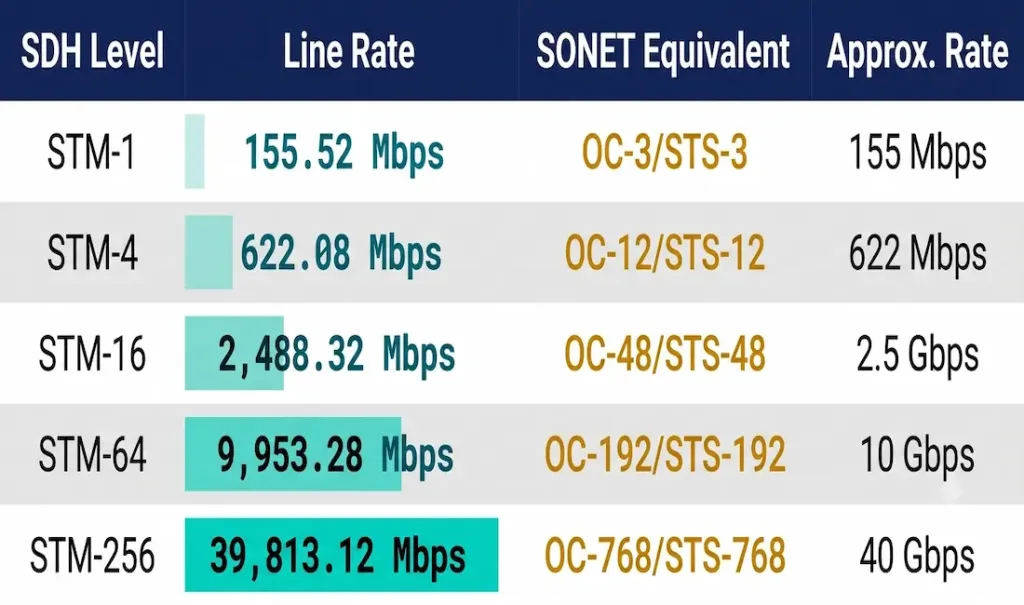
The basic level is STM-1 with a data rate of 155.52 Mbps. SDH defines a hierarchy of Synchronous Transport Modules (STMs) at fixed multiples of this base rate:
| SDH Level | Line Rate | Approximate Rate | SONET Equivalent |
|---|---|---|---|
| STM-1 | 155.52 Mbps | 155 Mbps | OC-3 / STS-3 |
| STM-4 | 622.08 Mbps | 622 Mbps | OC-12 / STS-12 |
| STM-16 | 2,488.32 Mbps | 2.5 Gbps | OC-48 / STS-48 |
| STM-64 | 9,953.28 Mbps | ≈10 Gbps | OC-192 / STS-192 |
| STM-256 | 39,813.12 Mbps | ≈40 Gbps | OC-768 / STS-768 |
Each STM-N level is exactly N times the STM-1 rate. This clean multiplying relationship — a direct consequence of synchronous operation — is what makes adding and dropping tributaries at any level straightforward compared to PDH.
SDH and SONET: The Relationship
SDH (ITU-T standard) and SONET (ANSI/Bellcore standard, primarily North America) were developed in parallel and deliberately designed to be interoperable at the signal level. The key mapping is:
- SONET STS-1 (51.84 Mbps) is the fundamental SONET building block
- SDH STM-1 (155.52 Mbps) = 3 × SONET STS-1 frames
- Higher levels align exactly: STM-4 = OC-12, STM-16 = OC-48, STM-64 = OC-192
At network boundaries where SONET and SDH equipment interconnect — for example, a transatlantic cable from a North American SONET network to a European SDH network — the signals are compatible at the optical interface. This interoperability was a deliberate design goal that allowed global telecommunications carriers to build seamless optical backbone networks across equipment from different vendors and continents.
SDH Frame Structure
Every SDH signal is organized into a repeating 125-microsecond frame. At STM-1 (155.52 Mbps), each frame carries exactly 2,430 bytes — 270 columns × 9 rows.
The frame is divided into two primary sections:
Section Overhead (SOH): The first 9 columns of the frame are reserved for section overhead. This overhead carries the framing bytes (for frame synchronization), error monitoring bytes (using B1 and B2 parity), network management bytes, and bytes for automatic protection switching (APS). The SOH is further divided into Regenerator Section Overhead (RSOH) for the segment between regenerators, and Multiplex Section Overhead (MSOH) for the segment between multiplexers.
Payload (Virtual Container area): The remaining 261 columns of the frame carry the Administrative Unit (AU) structure, which contains the actual payload data organized into Virtual Containers (VCs).
Virtual Containers and Tributary Mapping
The payload structure uses a concept called Virtual Containers (VCs) to carry lower-rate tributary signals inside an STM frame. This is where SDH’s add-drop flexibility comes from.
Lower-order VCs:
- VC-11 — carries a 1.544 Mbps (DS1/T1) signal
- VC-12 — carries a 2.048 Mbps (E1) signal
Higher-order VCs:
- VC-3 — carries a 34.368 Mbps (E3) or 44.736 Mbps (DS3) signal
- VC-4 — carries a 139.264 Mbps (E4) signal; the primary payload container for STM-1
Multiple lower-order VCs are multiplexed into higher-order VCs using a defined mapping hierarchy:
4 × VC-11  → TUG-2
7 × TUG-2  → TUG-3
3 × TUG-3  → VC-4
VC-4       → STM-1 payload
Or more directly:
3 × VC-3   → VC-4
VC-4       → STM-1 payload
Each VC also carries its own Path Overhead (POH) — a column of management bytes that travel with the payload from its point of origin to its point of termination, providing end-to-end error monitoring and path tracing independent of the section-level overhead.
SDH Network Elements
SDH networks are built from four primary network element types:
Regenerators — boost the optical signal over long fibre spans. They operate at the Regenerator Section level and process only the RSOH overhead bytes. They are transparent to the path and multiplex section overhead.
Add-Drop Multiplexers (ADMs) — the most important SDH network element. An ADM can add or drop individual tributaries (e.g., a single E1 circuit from a 2.5 Gbps STM-16 stream) while passing the remaining tributaries through without modification. This eliminates the full demultiplex-remultiplex requirement of PDH systems.
Digital Cross-Connects (DXCs) — large-scale switching elements that cross-connect tributaries between multiple SDH streams. DXCs provide the flexible traffic grooming and bandwidth management capability at major network nodes.
Terminal Multiplexers — equipment at the edges of the network that multiplexes lower-rate tributary signals (E1s, STM-1s) into higher-rate STM-N signals for transport across the backbone.
SDH Ring Protection
One of SDH’s most important operational features is its built-in protection mechanism. SDH networks are commonly deployed in ring topologies with automatic protection switching (APS), which provides sub-50ms restoration of traffic when a fibre cut or equipment failure occurs.
Unidirectional Path Switched Ring (UPSR): Each signal is transmitted simultaneously on both directions of the ring. If one path fails, the receiving end switches to the other path. Protection is at the path level.
Bidirectional Line Switched Ring (BLSR): Half the ring bandwidth is reserved as protection capacity. Under normal operation, working traffic uses one set of channels. A failure triggers coordinated switching by all nodes on the affected span, restoring traffic on the protection channels. More bandwidth-efficient than UPSR for hub-and-spoke traffic patterns.
Sub-50ms restoration time — much faster than IP rerouting — made SDH the dominant choice for voice and real-time traffic where brief outages are unacceptable.
SDH vs PDH: Key Comparison
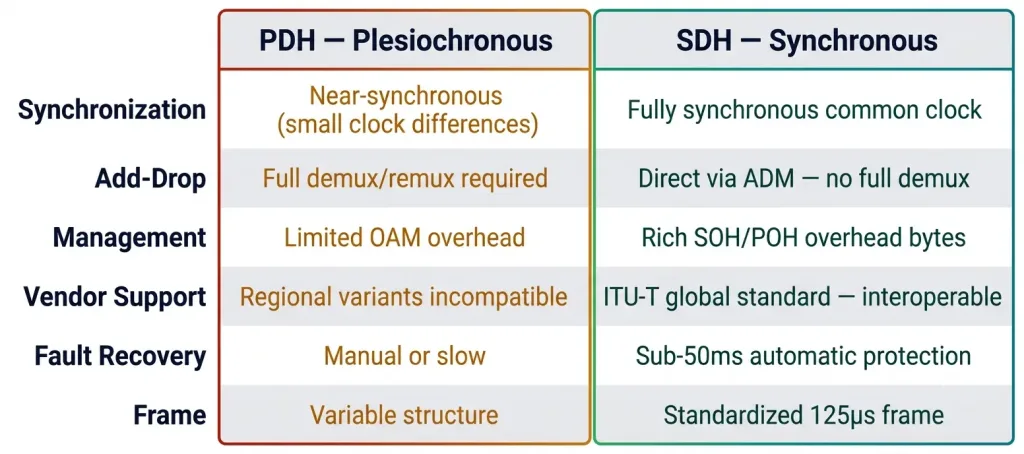
| Feature | PDH | SDH |
|---|---|---|
| Synchronization | Plesiochronous (near-synchronous) | Fully synchronous |
| Add-drop flexibility | Requires full demux/remux | Direct add-drop via ADM |
| Network management | Limited | Rich overhead with OAM bytes |
| Multi-vendor support | Limited | Standardized interfaces |
| Fault recovery | Manual or slow | Sub-50ms automatic protection |
| Frame structure | Variable | Standardized 125µs frame |
| Global standard | Regional variants (PDH-Europe, PDH-US differ) | Single ITU-T global standard |
Advantages of SDH
- Simplified add-drop: Individual tributaries can be added or dropped without full demultiplexing
- Operable with existing PDH systems: PDH tributaries (E1, E3, DS1, DS3) map cleanly into SDH Virtual Containers
- Multi-point networking: Ring and mesh topologies with automated protection switching
- Broadband transport: Capable of carrying ATM cells, PDH signals, Ethernet aggregations, IP/MPLS, and OTN signals as payloads
- Multi-vendor support: Standardized optical interfaces ensure interoperability between different equipment vendors
- Rich overhead: Section, line, and path overhead bytes provide comprehensive OAM (Operations, Administration, and Maintenance) capability
- Sub-50ms protection switching: Ring protection restores traffic faster than any IP-level rerouting mechanism
Disadvantages of SDH
- Complexity of lower-rate add-drop: Direct adding and dropping of lower-rate signals (below VC-3 level) requires complex pointer processing and mapping through multiple container levels
- Fixed synchronization dependency: SDH networks require a reliable timing hierarchy; loss of the primary clock source requires fallback to secondary references and can cause slips
- Equipment cost: SDH equipment is significantly more expensive than equivalent Ethernet or IP equipment for the same bandwidth
- Fixed bandwidth allocation: SDH allocates fixed circuit bandwidth regardless of actual traffic load — inefficient for bursty IP data traffic compared to packet-switched alternatives
- Software management complexity: Network management systems for large SDH networks are complex; software faults can affect network operations, requiring rigorous change management practices
SDH in Modern Networks
SDH is not obsolete — it is still widely deployed in telecommunications backbone networks globally, particularly for voice traffic and legacy enterprise circuits. However, its role has evolved significantly:
OTN overlay: Many carriers have overlaid OTN (Optical Transport Network, ITU-T G.709) on top of or alongside existing SDH infrastructure. OTN provides a more efficient wrapper for IP/Ethernet payloads and extends SDH’s OAM concepts to the optical layer.
MPLS and IP convergence: High-speed IP/MPLS routers increasingly interface directly with DWDM optical systems, bypassing the SDH layer for new deployments. New backbone links are often provisioned as IP over DWDM rather than IP over SDH.
Legacy circuit continuity: Thousands of SDH rings continue to carry enterprise leased-line circuits (E1, STM-1 leased lines) and interconnect mobile base stations (particularly 2G and 3G sites). These will remain in service until the underlying circuits are migrated to Ethernet or IP alternatives.
Packet-SDH (EoS): Ethernet over SDH (EoS) encapsulation standards (GFP, VCAT, LCAS) allow Ethernet traffic to be efficiently mapped into SDH Virtual Containers, providing a migration path for Ethernet services over existing SDH infrastructure without full replacement.
CCNA Exam Pointers
- SDH is an ITU-T standard; SONET is the equivalent ANSI standard used in North America
- STM-1 = 155.52 Mbps = OC-3 — the fundamental SDH building block
- SDH frame duration is 125 microseconds — same as SONET
- SDH uses synchronous multiplexing — all elements share a common clock
- PDH (predecessor) required full demux/remux to access tributaries; SDH allows direct add-drop
- ADM (Add-Drop Multiplexer) is the key SDH network element enabling flexible tributary access
- SDH ring protection restores traffic in sub-50ms
- SDH payloads include: ATM cells, PDH tributaries, Ethernet (via GFP/VCAT), OTN containers
- STM equivalences: STM-1=OC-3, STM-4=OC-12, STM-16=OC-48, STM-64=OC-192
Conclusion
SDH represented a fundamental leap in telecommunications transport design when it was introduced — replacing plesiochronous PDH systems with a fully synchronous, standardized, manageable, and recoverable optical transport hierarchy. Its core innovations — the STM frame structure, Virtual Container mapping, Add-Drop Multiplexer architecture, and sub-50ms ring protection — shaped how global telecommunications networks were built for two decades and continue to influence OTN and modern optical transport standards.
For network engineers, SDH’s concepts remain relevant for understanding WAN technologies, leased-line services, and the transport layer underneath IP networks, as well as for working with existing carrier infrastructure that continues to carry production traffic worldwide.
Frequently Asked Questions
What does SDH stand for and what is it used for?
SDH stands for Synchronous Digital Hierarchy. It is an ITU-T standard that defines multiplexing techniques and a frame structure for transporting digital signals — including voice, data, ATM cells, and Ethernet — over optical fibre networks at defined data rates. SDH is used by telecommunications carriers to build high-speed optical backbone networks capable of carrying large volumes of traffic between cities and countries. It is also the underlying transport technology for many enterprise leased-line services (E1, STM-1 circuits) and mobile network backhaul links, particularly for 2G and 3G sites. SDH remains in active deployment worldwide, though new capacity is increasingly provisioned using OTN or IP over DWDM architectures.
What is the difference between SDH and PDH?
PDH (Plesiochronous Digital Hierarchy) is SDH’s predecessor. The fundamental difference is synchronization: PDH is “almost synchronous” — different parts of the network run on slightly different clocks — while SDH uses a common timing hierarchy that keeps all network elements fully synchronized. This difference has major practical consequences. In PDH, accessing an individual low-speed tributary buried inside a high-speed signal requires complete demultiplexing and remultiplexing of the entire signal.
In SDH, an Add-Drop Multiplexer can directly add or drop individual tributaries without disturbing the rest of the payload, because the position of each tributary within the SDH frame is precisely known at all times due to synchronization. SDH also provides far richer network management overhead, automatic protection switching, and standardized optical interfaces that PDH lacks.
What is the difference between SDH and SONET?
SDH and SONET are equivalent standards developed in parallel — SDH by the ITU-T for global (primarily European) deployment, and SONET by ANSI for North American deployment. They are designed to be interoperable at the optical interface. The key relationship is that SDH’s fundamental building block (STM-1 at 155.52 Mbps) equals three SONET STS-1 frames (each 51.84 Mbps), or one OC-3 signal. Higher levels align exactly: SDH STM-4 = SONET OC-12, STM-16 = OC-48, STM-64 = OC-192. The main differences are in terminology and some overhead byte definitions, but signals are compatible at the physical interface, allowing North American SONET networks and European SDH networks to interconnect seamlessly.
What are the SDH STM levels and their data rates?
SDH defines a hierarchy of Synchronous Transport Modules (STMs) at fixed multiples of the STM-1 base rate. STM-1 runs at 155.52 Mbps, STM-4 at 622.08 Mbps (four times STM-1), STM-16 at 2,488.32 Mbps (approximately 2.5 Gbps), STM-64 at 9,953.28 Mbps (approximately 10 Gbps), and STM-256 at 39,813.12 Mbps (approximately 40 Gbps). Each level carries exactly N times the capacity of STM-1, which is a direct consequence of SDH’s synchronous multiplexing design. The most commonly deployed levels in backbone networks are STM-16 and STM-64, while STM-1 is widely used for enterprise leased-line access circuits.
Is SDH still relevant in 2026?
Yes — SDH remains in active deployment in telecommunications backbone networks globally and continues to carry significant volumes of voice traffic, enterprise leased-line circuits, and mobile network backhaul. However, its role in new deployments has diminished. New backbone capacity is predominantly provisioned using OTN (Optical Transport Network, ITU-T G.709) or direct IP over DWDM architectures, which are more efficient for data-centric traffic.
Many carriers are running structured migration programs to move traffic from SDH infrastructure to packet-based alternatives as SDH equipment ages and as Ethernet-based services replace legacy circuit services. For network engineers, SDH knowledge remains valuable for operating and troubleshooting existing carrier infrastructure, understanding WAN circuit technologies, and working with mobile network backhaul in markets where 2G and 3G services continue.