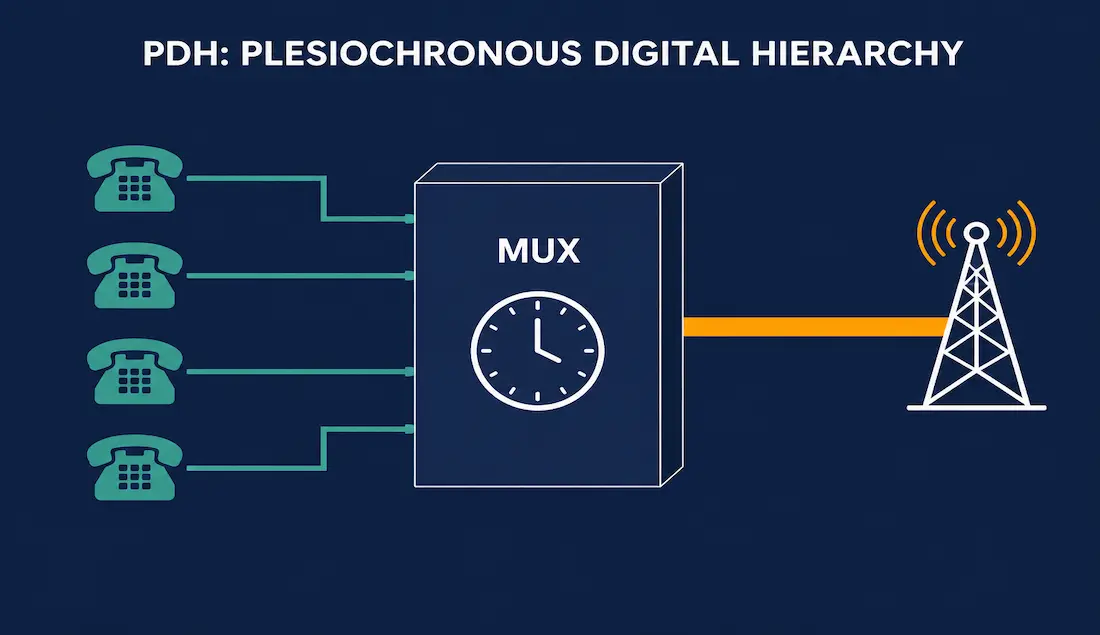
It is the abbreviation for Plesiochronous Digital Hierarchy. The term “plesiochronous” comes from two Greek words: plesio, meaning “near,” and chronos, meaning “time.” In a plesiochronous network, the clocks in different network elements run close to the same rate but are not perfectly synchronized, so signal arrival times can drift slightly when multiplexing. It was the first generation of digital telecommunications transport technology, developed by Bell Labs starting in the early 1960s and later adopted worldwide. It remained the dominant backbone technology until SDH and SONET replaced most of it starting in the late 1980s.
This guide covers how PDH works, its three regional hierarchies, the standard data rates at each level, why it was eventually replaced, and where it’s still relevant today.
How PDH Multiplexing Works
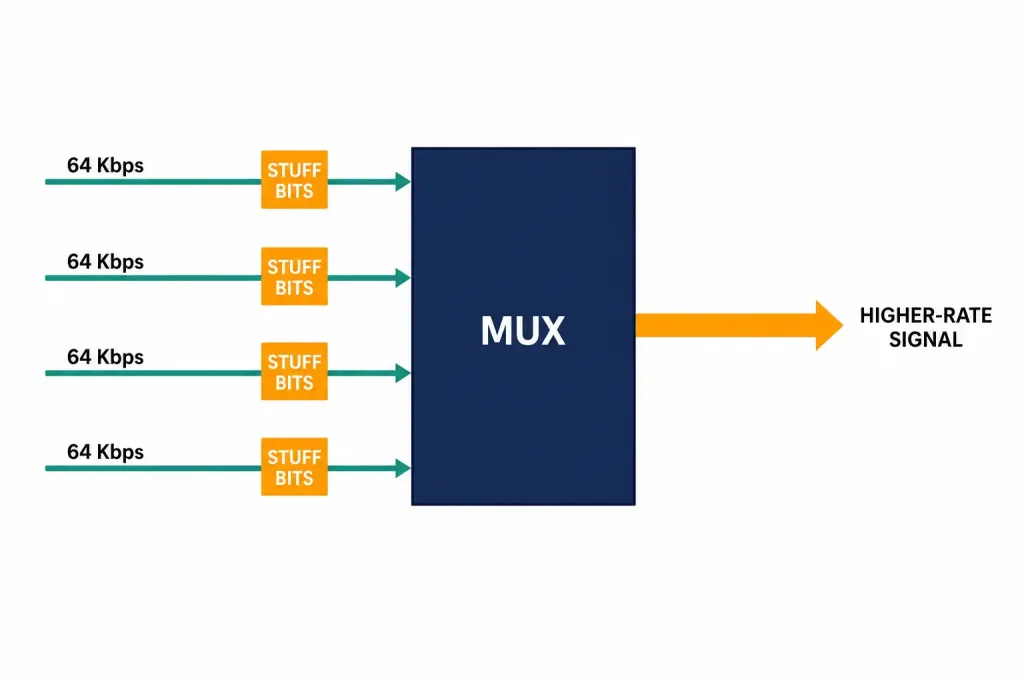
It combines many lower-speed digital voice or data channels into a single higher-speed signal using time-division multiplexing. Each individual voice channel is digitized at 64 Kbps, a rate derived from standard pulse-code modulation (PCM) sampling of analog voice at 8,000 samples per second. Multiple 64 Kbps channels are then bundled together into a first-level PDH signal, and multiple first-level signals are bundled again into a second-level signal, and so on up the hierarchy.
Because the clocks feeding each tributary signal into a multiplexer are not perfectly synchronized — only “plesiochronous,” or nearly synchronized — PDH uses a technique called bit stuffing (also called justification) to compensate for small timing differences between input streams. Extra padding bits are inserted as needed so that the combined signal maintains a stable output rate, and the receiving equipment removes this stuffing during demultiplexing.
The Three Regional PDH Hierarchies
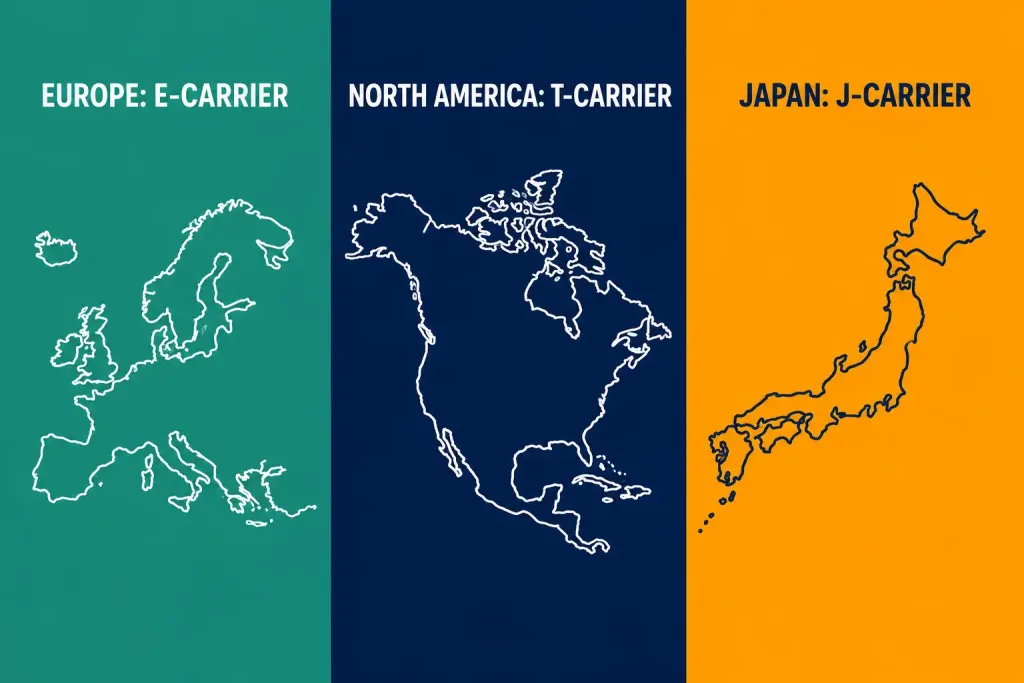
Unlike its successor SDH, which became a single global standard, It split into three separate, incompatible regional hierarchies that developed independently:
- European (E-carrier): Standardized by CEPT, used across Europe, most of Asia, Africa, and South America.
- North American (T-carrier): Developed by Bell Labs, used in the United States and Canada.
- Japanese (J-carrier): Used in Japan, sharing the same first-level rate as T-carrier but diverging at higher levels.
This regional split — not a single incompatible detail, but three genuinely different multiplexing hierarchies — is one of PDH’s defining limitations and a major reason SDH/SONET, which unified the world under one standard family, eventually took over.
European E-Carrier Hierarchy
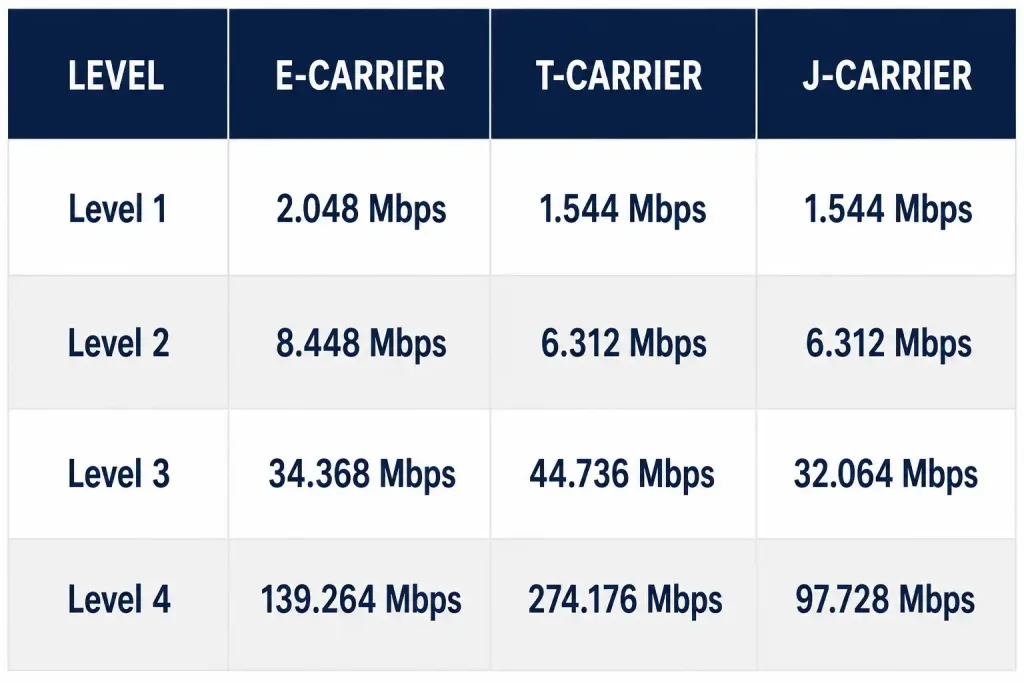
The European system’s base rate is E1 at 2.048 Mbps. An E1 signal carries 32 timeslots of 64 Kbps each: 30 timeslots carry actual voice or data traffic, timeslot 0 carries the frame alignment signal for synchronization, and timeslot 16 carries signaling information. Higher E-carrier levels are formed by multiplexing four lower-level signals together, with additional overhead added at each step:
| Level | Channels | Data Rate |
|---|---|---|
| E1 | 30 (+2 overhead) | 2.048 Mbps |
| E2 | 120 | 8.448 Mbps |
| E3 | 480 | 34.368 Mbps |
| E4 | 1,920 | 139.264 Mbps |
| E5 | 7,680 | 564.992 Mbps |
North American T-Carrier Hierarchy
The North American system’s base rate is T1 at 1.544 Mbps, also called DS1 (Digital Signal level 1). A T1 signal carries 24 channels of 64 Kbps each, plus a single framing bit per frame, transmitted 8,000 times per second: (24 × 8 bits + 1 framing bit) × 8,000 frames/sec = 1,544,000 bps.
| Level | Channels | Data Rate |
|---|---|---|
| T1 (DS1) | 24 | 1.544 Mbps |
| T2 (DS2) | 96 | 6.312 Mbps |
| T3 (DS3) | 672 | 44.736 Mbps |
| T4 (DS4) | 4,032 | 274.176 Mbps |
Japanese J-Carrier Hierarchy
Japan’s system shares the same 1.544 Mbps first level as North America but diverges at higher levels, using different multiplexing ratios:
| Level | Data Rate |
|---|---|
| J1 | 1.544 Mbps |
| J2 | 6.312 Mbps |
| J3 | 32.064 Mbps |
| J4 | 97.728 Mbps |
Worked Example: Why E2 Isn’t Exactly 4 × E1
A natural assumption is that E2 should be exactly four times the E1 rate: 4 × 2.048 Mbps = 8.192 Mbps. But the actual standardized E2 rate is 8.448 Mbps — higher than the simple multiplication suggests. The difference comes from additional framing and justification overhead added at each multiplexing stage to handle the plesiochronous timing differences between the four incoming E1 tributaries. This pattern repeats at every level of every PDH hierarchy: each step up adds a small amount of extra overhead beyond a clean multiple of the level below it, which is a useful detail to remember since it’s easy to assume the rates are perfectly proportional when they aren’t.
Advantages
- Simple to deploy for point-to-point links: No need for network-wide clock synchronization, which was a major cost and complexity advantage when PDH was first developed.
- Well-established, proven equipment: Decades of deployment mean PDH multiplexers, terminal equipment, and troubleshooting knowledge are well understood.
- Works over both copper and fiber, and microwave radio: PDH signals can be carried across a wide range of physical media.
Disadvantages
- Three incompatible regional hierarchies: Interconnecting European, North American, and Japanese PDH networks requires gateway equipment, unlike SDH/SONET’s more unified global approach.
- Difficult add/drop operations: To extract a single low-rate channel from a high-rate PDH signal, equipment must demultiplex all the way down through every intermediate level, then remultiplex everything back up — an expensive, error-prone process compared to SDH’s direct add/drop capability.
- Rigid, inflexible bandwidth management: It lacks the standardized management overhead that later gave SDH and SONET their remote monitoring and fast failure-recovery capabilities.
- High operational cost at scale: I <cite index=”53-1″>the cost of PDH-to-SDH backbone replacement in North America alone was $4.5 billion in 1998</cite>, reflecting how expensive PDH’s limitations had become for large carriers by the 1990s.
Why PDH Was Replaced
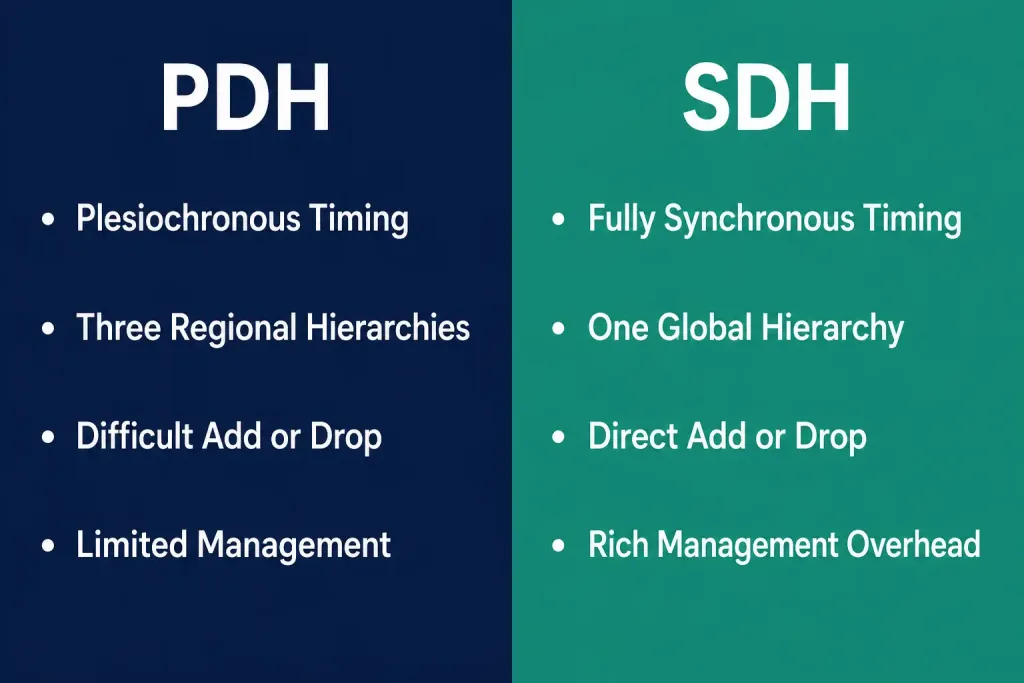
By the late 1980s, the telecom industry needed simpler add/drop capability, standardized global interfaces, and better network management than PDH could offer. SDH (in most of the world) and SONET (in North America) were developed specifically to solve these problems: both use a single, standardized global-scale hierarchy (rather than three incompatible regional ones), synchronous timing across the whole network instead of plesiochronous timing between elements, and built-in overhead that supports direct add/drop multiplexing and self-healing ring protection. Most carrier backbone networks completed this transition by around 2000.
Is PDH Still Used Today?
Pure PDH backbone networks are largely retired, but PDH-derived signals haven’t disappeared entirely. E1 and T1 circuits — the base-level PDH signals — remain in active use for older PBX telephone systems, certain leased-line services, and legacy equipment that has not yet been migrated to IP-based alternatives. In many cases today, an E1 or T1 signal is carried as a client signal inside a modern SDH, SONET, or OTN transport network rather than over dedicated PDH equipment, which is why understanding PDH’s basic framing and rate structure still has practical value even in a mostly post-PDH world.
Real-World Deployment Context
A practical example helps make the regional-hierarchy problem concrete. Imagine a telecom carrier in Pakistan (following the European E-carrier standard) needing to interconnect with a partner carrier in the United States (following the North American T-carrier standard) to route international voice traffic. The two networks’ PDH signals are not directly compatible — an E1 signal cannot simply plug into T1 equipment — so the interconnection point requires dedicated conversion or gateway equipment to translate between the two hierarchies. This kind of gateway requirement was routine at international telecom interconnection points throughout the PDH era, adding cost and complexity that a single global standard would have avoided.
This same regional divide is also why, even decades later, a network engineer working with legacy leased-line equipment still needs to know which region’s hierarchy applies before assuming a data rate. A “2 Mbps line” almost always means a European E1, while a “1.5 Mbps line” almost always means a North American T1 — the terminology itself is a legacy of PDH’s regional split, and it persists in leased-line contracts and equipment documentation even today.
PDH’s Legacy in Modern Standards
Even though pure PDH equipment has largely disappeared from carrier backbones, its influence is still visible in modern networking vocabulary and equipment interfaces. Cisco routers and other networking equipment still offer T1/E1 WAN interface cards, and CCNA-level WAN terminology inherited concepts like the DS0 64 Kbps channel unit directly from the PDH era. Voice-over-IP gateways that interconnect with traditional telephony equipment often still need to understand E1 or T1 framing to convert between circuit-switched PDH-style signals and IP packets. In this sense, PDH’s channel structure — the 64 Kbps voice channel as the fundamental building block — outlived the PDH transport hierarchy itself and became a lasting reference point across the SDH, SONET, and even VoIP eras that followed.
Troubleshooting and Exam Tips
- If asked for the PDH base rate, know both regional answers: E1 = 2.048 Mbps (Europe/most of the world) and T1 = 1.544 Mbps (North America). A question that just says “PDH rate” without specifying a region is ambiguous — check for regional context clues.
- Remember E1’s channel breakdown precisely: 30 traffic channels + timeslot 0 (framing) + timeslot 16 (signaling) = 32 timeslots total.
- Don’t assume higher PDH levels are simple multiples of the base rate — always account for added overhead (see the E2 worked example above).
- If a question describes difficulty extracting a single channel from a high-capacity signal without full demultiplexing, that’s describing a classic PDH limitation, not an SDH/SONET one.
- “Plesiochronous” (nearly synchronized) vs. “synchronous” (perfectly synchronized) is a common vocabulary trap — PDH is plesiochronous, SDH is synchronous, and that’s the core reason SDH could support easier add/drop operations.
Conclusion
Plesiochronous Digital Hierarchy was the first generation of digital telecommunications transport, multiplexing voice and data channels using nearly — but not perfectly — synchronized clocks across three separate regional hierarchies: European E-carrier, North American T-carrier, and Japanese J-carrier. Its reliance on plesiochronous timing and regional incompatibility made add/drop operations cumbersome and limited global interoperability, which is exactly what SDH and SONET were built to fix starting in the late 1980s. While pure PDH backbones are now largely retired, E1 and T1 signals persist in legacy telephony and leased-line services, often riding on top of modern synchronous transport networks.
Frequently Asked Questions
What does PDH stand for?
PDH stands for Plesiochronous Digital Hierarchy, a first-generation digital telecommunications transport technology developed in the 1960s that multiplexes multiple lower-speed channels into higher-speed signals using nearly (but not perfectly) synchronized clocks.
What is the difference between PDH and SDH?
PDH uses plesiochronous (nearly synchronized) timing and split into three incompatible regional hierarchies, making add/drop operations difficult. SDH uses fully synchronous timing across the network and a single global hierarchy, enabling direct add/drop multiplexing and better management overhead.
What is the PDH base rate?
It depends on the region. The European E-carrier base rate is E1 at 2.048 Mbps. The North American T-carrier base rate is T1 at 1.544 Mbps. Japan’s J-carrier system shares the 1.544 Mbps first level with North America but diverges at higher levels.
Why does E2 not equal exactly 4 times E1?
Because additional framing and bit-stuffing overhead is added at each multiplexing stage to compensate for the small timing differences between plesiochronous tributary signals. E2 is standardized at 8.448 Mbps rather than the 8.192 Mbps that simple multiplication would suggest.
Is PDH still used today?
Pure PDH backbone networks are largely retired, replaced by SDH, SONET, and now packet-based transport. However, E1 and T1 circuits — PDH’s base-level signals — remain in use for legacy telephony and certain leased-line services, frequently carried today as client signals inside modern synchronous or optical transport networks.