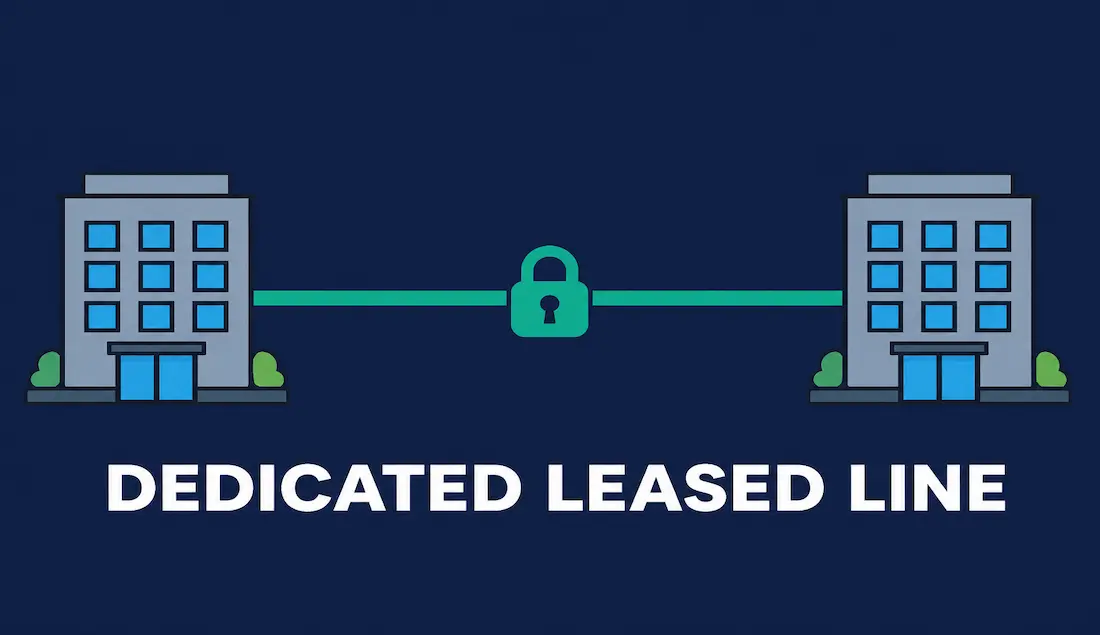
A leased line is a dedicated communication channel between two or more locations. It’s usually a pre-established WAN connection running from a customer’s premises to a service provider’s network, reserved exclusively for that customer’s traffic in exchange for a fixed recurring fee. Because the connection isn’t shared with other subscribers, it delivers guaranteed, consistent bandwidth around the clock, which is exactly why leased lines remain a core option for CCNA WAN technology questions and real enterprise network design alike.
Leased lines go by several other names depending on the source: leased circuits, serial links, serial lines, point-to-point links, or simply T1/E1 and T3/E3 lines, after the specific data-rate standards they run on.
How Leased Lines Actually Work
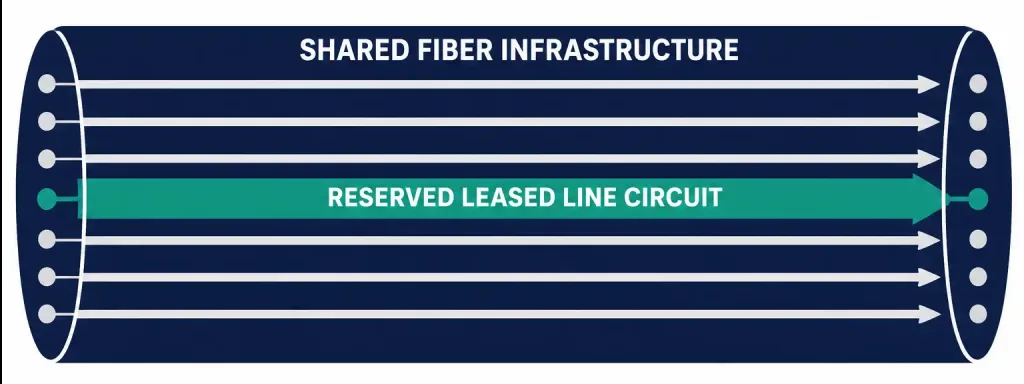
Physically, a leased line isn’t always a single dedicated cable running end to end. In most real deployments, it’s a reserved circuit carved out of the provider’s shared physical infrastructure — most commonly fiber optic cable for higher bandwidth and speed — but logically guaranteed and isolated for that one customer’s exclusive use. This distinction matters: the “dedication” is a guarantee of capacity and isolation, not necessarily a literal separate wire the whole way.
Because of this guaranteed capacity, dedicated circuit, and enhanced security, leased lines are considerably more expensive than shared connections, which is why they’re primarily used by large organizations with strict reliability needs rather than small businesses or individual consumers.
Common Leased Line Standards and Data Rates
Leased lines are offered at several standardized data rates, and the right choice depends on cost, required bandwidth, and the distance between connected sites.
| Standard | Data Rate |
|---|---|
| T1 | 1.544 Mbps |
| E1 | 2.048 Mbps |
| E3 | 34.368 Mbps |
| T3 | 44.736 Mbps |
| OC-1 | 51.84 Mbps |
| STM-1 | 155.52 Mbps |
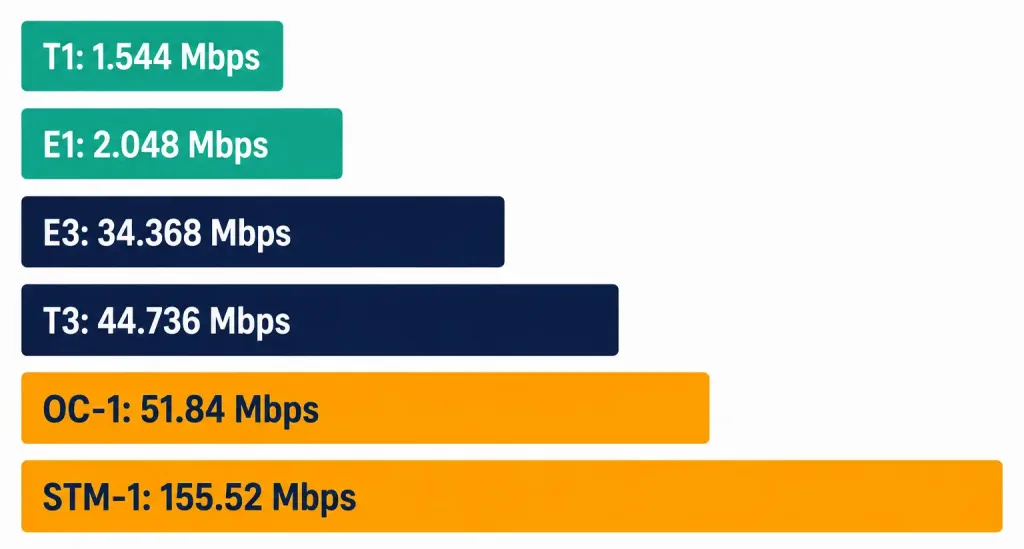
T1 and E1 are the entry-level leased-line rates, most commonly used for smaller offices or backup links. T3 and E3 sit in the middle tier, suited to larger offices or aggregation points. OC and STM rates represent the high end of the hierarchy, typically used by carriers and very large enterprises needing hundreds of megabits or more.
Worked Example: Choosing a Leased Line Rate for a Growing Office
Suppose a company currently uses a T1 line (1.544 Mbps) and finds it’s consistently saturated during business hours. Before jumping straight to a T3 (44.736 Mbps) — nearly 29 times the capacity and priced accordingly — it’s worth checking whether an E3 (34.368 Mbps) or a fractional T3 service would meet actual growth needs at a lower cost. This kind of capacity-planning exercise, matching the standardized rate tier to real traffic patterns rather than defaulting to the next rate up, is a common real-world WAN design decision that mirrors CCNA bandwidth-planning questions.
VPNs as a Leased Line Alternative
A virtual private network (VPN) is often used as a lower-cost alternative to a physical leased line. Instead of paying for guaranteed dedicated bandwidth, a VPN creates an encrypted virtual tunnel across a shared network — typically the public Internet — connecting two or more sites. This trades some of a leased line’s guaranteed performance and formal SLA for significantly lower cost, since no dedicated physical circuit needs to be provisioned or maintained by the provider. Many organizations that once relied exclusively on leased lines now use a mix: leased lines for their most latency-sensitive or highest-priority sites, and VPN connections for everything else.
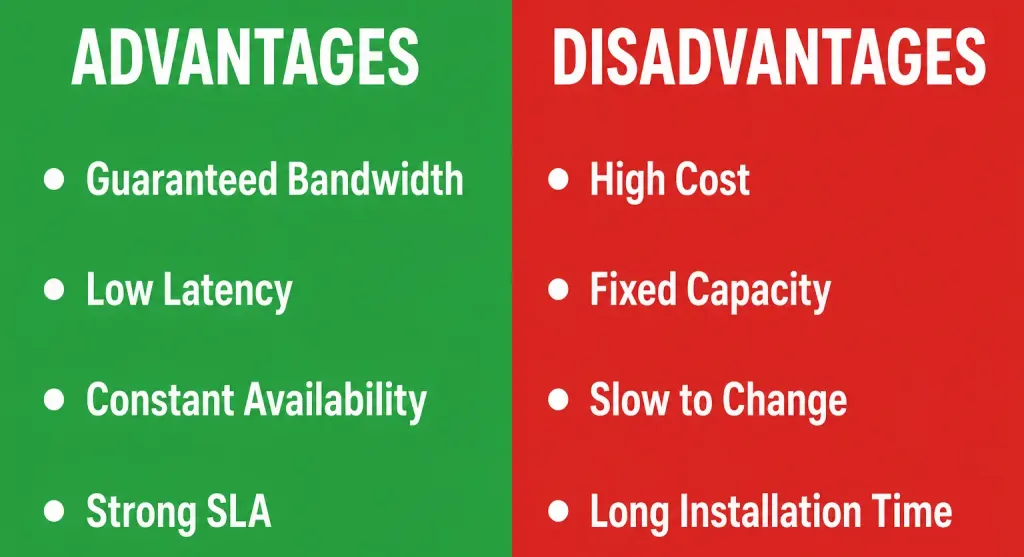
Advantages of Leased Lines
- Guaranteed, symmetric bandwidth: Upload and download speeds are equal and consistent, unlike many consumer broadband connections.
- Low latency and no jitter: Because the circuit isn’t shared, there’s no contention delay, even at comparatively modest bandwidth levels.
- Constant availability: Point-to-point links provide permanent, dedicated capacity, which matters for organizations that can’t tolerate connectivity gaps.
- Simple to install and maintain: Compared to more complex WAN technologies, leased lines require minimal ongoing configuration once installed.
- Backed by strong SLAs: Most leased line contracts include service level agreements guaranteeing uptime, often in the 99.5% to 99.999% range, with defined repair-time targets if something goes wrong.
Disadvantages of Leased Lines
- High cost: Leased lines are generally the most expensive WAN connection type, and cost scales further when an organization needs to connect many sites over long distances.
- Fixed capacity: Because the bandwidth is fixed by contract, it rarely matches actual traffic needs exactly — you either pay for unused headroom or run close to saturation.
- Slow to change: Any change to a leased line’s capacity generally requires a site visit and reconfiguration by ISP personnel, unlike more flexible cloud-based or software-defined connectivity options.
- Long installation timelines: Provisioning a new leased line, especially where new physical infrastructure must be run to a site, can take weeks or months.
Leased Lines vs. Broadband and VPN: Quick Comparison
| Factor | Leased Line | Business Broadband | VPN over Internet |
|---|---|---|---|
| Bandwidth | Dedicated, symmetric | Shared, often asymmetric | Shared, variable |
| Cost | Highest | Lowest | Low to moderate |
| SLA | Strong, guaranteed uptime | Limited or none | Depends on ISP, not dedicated |
| Setup time | Weeks to months | Days | Minimal (software-based) |
| Best for | Mission-critical, high-reliability links | General-purpose office Internet | Cost-sensitive site-to-site connectivity |
Real-World Deployment Scenario
Consider a mid-sized company with a headquarters and three branch offices that all need reliable, low-latency access to a central data center for VoIP calls, ERP software, and daily file transfers. A common approach is to install a leased line — often an E1 or a fractional T3, depending on traffic volume — between headquarters and the data center, since that link carries the most critical, latency-sensitive traffic and can least afford a slowdown during business hours. The three branch offices, which generate less traffic and can tolerate occasional latency, might instead connect via VPN over standard business Internet connections, saving significant cost while still providing adequate performance for less critical applications.
This kind of hybrid design — a leased line for the most critical link, cheaper alternatives for lower-priority ones — is extremely common in practice and reflects how CCNA-style WAN design questions are often structured: not “which technology is best,” but “which technology fits which requirement.” A useful way to frame this decision is to rank each site by how costly an outage or a slowdown would actually be to the business, then match the most expensive, highest-guarantee connectivity to the sites where that cost is highest, rather than applying the same connection type uniformly across every location regardless of its actual criticality.
Ordering and Provisioning a Leased Line
Provisioning a leased line typically follows a predictable sequence, useful to understand even for engineers who never place the order themselves:
- Site survey: The provider assesses whether existing fiber or copper infrastructure reaches the customer site, or whether new cable needs to be run.
- Contract and SLA negotiation: The customer selects a data rate tier and negotiates SLA terms, including uptime guarantees and repair-time commitments.
- Installation: A technician installs the necessary termination equipment (such as a CSU/DSU for a T1/E1 circuit) at the customer premises.
- Testing and handoff: The provider tests the circuit for the contracted bandwidth and error rate before formally handing it off to the customer’s network team.
- Ongoing maintenance: Any future capacity change typically requires a new site visit, which is why leased-line capacity planning benefits from forecasting growth in advance rather than reacting to saturation.
Security Considerations for Leased Lines
Because a leased line’s traffic doesn’t traverse the shared public Internet, it avoids a class of exposure that Internet-based connections face by default — but “dedicated” doesn’t automatically mean “encrypted.” A leased line’s data still travels in the clear unless the organization deliberately adds encryption, so it isn’t inherently more secure against an attacker with physical access to carrier infrastructure than a well-configured encrypted VPN would be against typical Internet-based threats. Organizations with strict compliance requirements often layer additional encryption on top of a leased line rather than relying on physical isolation alone, treating the dedicated circuit as one layer of defense rather than a complete security solution by itself.
Troubleshooting and Exam Tips
- If a question asks for the standard T1 data rate, remember 1.544 Mbps; for E1, remember 2.048 Mbps — these are the two most commonly tested leased-line rates on CCNA-style exams.
- Don’t confuse T3’s rate with a rounded figure — the correct value is 44.736 Mbps, not an approximation like “43.7 Mbps.”
- Remember that a leased line’s “dedication” refers to guaranteed capacity and isolation from other customers’ traffic, not necessarily a single physical wire running the entire distance — much of the underlying infrastructure may still be shared fiber with the leased line logically carved out.
- When comparing leased lines to VPNs on an exam, the key distinction is a leased line offers a formal SLA with guaranteed dedicated bandwidth, while a VPN runs over shared infrastructure without that same guarantee, even though it may still be adequately fast and secure for many use cases.
When a Leased Line Isn’t the Right Choice
Not every connectivity need justifies a leased line’s cost and commitment. A leased line is a poor fit when traffic volume is low and unpredictable, when a site is temporary or short-term, when budget constraints rule out a multi-year contract, or when the application involved can tolerate occasional latency or brief interruptions without meaningful business impact. In these cases, business broadband or a VPN-based connection typically delivers adequate performance at a fraction of the cost, and the money saved can often be better spent on other infrastructure priorities. Recognizing when a leased line is overkill is just as important a design skill as recognizing when one is genuinely needed.
Conclusion
A leased line is a dedicated, contractually guaranteed point-to-point WAN connection, most commonly running on standardized rates like T1, E1, T3, E3, OC, or STM. Its guaranteed bandwidth, low latency, and strong SLAs make it the preferred choice for organizations with mission-critical connectivity needs, even though the high cost and fixed capacity mean it isn’t the right fit for every situation. VPNs and other shared-infrastructure alternatives have narrowed the gap for cost-sensitive use cases, but for the highest reliability requirements, dedicated leased lines remain a foundational WAN technology worth understanding thoroughly.
Frequently Asked Questions
What is a leased line in networking?
A leased line is a dedicated, guaranteed-bandwidth point-to-point connection between two or more locations, reserved for a single customer’s exclusive use in exchange for a fixed recurring fee, commonly running on standards like T1, E1, T3, E3, OC, or STM.
What is the data rate of a T1 leased line?
A T1 leased line supports 1.544 Mbps. Its European equivalent, E1, supports 2.048 Mbps.
Is a leased line the same as a physically separate cable?
Not necessarily. A leased line is often a logically reserved, guaranteed circuit carved out of the provider’s shared physical fiber infrastructure, rather than one continuous dedicated wire running the entire distance between sites.
What’s the difference between a leased line and a VPN?
A leased line provides guaranteed, dedicated bandwidth over a physical circuit backed by a formal SLA. A VPN creates an encrypted tunnel over shared infrastructure, typically the public Internet, at lower cost but without the same guaranteed performance.
Why are leased lines so expensive?
Leased lines reserve guaranteed dedicated capacity exclusively for one customer, which costs providers more to provision and maintain than a shared connection serving many customers at once — that dedicated guarantee is what large organizations are paying for.
Do leased lines need a physical site survey before installation?
Usually, yes. Providers typically assess whether existing fiber or copper infrastructure already reaches the customer site or whether new cable needs to be run, which directly affects both installation timelines and cost.