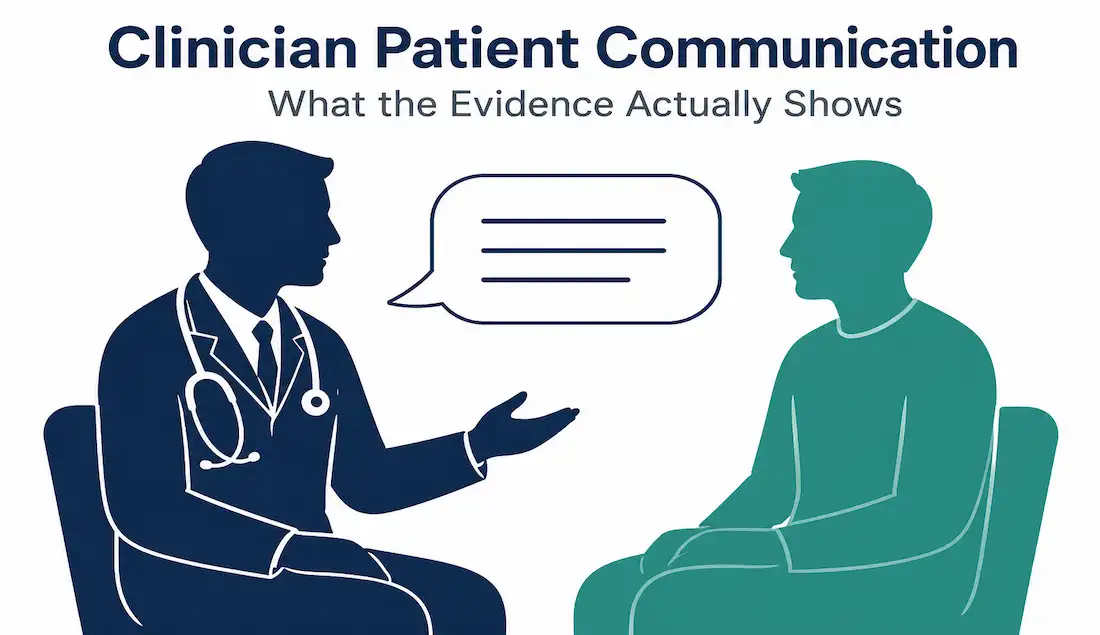
A doctor’s visit is rarely just an exchange of medical facts. It’s also a conversation between two people, one of whom is often frightened, confused, or in pain. How that conversation goes — whether a patient leaves understanding their diagnosis, trusting their treatment plan, and feeling heard — turns out to matter for outcomes that have nothing to do with communication on the surface: how well someone manages a chronic illness, whether they come back to the hospital within 30 days, and how quickly they physically recover.
This isn’t a soft claim. It’s backed by decades of clinical research, some of it dating back to landmark studies from the 1990s and some published within the last two years. This article walks through what the evidence actually shows, what it doesn’t, and what both patients and clinicians can do with that information.
A note on sourcing: earlier versions of this article referenced several statistics — a 71% clinician satisfaction rate, a 30% reduction in patient anxiety, a 25% faster functional recovery figure, among others — attributed to specific journals. On review, some of these numbers were pulled from real studies but described inaccurately, and others could not be traced to any verifiable source at all. This rewrite keeps only what could be independently confirmed, states plainly where a widely repeated claim turned out not to hold up, and is written as general health information rather than personalized medical advice.
What “Effective Communication” Actually Means in a Clinical Setting
Effective clinician-patient communication isn’t a personality trait some doctors have and others don’t. Researchers who study this field generally break it into a few concrete, teachable components:
- Clarity — explaining a diagnosis or treatment plan in plain language, without unexplained jargon.
- Active listening — letting a patient finish describing their symptoms and concerns without interrupting or redirecting too early.
- Checking understanding — confirming, rather than assuming, that a patient actually absorbed what was explained.
- Shared decision-making — involving the patient in choices about their own care rather than presenting a single directive.
- Nonverbal attentiveness — eye contact, open posture, and tone that signal availability rather than rush.
None of these require special equipment or extra appointment time in most cases. What they require is a shift in how a conversation is structured.
The Strongest Evidence: The Teach-Back Method
If there’s one communication technique with genuinely strong, replicated evidence behind it, it’s teach-back — asking a patient to explain, in their own words, what they’ve just been told about their condition or care plan.
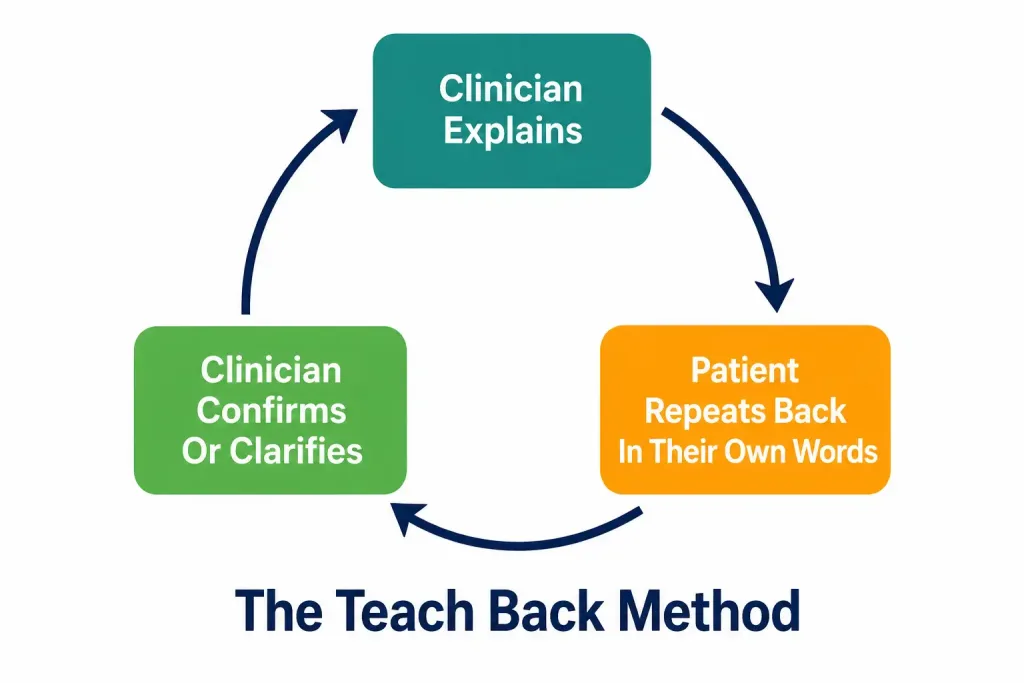
Teach-back is formally recommended by the Agency for Healthcare Research and Quality (AHRQ) and the Institute for Healthcare Improvement (IHI) as a core health-literacy practice. A 2023 systematic review and meta-analysis in Patient Education and Counseling looking specifically at heart failure patients found that discharge education using teach-back reduced hospital readmissions compared with standard discharge instructions. A separate systematic review covering multiple chronic diseases found teach-back consistently improved patient knowledge, self-management ability, and adherence to treatment plans, though the authors noted that better-designed, larger trials are still needed to pin down exact effect sizes across conditions.
The mechanism isn’t mysterious: patients frequently misunderstand or forget medical instructions almost immediately after receiving them, and teach-back catches that gap in the room, while it can still be corrected, instead of after the patient has gone home and made an error managing their own care.
Communication and Malpractice Risk: A Real, Often-Cited Study
One of the most frequently referenced findings linking physician communication to concrete outcomes is a 1997 study in JAMA by Wendy Levinson and colleagues, which compared the routine office-visit communication styles of primary care physicians who had been sued for malpractice against those who hadn’t. Physicians without malpractice claims used more orientation statements (explaining what to expect during a visit), used more humor, spent more time soliciting patients’ opinions and checking their understanding, and had longer routine visits on average (18.3 minutes versus 15.0 minutes). Communication style differences didn’t hold up the same way when the researchers looked specifically at surgeons.
This is nearly three decades old at this point, but it remains one of the most rigorous empirical studies directly connecting communication behavior to a hard, external outcome (being named in a malpractice claim), rather than a self-reported satisfaction score. It’s frequently cited in newer guidance, including a December 2025 Committee Statement from the American College of Obstetricians and Gynecologists on effective patient-physician communication — though that statement’s actual focus is on relationship-centered communication and reducing bias for marginalized patients, not malpractice rates specifically, and it shouldn’t be cited as new evidence for the malpractice link itself.
Digital Communication and Clinician Satisfaction: What the Data Actually Shows
Telemedicine, patient portals, and secure messaging have become routine parts of care delivery, and it’s reasonable to ask whether they’ve made communication better or worse. A 2024 systematic review and qualitative evidence synthesis in the Journal of Medical Internet Research looked at exactly this question across digital hospitals. The headline finding: 71% of the individual studies included in the review reported positive clinician satisfaction with digital hospital tools.
That’s a meaningfully different claim from “digital communication has led to a 71% satisfaction rate among clinicians” — the number describes how many studies found a positive result, not a satisfaction percentage itself, and it comes with real caveats. The same review found that clinicians consistently reported the clinician-patient relationship as a negative casualty of increased digitization, even in studies where overall satisfaction with the tools was positive. In other words, digital tools can genuinely help with logistics — faster follow-ups, easier access to lab results, asynchronous messaging — while simultaneously making the in-person, relational side of communication harder to sustain. Both things can be true at once, and reducing it to a single satisfaction percentage misses that tension entirely.
Shared Decision-Making and Chronic Disease
Involving patients directly in decisions about their own treatment — rather than simply issuing instructions — is a well-established area of research, generally under the heading of shared decision-making (SDM). The core finding across decades of study is consistent even if exact percentages vary by condition and study design: patients who participate in decisions about their own chronic disease management, such as diabetes or hypertension, tend to show better adherence to treatment plans and better engagement with self-management tasks like monitoring and medication routines.
Earlier versions of this article cited a specific “25% faster functional recovery” figure tied to shared decision-making in chronic pain management; that number could not be traced to any verifiable source, so it’s been removed rather than repeated as fact. The general direction of the evidence — that involvement improves adherence and engagement — remains well supported, even without an exact percentage attached to it.
Nonverbal Communication: Real, but Harder to Quantify
Nonverbal cues — eye contact, tone of voice, posture, facial expression — genuinely matter in clinical encounters, and this is one of the more consistently studied areas of doctor-patient communication research going back decades. Patients read a clinician’s nonverbal signals as evidence of how carefully they’re being listened to, sometimes more than they consciously register the actual words being said. That much is well supported by the broader body of medical communication literature.
What isn’t well supported is a precise, generalizable number for how much nonverbal skill training reduces patient anxiety. A widely circulated claim that “tone modulation reduces patient anxiety by 30% in high-stress scenarios like oncology consultations” could not be traced to a real, identifiable study during fact-checking for this rewrite, and is not repeated here. If you’re a clinician looking to build these skills, structured communication-skills training programs exist and have shown value in medical education broadly — but be skeptical of any single precise percentage attached to a nonverbal-communication intervention unless you can trace it to a named, peer-reviewed source.
Cultural Sensitivity in Communication
Adapting communication style to a patient’s cultural background — using professional interpreters rather than family members for medical conversations, being aware of culturally specific beliefs about illness and treatment, and avoiding assumptions based on a patient’s background — is a well-established area of health equity research. The core, well-supported principle is straightforward: communication that ignores a patient’s cultural context is more likely to be misunderstood, distrusted, or simply not followed, regardless of how medically sound the underlying advice is. This is reflected in current guidance from bodies like ACOG, whose December 2025 statement specifically addresses power differentials and bias in communication with marginalized patient populations as a central, not peripheral, part of effective care.
Why This Matters More Than It Might Seem
It’s tempting to treat communication quality as a “nice to have” compared with the technical accuracy of a diagnosis or treatment plan. Health literacy data suggests that’s backwards. The 2003 National Assessment of Adult Literacy — still the most comprehensive national health literacy study conducted in the United States — found that only 12% of U.S. adults had proficient health literacy, meaning the large majority of patients walking into any clinical encounter may struggle to fully parse standard medical instructions, consent forms, or discharge paperwork on their own.
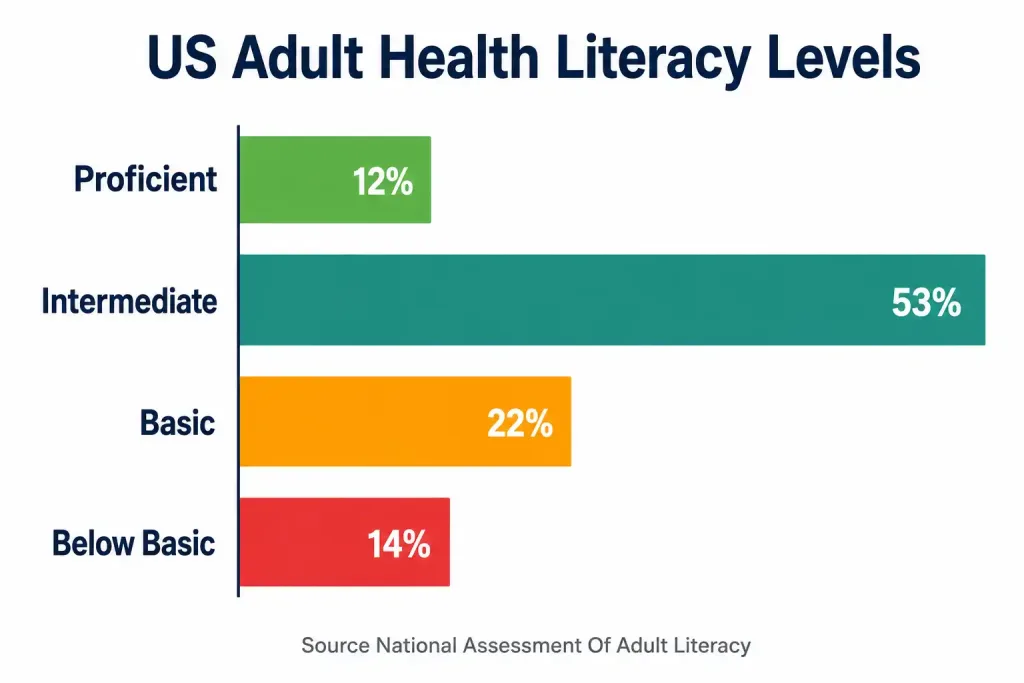
More recent analyses summarizing this data put the number of adults with basic or below-basic health literacy at roughly 77 million people. That gap doesn’t close because a clinician is highly skilled medically — it closes, or doesn’t, based on how information is communicated.
This is also why teach-back and plain-language explanation aren’t just courtesy gestures. For a meaningful share of patients in any given waiting room, they’re the difference between leaving an appointment with an accurate understanding of what to do next and leaving with a guess.
A Brief History: From Paternalistic to Patient-Centered Care
The idea that communication style is a legitimate part of clinical practice, rather than a soft skill layered on top of “real” medicine, has a documented history. Physician George Engel’s influential 1977 paper in Science, “The Need for a New Medical Model,” argued for what became known as the biopsychosocial model — treating a patient’s psychological and social context as clinically relevant alongside their biological disease process, rather than treating the two as separate concerns. That framework laid groundwork for what’s now generally called patient-centered care: an approach that treats the patient’s own understanding, preferences, and involvement as part of the clinical picture, not an add-on to it.
This shift has been gradual and is still ongoing. Medical education has responded by building communication skills directly into training and assessment — most visibly through Objective Structured Clinical Examinations (OSCEs), which use standardized patients (trained actors presenting as patients) to assess how medical students and residents actually communicate under realistic conditions, not just what they know on a written exam. This is a meaningfully different approach from decades earlier, when communication skill was rarely formally assessed at all.
Telemedicine’s Real Trade-Off
The rise of virtual visits has introduced a communication challenge that didn’t meaningfully exist for most of medical history: sustaining rapport and reading nonverbal cues through a screen. Clinicians who’ve adapted to video visits often describe deliberately compensating for what’s called “webside manner” — being more explicit about things a patient could previously infer from body language alone, since a webcam frame and imperfect video quality strip out much of the nonverbal information that in-person visits carry for free.
This connects back to the JMIR findings referenced earlier: the same body of research that found positive clinician satisfaction with digital hospital tools also flagged the clinician-patient relationship as one of the more consistent casualties of increased digitization. The practical implication isn’t that telemedicine is bad — it’s that virtual communication and in-person communication aren’t interchangeable skill sets, and treating them as identical is where quality tends to slip.
What This Looks Like in Practice: Two Versions of the Same Visit
It’s easier to see why these practices matter with a concrete comparison. Consider a patient newly diagnosed with type 2 diabetes.
Without these practices: The clinician explains the diagnosis, prescribes metformin, mentions dietary changes in passing, and moves to the next patient. The visit takes eight minutes. The patient nods throughout, partly out of politeness and partly because they don’t want to seem uninformed by asking follow-up questions. They leave with a prescription and a vague sense that they’re supposed to “watch their sugar,” without a clear idea of what that means day to day, what symptoms would warrant an urgent call, or why the medication matters if they feel fine.
With these practices: The clinician explains the diagnosis in plain terms, then asks the patient to explain back what type 2 diabetes means for their daily life, correcting a misunderstanding about needing to eliminate all sugar entirely rather than manage overall intake. They discuss two medication options and let the patient weigh in on timing preferences given their work schedule. Before ending the visit, the clinician confirms the patient knows one concrete warning sign that would justify calling before the next scheduled appointment. The visit takes twelve minutes — four minutes longer — but the patient leaves with an accurate mental model of their condition instead of an incomplete one.
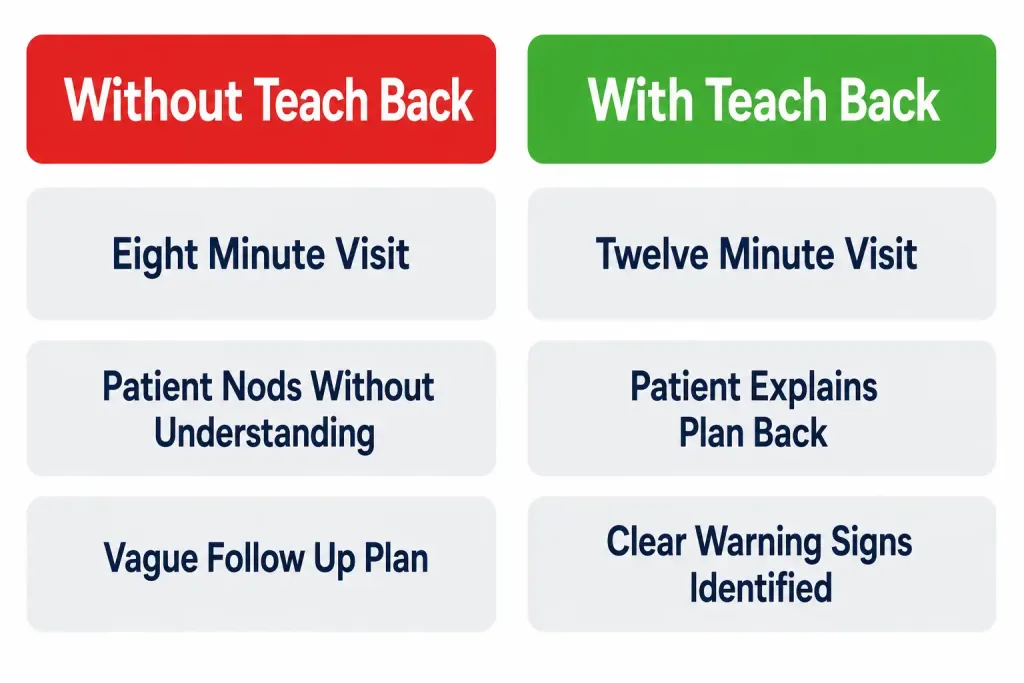
Neither version requires exotic training or new technology. The difference is entirely in structure: whether understanding was confirmed rather than assumed, and whether the patient was a participant in the decision rather than a recipient of it. This is also why the evidence on teach-back specifically, rather than communication skill in the abstract, tends to be the most replicable finding across studies — it’s a discrete, observable behavior rather than a vague quality like “empathy,” which is harder to standardize and measure consistently across research.
What Patients Can Do
Effective communication isn’t solely the clinician’s responsibility. A few concrete things a patient can do to get more out of a clinical conversation:
- Prepare questions in advance. Appointments move quickly; writing down your top two or three concerns beforehand makes it far less likely you’ll leave without addressing them.
- Ask for teach-back yourself. If a clinician doesn’t initiate it, you can say, “Can I repeat that back to you to make sure I’ve got it right?” This is a normal, welcome request, not an imposition.
- Say when you don’t understand a term. Clinicians sometimes forget which words are jargon. Asking “what does that mean in plain terms?” is a completely reasonable interruption.
- Bring someone with you, if useful. A second set of ears can catch details you miss, especially during a stressful or overwhelming diagnosis conversation.
- Use patient portals for follow-up, not first-line concerns. Portals are useful for routine questions and results, but urgent or complex concerns are usually better handled with a call or visit.
What Clinicians Can Do
For clinicians, most of the evidence points toward a small number of high-leverage habits rather than a long list of soft skills:
- Build teach-back into routine visits, particularly at discharge or when explaining a new diagnosis or medication.
- Slow down the opening of a visit. The Levinson findings on orientation statements — briefly explaining what the visit will cover — cost very little time and are associated with better outcomes.
- Treat shared decision-making as a default, not an optional extra step reserved for major decisions.
- Use professional interpreter services rather than improvising with family members, particularly for anything involving diagnosis, consent, or medication instructions.
- Be cautious about over-digitizing communication. The JMIR findings are a useful reminder that convenience tools can quietly erode the relational side of care if they become a substitute for, rather than a supplement to, direct conversation.
Conclusion
The honest version of this topic is less dramatic than the statistic-heavy version, but it’s also more trustworthy: strong evidence supports specific, teachable practices — teach-back, orientation statements at the start of a visit, shared decision-making, appropriate use of interpreters — as genuinely connected to better outcomes, including fewer malpractice claims and better chronic disease management. Some other frequently repeated claims about precise percentage improvements in anxiety, satisfaction, or recovery speed don’t hold up under a source check and shouldn’t be treated as established fact just because they sound authoritative. Good communication in healthcare is real, valuable, and worth investing in — it just doesn’t need invented statistics to make the case.
FAQs
What role does trust play in clinician-patient relationships?
Trust built through consistent, honest communication makes patients more likely to disclose relevant symptoms, follow treatment recommendations, and return for necessary follow-up care. The Levinson malpractice study is one of the clearer empirical demonstrations that this isn’t just a nice idea — physicians whose patients described feeling heard and informed had measurably lower malpractice claim rates.
What is effective clinician-patient communication, specifically?
It’s a set of teachable practices, not an innate personality trait: explaining information in plain language, actively listening without interrupting, confirming understanding through methods like teach-back, and involving patients in decisions about their own care.
Does communication actually affect how fast someone physically recovers?
Indirectly, yes, primarily through adherence: patients who understand their treatment plan and feel involved in decisions about it are more likely to follow through with medications, follow-up appointments, and self-management tasks, all of which affect recovery trajectories. Direct, precisely quantified links between communication style and physical healing speed are harder to establish and should be treated cautiously when a source presents one exact percentage.
Why does nonverbal communication matter in healthcare?
Patients register tone, eye contact, and body language as signals of how carefully they’re being listened to, often independent of the actual words used. This is a well-established finding in medical communication research, even though precise numeric claims about how much any single nonverbal adjustment reduces anxiety should be treated skeptically absent a clear, checkable source.
Have digital tools like telemedicine and patient portals improved clinician-patient communication?
The evidence is mixed rather than uniformly positive. A 2024 JMIR systematic review found that most included studies reported positive clinician satisfaction with digital hospital tools, but the same body of research also consistently found that increased digitization can strain the relational, in-person side of the clinician-patient relationship. Digital tools are a genuine convenience, not an unambiguous communication upgrade.