Star fruit, also called carambola, is a tropical fruit that gets its name from its distinctive star shape when sliced crosswise. It has a genuinely useful nutritional profile — low calorie, high in vitamin C, a good source of fiber — but it also carries a real, documented health risk for a specific group of people that any honest article on this topic needs to lead with, not bury at the bottom.
Read This First: Star Fruit Is Dangerous for Anyone With Kidney Disease
This is the single most important fact about star fruit, and it’s more clinically significant than any of the benefits below. Star fruit contains a neurotoxin called caramboxin, along with oxalic acid, both of which a healthy kidney can filter out of the body without issue. For someone with impaired kidney function or kidney disease, these substances can’t be cleared properly and build up in the bloodstream, where they can cross the blood-brain barrier and cause serious, sometimes irreversible harm.
According to the National Kidney Foundation and multiple published clinical case reports, star fruit toxicity in people with kidney disease can cause: persistent, intractable hiccups (often the first warning sign), vomiting, mental confusion, muscle weakness, numbness, seizures, and in serious cases, coma or death. Some documented cases have occurred even in people with previously normal kidney function after consuming large quantities at once, though the risk is dramatically higher and better-documented in people with existing kidney impairment. Physicians are specifically trained to ask patients presenting with unexplained, intractable hiccups whether they’ve recently eaten star fruit.
If you have kidney disease of any kind, or reduced kidney function for any reason, avoid star fruit entirely and don’t treat this as a “consume in moderation” situation — talk to your doctor before eating it in any form, including juice.
A second, separate warning worth knowing: star fruit has been shown to inhibit an enzyme (CYP3A4) involved in how the body processes many common medications — a similar interaction to the well-known grapefruit-and-medication warning. This can cause certain drugs to build up to higher, potentially dangerous levels in your bloodstream. If you take prescription medication regularly, it’s worth checking with your doctor or pharmacist before adding star fruit to your diet regularly, not just if you have kidney disease specifically.
Who Exactly Is at Risk
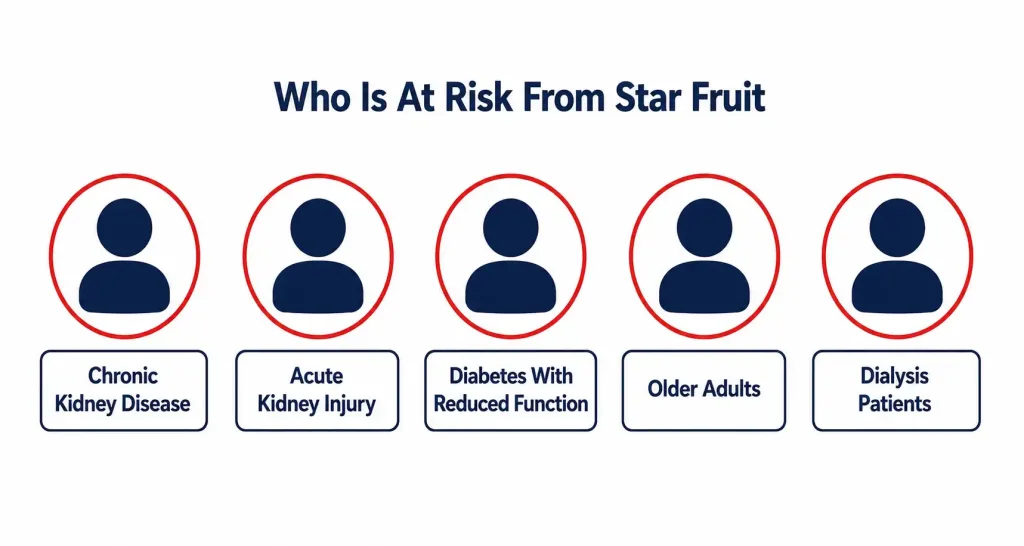
“Kidney disease” covers a wide range of severity, and it’s worth being specific about who this warning applies to:
- Anyone diagnosed with chronic kidney disease (CKD), at any stage, including earlier stages that haven’t yet progressed to dialysis-dependent kidney failure.
- Anyone with acute kidney injury, even if temporary or expected to resolve.
- People with diabetes and reduced kidney function — diabetes is one of the leading causes of chronic kidney disease, and reduced kidney function can develop gradually without dramatic symptoms, meaning some people may have meaningfully reduced kidney function without a formal CKD diagnosis yet.
- Older adults generally, since kidney function naturally declines with age even without a specific diagnosed condition, and this population is also more likely to be on multiple medications that could interact via the CYP3A4 pathway mentioned above.
- Anyone on dialysis — this group faces some of the most severe documented reactions in published case reports, since their kidneys have essentially no capacity to clear the neurotoxin.
If you’re unsure whether your kidney function falls into a risk category, this is a reasonable, low-effort question to raise at your next doctor’s appointment rather than assuming it doesn’t apply to you.
Recognizing Star Fruit Toxicity: When to Seek Emergency Care
If someone with any degree of kidney impairment has eaten star fruit and develops any of the following, this warrants urgent medical attention, not a wait-and-see approach:
- Persistent, intractable hiccups that won’t stop
- Vomiting
- Sudden confusion or altered mental state
- Muscle weakness or numbness in the limbs
- Seizures
Because intractable hiccups are often the earliest and most distinctive warning sign, mentioning recent star fruit consumption specifically to any treating physician or emergency room staff can meaningfully speed up correct diagnosis and treatment, since this specific cause isn’t always the first thing considered for these symptoms.
Nutrition Facts
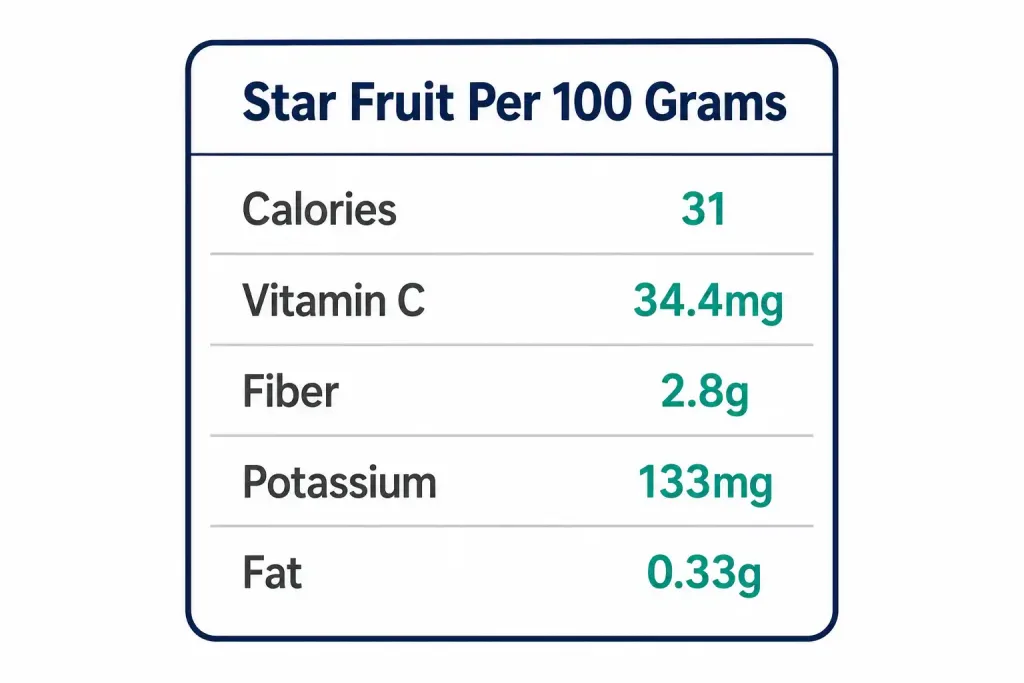
Per 100 grams of raw star fruit (roughly one medium fruit):
- Calories: 31
- Vitamin C: 34.4 mg (about 38-57% of the Daily Value, depending on which reference intake is used)
- Dietary fiber: 2.8 g
- Potassium: 133 mg
- Magnesium: 10 mg
- Fat: 0.33 g (virtually fat-free)
- Vitamin A: minimal (66 mcg RAE) — not a significant source, despite sometimes being described as one
Star fruit’s standout nutrient is genuinely vitamin C — it ranks higher in vitamin C content than the large majority of common fruits, providing a meaningful share of daily requirements in a low-calorie package.
For People Without Kidney Concerns: The Real Benefits
Assuming no kidney impairment and no concerning drug interactions with your current medications, star fruit does offer legitimate nutritional value:
A strong vitamin C source. Vitamin C supports immune function and acts as an antioxidant, helping neutralize free radicals that contribute to cellular damage over time. Diets consistently rich in vitamin C are associated with lower rates of certain chronic conditions, though this is a general dietary pattern benefit rather than something one fruit alone delivers on its own. Vitamin C degrades with exposure to heat, air, and light, so eating star fruit fresh — rather than after extended storage or cooking — preserves more of its vitamin C content. Store cut star fruit in an airtight container in the refrigerator and consume within a day or two for the best nutrient retention, since cut surfaces exposed to air lose vitamin C more quickly than the whole, uncut fruit.
A source of fiber. The 2.8g of fiber per 100g supports digestive regularity and can help you feel fuller for longer, which is relevant to weight management as part of an overall balanced diet.
Potassium content that supports heart health. Potassium helps the body balance sodium levels, which plays a role in healthy blood pressure regulation. This is genuinely useful for cardiovascular health as part of a varied diet — though star fruit’s potassium content (133mg per 100g) is modest compared to potassium-dense foods like bananas (roughly 358mg per 100g) or potatoes, so it shouldn’t be relied on as a primary potassium source.
Low calorie density. At just 31 calories per 100g, star fruit is a reasonable choice for anyone managing calorie intake while still wanting genuine nutritional content rather than empty calories.
Antioxidant content. Beyond vitamin C, star fruit contains additional antioxidant compounds (flavonoids and polyphenols) that contribute to its overall nutritional profile, though specific disease-prevention claims tied to these compounds in star fruit specifically are less robustly studied than its vitamin C content.
Claims Worth Being Skeptical Of
A few commonly repeated claims about star fruit don’t hold up well under scrutiny and are worth treating cautiously:
- “Treats sore eyes” — there’s no solid clinical evidence supporting star fruit as an eye treatment. This appears to be an extrapolation from its general antioxidant and vitamin content rather than anything specifically studied or demonstrated.
- “Improves hair health via vitamin A” — as shown in the nutrition data above, star fruit’s vitamin A content is minimal, not a meaningful source for this claimed benefit.
- General “cancer prevention” — while vitamin C and fiber are both associated with general health benefits, and antioxidants in the diet broadly are linked to reduced oxidative stress, star fruit itself hasn’t been specifically studied as a cancer-prevention food, and this kind of broad claim outpaces the actual evidence for this specific fruit.
How to Eat It Safely
For people without kidney concerns or relevant medication interactions, star fruit can be eaten raw (skin included, after washing), juiced, or blended into a smoothie. It’s most nutritious and flavorful eaten within a few days of purchase — its vitamin C content and flavor both decline with storage time. Choose fruit that’s firm with a bright yellow color for the best balance of ripeness and tartness; greener fruit will taste more sour.
How Star Fruit Compares to Other Common Fruits
Context helps calibrate expectations about star fruit’s nutritional standing rather than treating it as uniquely exceptional:
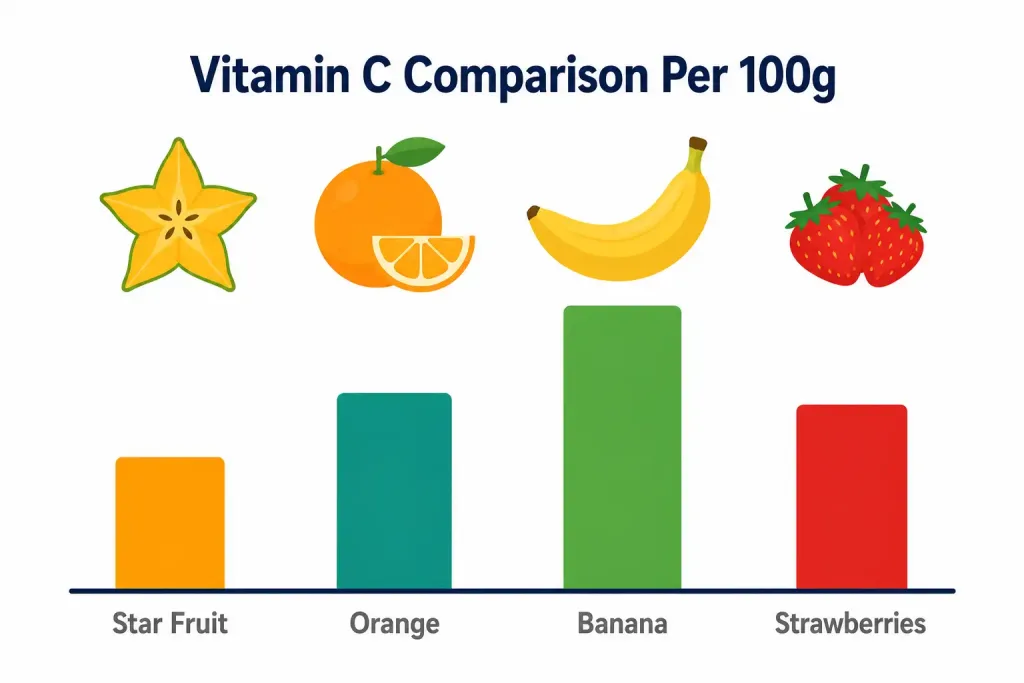
| Fruit (per 100g) | Calories | Vitamin C | Fiber | Potassium |
|---|---|---|---|---|
| Star fruit | 31 | 34.4mg | 2.8g | 133mg |
| Orange | 47 | 53.2mg | 2.4g | 181mg |
| Banana | 89 | 8.7mg | 2.6g | 358mg |
| Strawberries | 32 | 58.8mg | 2.0g | 153mg |
Star fruit holds up well on vitamin C relative to its very low calorie count, and its fiber content is comparable to other common fruits — but it’s not dramatically superior to well-known options like oranges or strawberries on vitamin C specifically, and it’s meaningfully lower in potassium than bananas. It’s a genuinely good option, not a uniquely superior one, which is worth knowing given how some marketing-style content overstates single-food benefits.
Frequently Asked Questions
Can I drink star fruit juice if I don’t have kidney disease? Generally yes, in reasonable amounts, though juicing concentrates the fruit and makes it easier to consume a larger effective quantity quickly than eating the whole fruit — worth keeping portions moderate even without a diagnosed kidney condition, simply as a general precaution given documented cases of toxicity even in some people with normal kidney function after very large quantities.
Is the skin of star fruit safe to eat? Yes, the skin is edible and commonly eaten along with the flesh after washing — it doesn’t need to be peeled the way many other fruits do.
How is star fruit different from other tropical fruits I should worry about? This particular neurotoxin/kidney risk is specific to star fruit — it’s not a general “be careful with tropical fruit” caution. Most other common tropical fruits don’t carry this specific documented risk profile.
Does cooking star fruit reduce the toxin risk? There isn’t good evidence that cooking neutralizes caramboxin or reduces oxalate content meaningfully. The safe approach for anyone with kidney impairment is avoidance, not moderation through preparation method.
My doctor never mentioned this — should I be worried I’ve been eating it safely for years? Not necessarily cause for alarm if you have no kidney issues and haven’t experienced any symptoms — the risk is specifically tied to kidney function, not a universal danger. If you do have any degree of kidney impairment and have been eating star fruit regularly without issue, that’s still worth flagging to your doctor rather than assuming past safety guarantees future safety, since kidney function can decline gradually without obvious symptoms.
Related Reading
For more on nutrient-dense fruits and their role in skin health, see our guide on the benefits of yellow fruits and vegetables for skin health, and for a broader look at protein sources beyond animal products, see the best plant-based protein foods.
The Bottom Line
Star fruit is a genuinely nutritious, low-calorie fruit with a strong vitamin C profile — for people with healthy kidney function and no concerning medication interactions. But the kidney-disease risk here isn’t a minor footnote; it’s a well-documented, potentially fatal interaction that deserves to be the first thing anyone learns about this fruit, not an afterthought below a list of benefits. If you have any degree of kidney impairment, skip star fruit entirely and talk to your doctor about safer fruit options that deliver similar nutritional benefits without the risk.