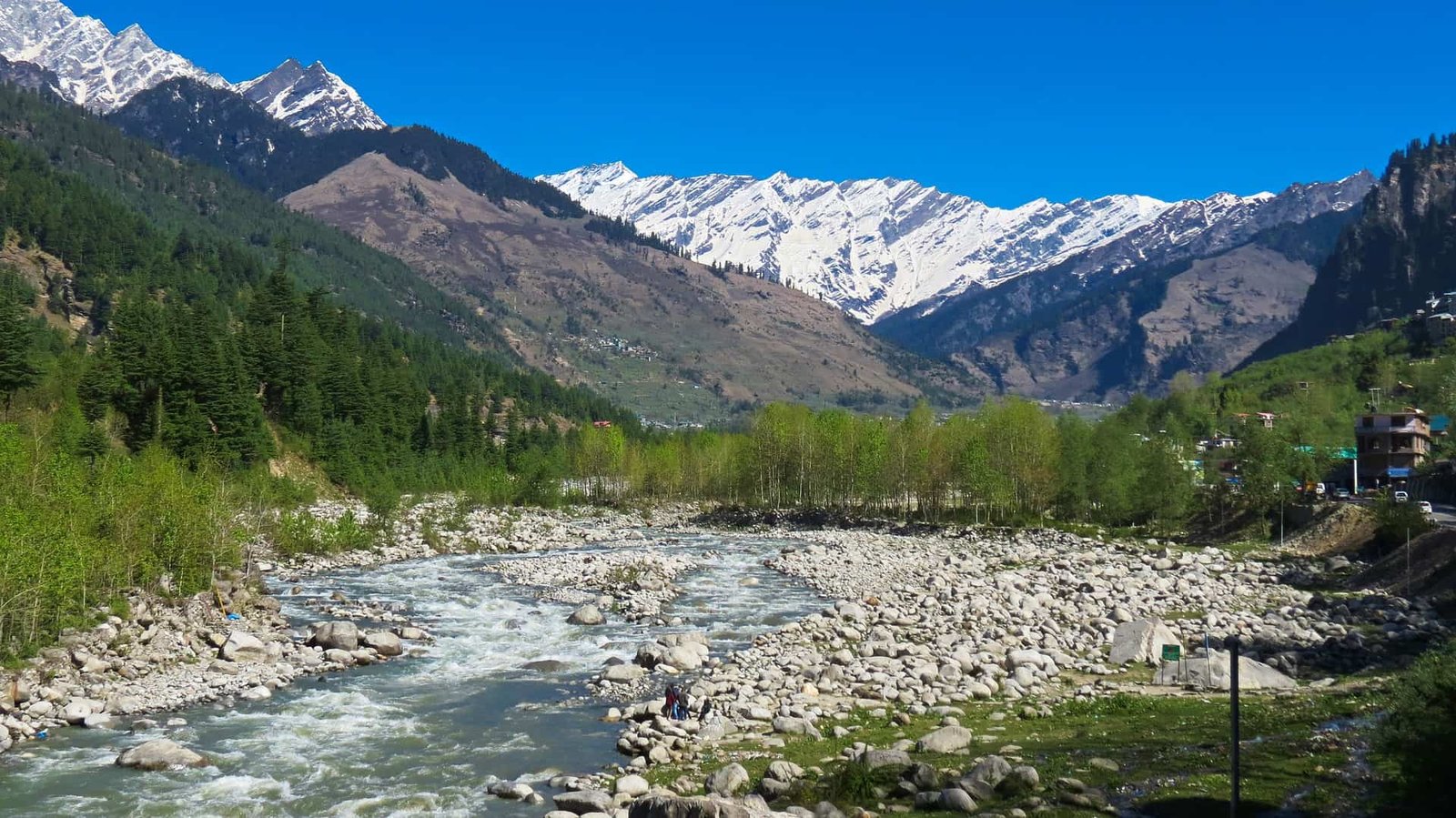
Manali sits in Himachal Pradesh, about 270 km north of Shimla, cradled between the Pir Panjal and Dhauladhar mountain ranges with the Beas River running through it. It’s one of North India’s most popular hill destinations, known for snow-capped peaks, hot springs, ancient temples, and easy access to high-altitude passes. Here are eight places to build a Manali itinerary around, along with practical access notes that have changed meaningfully in recent years.
Rohtang Pass
Rohtang Pass sits at roughly 3,978 meters, about 51 km from Manali, and has historically served as the main gateway toward the Lahaul-Spiti and Leh valleys. It offers sweeping views of snow-capped peaks, with the Beas Kund and Dassaur Lake nearby and the Sonapani Glacier visible from the summit area.
Access here has changed significantly since 2020: the Atal Tunnel, a 9.02 km tunnel running under the Pir Panjal range, now bypasses Rohtang Pass entirely, cutting the journey to Lahaul Valley from roughly five hours to under 30 minutes, with no permit required for the tunnel itself (though vehicles typically still need to register through Himachal Pradesh’s e-Aagman system for entry into Lahaul).
Rohtang Pass itself remains open only seasonally — generally from May or June through October, depending on snow clearance — and requires its own online permit through the Himachal Pradesh government portal, along with a daily vehicle cap. In short: take the tunnel if you’re heading onward to Lahaul or Leh; take the pass itself only if the high-altitude snow experience is the actual point of your visit. Always check current road and permit status before setting out, since conditions can close either route with little notice.
Solang Valley
About 14 km northwest of Manali, between the town and Beas Kund, Solang Valley is one of the region’s most active adventure hubs. In winter, it functions as a small ski resort with rental equipment available on-site; in summer, the same slopes shift to paragliding, zorbing, and horseback riding. The valley’s views across snow-capped peaks and glaciers make it worth visiting even for travelers who skip the activities entirely.
Old Manali
Across the Manalsu Nala from the main town, Old Manali has a noticeably slower pace than central Manali — rustic guesthouses, cafes, and a village atmosphere that’s become popular with longer-staying travelers. The Temple of Manu Maharishi, dedicated to the sage from whom Manali’s name is traditionally derived, is one of the area’s central landmarks. Despite its growing popularity, Old Manali has largely kept its mountain-village character rather than fully converting to a standard tourist strip.
Naggar
About 20 km from Manali, Naggar served as the capital of the Kullu region for several centuries before the capital moved to Sultanpur (modern Kullu town). Naggar Castle, built from stone and timber, is now a heritage hotel with views across the Kullu Valley. The town also holds the Roerich Art Gallery — dedicated to the Russian painter Nicholas Roerich, who lived in Naggar for years — along with several notable temples including Jagatsukh’s Gauri Shankar and the Tripura Sundari temple. The Naggar Fair, held annually in spring, adds a cultural draw beyond the town’s architecture and art.
Jogini Falls
Roughly 2 km north of Vashisht village, Jogini Falls is reached via a scenic walking trail through pine forest with mountain views along the way. It’s a genuinely quieter spot than most of the destinations on this list, since reaching it requires a walk rather than a drive — a reasonable trade if you’re looking for something less crowded than Solang or Rohtang.
Vashisht Hot Water Springs
The village of Vashisht, about 3 km from Manali on the banks of the Beas River, is known for its natural hot sulfur springs. Public bathhouses let visitors soak in the mineral-rich water, which is traditionally believed to have therapeutic properties. The village’s main temple, dedicated to the sage Vashisht, sits at the town square and is the other significant reason to stop here beyond the springs themselves.
Beas Kund
At around 4,000 meters and considered the source of the Beas River, Beas Kund is a glacial lake with strong religious significance — tradition holds that the sage Vyasa bathed here daily, making it a pilgrimage site for Hindu visitors. It’s also the endpoint of one of the more popular short treks in the region, which runs through Solang Valley and offers consistent views of the surrounding snow-capped peaks along the way.
Hadimba Temple
Built in 1553 by Raja Bahadur Singh, Hadimba Temple sits in the cedar forest of Dhungri, about 2 km from central Manali. It’s dedicated to Hidimba (also spelled Hadimba), a figure from the Mahabharata who, according to the epic, married the Pandava prince Bhima and later became venerated as a goddess. The temple’s four-tiered pagoda-style roof is unusual for North Indian temple architecture, and its wooden walls carry detailed carvings of mythological figures and animals.
Notably, there’s no conventional idol inside — the inner sanctum centers on a rock said to bear the goddess’s footprints, reflecting older tribal worship traditions predating the temple’s construction. The Dhungri Mela festival, held over several days each May, draws crowds for its music, dance, and ceremonial procession of the temple’s deity.
Planning Notes
Rohtang Pass’s permit requirement and seasonal closures make it the one destination on this list that needs advance planning rather than a same-day decision — check current status and book the online permit ahead of time if the pass itself (rather than the Atal Tunnel route) is the goal. Solang Valley, Old Manali, and Vashisht are all close enough to central Manali to combine into a single day if time is limited, while Naggar and Jogini Falls reward a slower half-day each given their more specific, single-destination nature.