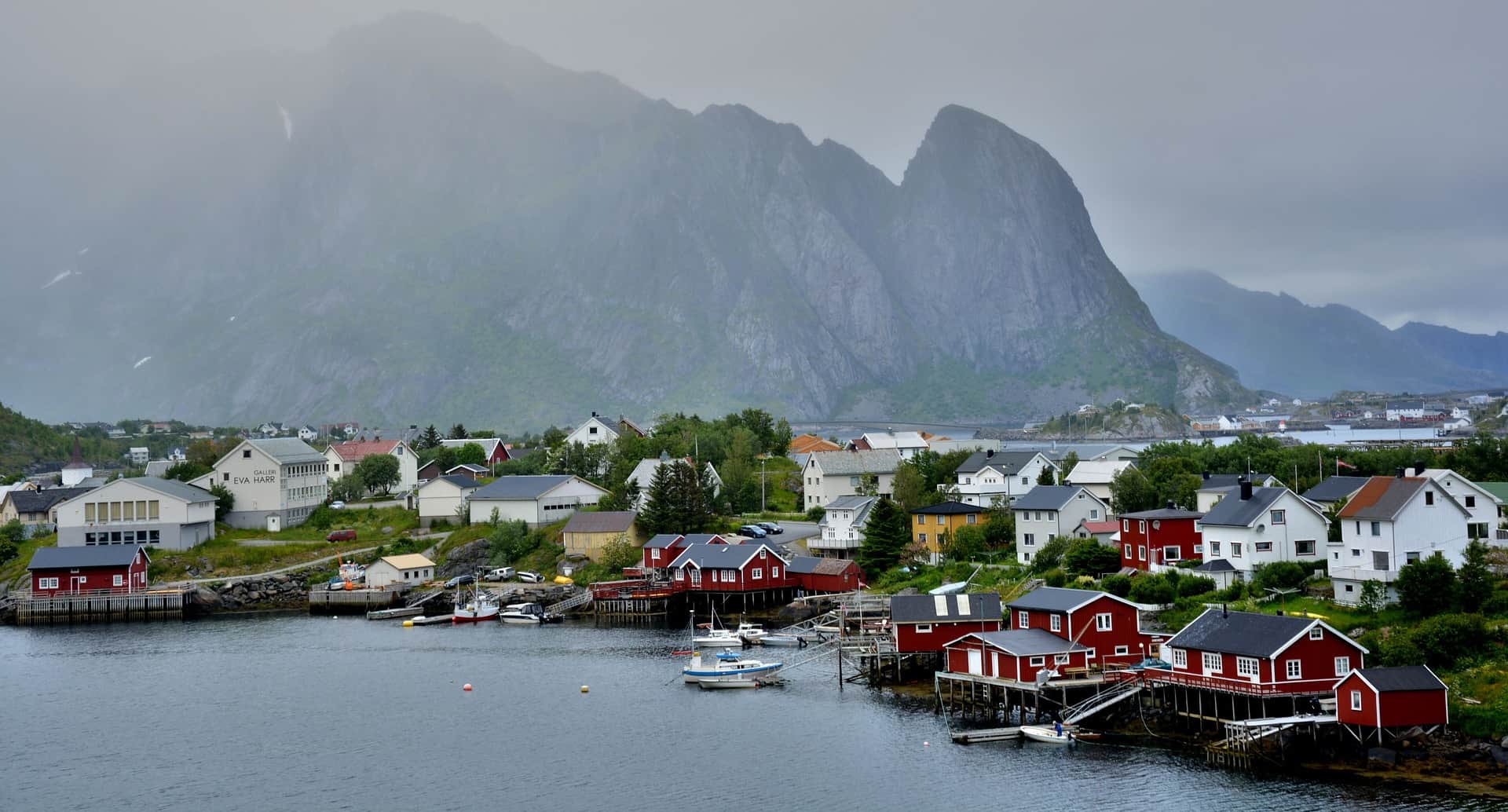
Norway is a country built around dramatic geography: rugged mountains, glacial valleys, and fjords that cut deep into the coastline, alongside the world’s strongest tidal current and phenomena like the aurora borealis and the midnight sun, both visible depending on season and latitude. Here are nine places that show off that range, from the capital to the fjords that give the country its postcard reputation.
1. Oslo
Norway’s capital sits in the southeastern part of the country, at the head of the Oslofjord. The city offers extensive green space, including Frogner Park and the Vigeland Sculpture Park, alongside a deep well of history. The Viking Ship Museum houses well-preserved Viking-era longships and offers a direct look at early Norwegian seafaring and craftsmanship. Akershus Fortress, a 13th-century structure on the fjord’s edge, has served over the centuries as a royal residence, a military stronghold, and a prison, and remains one of the city’s most visited historical sites.
2. Ålesund
Ålesund is a harbor town on Norway’s west coast known for a specific architectural story: after a fire destroyed nearly the entire town in 1904, it was rebuilt almost entirely in Art Nouveau style, making it one of the more architecturally distinctive towns in the country today. Surrounded by rugged mountains and fjords, Ålesund also sits within reach of Geirangerfjord, a UNESCO World Heritage Site. Museums, parks, and the Art Nouveau streetscape itself are enough to fill a stay of several days.
3. Åndalsnes
Åndalsnes is built for walking, with soaring mountains and hairpin trails surrounding the town, and enough variety in routes to suit both casual walkers and serious hikers. The Nesaksla viewpoint is reachable via a roughly 20-minute cable car ride or a longer hike from the town center. Nearby, Trollstigen (the “Troll’s Path”) is a famous switchback mountain road with waterfalls, dramatic peaks, and green valleys along the route, while the sheer rock face of Trollveggen (“Troll Wall”) is one of Europe’s tallest vertical rock walls and a serious draw for climbers.
4. Bergen
Bergen sits on Norway’s southwestern coast, surrounded by mountains and close to Sognefjord, Norway’s longest and deepest fjord at 205 km long and roughly 1,308 meters deep — the second-longest fjord in the world after Greenland’s Scoresby Sund. In the city itself, the colorful wooden buildings of Bryggen, the old Hanseatic wharf, are a UNESCO World Heritage Site facing the harbor, with Bergenhus Fortress nearby. Mount Fløyen, accessible by hiking trail or by the Fløibanen funicular, offers a wide panorama over the city and surrounding fjords, and Bergen’s seafood market and museums round out a stay of several days.
5. Bodø
Bodø, just north of the Arctic Circle, is the gateway to Saltstraumen, widely described as the world’s strongest maelstrom or tidal current. Roughly every six hours, an estimated 400 million cubic meters of seawater force their way through a narrow, 150-meter-wide strait at speeds reaching around 20 knots, creating whirlpools that can be viewed from the shore, the Saltstraumbrua bridge, or by boat. The strong current keeps the area rich in fish and marine life, making it popular with anglers as well as sightseers. Bodø’s position north of the Arctic Circle also makes it a solid base for both the aurora borealis in winter and the midnight sun in summer.
6. Eidfjord
Eidfjord sits at the edge of Hardangervidda, Northern Europe’s largest mountain plateau and the core of Norway’s largest national park, offering extensive hiking and fishing across open highland terrain. The Hardangerjøkulen Glacier is visible from the village itself, and Vøringsfossen, one of Norway’s most famous waterfalls, sits nearby. The area carries substantial Viking-era history, including old burial sites, alongside a 13th-century stave church in the village.
7. Flåm
Flåm sits at the end of Aurlandsfjord, a narrow branch of Sognefjord in southwestern Norway. Fjord cruises from Flåm typically run one to four hours and pass through UNESCO-listed sections of the fjord system, including the Nærøyfjord, with guides pointing out rock formations, glaciers, and local history and legend along the way. Flåm is also the starting point of the Flåm Railway, one of the steepest standard-gauge rail lines in the world, connecting the fjord to the mountain village of Myrdal.
8. Nordfjord
Nordfjord borders Jostedalsbreen, the largest glacier on mainland Europe, protected within Jostedalsbreen National Park since it was established in 1991. The district combines mountain valleys, a rugged coastal cape, and agricultural lowland. Nearby, Hornindalsvatnet is both Norway’s and Europe’s deepest lake, reaching a measured depth of 514 meters. Nordfjord supports year-round activity — alpine skiing, cycling, glacier walking, kayaking, and surfing — depending on season and location within the district.
9. Geirangerfjord
Geirangerfjord, in western Norway, is one of the country’s most recognized fjords and a UNESCO World Heritage Site in its own right. Its best-known features are its waterfalls, including the Seven Sisters and the Bridal Veil, which drop directly into the fjord along a stretch of steep cliffs. Ferries, cycling routes, and hiking trails all offer different vantage points on the fjord, from cliff-top views down to water level, making it a destination that rewards more than a single quick stop.
Planning Notes
Several of these destinations cluster geographically: Ålesund, Åndalsnes, and Geirangerfjord sit close enough together on Norway’s western coast to combine into a single multi-day fjord-and-mountain leg of a trip, while Flåm and Bergen are commonly linked via the well-known “Norway in a Nutshell” rail-and-fjord route. Bodø and the far north are a separate trip in practice, given the distance from the southern and western destinations on this list — worth treating as its own leg rather than trying to fit in alongside Oslo or Bergen on a single visit.