Sri Lanka packs an unusual range of experiences into a relatively small island off the southern coast of India: colonial port cities, ancient Buddhist capitals more than two thousand years old, wildlife parks with some of the best elephant and leopard sightings in Asia, and a coastline stretching from surf beaches to quiet colonial forts. The island holds eight UNESCO World Heritage Sites, several of which appear on this list. Here are nine places worth building an itinerary around.
1. Colombo
Sri Lanka’s capital blends its colonial and indigenous past with a fully modern city built up around it. The island held major strategic importance for European trading powers along historic spice trade routes, and it passed through Portuguese, Dutch, and British colonial rule in succession before independence. That layered history is visible throughout Colombo’s architecture and arts today, alongside a functioning contemporary capital city.
2. Kandy
Kandy was the last royal capital of Sri Lanka before the full colonial period, and it held on to genuine independence through the 15th to 18th centuries — known as the Kandyan Era — even while most coastal regions had already fallen under European control. The Temple of the Sacred Tooth Relic, part of the former royal palace complex, houses what’s believed to be a tooth relic of the Buddha and remains an active site of worship. The Kandy National Museum, nearby, covers the region’s history in more depth.
3. Udawalawe National Park
About an hour’s drive from Hambantota in the island’s south, Udawalawe sits at the boundary between Sri Lanka’s wet and dry zones, which shapes both its terrain and its wildlife. It’s one of the most reliable places in the world to see wild Asian elephants, with an estimated 400-plus elephants resident in the park. Beyond elephants, expect water buffalo, mugger crocodiles, sambar and spotted deer, wild boar, and the endemic toque macaque, a monkey species found only in Sri Lanka — not an ape, since Sri Lanka has no native ape species. Leopards and sloth bears are present but genuinely elusive; sightings happen, but they’re the exception rather than the rule. The park is also a strong destination for birdwatching, with over 180 recorded species.
4. Galle
Reached from Colombo by one of the country’s coastal highways, Galle is defined by its 17th-century seaside fort, built during the Dutch colonial period on top of earlier Portuguese fortifications. Galle Fort is a UNESCO World Heritage Site — a still-inhabited walled town now filled with shops, cafes, and restaurants alongside its original residents. The fort’s car-free streets and its position surrounded by the sea on three sides make it one of the more pleasant places in Sri Lanka to simply walk without a fixed plan.
5. Hikkaduwa Beach
About 90 minutes from Colombo, Hikkaduwa is one of Sri Lanka’s best-known surf destinations, with equipment for surfing, bodyboarding, and snorkeling easily rented from stands along the beach. The best wave conditions generally run from November through March. It’s a wide beach that rarely feels overcrowded even during peak season, backed by a strip of beachfront food stalls, small guesthouses, and budget-to-midrange hotels.
6. Galle Face Green
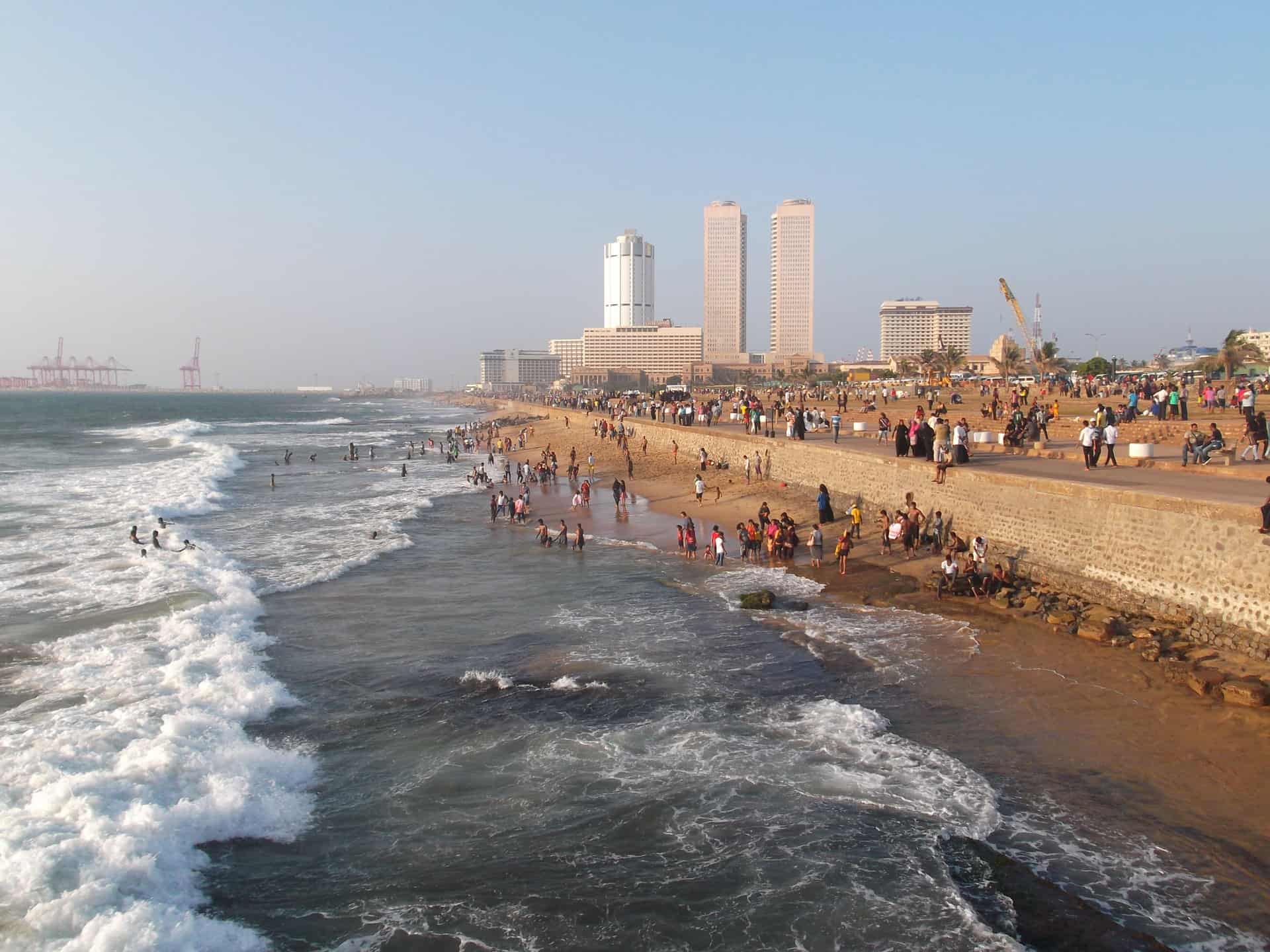
A long stretch of open oceanfront lawn in central Colombo, Galle Face Green functions as the city’s communal outdoor space — locals come to fly kites, play informal cricket or football, eat from the row of food stalls that line its edge, and simply watch the sunset over the Indian Ocean. It’s busiest and liveliest on weekend evenings, particularly Friday and Saturday, when the atmosphere shifts from a daytime park into something closer to a nightly gathering.
7. Yala National Park
On the island’s southeastern coast, Yala is best known for leopard sightings — genuinely uncommon anywhere else in the world at this density, though still not guaranteed on any single visit. The park also holds a substantial population of Asian elephants and spans a wider range of habitat than its leopard reputation suggests, including coastal wetlands, dry-zone forest, and open grassland, giving visitors a broader wildlife and ecosystem experience than a single-species safari.
8. Anuradhapura
One of Sri Lanka’s ancient capitals, Anuradhapura pairs the ruins of a once-major city with a still-active religious site at its center. The Jaya Sri Maha Bodhi, a sacred fig tree within the city, was planted in 288 BCE from a cutting of the tree in Bodh Gaya, India, under which the Buddha is traditionally said to have attained enlightenment. With a continuous, documented history stretching back over 2,300 years, it’s widely cited as the oldest human-planted tree in the world with a confirmed planting date. The surrounding ruins — temples, stupas, and ancient reservoirs — reward at least one full day, and many travelers stay two nights to cover the site without rushing.
9. Polonnaruwa
Sri Lanka’s second ancient capital, Polonnaruwa succeeded Anuradhapura roughly a thousand years ago and is also a UNESCO World Heritage Site. Unlike Anuradhapura’s more scattered ruins, Polonnaruwa’s compact garden city — palaces, temples, and reservoirs — is well preserved and best explored by bicycle, which most visitors rent on-site. A resident population of macaques has lived among the ruins for generations and is a near-guaranteed sighting. Pop-culture footnote: Polonnaruwa’s temple ruins, along with Sigiriya rock fortress, appear in Duran Duran’s 1982 music video for “Save a Prayer,” filmed on location in Sri Lanka.
Planning Notes
These nine places span the full width of the island, so realistic logistics matter more than enthusiasm alone. Anuradhapura and Polonnaruwa are usually combined with Sigiriya as part of Sri Lanka’s “Cultural Triangle,” typically covered over several days from a central base. Kandy sits conveniently between the Cultural Triangle and the southern coast, making it a natural stop on the way to Galle, Hikkaduwa, or the southern national parks. Yala and Udawalawe, both in the south, are close enough to pair on a single wildlife-focused leg of a trip rather than treating them as separate excursions.