
A good copywriter isn’t a better-sounding writer. That’s the mix-up most people make. A journalist informs. A novelist entertains. A copywriter does neither as the main job — their words exist to move someone toward a specific action, whether that’s clicking a button, filling out a form, or buying something. Here’s what the job actually involves, the frameworks that make it work, and what separates copy that converts from copy that just sounds nice.
The Core Job: Writing That’s Built to Move Someone
Copywriting shows up almost everywhere a business talks to a customer: product pages, landing pages, email subject lines, ad headlines, social captions, and the one-liner under a pricing table that nudges someone toward “Upgrade” instead of “Maybe later.” The format changes constantly. The underlying job doesn’t — every piece is written with a specific reader action in mind, not just information delivery.
That distinction matters because it changes how the writing gets judged. A blog post succeeds if it’s informative and well-organized. A piece of copy succeeds only if it produces the action it was written for — click-through, signup, purchase. A beautifully written headline that doesn’t get clicked has failed at its one job, however good the sentence was on its own.
What a Copywriter Actually Needs to Know Before Writing a Word
- Who the reader actually is. Not a vague “our customers,” but a specific persona: what they already believe, what’s stopping them from buying, and what language they’d actually use to describe their own problem. Copy written for an imagined generic reader almost always reads generic.
- What the one objective is. Every effective piece of copy pushes toward a single action. Copy trying to get someone to both “learn more” and “buy now” in the same breath usually accomplishes neither, because it splits the reader’s attention instead of guiding it.
- The difference between a feature and a benefit. “256-bit encryption” is a feature. “Your customers’ data stays safe even if a device gets stolen” is the benefit a reader actually cares about. Good copywriters translate constantly between the two, because most buyers don’t make decisions based on specifications — they make them based on what the specification actually means for them.
A lot of what separates a strong copywriter from a mediocre one is genuinely just experience — recognizing which angle will land with a specific audience is a pattern-matching skill that improves with repetition, not something a course alone fully teaches.
The Frameworks That Actually Structure Good Copy
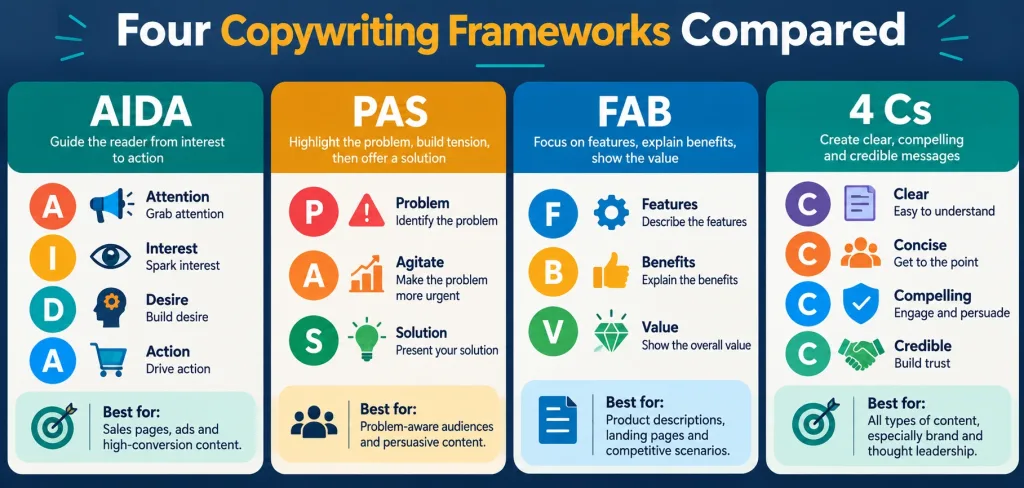
Most working copywriters lean on a handful of proven structures rather than reinventing the approach every time. Here are the ones worth actually knowing:
AIDA (Attention, Interest, Desire, Action) is the most widely taught structure, and for good reason — it’s simple and broadly applicable. Grab attention with a strong headline, build interest by speaking to a real problem, create desire by connecting the product to a benefit the reader actually wants, then close with a clear action. It works well for straightforward products where the reader doesn’t need much convincing once they understand the benefit.
PAS (Problem, Agitation, Solution) takes a sharper angle. Name the reader’s problem directly, spend a moment making them feel its real cost or frustration (not manipulatively — just honestly, in a way that mirrors how they actually experience it), then introduce the solution as genuine relief. PAS tends to outperform AIDA for products solving a painful, acute problem, where the reader already feels the pain and just needs to see the fix.
FAB (Features, Advantages, Benefits) is less a persuasion arc and more a translation tool, useful specifically for technical products. List the feature, explain what it does functionally (the advantage), then connect it to what that actually means for the reader’s life or business (the benefit). It’s the structure that keeps copy for complex products from reading like a spec sheet.
The 4 Cs (Clear, Concise, Compelling, Credible) function less as a writing arc and more as an editing checklist. Is the sentence clear on a single read? Is every word earning its place? Is there a real reason to care? Is the claim backed by something believable? Running a finished draft against these four questions catches a surprising amount of weak copy before it ships.
None of these frameworks is universally “better.” The right choice depends on the product, the reader’s existing awareness of their problem, and how much persuading actually needs to happen versus how much the reader already wants to act.
Where Copywriting Skill Actually Comes From
Formal training teaches the frameworks above and the mechanics of structuring a sales message — genuinely useful groundwork. But a meaningful part of what makes copy actually work is something training alone doesn’t fully transfer: a feel for tone, timing, and which specific words will land with a specific audience. That comes from writing a lot, watching what converts and what doesn’t, and adjusting. Courses accelerate the learning curve; they don’t replace the repetitions.
Common Mistakes That Undercut Otherwise Good Copy
- Leading with features instead of benefits, especially in technical or B2B copy, where it’s tempting to list specifications because they feel objective and defensible.
- Writing for two audiences and two goals in the same piece, which dilutes the one clear action every effective piece of copy needs.
- Overusing urgency and scarcity language until it stops being believable — a countdown timer on literally everything trains readers to ignore it entirely.
- Skipping the actual research step and guessing at what the audience cares about, rather than reading real customer language from reviews, support tickets, or sales calls before writing a word.
The Bottom Line
Copywriting is a specific, outcome-driven kind of writing, not a more polished version of general content writing. The job is to understand a reader’s actual problem, choose the right structural framework for that problem (AIDA, PAS, FAB, or an editing pass through the 4 Cs), and write toward one clear action rather than trying to accomplish several things in one piece. The frameworks give you a reliable starting structure. The judgment about which one fits, and which words will actually land with a specific reader, comes from doing it repeatedly and paying attention to what works.
Frequently Asked Questions
What’s the difference between copywriting and content writing?
Copywriting is built to drive a specific action — a click, a signup, a purchase. Content writing (blog posts, articles, guides) is generally built to inform or build trust over time, without necessarily pushing toward one immediate action. The two skills overlap, but they’re judged by different standards of success.
Do I need formal training to become a copywriter?
It helps, particularly for learning the core frameworks and sales-writing mechanics quickly rather than discovering them by trial and error. But a meaningful part of copywriting skill — tone, timing, audience-specific word choice — comes from writing a high volume of real copy and seeing what actually converts, which training alone doesn’t fully replace.
Which framework should I use: AIDA or PAS?
AIDA tends to work well for straightforward products where the reader just needs to understand the benefit. PAS tends to work better for products solving an acute, already-felt pain point, since it leans into agitating a problem the reader already recognizes before offering relief.
What makes copy actually convert, beyond following a framework?
Specific, concrete language that mirrors how the actual target reader talks about their problem — pulled from real customer reviews, support conversations, or sales calls — tends to outperform generic, framework-perfect copy that never bothered to research the audience’s actual words.