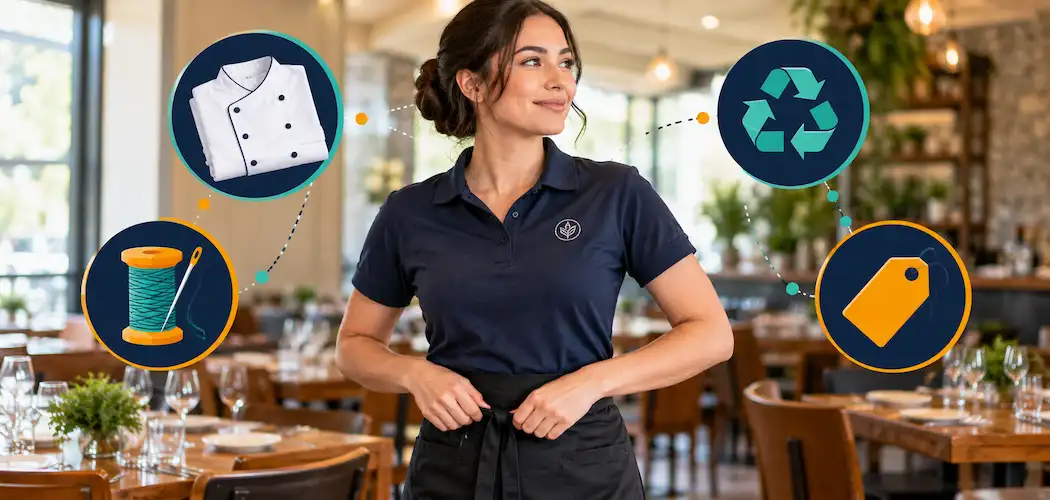
A restaurant’s uniform is one of the few brand touchpoints every single customer sees, whether they notice it consciously or not. Before a server says a word or a chef plates a dish, the uniform has already communicated something — about hygiene standards, professionalism, and how seriously the business takes its own identity. Here’s a practical, honest look at what actually goes into choosing branded uniforms that work for a restaurant, not just an idealized version of why uniforms matter.
Why Branded Uniforms Actually Matter
A uniform does a few genuinely useful jobs at once, beyond just “looking professional.”
Hygiene and food safety. In a kitchen or front-of-house environment, a uniform that’s designed for the job — easy to clean, resistant to stains, appropriate for heat and spills — isn’t a style choice, it’s a practical food-safety consideration. Staff who feel self-conscious about a uniform that shows every stain are less likely to keep working comfortably through a busy shift.
Instant staff identification. Especially in a larger restaurant or a fast-casual environment with an open kitchen, customers need to be able to tell at a glance who works there. This matters for basic things like knowing who to ask for help, and it matters for safety — staff need to be identifiable during an emergency as much as during a normal shift.
Brand consistency. A consistent uniform across every location (for restaurants with more than one site) reinforces brand recognition in a way that’s genuinely measurable — customers associate a specific look with a specific experience, the same way they associate a logo or a color palette with a brand.
Staff morale and team identity. This one is harder to measure precisely, but it’s a real, frequently reported effect: a uniform that staff feel reasonably comfortable and good in, rather than cheap or ill-fitting, tends to support a stronger sense of being part of a team — and the reverse is true too. A uniform staff visibly dislike wearing can become a recurring minor friction point.
The Core Uniform Pieces Most Restaurants Need
A restaurant uniform program usually breaks down into a handful of core pieces rather than one single garment:
- Aprons — for kitchen staff, these need to be heat- and stain-resistant; for front-of-house staff, a lighter bistro or waist apron is more common, often doubling as a place to carry a notepad or wine key.
- Shirts — short-sleeve polos or button-downs are the most common front-of-house choice for warmer environments and faster-paced service; long-sleeve options suit more formal dining rooms or cooler climates.
- Chef coats and kitchen wear — traditionally double-breasted (so a stain can be hidden by rebuttoning the opposite side) and made from heavier, heat-resistant fabric.
- Printed or embroidered branding — a logo, restaurant name, or simple design element applied to the base garment, which is where most of the actual “branding” in a branded uniform happens.
Choosing Materials: What Actually Matters
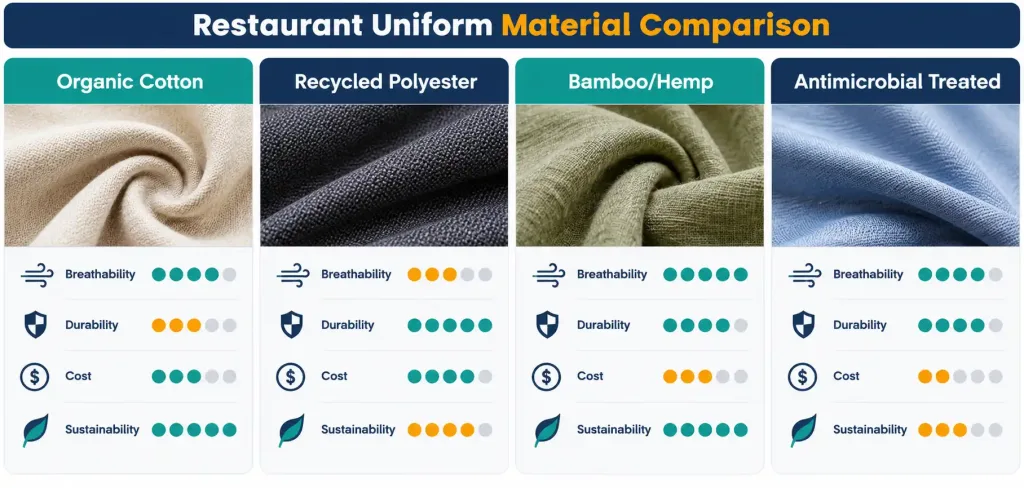
Material choice affects comfort, durability, and increasingly, sustainability — and it’s worth understanding the real tradeoffs rather than treating “eco-friendly” as a single checkbox.
- Organic cotton is breathable and comfortable for long shifts, but less stain- and wrinkle-resistant than synthetic blends, which matters more in a kitchen than a dining room.
- Recycled polyester is a genuinely meaningful sustainability choice with real research behind it, not just a marketing label. Recycling PET (the plastic used in bottles) into polyester fiber cuts carbon emissions by roughly 25% to 75% compared with producing virgin polyester, depending on the specific recycling process, according to a widely cited life-cycle analysis published in Resources, Conservation and Recycling (Shen, Worrell & Patel, 2010). Individual manufacturers report even higher figures for their own proprietary recycling processes — but a claim at that level should specify the manufacturer and process behind it, rather than being stated as a generic industry average.
- Bamboo and hemp fabrics are increasingly used for their breathability and lower water use in cultivation compared with conventional cotton, though they’re typically a pricier option and less widely available at the volume a multi-location restaurant group would need.
- Antimicrobial and moisture-wicking treatments are a genuinely useful functional upgrade for kitchen environments specifically — reducing odor retention and bacterial buildup over a long, physically demanding shift — though the effectiveness and durability of these treatments vary by manufacturer and wash cycle, so it’s worth asking a supplier directly how the treatment is applied and how long it’s expected to last through regular laundering.
Sourcing Custom-Branded Uniforms
Once you know the pieces and materials you need, the next step is finding a supplier that can handle actual branding — embroidery, screen printing, or heat-transfer logos — at the quality and order volume your restaurant needs. custom-branded uniforms suppliers like The Promo Group offer a useful starting point for comparing styles, fabric options, and branding methods side by side, which is worth doing before committing to a full staff order. Whichever supplier you choose, ask for a physical sample first — fabric weight and print durability are genuinely difficult to judge from a product photo alone, and a logo that looks sharp on a screen can print differently once it’s actually embroidered or heat-pressed onto fabric.
A few practical questions worth asking any uniform supplier directly: What’s the minimum order quantity, and does it scale with staff turnover? What’s the realistic turnaround time for a reorder when a new hire needs a uniform mid-season? And does the branding method (embroidery versus screen print) hold up to commercial laundering, since restaurant uniforms get washed far more often than typical workwear?
Caring for Branded Uniforms
A uniform program’s actual cost isn’t just the upfront purchase — it’s how long each piece lasts through regular wear and commercial-grade laundering. A few practical habits extend uniform life meaningfully:
- Follow the care label exactly, especially for antimicrobial or moisture-wicking treatments, which can degrade faster under high heat or harsh detergents than the base fabric does.
- Wash branded items inside-out when possible, to reduce direct abrasion on embroidered or printed logos.
- Address stains promptly rather than letting them set through a full wash cycle, since kitchen stains (oil, sauce, grease) are often far harder to remove once they’ve dried.
- Rotate uniforms across a large enough stock that no single set is worn and washed every single shift, which meaningfully extends the usable life of the whole program.
- Keep a small reserve stock sized for your newest hires, so a new staff member isn’t waiting a full reorder cycle before they have a proper uniform.
The Business Case: What the Market Data Actually Shows
Uniform and workwear demand has grown steadily, and the restaurant sector is part of a broader trend rather than an isolated case. The global workwear market was valued at roughly $20.1 billion in 2025 and is projected to reach about $31.3 billion by 2034, growing at a compound annual rate of around 4.9%, according to IMARC Group. The chef-uniform segment specifically — a more direct proxy for restaurant kitchen wear — was valued at approximately $3.8 billion in 2024 and is projected to reach about $6.4 billion by 2033 at a 5.9% CAGR, according to DataHorizzon Research.
That growth reflects a real shift: more restaurant groups are treating uniforms as a deliberate brand and operations decision rather than an afterthought, particularly as sustainable and functional fabric options have become more widely available at commercial scale.
A Note on International Markets
Hospitality businesses outside North America and Europe are part of this same shift. Australia’s hospitality sector, for instance, has seen growing adoption of sustainable and branded uniform programs as part of broader efforts to differentiate in a competitive dining market — though specific, verifiable sales-impact figures tied to uniform changes alone are hard to isolate from everything else a restaurant typically changes at the same time (menu, service style, marketing). Treat any single-restaurant case study claiming a precise sales lift from uniforms alone with real skepticism unless it comes with a named, verifiable source.
The Bottom Line
A branded restaurant uniform program is a genuinely worthwhile investment in hygiene, staff identification, brand consistency, and team morale — but getting real value out of it means paying attention to material tradeoffs, realistic durability expectations, and a supplier who can actually deliver consistent branding at the order volume your restaurant needs. Sustainability claims are worth taking seriously (recycled polyester’s carbon savings are real and well-documented), but worth verifying against the specific process a manufacturer is actually using, rather than accepting a round, impressive-sounding percentage at face value.
Frequently Asked Questions
What’s the most durable fabric for restaurant kitchen uniforms?
Heavier cotton-polyester blends tend to hold up best to repeated commercial washing and kitchen heat, though pure recycled polyester options have improved significantly in durability and are a strong sustainable alternative worth comparing directly against blends.
How much carbon does recycled polyester actually save?
Recycling PET plastic into polyester fiber cuts carbon emissions by roughly 25% to 75% compared with virgin polyester production, according to a widely cited life-cycle analysis (Shen, Worrell & Patel, 2010, Resources, Conservation and Recycling). Individual manufacturers sometimes report higher figures for their specific proprietary process — worth asking which process a supplier is actually using.
How big is the restaurant and chef uniform market?
The global chef-uniform segment was valued at approximately $3.8 billion in 2024 and is projected to reach about $6.4 billion by 2033 at a 5.9% CAGR, according to DataHorizzon Research. The broader workwear market was valued at roughly $20.1 billion in 2025, projected to reach $31.3 billion by 2034.
Should uniform branding be embroidered or screen-printed?
Embroidery generally holds up better to repeated commercial washing and looks more polished on heavier garments like chef coats, while screen printing is usually cheaper and works well on lighter shirts and aprons that are replaced more frequently. Ask any supplier directly how their specific method performs after dozens of commercial wash cycles.