
Forex (foreign exchange) trading gets pitched constantly as an accessible, low-cost way to start investing — trade any time, start small, use leverage to multiply your gains. Most of that framing is technically true and also dangerously incomplete, because it describes the upside of leverage without the part that actually determines most people’s outcome: most retail traders using it lose money. Here’s what the forex market actually is, how leverage really cuts both ways, and what to understand honestly before considering it.
What the Forex Market Actually Is
Forex is the market where currencies are exchanged against each other — trading one country’s currency for another’s, which businesses, banks, and governments do constantly for trade, investment, and hedging purposes. It’s genuinely the largest financial market in the world by trading volume: average daily turnover reached roughly $9.6 trillion in April 2025, according to the Bank for International Settlements’ Triennial Central Bank Survey, the authoritative source for this figure.
The market operates nearly continuously across global trading sessions — Sydney, Tokyo, London, and New York overlap in sequence, so some portion of the market is open essentially around the clock on weekdays, closing only over the weekend. That part of the common pitch is accurate: forex does trade on a near-24-hour schedule during the week.
What Leverage Actually Does — Both Directions
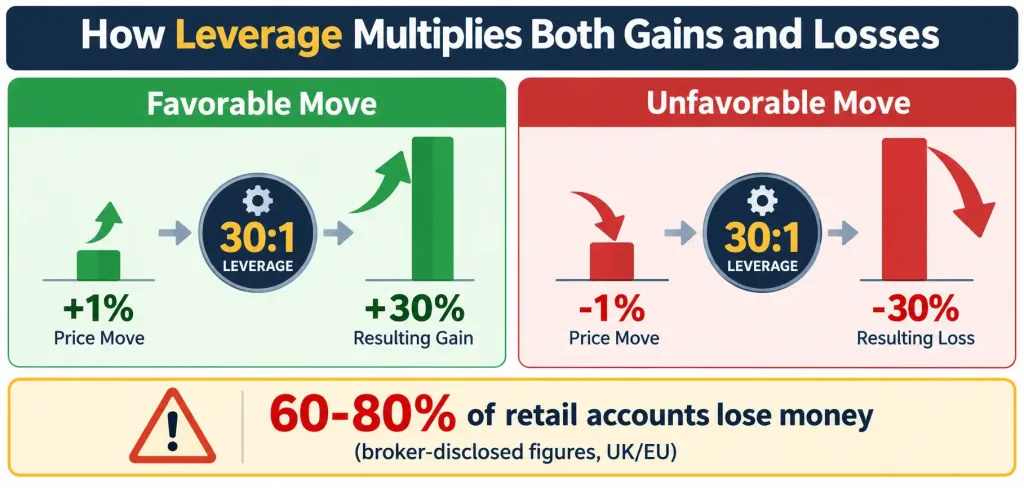
Leverage is the part of forex trading that gets described as a benefit far more often than it gets described honestly. Here’s the actual mechanism: leverage lets you control a much larger position than your account balance alone would allow — for example, with 30:1 leverage, a $1,000 account can control a $30,000 position. That means a small favorable price move produces a proportionally much larger gain on your account balance than it would without leverage.
The same math runs in reverse. A small unfavorable price move produces a proportionally much larger loss, and because currency prices move constantly and sometimes sharply, leveraged positions can lose a meaningful share of an account’s value quickly. This isn’t a minor caveat — it’s the central risk of the entire structure, and it’s the reason regulators in several major markets have stepped in directly.
The regulatory disclosure that matters most: In the UK and EU, financial regulators require brokers to publicly disclose what percentage of their retail client accounts lose money trading leveraged forex and CFD products. Those broker-disclosed figures have consistently shown that roughly 60% to 80% of retail accounts lose money, depending on the specific broker, according to figures compiled from broker homepage disclosures (reported by Wolf Street, among others, tracking the UK Financial Conduct Authority’s mandated disclosures). The European Securities and Markets Authority (ESMA) separately caps leverage at 30:1 for major currency pairs and 20:1 for non-major pairs specifically because of how much leveraged retail trading was costing ordinary account holders.
That figure is the single most important piece of context missing from most “forex is beginner-friendly” content, and it’s worth sitting with before anything else: on the broker’s own disclosed numbers, most retail accounts lose money using this exact product.
Why Forex CFDs Are Banned for US Retail Traders
It’s genuinely worth knowing that the specific leveraged forex CFD (contract for difference) products common in UK, EU, and Australian retail trading are not legal for US retail traders at all — the CFTC and SEC don’t permit them, specifically because of the leverage and loss-risk profile described above. Other jurisdictions permit them with the leverage caps and mandatory loss disclosures mentioned above; the US took a different regulatory approach entirely. This split alone is a meaningful signal about how seriously different regulators take the risk here.
What Genuinely Matters Before Considering Forex Trading
- Understand that leverage amplifies losses as much as gains — this is the single most important concept, and it’s the one most promotional content either understates or omits entirely.
- Check your broker’s actual regulatory status and required risk disclosures directly, rather than taking a third-party article’s word for it — in the UK, this disclosure is required on the broker’s own homepage.
- Start with a demo account for genuinely as long as it takes to understand position sizing and risk management, not as a quick formality before funding a real account.
- Never trade with money you can’t afford to lose entirely — given that most retail accounts lose money on broker-disclosed figures, this isn’t a cautious hedge, it’s the realistic baseline expectation.
- Understand that “low transaction costs” and “high liquidity” are real features of the forex market itself, but neither offsets the leverage risk — they describe how easily you can enter and exit positions, not whether doing so is likely to be profitable for you specifically.
The Bottom Line
Forex is a real, massive, continuously operating market, and the mechanical facts commonly cited about it — near-24-hour trading, high liquidity, relatively low transaction costs — are accurate. What’s usually missing from the pitch is the leverage risk stated in proportion to its actual importance: broker-disclosed figures from regulated markets consistently show most retail accounts lose money using these products. That’s not a reason nobody should ever trade forex, but it is the context that should come first, not as an afterthought buried under a list of benefits.
Frequently Asked Questions
How big is the forex market?
Average daily turnover reached roughly $9.6 trillion in April 2025, according to the Bank for International Settlements’ Triennial Central Bank Survey — making it the largest financial market in the world by volume.
What percentage of retail forex traders actually lose money?
Based on broker-disclosed figures required by UK and EU regulators, roughly 60% to 80% of retail accounts lose money trading leveraged forex and CFD products, depending on the specific broker.
Why can’t US traders access the same forex CFD products available in the UK or EU?
The CFTC and SEC don’t permit leveraged forex CFD products for US retail traders, specifically because of their leverage and loss-risk profile. The UK, EU, Australia, and other jurisdictions permit them instead, with leverage caps (30:1 for major currency pairs in the EU) and mandatory loss-percentage disclosures.
Is leverage in forex trading always a bad thing?
Leverage itself is a neutral mechanism — it amplifies whatever the underlying price move is, favorable or unfavorable. The risk isn’t leverage existing; it’s that most retail traders underestimate how quickly it can amplify losses, which is exactly what the broker-disclosed loss percentages reflect.