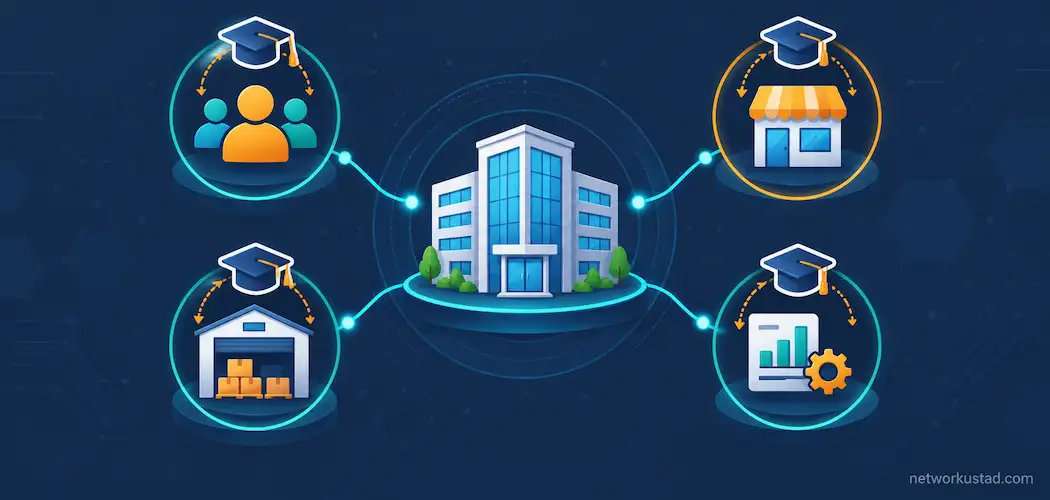
Most companies train their own employees as a matter of course. Far fewer extend that same investment to the people outside the org chart who still shape how customers experience the brand — resellers, distributors, consultants, and the customers themselves. Extended enterprise training closes that gap, and it’s a genuinely measurable investment now, not just a nice-to-have.
Why This Is Worth Taking Seriously Right Now
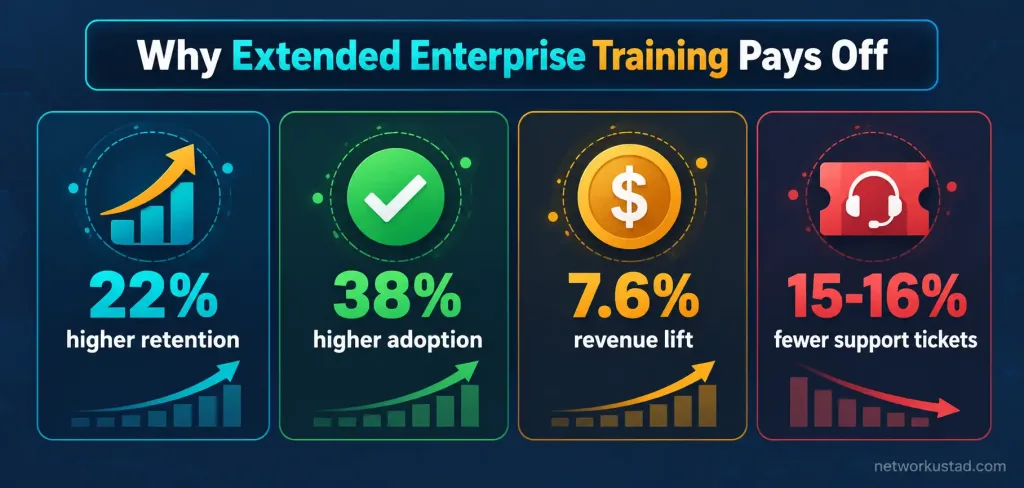
Investment in this space is accelerating. LearnUpon’s 2025 research found 93% of organizations increased their customer education investment over the past year, with 92% expecting further growth in 2025. The returns back up that spending: Intellum’s 2024 research, based on Forrester data, found customer education programs raise product retention by an average of 22% and product adoption by 38%, while 96% of organizations report recouping their investment and 86% report a clearly positive return. Extended enterprise training isn’t a soft, hard-to-measure initiative anymore — it has real, tracked numbers behind it.
1. Brand Consistency Across Every Partner Touchpoint
A reseller or distributor who’s never been properly trained on a product ends up explaining it in their own words, which drifts from the actual messaging over time — sometimes in small ways, sometimes in ways that actively misrepresent what a product does. Standardized extended enterprise training keeps that external-facing message consistent, regardless of how many layers removed from the original company a given conversation happens to be. A customer hearing the same core message from a reseller that they’d hear directly from the company builds more trust than one getting a garbled, inconsistent version secondhand.
2. Fewer Communication Breakdowns Across the Partner Network
Information naturally degrades as it passes through more hands — a detail that matters gets dropped, or a nuance gets flattened into something simpler and less accurate. Extended enterprise training gives every layer of a partner network — vendors, resellers, consultants — a shared, consistent source of information to work from, rather than relying on each person passing along whatever they individually remember from an earlier conversation or outdated document.
3. Trained Customers Buy More and Need Less Support
This is the part of extended enterprise training with the clearest data behind it. Intellum’s 2024 research found customer education programs drive an average 7.6% increase in annual revenue for the products they target, with 60% of companies running curriculum-based education programs reporting increased revenue overall.
The same research found a 15–16% reduction in support requests among companies that invest in customer education — the exact figure varies slightly across Intellum’s own reporting, but the direction is consistent: trained customers generate fewer confused support tickets and a lower average support cost per account. A customer who genuinely understands a product is also simply more likely to renew and recommend it, which is where the retention and advocacy benefits of training customers directly connect back to revenue.
4. Training Surfaces Process Gaps Nobody Else Catches
Building out a training program forces a company to document its own processes clearly enough for an outside partner to follow them — and that documentation exercise alone tends to surface bottlenecks and unclear handoffs that were previously invisible simply because everyone internally already knew the workarounds. A supply-chain process that makes sense to the people who built it informally often reveals real gaps the moment someone has to write it down clearly enough for an external distributor to execute it correctly without hand-holding.
5. It Scales Where Internal-Only Training Can’t
A company training only its direct employees caps its reach at headcount. Extended enterprise training reaches everyone actually touching the customer relationship: distributors selling the product, consultants implementing it, resellers positioning it, and customers using it day to day. LearnUpon’s research found customer support (44%) and customer retention (41%, rising to 53% at companies over 500 employees) are the two leading reasons organizations invest here — both of which scale with the size of the extended network being trained, not just the internal team.
What Actually Needs Training, and for Whom
Extended enterprise training isn’t one program — it covers meaningfully different audiences with different needs. Customers generally need product-usage training focused on getting real value quickly, often self-paced and bite-sized. Resellers and distributors need deeper product knowledge plus sales positioning — not just what the product does, but how to pitch it credibly to their own customers. Consultants and implementation partners typically need the most technical depth, since they’re often the ones troubleshooting issues directly without the vendor’s own support team involved. Treating all three audiences identically, with one generic training module, is a common reason extended enterprise training programs underperform — the content and format genuinely need to differ by audience.
Choosing a Platform for This
Most dedicated learning management systems support extended enterprise use cases now, typically through separate portals or access tiers for internal staff versus external partners and customers. Only about 25% of companies currently use a platform purpose-built for customer and partner education, according to LearnUpon’s research — most still rely on more generic internal-only tools repurposed for external use, which tends to show in a clunkier experience for the external audience. Evaluating a platform specifically for its external-user experience, not just its internal admin features, is worth prioritizing if an organization hasn’t formalized this yet; a platform that’s excellent for onboarding new employees isn’t automatically good at managing thousands of external customer accounts with very different support needs.
Common Mistakes Companies Make With Extended Enterprise Training
A few patterns show up often enough to name directly. Treating external training as a one-time launch event rather than an ongoing program is one of the most common — a reseller trained once, at product launch, with no refresher as the product changes, drifts out of date just as quickly as an untrained one eventually does.
Measuring only completion rates, rather than actual business outcomes like support-ticket reduction or renewal rates, is another frequent mistake; LearnUpon’s research found 35% of organizations cite difficulty measuring real impact as their biggest challenge, which often traces back to tracking the wrong metric from the start. A third mistake is applying identical training content across customers, resellers, and consultants despite their genuinely different needs, which tends to under-serve all three groups at once rather than serving any of them well.
Where This Fits Alongside Existing Partner Programs
Many companies already run partner programs — co-marketing funds, certification tiers, sales incentive structures — without a formal training component built in, or with training treated as a minor checkbox rather than a core part of the program. Extended enterprise training works best woven into an existing partner program rather than run as a separate, parallel initiative that partners have to engage with on top of everything else already asked of them.
Tying a partner’s certification status, earned through actual training completion and assessment, to tangible benefits they already value — better margins, co-marketing funds, priority lead distribution — gives partners a direct incentive to actually complete training rather than treating it as optional busywork they can skip without consequence. Companies that bolt extended enterprise training onto an existing program this way tend to see meaningfully higher completion rates than those running it as a standalone, unincentivized ask.
Measuring What Actually Matters Over Time
A training program that launches well but is never revisited tends to quietly decay in relevance as products, pricing, and competitive positioning change underneath it. Setting a regular review cadence — quarterly for fast-moving products, annually at minimum for anything more stable — keeps extended enterprise training content from going stale the way the original un-updated advice in this space often does.
Beyond content freshness, tracking a small set of consistent metrics over multiple quarters, rather than a one-time completion snapshot, is what actually demonstrates the program’s value to leadership: trend lines in support-ticket volume, renewal rates among trained versus untrained accounts, and partner-reported confidence in positioning the product all tell a more convincing story over a year than a single quarter’s completion percentage ever could on its own.
Extended enterprise training has moved from a soft, hard-to-justify initiative to one with real, trackable numbers behind it: 22% higher retention, 38% higher product adoption, a measurable revenue lift, and fewer support tickets, according to recent Intellum and Forrester research. The honest caveat is that it only works when tailored to the specific audience — customers, resellers, and consultants genuinely need different content, not one generic module stretched across all three — and when treated as an ongoing program rather than a one-time launch event.
Building a Business Case Leadership Will Actually Approve
Getting budget approved for extended enterprise training usually comes down to connecting it to a metric leadership already tracks, rather than pitching it as a standalone education initiative. Support cost reduction is often the easiest entry point, since it’s already measured and the 15–16% reduction figure from Intellum’s research gives a concrete, defensible number to project against current support spend.
Retention is the stronger long-term argument but takes longer to prove out, since it requires comparing trained versus untrained customer cohorts over at least one renewal cycle, not just a single quarter. Starting with a pilot program covering one product line or one partner tier, rather than committing to a full rollout immediately, gives a company real internal data to make the broader case with, instead of relying entirely on industry benchmarks from outside research.
How Training Content Should Differ by Delivery Format
Not every piece of extended enterprise training content belongs in the same format. Short, searchable micro-lessons work well for customers who need a quick answer to a specific question while actively using a product, rather than sitting through a long onboarding course they’ll mostly forget by the time they need it. Resellers and distributors generally benefit more from structured, sequential courses with a certification or completion credential at the end, since that credential itself becomes something they can use to signal expertise to their own customers.
Consultants and implementation partners often need searchable technical documentation paired with live or recorded deep-dive sessions, since their questions tend to be specific and technical rather than the kind a generic onboarding video can anticipate in advance. Matching format to audience, not just content to audience, is a detail that gets overlooked even by companies that otherwise take extended enterprise training seriously.
Frequently Asked Questions
What’s the difference between extended enterprise training and regular employee training?
Extended enterprise training reaches people outside the direct employee relationship — customers, resellers, distributors, and consultants — rather than stopping at internal staff. It typically requires different content and delivery formats for each external audience.
Does customer education actually improve revenue?
Yes, measurably. Intellum’s 2024 research found customer education programs drive an average 7.6% revenue increase for the products they target, and 60% of companies running curriculum-based programs report increased revenue overall.
What’s the biggest mistake companies make with this kind of training?
Treating it as a one-time launch event instead of an ongoing program, and applying identical content across very different audiences (customers vs. resellers vs. consultants) instead of tailoring it to each group’s actual needs.
Do I need a specialized platform for extended enterprise training?
Not strictly, but it helps. Only about 25% of organizations currently use a platform purpose-built for external education, according to LearnUpon’s research — most repurpose internal-only tools, which tends to produce a weaker experience for external users specifically.
How is extended enterprise training’s success actually measured?
By outcomes, not just completion rates — support-ticket reduction, renewal and retention rates, and revenue tied to trained customers are the metrics with real data behind them. Measuring only completion rates is a common reason organizations struggle to demonstrate the program’s actual value.