
Picking a web development company is one of those decisions that’s easy to get wrong in ways you won’t notice until months later — a site that looks fine in the demo but loads slowly, can’t be updated without calling the agency back, or was never actually built with search visibility in mind. The good news is that almost all of this is avoidable by checking a handful of concrete things before you sign anything, rather than going on a sales pitch and a nice portfolio page alone.
Start With the Portfolio — But Look Past the Screenshots
Every agency shows you their best-looking work. What actually matters is whether that work is relevant to what you need. A beautiful portfolio of restaurant sites tells you little if you’re building an e-commerce platform with inventory management and payment processing. Ask specifically for 2–3 live sites similar in scope to yours, then actually visit them: check how they load on a phone, whether navigation makes sense, and whether the site still looks maintained a year or two after launch (an abandoned-looking “recent project” is a real warning sign).
Ask How They Handle SEO — Not Whether They “Do” SEO
Page speed, clean URL structure, mobile responsiveness, and semantic HTML all affect how a site performs in search results, and they’re decided during development, not bolted on afterward. Almost every agency will say “yes, we do SEO” when asked directly. A more useful question is how: do they optimize image sizes and lazy-load content by default? Do they build semantic HTML rather than div-soup? Will the final site pass Google’s Core Web Vitals without extra work? If the answers are vague, that’s worth noting before you commit.
Design Matters, But Function Has to Come First
Visual design absolutely affects whether visitors stick around, but a site that looks sharp and loads slowly, breaks on mobile, or confuses users with unclear navigation will lose them anyway. The right question isn’t “is this pretty?” — it’s whether the design serves the site’s actual job: getting visitors to find what they need and take the action you want, quickly and without friction.
Confirm Both Front-End and Back-End Capability
A surprising number of smaller agencies specialize in front-end design and either outsource or struggle with back-end functionality — databases, server logic, integrations, content management. If your site needs anything beyond static pages (user accounts, a store, a booking system, custom forms that actually do something with the data), ask directly what their back-end stack is and ask to see a working example of similar functionality, not just a screenshot of the admin panel.
Check References the Right Way
A portfolio shows you the finished product. References tell you what the process was actually like — whether the agency hit deadlines, communicated clearly when something went wrong, and made revisions without a fight over scope. When you talk to a past client, ask specifically: did the project come in on time and on budget, and if not, why? Would they hire this agency again for a second project? That second question tends to surface things a polite “sure, it went fine” doesn’t.
Set a Realistic Budget Before You Start Shopping
Web development pricing varies enormously depending on scope, and the cheapest quote is rarely the cheapest outcome — a site that needs a full rebuild in a year because it was built on outdated or unmaintainable code ends up costing more than paying properly the first time. Before reaching out to agencies, have a rough sense of what you actually need (a marketing site vs. a custom web application are very different projects) so quotes you receive are comparable to each other rather than wildly different scopes dressed up as the same thing.
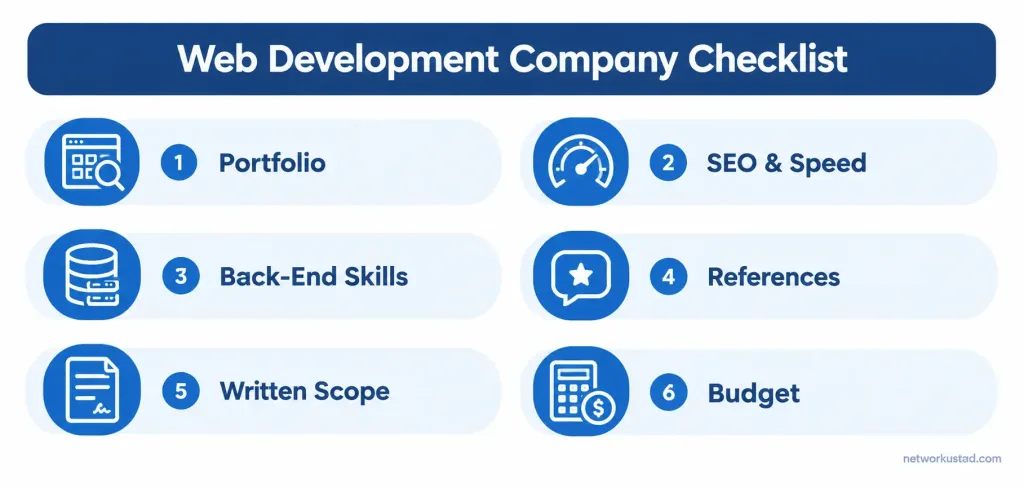
A Quick Checklist Before You Sign With a Web Development Company
- Ask for 2–3 live examples similar in scope to your project, and actually test them yourself.
- Ask specifically how they approach page speed, mobile responsiveness, and semantic markup — not just “do you do SEO.”
- Confirm their back-end capability if your site needs anything beyond static pages.
- Talk to at least one past client and ask whether they’d hire the agency again.
- Get a written scope and timeline before any work begins, and know what counts as a “revision” versus a billable change request.
- Compare quotes against the same defined scope, not against each other’s marketing pitch.
Frequently Asked Questions
How much should a website cost?
It depends entirely on scope — a simple marketing site and a custom web application with user accounts and payment processing are not comparable projects, even from the same agency. Get a detailed scope first, then compare quotes against that scope rather than against each other’s headline price.
Should I avoid agencies that only do front-end design?
Not necessarily, but only if your project genuinely doesn’t need back-end functionality. If you need a database, user accounts, or custom integrations, confirm upfront whether the agency builds that themselves or outsources it, since that affects both cost and who you’ll be dealing with if something breaks later.
What’s the most useful question to ask a past client reference?
Whether they’d hire the same agency again for a second project. It’s a more honest signal than asking generally how the first project went, since people tend to be polite about finished work even when the process itself was frustrating.
Does a cheaper quote mean lower quality?
Not automatically, but a quote far below others for the same defined scope is worth asking hard questions about — what’s being cut to hit that price, and what happens to cost later if the site needs to scale or add features the cheap build didn’t account for.
The Bottom Line
Choosing a web development company comes down to checking a short list of concrete things — relevant portfolio examples you actually test yourself, a real answer on how they handle SEO and performance, confirmed back-end capability if you need it, an honest reference check, and a realistic budget matched to your actual scope. None of this takes long to verify, and skipping it is usually what leads to the expensive rebuild a year or two down the line.