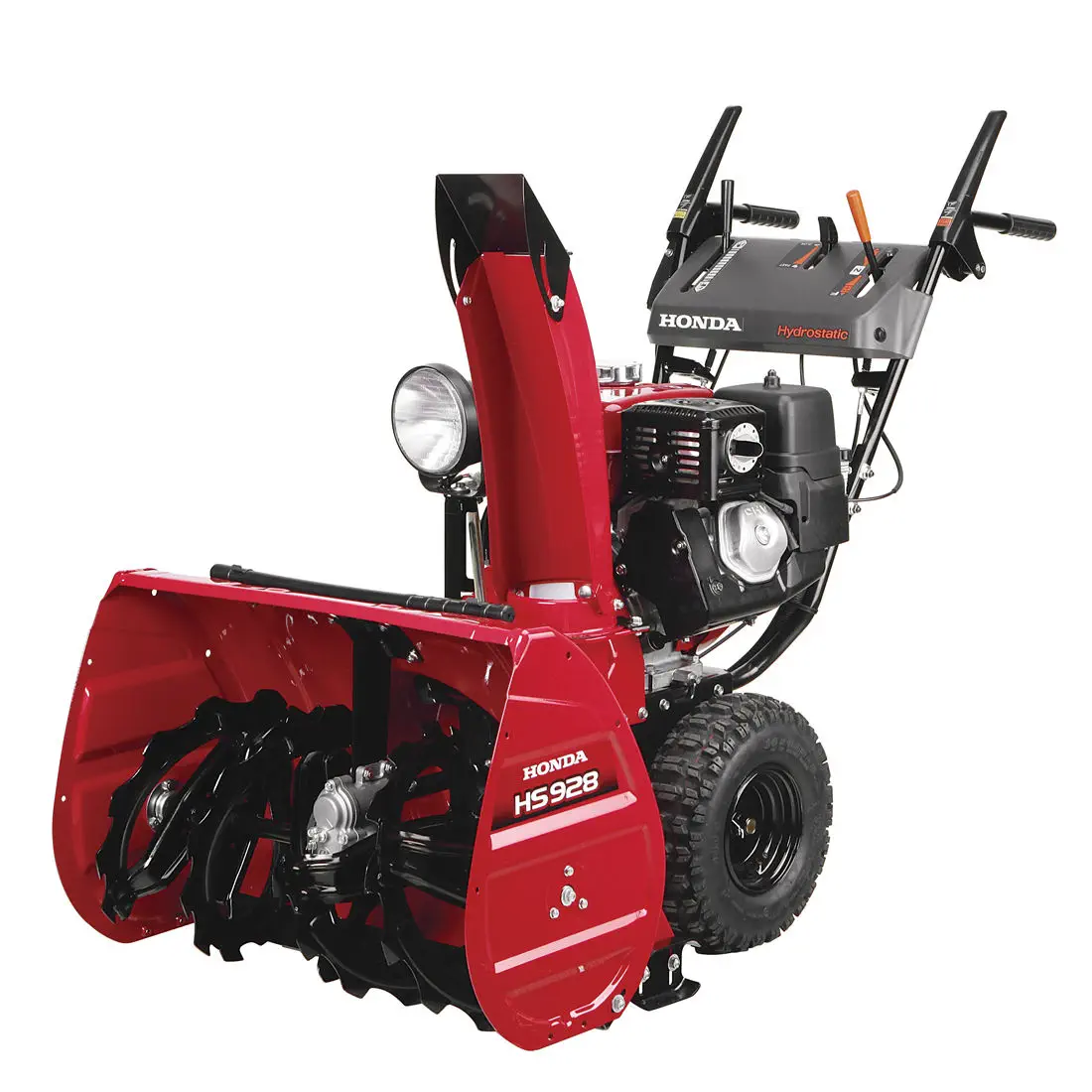
The average American driveway accumulates roughly 2,500 pounds of snow during a single 6-inch storm. Shoveling that by hand burns 400 calories per hour—and sends 11,500 people to the emergency room annually with cardiac events, according to the American Journal of Emergency Medicine. Snowblowers turn a three-hour backbreaking ordeal into a 45-minute walk, but only if the machine starts, the auger doesn’t shear on a frozen newspaper, and the operator keeps all ten fingers. The gap between buying a snowblower and using it safely for a decade hinges on decisions most homeowners never think about until the first storm hits.
Single-Stage vs. Two-Stage vs. Three-Stage: Which Snowblowers Actually Match Your Driveway
Manufacturers market snowblowers by stage count as if more stages always mean better performance. The reality is messier. Single-stage machines use a rubber-edged auger that scrapes the pavement and throws snow in one motion. They clear down to the surface, making them ideal for smooth concrete or asphalt driveways up to 60 feet long. But the auger makes direct contact, so gravel driveways chew through rubber paddles in a single season. Two-stage snowblowers add a metal impeller behind the auger, which spins independently to hurl snow farther—often 35 to 50 feet. The auger housing sits slightly above the ground, so they tolerate gravel and uneven surfaces. They also handle snow depths over 12 inches without bogging. The trade-off: they weigh 200 to 300 pounds, cost $800 to $2,500, and demand more storage space. A 2026 Consumer Reports analysis found that 74% of two-stage owners with driveways under 40 feet regretted the purchase, citing maneuverability and storage headaches. Three-stage models add a vertical accelerator that chops compacted snow before the impeller touches it. Toro and Cub Cadet dominate this niche. In heavy, wet lake-effect snow, the accelerator prevents clogging better than any two-stage design. But for the typical suburban driveway, the extra $400 to $600 premium rarely justifies itself. Snowblowers with three stages shine only where snowbanks routinely exceed 18 inches or where municipal plows leave concrete-hard berms at the driveway entrance.
The Hidden Costs of Snowblower Ownership That Manufacturers Won’t Mention
The sticker price on snowblowers is the down payment on a relationship. Fuel stabilizer, ethanol-free gasoline, and synthetic 5W-30 oil add $40 to $60 annually. Shear pins—designed to break before the gearbox does—cost $2 each but snap in pairs when the auger hits a frozen newspaper or hidden curb. A single season can eat through six to ten pins. Belts stretch and crack after three winters; replacement belts run $25 to $50, and labor at a small-engine shop adds $90 per hour. A 2026 survey by Equipment World magazine pegged the average five-year total cost of ownership for a $1,200 two-stage snowblower at $2,340 when factoring in fuel, maintenance, repairs, and storage. Battery-powered snowblowers slash fuel costs but introduce battery degradation. Ego and Greenworks offer 56V and 80V platforms with batteries that lose 20% capacity after 500 charge cycles. In cold-soaked conditions below 10°F, runtime drops 30% because lithium-ion chemistry slows. A homeowner clearing a 50-foot driveway in Minnesota might need two sets of batteries, pushing the effective cost past a comparable gas model. These are not hidden fees; they are physics.
How to Maintain Snowblowers So They Start on the First Pull Every Winter
The most common reason snowblowers fail to start in December is fuel left in the carburetor since March. Gasoline oxidizes into varnish that clogs jets. Draining the tank and running the carburetor dry before summer storage prevents 90% of no-start situations. Adding fuel stabilizer to the last tank of the season, then running the engine for five minutes, coats the system protectively. Spark plugs degrade silently. A fouled plug produces a weak spark that might ignite summer air but fails at 15°F. Replacing the plug every two years—cost: $4—eliminates a variable that leaves people yanking the recoil starter until their shoulder gives out. Shear pins should be checked before each storm; a bent pin that hasn’t yet snapped can misalign the auger and score the housing. Skid shoes, the metal plates that set the scraper bar height, wear unevenly. Flipping them mid-season doubles their life. Belt tension matters. A slipping belt generates heat, glazes the surface, and eventually snaps under load. Checking tension takes five minutes with a wrench and a spring gauge. Most manuals specify a ½-inch deflection under moderate thumb pressure. Ignore it, and a $25 belt replacement becomes a $300 service call when the machine quits mid-storm with a driveway half-cleared.
The Surprising Safety Risks of Snowblowers and How to Avoid the Emergency Room
The U.S. Consumer Product Safety Commission reports that snowblowers cause over 5,700 emergency department visits each year. The most catastrophic injuries involve hands. A clogged discharge chute tempts operators to reach in with fingers while the auger is still spinning—even with the drive disengaged, the impeller can retain kinetic energy for several seconds. A wooden clearing stick, supplied with every new machine, eliminates that risk entirely. Yet in a 2026 study published in the Journal of Hand Surgery, 68% of snowblower amputee patients said they knew about the stick but chose not to use it. Carbon monoxide poisoning ranks second. Running a gas snowblower inside a garage, even with the door open, can raise CO levels to 500 parts per million within three minutes—enough to cause headache, dizziness, and loss of consciousness. The fix is absolute: start and run the machine outdoors, never in an attached structure. Eye injuries from flying gravel and ice shards are common; polycarbonate safety glasses, not sunglasses, stop projectiles traveling at 100 feet per second.
When to Repair vs. Replace: A Cost-Benefit Analysis for Aging Snowblowers
A well-maintained two-stage snowblower with a Honda or Briggs & Stratton engine can last 20 years. But when the repair estimate exceeds 50% of a comparable new model’s price, replacement becomes the rational choice. A 2026 analysis by Small Engine Warehouse found that replacing an auger gearbox on a 12-year-old machine cost $480 on average, while a new entry-level two-stage unit started at $799. At that threshold, the remaining lifespan of the old machine’s engine—typically another 5 to 7 years—does not justify the investment. Used snowblowers present a different equation. Honda snowblowers, in particular, retain value because their GX-series engines routinely surpass 1,000 hours before major service. Buyers scouring Craigslist for a used Honda should compression-test the engine, inspect the auger housing for rust-through, and verify that the impeller spins freely without bearing play. A $300 used Honda with a healthy engine and a worn scraper bar is a bargain; the same money spent on a rusted-out housing is scrap metal.
The Environmental and Noise Impact of Gas-Powered Snowblowers
A typical 250cc four-stroke snowblower engine emits as much carbon monoxide in one hour as a modern car driving 300 miles, according to a 2025 EPA small-engine study. Hydrocarbon and nitrogen oxide emissions are similarly disproportionate because small engines lack catalytic converters and oxygen sensors. Several municipalities in Colorado and Vermont have begun offering rebates of $150 to $300 for residents who trade in gas snowblowers for electric models. Noise is another factor. Gas snowblowers operate at 100 to 105 decibels at the operator’s ear—loud enough to cause permanent hearing damage after 15 minutes without protection. Battery-electric snowblowers from Ego and Toro measure 75 to 85 decibels, roughly the level of a vacuum cleaner. For neighborhoods with early-morning clearing, that difference means the ability to start at 5 a.m. without waking the entire block.
What the Future Holds for Snowblowers
Autonomous snowblowers are moving from trade-show demos to driveways. In late 2025, Husqvarna and Yarbo began shipping GPS-guided robotic snowblowers that map the property, clear on schedule, and return to a charging dock. Early adopters report that the machines handle up to 10 inches of powder but struggle with the heavy, compacted snow at the driveway apron after a plow pass. The current price—$3,500 to $5,000—limits the market, but component costs are falling. Industry analysts project that by 2028, entry-level autonomous snowblowers will compete with high-end two-stage models on price. Battery technology is advancing faster. Solid-state cells, now in pilot production at Toyota and Samsung SDI, promise double the energy density of current lithium-ion packs. That would give a battery snowblower the runtime to clear a 100-foot driveway on a single charge in sub-zero temperatures—the last remaining advantage of gas. For now, the choice remains a trade-off between convenience and capability, but the gap is narrowing every winter. Snowblowers will not disappear from northern garages anytime soon. The machines that earn their keep are the ones matched to the specific snowfall, driveway surface, and physical capacity of the operator—not the ones with the highest stage count or the loudest marketing. Understanding the real costs, the maintenance rituals, and the safety boundaries turns a seasonal frustration into a tool that works on the coldest morning of the year without drama.